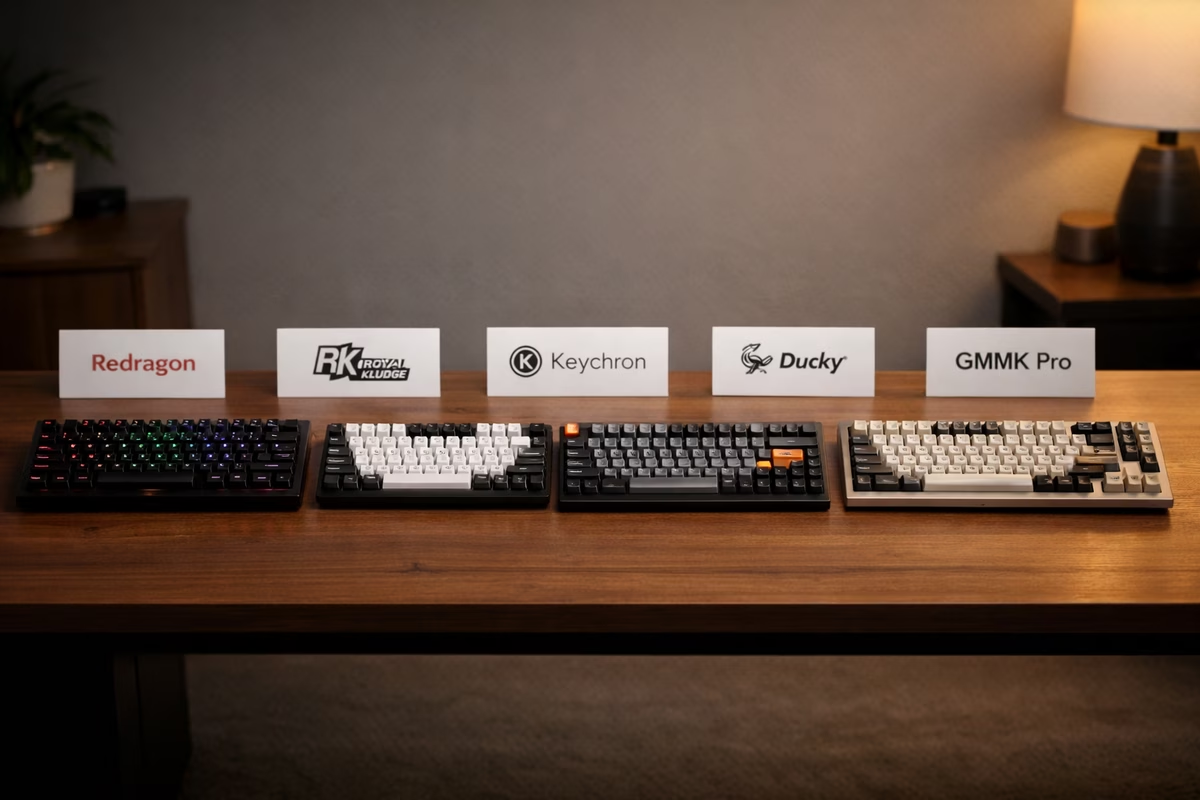
Keyboard Brand Guide
The mechanical keyboard market has dozens of brands, from budget-friendly to ultra-premium. This guide helps you understand each brand’s strengths, weaknesses, and target audience.
One note up front: “brand” matters less than people think. In keyboards, the experience is a stack of choices—layout, mounting style, stabilizers, switches, keycaps, plate material, case material, firmware, and (crucially) quality control. Two brands can sell boards at the same price that feel wildly different, and the same brand can ship both excellent and mediocre boards depending on the model line.
Use this guide like a map, not a scoreboard. The goal is to pick a brand that matches your constraints (budget, layout, hot-swap vs solder, Mac/Windows, wireless, noise tolerance) and then choose a specific model with a clear understanding of what you’ll likely want to tune.
How to Choose a Brand (Without Regret)
If you want a first mechanical keyboard that just works, prioritize three things over marketing: support, compatibility, and “how easy is it to fix small annoyances.”
Support means the basics: replacement parts exist, documentation is readable, and if something arrives defective you can actually get it solved. Compatibility means the boring details: does it support the firmware ecosystem you want (VIA/QMK vs proprietary), does it play nicely with your OS, and is it a standard layout that won’t make keycap shopping painful later.
The “easy to fix” part is what separates a pleasant first board from an endless project. Most entry and mid-range boards benefit from stabilizer tuning, and many sound and feel improvements are inexpensive. A hot-swap board lets you iterate without committing; a soldered board is fine too, but it raises the cost of experimentation.
Finally: beware spec-sheet mirages. “Aluminum case” can mean very different machining quality. “PBT keycaps” can still have thin walls and rough legends. “Gasket mount” can feel stiff if the implementation is poor. That’s why this guide focuses on practical strengths and weaknesses rather than adjectives.
Two practical buying tips are worth keeping in mind. First, if you’re new, prefer retailers with easy returns. Keyboard feel is subjective, and a no-drama return policy is the cheapest way to learn. Second, don’t overlook the used market for popular enthusiast boards—many people buy, mod lightly, and sell when they change layouts. For stable, well-supported models, used can be a great way to get into a higher tier without paying full price.
Brand Categories
Before we dive into individual brands, it helps to know the rough pricing tiers. Budget-friendly boards ($50–$100) are entry-level quality with great value—perfect for a first mechanical keyboard. Mid-range boards ($100–$200) step up to enthusiast-grade construction with better switches and keycaps. Premium boards ($200–$400) bring high-end materials, excellent build quality, and serious customization features. And at the top, custom and enthusiast boards ($400+) come from boutique brands, often through group buys, with ultimate quality and limited availability.
Budget Brands ($50–$100)
Redragon
Redragon is a budget-first brand from China, typically in the ~$40–$90 range. It’s best when you want a “does this hobby even click for me?” keyboard or a gaming board on a strict budget.
The appeal is straightforward: low price, lots of RGB options, and common layouts like full-size and TKL. Many boards ship with Outemu switches—serviceable, but rarely the smoothest option out of the box.
The trade-offs are the ones you’d expect: more plastic, less refinement, keycaps that can shine quickly, scratchier switches, and limited customization compared to enthusiast brands.
If you’re picking from the lineup, the K552 Kumara is a common “first TKL” entry, and the K556/K580 lines show up often when people want full-size or budget wireless.
Verdict: great for testing the waters before investing more.
Royal Kludge (RK)
Royal Kludge (RK) is a China-based brand that’s often strongest in budget wireless boards (~$50–$100), especially in compact layouts.
RK’s main strength is value-per-feature: Bluetooth and 2.4GHz options, hot-swap models at low prices, and compact layouts like 65% and 75%. Stock switches are often decent for the price.
The trade-offs are case feel (many are hollow plastic), hit-or-miss software, and QC inconsistency.
Popular models include the RK61 (60%), RK68 (65%), RK84 (75%), and RK100 (96%)—a range that covers most common “compact but practical” preferences.
Verdict: one of the best budget picks if wireless matters and you want a compact layout.
Keychron (C-Series)
Keychron’s C-series (Hong Kong/China) sits around $50–$70 and is a frequent recommendation for a “first board that doesn’t feel like a toy,” especially for Mac users or anyone who wants broad compatibility without fuss.
The C-series wins on value and usability: Mac/Windows support, generally solid build choices for the price, and commonly smooth-feeling Gateron switch options. Many models offer hot-swap or wireless variants depending on the exact board.
The common downsides are a taller profile, stabilizers that benefit from tuning, and basic plastic cases.
Popular entry points include the C1/C2 (full-size/TKL) and the K2 (75%) depending on what layout you want.
Verdict: a strong “default recommendation” in the budget tier.
Mid-Range Brands ($100–$200)
This is where things start to get really interesting. Mid-range boards bridge the gap between “good enough” and “genuinely great,” and the brands here all have distinct personalities worth understanding.
Keychron (Q & V Series)
Keychron’s Q and V series, designed in Hong Kong and manufactured in China, sit squarely in the $100–$200 range and are often the first stop for anyone wanting a custom keyboard experience without the full DIY commitment. The Q-series in particular punches well above its weight, delivering aluminum cases, gasket mounting, hot-swap PCBs, screw-in stabilizers, and full QMK/VIA support—features that would have cost $300 or more just a few years ago.
That said, the stock stabilizers still benefit from tuning (a common theme you’ll notice across most brands at this price), the boards tend to be heavier than alternatives, and the aesthetic variety is somewhat limited if you’re looking for something eye-catching. But for pure value, it’s hard to beat what Keychron offers here.
The Q1 is their flagship 75% at around $170 and delivers incredible value for an enthusiast-grade board. The Q2 brings the same gasket-mount aluminum treatment to a 65% layout, while the Q3 does it for TKL fans. If you want to spend less, the V1 offers gasket mounting in a plastic case for around $100—a genuinely good entry into the world of better typing feel.
Verdict: the Q-series competes with keyboards costing $300 or more, making it the best value in the mid-range tier.
Ducky
Ducky is a Taiwanese brand that’s been around long enough to earn a serious reputation, and their boards typically land between $110 and $180. If you’re looking for a reliable prebuilt that just works without any fuss, Ducky is the brand that keeps coming up in recommendations, and for good reason.
Their strength lies in the fundamentals: excellent build quality, genuine Cherry MX switches, PBT keycaps, and some of the best stabilizers you’ll find at this price point. Ducky boards have a proven track record of reliability that few brands can match. They’re the kind of keyboard you can buy once and use for years without thinking about it.
The flip side is that Ducky boards are not hot-swap, which limits customization if you want to experiment with different switches down the road. They can also be harder to find in stock, and the aesthetics lean more toward basic and functional rather than flashy.
Their popular lineup includes the Ducky One 3, which comes in various sizes around $130–$150 and is a solid all-arounder. The One 2 Mini remains a compact classic at 60% for about $120, and the Shine 7 is their full-size premium offering at $180 for those who want RGB done right.
Verdict: the “Toyota of keyboards”—reliable, well-built, and no surprises. You know exactly what you’re getting.
Varmilo
Varmilo, based in China and Taiwan, occupies a unique space in the $120–$200 range: they’re the brand you choose when you care deeply about how your keyboard looks sitting on your desk. Their aesthetic game is arguably the best in the mid-range, with beautiful floral, minimalist, and themed designs that make other brands look a bit plain by comparison.
But Varmilo is more than just a pretty face. Their PBT dye-sublimated keycaps are genuinely top-tier for this price bracket, the stabilizers are excellent out of the box, and they offer both Cherry MX and their own EC switch options. They also have silent switch variants that make them a fantastic choice for shared office environments where you don’t want to announce every keystroke.
The downsides mirror Ducky’s in some ways: no hot-swap, limited availability, and the pricing can feel steep for the feature set if you’re comparing spec sheets rather than looking at the total package. Most Varmilo boards also skip RGB, which is either a dealbreaker or a relief depending on your taste.
If you’re shopping their lineup, the VA87M is a premium TKL in the $140–$180 range, the MA108M is a beautiful full-size option at $150–$200, and the MIYA Pro delivers a compact 65% layout for $140–$160.
Verdict: the best aesthetics and keycap quality in the mid-range, and genuinely office-friendly.
Leopold
Leopold is a South Korean brand that occupies a near-mythical status among typing purists, and their $110–$150 price range makes them surprisingly accessible for what you get. If you’ve ever read a forum post that says “just get a Leopold” with no further explanation, it’s because the typing experience speaks for itself.
What sets Leopold apart is their stabilizers—widely considered the best stock stabilizers in the entire mechanical keyboard world. Combine that with an exceptional overall typing feel, ultra-reliable build quality, and a philosophy of “no bloat,” and you get a keyboard that does one thing extraordinarily well: let you type. There’s no RGB, no companion software, no flashy features. Just a keyboard that feels incredible under your fingers.
The trade-offs are obvious: no hot-swap, minimal customization options, no RGB or fancy features whatsoever, and they can be harder to find depending on your region. Leopold boards are for people who know exactly what they want and don’t need bells and whistles to enjoy it.
Their classic lineup is straightforward. The FC660M is a legendary compact 65% layout at around $120 that has converted countless typists. The FC750R delivers a perfect TKL typing experience at the same price, and the FC900R rounds things out with a premium full-size option at $130.
Verdict: the best typing feel you can buy stock, no frills, just perfection.
Akko
Akko is a Chinese brand that bridges the gap between budget and mid-range, with most boards falling in the $80–$150 range. They’ve carved out a niche as the brand for budget enthusiasts who want creative designs and a wide variety of switch options without spending premium prices.
Their in-house Akko switches deserve special mention—they’re genuinely good for the price and come in a wider variety of weights and feel profiles than most brands bother to offer. Akko also leans into fun with their aesthetics, offering themed designs and colorful keycap sets that give their boards real personality. Most models feature hot-swap PCBs and PBT keycaps, which is great value at these prices.
The downsides are build quality inconsistency and occasional QC issues. The companion software is also fairly basic compared to QMK/VIA ecosystems. It’s the kind of brand where individual models can be great, but you should check reviews for the specific board you’re considering rather than assuming the brand name guarantees a consistent experience.
Worth looking at are the Akko 3068B, a budget Bluetooth 65% at about $90, the MOD 007 HE at $140 with hall effect switches for the tech-curious, and the PC75B Plus at $120 as a solid mid-range 75%.
Verdict: creative designs and good switches, but do your homework on the specific model because QC can be hit-or-miss.
Premium Brands ($200–$400)
Once you cross the $200 threshold, you’re entering territory where keyboards stop being tools and start becoming experiences. The brands here offer materials, build quality, and design thinking that genuinely justify higher prices—though the law of diminishing returns is definitely in effect.
GMMK Pro / Glorious
Glorious is a USA-based brand, and their GMMK Pro at around $170–$200 occupies a fascinating position in the market: it’s essentially a modding platform disguised as a keyboard. If you’re the kind of person who enjoys tinkering, swapping parts, and gradually dialing in your perfect typing feel, the GMMK Pro was basically designed for you.
The board is fully modular with hot-swap everything, an aluminum case, gasket mounting, and a wide accessory ecosystem that makes it easy to experiment. It’s the keyboard equivalent of buying a car with good bones that you plan to upgrade piece by piece. The community around GMMK modding is also excellent, with plenty of guides and sound tests for various configurations.
The honest truth, though, is that the stock experience needs work. The sound out of the box is underwhelming, the stabilizers need tuning, and the plate and gasket implementation benefits from modding. It’s not a board you buy to enjoy immediately—it’s a board you buy to learn on and improve.
Beyond the Pro, the GMMK 2 offers a mid-range hot-swap option in various sizes at $120–$140, and they even make a standalone numpad for about $50 if you went compact but miss the number keys.
Verdict: the best platform for learning modding and customization, but plan on putting in some work to get it sounding great.
KBDfans
KBDfans, based in China, is less of a traditional brand and more of an entire ecosystem for custom keyboard builders. Their range spans $200 to $400 and beyond, and they offer a massive selection of cases, PCBs, switches, keycaps, and complete DIY kits that has made them a community favorite for years.
What makes KBDfans special is the combination of quality materials (proper aluminum cases, solid PCB design) with good documentation and a genuine understanding of what builders want. Their kits are designed to be assembled, not just purchased, and the experience of building a KBDfans board is part of the appeal.
The flip side is that you need some assembly knowledge to get the most out of their offerings. Shipping from China means longer wait times, stock varies constantly, and costs can creep up quickly once you start adding premium components. It’s the keyboard equivalent of a gourmet meal kit: the ingredients are excellent, but you’re doing the cooking.
Their standout offerings include the KBD67 Lite at around $110 as a budget custom kit that’s incredibly popular for first-time builders, the KBD67 MKII as a premium 65% in the $200–$300 range, the Tofu65 as a beloved 65% case option at $180–$250, and the D65 as a high-end gasket mount starting at $350.
Verdict: the best destination for DIY builders who want custom experiences at reasonable prices, as long as you’re ready to get your hands dirty.
Mode Designs
Mode Designs is a USA-based brand that represents what happens when a keyboard company decides to do everything at the highest possible level. Their $300–$500 price range is steep, but the execution is genuinely exceptional. If you’ve ever picked up a product and immediately thought “oh, this is different,” that’s the Mode experience.
The build quality is impeccable, with beautiful anodization and finishes that make the keyboard feel like a precision instrument. Their mounting systems are innovative and well-implemented, the typing experience is top-shelf, and their customer support has earned them a loyal following in the enthusiast community. These are boards that make you want to type just to feel them.
The obvious downsides are price, availability, and patience. Many Mode boards are sold through group buys with limited stock, which means wait times and the possibility of missing out entirely. You’re paying a premium, and while the quality justifies it, the law of diminishing returns means the jump from a $170 Keychron Q-series to a $400 Mode board is noticeable but not transformative.
Their current lineup features the Sonnet, a premium 75% in the $350–$450 range, the Envoy as a compact premium 65% at $300–$400, and the Eighty as a high-end TKL at $400–$500.
Verdict: premium quality at a premium price. For many enthusiasts, this is endgame material.
IQUNIX
IQUNIX is a Chinese brand in the $200–$300 range that has carved out a niche with distinctive designs and wireless premium keyboards. Where most aluminum keyboard brands play it safe with minimalist slabs, IQUNIX takes creative risks that make their boards instantly recognizable.
Their strength is in unique aesthetics—models like the OG80 and F-series have a design language that stands apart from the crowd. They also offer aluminum cases with wireless capability, which is a combination that’s surprisingly hard to find at this price point. If you want a keyboard that looks different from everything else on the market and don’t need a cable, IQUNIX deserves a look.
The challenges are real, though: pricing can feel steep for the feature set, availability outside China is limited, and the English software experience can be rough around the edges. These are boards that reward patience in finding and configuring.
Their notable models include the F96, a wireless aluminum full-size at around $250, and the OG80, a beautiful wireless TKL at $280 that turns heads wherever it goes.
Verdict: beautiful keyboards if you can find them, with a design identity all their own.
Enthusiast/Custom Brands ($400+)
Welcome to the deep end. These brands aren’t really competing on value or features—they’re selling craftsmanship, exclusivity, and the pursuit of perfection. If you’re browsing this section, you already know what you like and you’re looking for the best possible version of it.
Sangeo
Sangeo is a South Korean brand operating in the $400–$600 range that has earned serious respect in the enthusiast community for unique designs and exceptional build quality. Their boards are produced in limited runs, which gives them a certain prestige and desirability that mass-produced boards simply can’t match.
The appeal is in the details: meticulous construction, distinctive layouts, and a level of finish that rewards close inspection. Owning a Sangeo board is as much about appreciating the craft as it is about typing on it.
The challenges are what you’d expect at this level: very expensive, hard to obtain through group buys, and long wait times that test your patience. Their lineup includes the Sangeo60, a 60% layout starting at $400, and the Sangeo65, a 65% starting at $450.
Verdict: for collectors and enthusiasts chasing perfection, Sangeo delivers.
Rama Works
Rama Works, based in Australia, operates in the $500–$1,000+ range and sits at the intersection of mechanical keyboards and industrial art. These aren’t just typing instruments—they’re objects designed to be admired, displayed, and appreciated as much as used.
The CNC machining is flawless, the designs are innovative and often ahead of their time, and the aesthetic quality is unmatched in the keyboard world. Owning a Rama board carries collectible value that often appreciates over time, which is rare in consumer electronics. Every detail, from the weight to the anodization to the packaging, communicates that this is something special.
The reality of buying Rama is that you’ll need patience measured in years (wait times of 1–2 years are normal), a budget that can handle the price tag, and acceptance that limited runs mean you might miss out entirely. The boards can also prioritize form over function in some cases, making them less practical as daily drivers than their price might suggest.
Signature models include the U80-A, a stunning TKL starting at $500, the M65-C, a premium 65% at $600 and up, and the Thermal, another 65% starting at $500 that showcases their design innovation.
Verdict: art pieces for collectors who value aesthetics above all else.
TGR
TGR, from South Korea, exists at the absolute pinnacle of the mechanical keyboard world, with prices ranging from $600 to well over $2,000. These are the boards that people whisper about in forums—legendary status, exceptional quality, and a resale market that can make the original pricing look like a bargain.
The appeal is pure exclusivity and craft. TGR boards are collector’s items first and keyboards second, with a level of quality and attention to detail that few manufacturers in any industry can match. Their status in the community is unrivaled, and simply owning one signals a deep commitment to the hobby.
The reality is that TGR boards are prohibitively expensive and nearly impossible to obtain through normal channels. The Jane, starting at $1,500 or more, and the Alice, starting at $1,000 or more, represent the pinnacle of what’s possible in a mechanical keyboard—but at prices that make them impractical purchases for the vast majority of enthusiasts.
Verdict: collector’s items rather than practical purchases for most people, but if you know, you know.
Switch Manufacturers (Separate from Keyboard Brands)
It’s worth noting that the switches inside your keyboard often come from completely different companies than the one whose logo is on the case. Understanding the major switch manufacturers gives you a much better sense of what you’re actually typing on, regardless of which brand sold you the board.
Cherry (Germany)
Cherry is the original mechanical switch inventor, and the Cherry MX standard is essentially the blueprint that every other switch manufacturer builds upon. Their switches are reliable, proven, and widely compatible. While enthusiasts sometimes argue that other manufacturers have surpassed Cherry in smoothness and feel, there’s something to be said for the decades of refinement and the sheer ubiquity of Cherry MX compatibility across keycap sets and keyboards.
Gateron (China)
Gateron has become the go-to alternative to Cherry for many enthusiasts, thanks to switches that are generally smoother out of the box at an excellent price point. They offer a wide variety of options across linear, tactile, and clicky categories, and you’ll find Gateron switches stock in boards from Keychron, Akko, and many other popular brands. For most people, Gateron represents the sweet spot of quality and value.
Kailh (China)
Kailh is the innovator of the bunch, best known for their Box switches that introduced a unique stem design with improved dust and water resistance. Their Speed switches cater to gamers who want shorter actuation distances, and the Box Jade and Box Navy switches deliver some of the thickest, most satisfying click sounds available. If you want something that feels different from the standard Cherry-style experience, Kailh is worth exploring.
ZealPC (Canada)
ZealPC represents the premium end of the switch market with offerings like the Zealios (tactile), Tealios (linear), and Zilent (silent tactile). These switches are ultra-smooth and beautifully constructed, but they come at a significantly higher price than mainstream options. They’re the switches you buy when you’ve tried everything else and want the very best, regardless of cost.
Gazzew (USA/China)
Gazzew has earned a cult following with their Boba switch lineup, which includes the U4T (tactile and thocky), U4 (silent tactile), and LT (linear). What makes Gazzew special is the combination of strong tactility, great value for the performance level, and a character that feels distinct from other manufacturers. The Boba U4T in particular has become one of the most recommended tactile switches in the hobby.
Brand Recommendations by Budget
If you want the quick version, here’s how to think about brands at each price point.
Under $100
For most people starting out, the Keychron C-series is the best overall pick—solid build, good compatibility, and a smooth path to upgrading later. If wireless is important and you want a compact layout, the Royal Kludge RK68 is hard to beat for the money. And if you’re on an absolute shoestring budget and just want to see what mechanical keyboards are all about, the Redragon K552 gets you in the door for very little.
$100–$150
This is the sweet spot where quality takes a real jump. The Keychron Q1, Q2, and V-series offer the best value with features that compete far above their price. The Ducky One 3 is the most reliable option if you just want something excellent without thinking about it. And the Leopold FC660M delivers the best pure typing experience you’ll find at this price—or arguably any price.
$150–$250
Spend a bit more and customization and premium materials come into play. The Keychron Q-series continues to shine if you want options and tweakability. The GMMK Pro is the go-to if modding is part of the fun for you. And Varmilo is the choice when aesthetics matter as much as performance.
$250–$400
At this level, every board should feel special. Mode Designs delivers premium quality that’s immediately apparent the moment you touch it. KBDfans customs are the pick for DIY builders who want to construct something uniquely theirs. And IQUNIX offers designs that look like nothing else on the market.
$400+
This is collector and enthusiast territory. Rama Works creates art pieces that happen to be functional keyboards. Sangeo delivers enthusiast-grade quality for those who appreciate meticulous Korean craftsmanship. And TGR boards are collector’s items with legendary status in the community.
How to Choose a Brand
Knowing which brands exist is one thing—knowing which one is right for you is another. Here’s how to think about it based on what you actually care about.
Beginners
If you’re just getting started, keep it simple. Keychron, Ducky, or Royal Kludge all offer quality without overwhelming you with options. You want a board that works well out of the box, has decent documentation, and won’t make you feel like you need a PhD in keyboard engineering to enjoy it.
Modders
If half the fun is taking things apart and making them better, go with the GMMK Pro or Keychron Q-series. Both offer hot-swap flexibility and easy customization, with large communities sharing mod guides and sound tests. They’re designed to be platforms, not finished products.
Typists
If the only thing that matters is how the keyboard feels under your fingers, Leopold and Varmilo offer the best stock typing experience with minimal setup required. No need to mod, tune, or tinker—just plug in and enjoy.
Gamers
For gaming, you want reliability, responsive switches, and no unnecessary complexity. Keychron, Ducky, or GMMK with linear switches all work great. Low-latency performance at this level is more about switch choice than brand, so focus on getting the right linear switch rather than chasing gaming-specific marketing.
Collectors
If keyboards are a passion and you want pieces that represent the pinnacle of the craft, look at Rama Works, Mode Designs, or Sangeo. These brands deliver boutique quality, distinctive aesthetics, and the kind of build quality that makes every typing session feel like an event.
Takeaway
If we had to boil the entire guide down to a handful of picks: Keychron is the best overall brand because they cover everything from budget to enthusiast with consistently strong value. The Keychron Q-series specifically offers the best value in the market right now. For reliability, Ducky and Leopold are the names to trust. If modding is your thing, GMMK Pro and KBDfans give you the best platforms. And for pure aesthetics, Varmilo and Rama Works stand in a class of their own.
Your perfect brand ultimately depends on your budget, your use case, and how much you want to tinker. The good news is that the keyboard market in 2024 is deep enough that there’s a great option at every price point. The bad news is that once you find your first board you love, you’ll probably start eyeing the next tier up. That’s just how this hobby works.
Next Steps
- Switch Guide - Choose the right switches
- Building Guide - Assemble a custom keyboard
- Keyboard Database - Browse keyboards by brand and price