
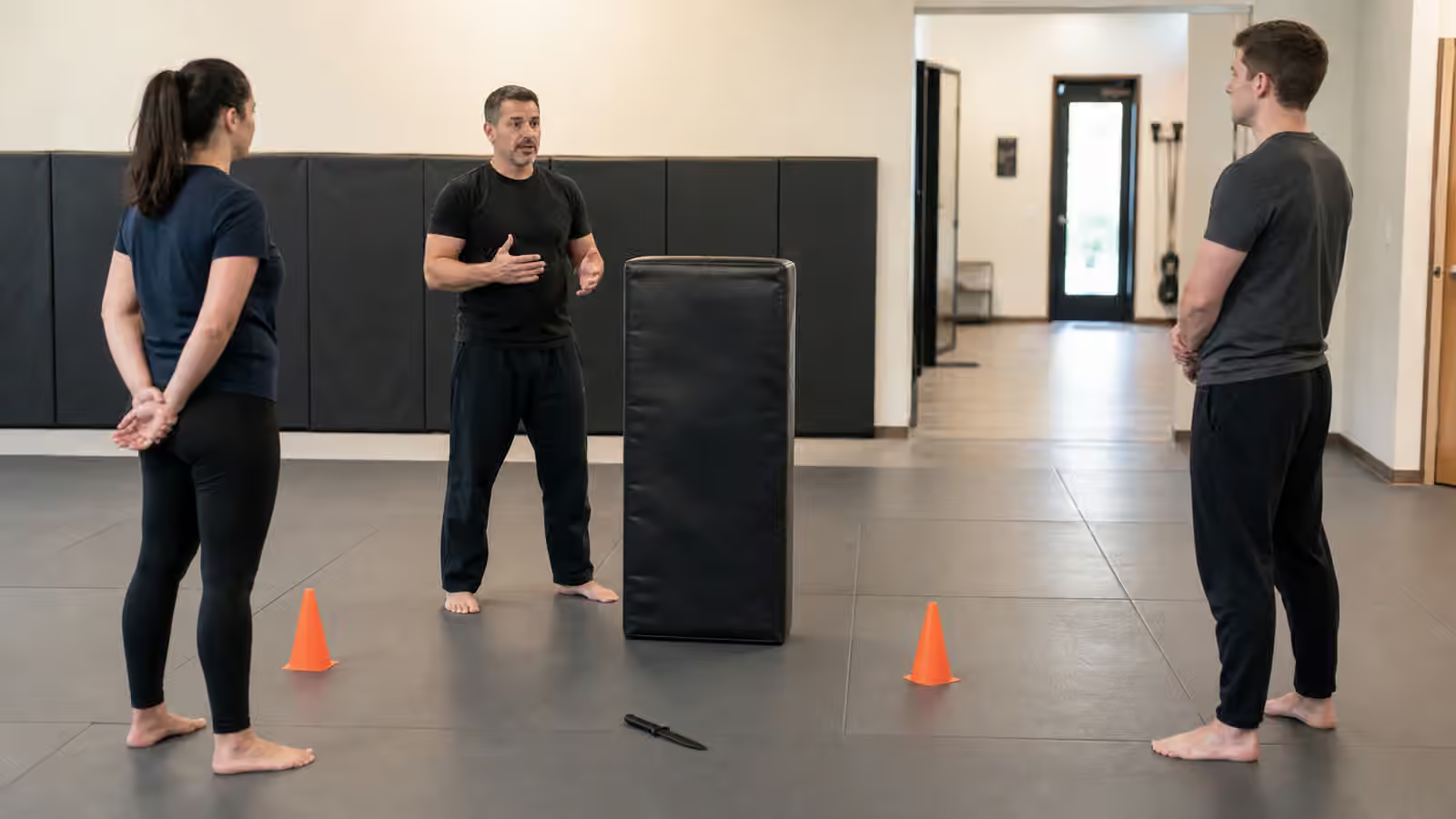
Weapon topics are where Krav Maga can lose its seriousness the fastest. A rubber knife appears on the mat, a plastic training gun sits on a bench, or an instructor mentions a bottle, stick, or improvised tool, and the room changes. Beginners lean forward. People want the answer. They want to know where the hands go, which direction the wrist turns, how close is too close, and which movement solves the problem before fear has time to arrive.
That hunger is understandable, but it is also dangerous. Weapons do not become simple because the training object is soft. A dull rubber prop does not carry the chaos, injury potential, surprise, legal aftermath, or emotional confusion of a real weapon. The mat gives students a cleaner version of the problem so they can learn, not because the problem itself is clean.
The first lesson of weapon awareness should be humility. A weapon changes distance immediately. It changes timing. It changes what a mistake can cost. It changes what bystanders may do, how quickly panic spreads, and what the aftermath may require. Good Krav Maga training should not make students casual around that fact. It should make them more sober, more alert to early exits, and less eager to test clever answers against situations they do not have to enter.
A Prop Is Not a Promise
Training props are useful because they let a class discuss difficult subjects without using real danger. A rubber knife can show why hands alone may be late. A padded stick can show how distance collapses. A plastic firearm replica, where legally and responsibly used in a controlled school, can teach students that fantasy movements often ignore timing, line, and consequence. None of these props proves that a student is safe.
The difference between a prop and a weapon is not only material. It is context. In class, the floor is padded, the lighting is known, the roles are assigned, the instructor is watching, and the drill can stop. Outside class, the person holding the weapon may be panicked, intoxicated, desperate, skilled, unskilled, alone, accompanied, bluffing, committed, or changing their mind from one second to the next. The surface may be concrete. The exit may be blocked. Your hands may be full. Someone you care about may be beside you. You may not even know a weapon is present until the moment is already late.
This is why written guidebooks should not pretend to teach weapon defenses. A page can explain principles, risks, training culture, and better questions. It cannot watch your posture, correct your angle, judge the distance, manage your partner, or decide whether the drill is too much for the room. If a source gives a tidy sequence and treats it like a reliable answer, it is probably giving comfort before it gives skill.
Distance Comes Before Technique
The most practical weapon lesson is often the least dramatic one: do not arrive late if you can avoid it. Distance is not a decoration around the technique. It is the condition that decides whether anything else is possible. Distance, Awareness, and Exit explains this for ordinary self-defense, but weapon topics make it sharper. A small object can extend danger beyond the reach your body expects. A person who is empty-handed at one moment may not stay that way. A threat that looked verbal can become physical during the time you spend arguing with yourself.
Good training should make students notice hands, clothing, bags, posture, approach lines, and exits without turning them into suspicious people. Awareness is not staring at everyone as if they are hiding something. It is reading the situation early enough that you can choose the boring answer. Cross the street. Leave the argument. Put a table between you and the person who keeps closing distance. Let the group pass. Give up the object if keeping it means staying inside danger. Ask for help from staff, friends, or authorities when the setting allows it.
There is no shame in an answer that looks unheroic. If compliance, distance, a barrier, or leaving reduces the chance of injury, it deserves to be treated as a real self-defense choice. That does not mean every situation is solved by compliance or escape. People can be unpredictable, and some moments become physical despite better decisions. The point is that Krav Maga should not train students to skip the earlier options because the later options look more exciting.
Barriers Are Often Smarter Than Bravery
A barrier can be a counter, car, door, wall corner, chair, table, bag, or even a line of people moving through a public space. It is not magic. It can fail. It can trap you if you misread it. But it can also buy time, interrupt a straight line, and make the other person solve a movement problem before reaching you. That time may be the difference between panic and a decision.
Environmental Movement in Krav Maga is useful here because weapons make the environment matter more, not less. A doorway may be an exit or a funnel. A parked car may be cover from a line of movement but also a place where your feet tangle. A chair may slow someone down or trip you. A bag may need to be dropped because a hand that is protecting property cannot also protect space.
In class, beginner weapon-awareness drills should treat barriers as decision tools rather than movie props. A student may practice moving around a padded shield, using voice, keeping distance, and exiting without touching the training prop at all. That may disappoint someone who came for the dramatic disarm, but it teaches a better habit. If the safest line is around the problem and out the door, the student’s pride should not drag them back into the center of the mat.
The same is true of everyday objects. A phone can call for help, but it can also swallow attention. Keys may feel reassuring in the hand, but they can make movement clumsy. A backpack can block a grip or become something that pins your own shoulder. Good training does not turn every object into a weapon fantasy. It asks what the object gives, what it takes away, and whether letting go would make the body more available.
Responsible Weapon Drills Need Strong Boundaries
Weapon drills require clearer boundaries than ordinary beginner contact. The instructor should explain the goal, the roles, the prop, the intensity, the stop signal, and the point where the drill ends. Students should know what is not being trained. If the drill is about noticing distance, it should not become a surprise wrestling match. If it is about using a barrier, it should not become a chase. If it is about compliance language, it should not become a test of who can act more intimidating.
This connects directly to Scenario Training and Ethics . A weapon prop raises the emotional temperature even when everyone knows it is fake. Some students become tense. Some become fascinated. Some laugh because they are uncomfortable. Some get reckless because the prop is soft and the danger feels pretend. The instructor has to keep the room honest. The role player has to stay disciplined. The defender has to know they are allowed to stop.
Surprise deserves special caution. There is a difference between controlled uncertainty and ambush as entertainment. A student can learn to respond to changing cues without being startled into chaos. The drill can begin with known distance, known roles, and a known prop. Later, if the school and students are ready, the instructor may add decision-making, movement, noise, or fatigue. But every layer should serve a learning purpose. If the only lesson is that everyone felt scared, the drill was too shallow.
A responsible school also debriefs. What did the student notice early? Where was the exit? Did the barrier help or trap them? Did voice change anything? Did the student freeze because the situation was too much or because the instruction was unclear? Did the role player stay inside the frame? Debriefing keeps weapon training from becoming a collection of stories about adrenaline.
Verbal Boundaries Still Matter
People sometimes imagine weapon situations as moments where words have already failed. Sometimes that is true. Sometimes it is not. The earlier stages may still involve confusion, intimidation, bargaining, threats, or a demand. Voice can buy time, draw attention, communicate compliance, set distance, or help another person understand what you are doing. It can also reveal whether the person is responsive to normal human cues or moving past them.
De-escalation and Verbal Boundaries belongs beside any weapon-awareness curriculum because silence is not automatically safer and shouting is not automatically stronger. A calm sentence may be more useful than a theatrical command. A clear “take it” may be safer than tugging over property. A firm “stay there” may matter if there is space to move. A direct request for a bystander to call for help may be clearer than hoping the room understands what is happening.
No phrase guarantees safety. Words can fail, and they often fail when a person is committed to violence. Still, training the voice keeps the student from reducing every problem to hands. It reminds them that self-defense includes attention, communication, timing, witnesses, and aftermath. The body is not the only tool in the room.
The Trap of Technique Collecting
Weapon defenses attract collectors. A student sees one answer for a knife, another for a stick, another for a gun, another for a bottle, another for a seated position, another for a wall, another for a car. The list grows, and the student feels prepared because the mind has a folder for every object. The danger is that the folder may not open under stress.
Real problems do not announce which page they belong to. A threat may begin as a conversation. The weapon may appear late. The angle may be wrong. The grip may not match the lesson. The person may be too close, too far, moving, falling, or using the weapon only as leverage for a demand. A technique learned as a shape can fail when the scene refuses to hold still.
This does not mean techniques are worthless. Qualified instructors teach specific movements for specific reasons, and some students train them with seriousness for years. The problem is treating the catalog as the point. A beginner is better served by questions that survive variety. Did I notice the danger early? Is there an exit? Can I create distance? Can I use a barrier? Can I comply and leave? Can I protect another person without freezing in place? Is the drill teaching judgment or just choreography?
Training Between Krav Maga Classes gives a useful warning here. Do not recreate weapon drills at home with a friend who was not in class. Do not add surprise because the first few repetitions felt easy. Do not buy hard props and turn a living room into a private test. Weapon topics need supervision, clear rules, and people who understand how quickly role play can become careless.
Aftermath Is Part of the Lesson
Weapon awareness does not end when the immediate danger changes. Afterward there may be injuries, shock, missing property, witnesses, police, medical needs, family members, cameras, and confused memory. Laws vary by location, and this guide is not legal advice, but the general seriousness is worth naming. Physical force around weapons is likely to be judged carefully afterward. So are the choices before and after it.
A mature class should leave room for that conversation. If a drill ends with the student escaping, what happens next? Do they keep moving to safety? Do they call emergency services? Do they check themselves for injury they did not feel at first? Do they avoid picking up or handling an object that may matter later? Do they stop talking when they are too flooded to explain clearly? Written answers cannot cover every setting, but training can remind students that the final movement is not the final responsibility.
Emotional aftermath matters too. Weapon drills can affect people differently. A person may feel embarrassed by freezing, proud of moving, unsettled by the prop, or unusually quiet after a loud round. That does not make them weak. It means the subject has weight. Good instructors manage the come-down with the same care they manage the drill. Water, breathing, a short debrief, and a reset can prevent a serious lesson from becoming residue.
Caution Is a Skill
The best weapon-awareness training does not make students fearless. Fearless people often arrive late because they underestimate what is in front of them. The better goal is caution with movement inside it. Notice the hands. Notice the distance. Notice the door. Notice the barrier. Notice your own urge to prove something. Then choose the answer that reduces harm as early as possible.
Krav Maga is often described as direct, and directness has value. But directness without caution becomes fantasy. The weapon topic exposes that quickly. A student who rushes toward every prop may look committed in class and make terrible choices outside it. A student who learns to leave, comply when appropriate, use barriers, call for help, and train physical answers only under qualified supervision may look less dramatic, but they are closer to the heart of practical self-defense.
The rubber prop on the mat is not there to make danger feel manageable. It is there to remind the room that danger deserves respect before it deserves technique. If the lesson leaves you more humble, more attentive to exits, more careful with training partners, and less interested in clever promises, it has done useful work.


