Self-defense training often imagines a body with perfect information. The student sees the approach clearly, hears the instruction, notices the side movement, reads the partner’s hands, and understands the coach across the room. Real students are less tidy. Some wear glasses. Some use contact lenses. Some have hearing aids, tinnitus, partial hearing, processing delays, light sensitivity, poor night vision, vestibular issues, or simply a tired nervous system after a hard day. None of these details remove them from Krav Maga. They change how training should be organized.
A serious room does not treat sensory limits as excuses or as inspirational decorations. It treats them as practical facts. The student needs enough information to train safely, the partner needs enough clarity to feed the drill correctly, and the instructor needs enough honesty to adapt without making the student feel like a problem.
Vision Is Not A Single Skill
Seeing well in class is not only about reading the instructor’s demonstration from across the room. It includes peripheral awareness, depth judgment, glare, motion, low light, fogged lenses, sweat on glasses, and the split second after a frame or cover changes where the eyes are pointed. A student may see the whiteboard clearly and still lose a partner’s shoulder movement at close range. Another may see well in daylight and struggle when the room dims or when glasses shift during contact.
Visual Scanning Under Pressure describes how stress narrows attention. Glasses and vision limits add another layer. The student may need to turn the head more deliberately, choose a training position with less glare, or ask the coach to repeat a demonstration from the angle they will actually use. That is not special treatment in the sentimental sense. It is accurate training.
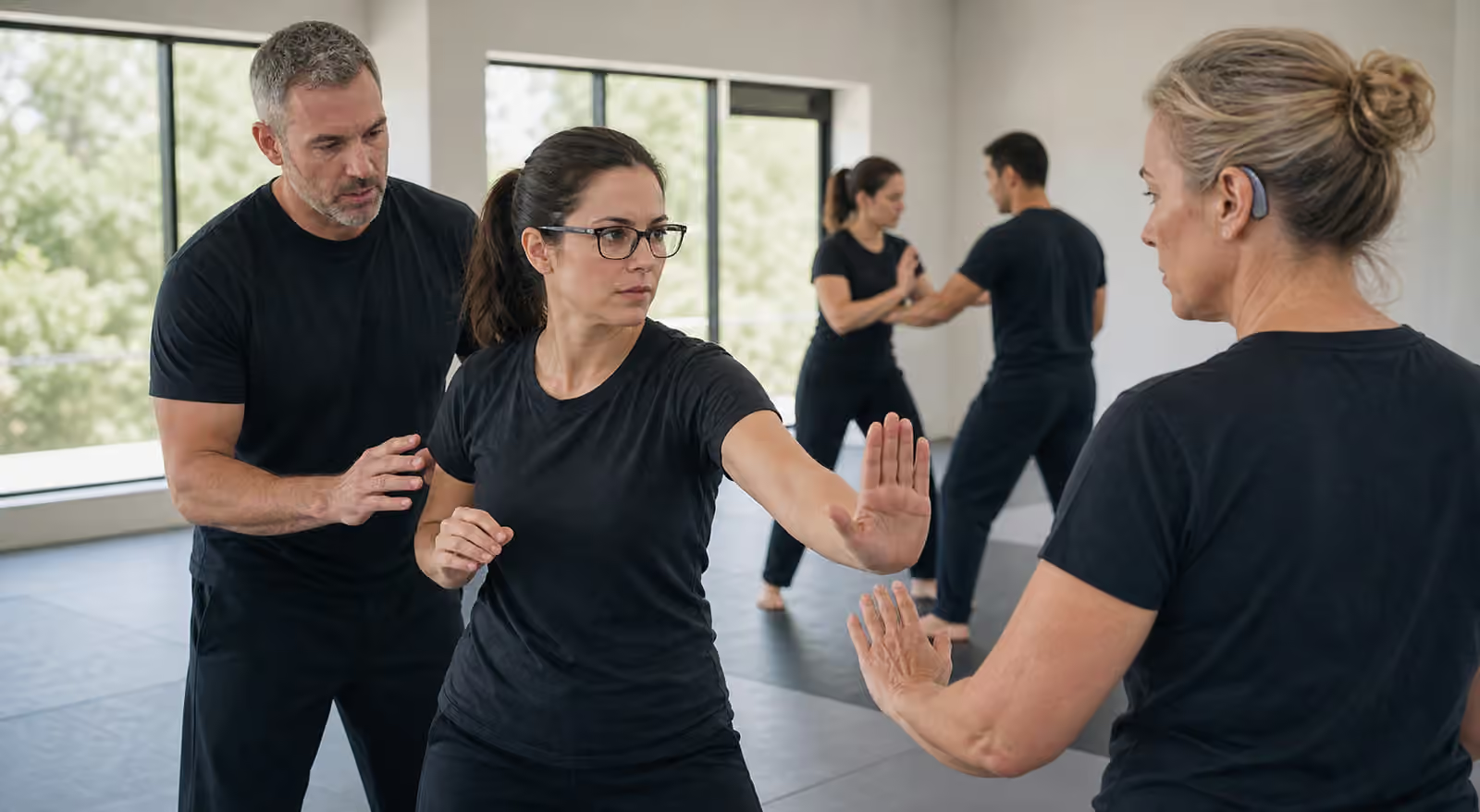
Glasses can also make contact drills more emotional. A student who worries about broken frames may flinch before the drill even begins. They may protect the glasses instead of protecting the head. They may remove them and then lose distance information. Neither choice is automatically correct. The school should help the student decide what is safe for the drill, what equipment rules apply, and when slower contact is the better version.
Hearing Changes Timing
Hearing matters before movement begins. Students listen for the drill frame, the stop signal, the partner’s boundary, the coach’s correction, and the change from one round to the next. A student who misses part of the instruction may appear careless when they are actually missing information. A partner who speaks from the wrong side may think they were ignored. A noisy room can turn a simple drill into a confusing one.
Safety Signals and Stopping Early belongs close to this topic. A safety system only works when people can perceive it. If the room uses verbal stop cues, hand signals, whistles, claps, or visual pauses, those cues need to be understood by the people training. A student with hearing aids may hear better from one side. Another may need to see the instructor’s face. A third may need the drill name repeated at normal volume after the room quiets.
This is not a demand that every class become silent. Krav Maga training often includes noise because pressure changes attention. The point is sequencing. Teach the drill clearly before noise is added. Confirm the stop signal before contact begins. Let students say when they did not hear the assignment. Then pressure can be introduced with purpose instead of confusion.
Partners Need To Know What Matters
Not every sensory detail needs to be announced to the whole room. Privacy matters. But partners do need enough information to train safely. A simple sentence can be enough: “Please feed from this side first,” “I need to see your hands before we start,” “Do not touch my hearing aid,” “My glasses are staying on for this light round,” or “I am removing my glasses, so keep the movement slow.” These are training instructions, not apologies.
Partner Work in Krav Maga argues that contact, consent, and control are part of the skill. Sensory limits make that argument visible. A partner who ignores a hearing aid, jokes about glasses, or speeds up after being asked to slow down is not adding realism. They are weakening trust. A partner who adjusts clearly and keeps the drill honest is giving useful pressure within a safe frame.
Instructors can model this by speaking plainly. They do not need to make a speech about inclusion every time. They can ask, “Can everyone see this angle?” or “Do you need the stop cue shown visually as well?” They can place students where they can receive correction. They can remind the class that a modification is not a shortcut. It is the version that lets the lesson happen.
Losing A Sense For A Moment Is Different From Training Blind
Some classes use drills where eyes are closed briefly, where a student turns before a cue, or where a partner begins from a position outside direct sight. Those drills can teach startle response, touch information, or recovery from surprise. They should not be confused with casually simulating blindness, deafness, or disability. A few seconds of restricted information in a controlled drill does not give a student lived understanding of someone else’s body.
The ethical approach is narrower and more useful. The instructor names the training purpose. Perhaps the student is learning to recover posture after being turned. Perhaps they are noticing pressure through the forearm when close vision is unavailable. Perhaps they are practicing voice and exit after a startled glance. The drill has boundaries, stop signals, and a return to normal information afterward.
Scenario Training and Ethics is relevant here because role play can become careless when people treat sensory limits as props. Training should not mock confusion, imitate disability for entertainment, or turn a student’s real adaptation into a class joke. Krav Maga is practical enough to be respectful. It does not need theater to teach that information can disappear under stress.
Equipment Has To Be Managed Before Pressure
Glasses, contacts, hearing aids, retainers, protective eyewear, and other aids have practical needs. They may need a case near the training area. They may need to be removed before certain contact drills. They may need to be secured. They may be expensive, medically important, or hard to replace quickly. A written guide cannot decide for each student, and medical or equipment questions should be handled with qualified guidance. The training habit is to plan before the round starts.
Krav Maga Training Gear covers shoes, wraps, mouthguards, bags, and small hazards. Sensory equipment belongs in that same conversation because it affects attention and safety. A student who keeps glasses on during light padwork may need the partner to avoid face contact. A student who removes hearing aids may need a visual cue for stopping. A student with contacts may need time to reset if one shifts. None of this is dramatic. It is class management.
The worst plan is silent improvisation. The student hides the concern, the partner guesses, the drill gets faster, and everyone acts surprised when the preventable problem appears. Good rooms invite earlier speech. “I need to adjust this before we start” should be a normal sentence.
Sensory Honesty Improves Everyone’s Training
Students with ordinary vision and hearing can learn from this topic too. Stress reduces information. Sweat blurs. Loud rooms confuse. Low light changes confidence. Fatigue makes instructions harder to hold. A person who has never worn glasses can still become visually late after a hard round. A person with sharp hearing can still miss a stop cue when pride is loud.
Breathing and Stress Recovery helps because recovery brings information back. After a startle, a student can exhale, reset the eyes, listen again, and check the partner’s position. That reset is not only emotional. It is perceptual. The student is rebuilding the picture of the room.
The goal is not perfect awareness. Perfect awareness is a myth. The goal is accurate awareness. Know what you can perceive, what you tend to miss, what equipment changes, what your partner needs to know, and when to ask the instructor for a clearer frame. Krav Maga works better when students stop pretending they are standard training bodies and start training the bodies they actually bring into the room.
Glasses, hearing aids, and sensory limits do not make training less serious. They make seriousness easier to measure. A serious class handles them early, clearly, and without embarrassment. It keeps the drill honest enough to matter and safe enough to repeat.