The first time you see someone wrap tefillin, it can look like a private language made visible.
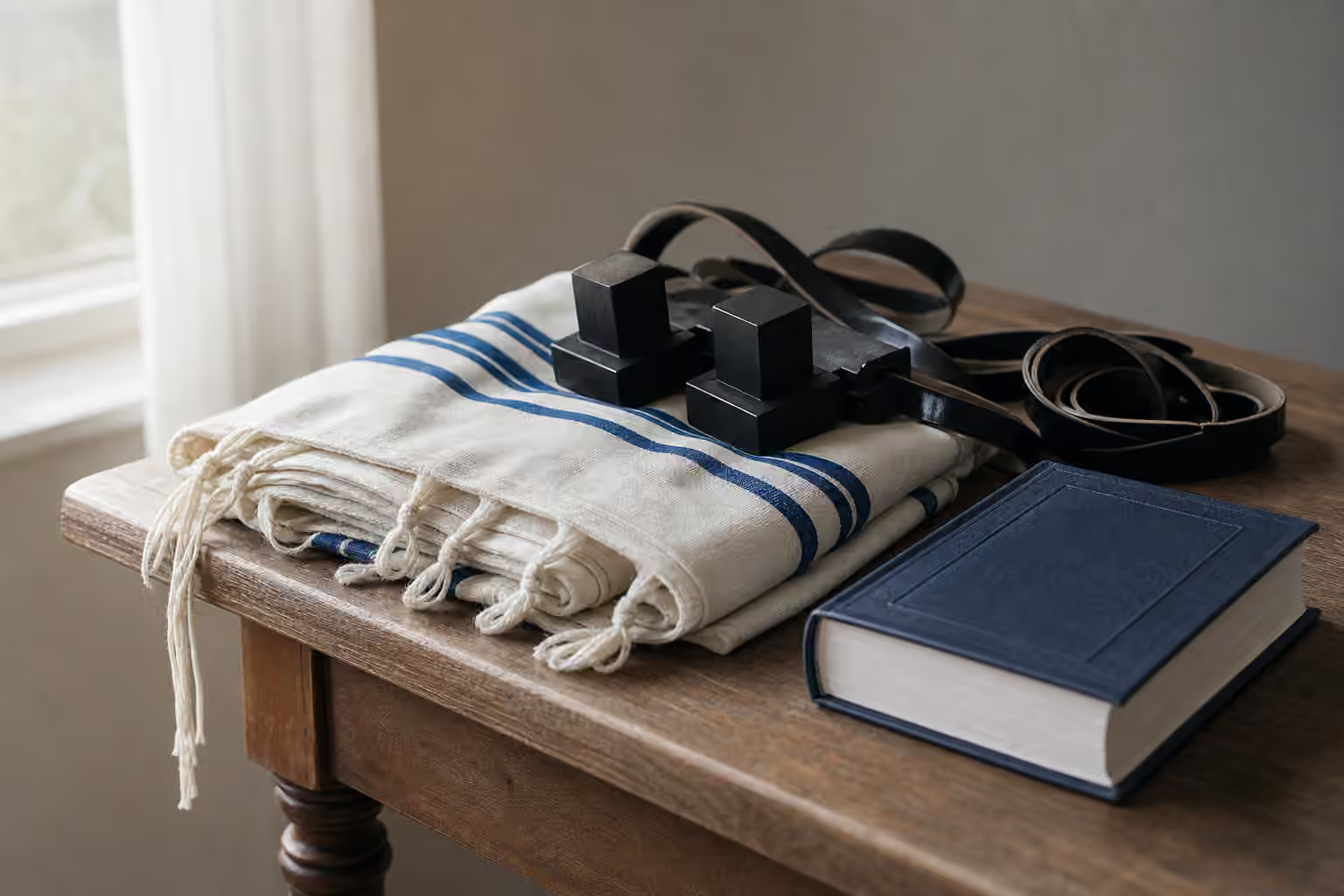
There is a small black box placed against the arm, another set near the hairline, leather straps crossing the hand and fingers, a folded shawl lifted over the shoulders, and a prayer book open nearby. Some people move quickly because they have done it for years. Some pause over every knot. Some kiss the fringes of the tallit before putting it on. Some say blessings softly. A beginner may watch all of this and wonder which parts are required, which are custom, and which are simply the confidence of practice. For background, read Numbers 15:37–41 (tzitzit) .
Tallit and tefillin are not props for looking religious. They are ritual objects that turn morning prayer into something physical. A tallit, often called a prayer shawl, gathers the body into a garment with fringes called tzitzit. Tefillin are small boxes containing scriptural passages, worn with leather straps on the arm and head during weekday morning prayer in many traditional communities. Together they make prayer less abstract. The body is not left outside the room while the mind tries to concentrate. The arm, head, shoulders, eyes, and hands all learn where they are.
That physicality can be comforting, but it can also intimidate. The objects have rules. They carry history. They vary by community. They may be associated with gender, age, family custom, denominational practice, and levels of observance. A beginner does not need to master every detail before understanding why these objects matter. The better first step is to learn what each object is doing in the life of prayer.
A tallit makes commandments wearable
The tallit is familiar because it is visible. In many synagogues, adults wear large prayer shawls during morning services, especially on Shabbat, festivals, and weekday mornings. The fabric may be white with black, blue, or colored stripes. It may be wool, cotton, silk, synthetic, plain, or beautifully decorated. Some people wear a large tallit only during prayer, while some also wear a smaller garment with fringes, often called a tallit katan, under or over clothing during the day.
The essential feature is not the shawl’s design. It is the tzitzit, the fringes tied at the corners. The biblical commandment to wear fringes is connected with remembering the commandments. That is why the tallit is more than a ceremonial covering. It is a garment of memory. It lets the body carry a reminder before the mind has had time to wander.
When a person puts on a tallit, the motion can feel like entering a small tent of attention. Some gather the fabric around the shoulders. Some briefly cover the head. Some hold the fringes during parts of prayer such as the Shema, depending on custom. In a room full of people, each tallit can still create a small private space. It says that prayer is communal, but attention must be worn by a person.
For beginners visiting services, Synagogue and Prayer for Beginners explains the broader room: the siddur, ark, Torah reading, standing, sitting, and how to participate without pretending to know everything. Tallit belongs inside that landscape. It is not a costume for crossing the threshold. It is one way a community marks morning prayer, Torah reading, and the dignity of standing before inherited words.
Tefillin make covenant precise
Tefillin can feel stranger because they are less familiar in public culture. Each set has two parts. The shel yad is placed on the arm, traditionally toward the heart. The shel rosh is placed on the head. Inside the black leather boxes are parchment passages from the Torah, including words that speak of binding these teachings on the hand and between the eyes. The straps are arranged in ways that differ somewhat by custom, but the underlying image is clear: action and thought are bound into prayer.
This is why tefillin are often associated with weekday morning discipline. They are not usually worn on Shabbat and festivals, because those days have their own signs of covenant. In communities where tefillin practice is central, the act of wrapping marks an ordinary weekday as spiritually serious. Before work, school, errands, messages, meetings, or family demands, the body is asked to remember what it serves.
There is a useful humility in tefillin. The boxes are small, exact, and not especially glamorous. They require care. The straps can tangle. The placement can be awkward at first. The blessing may be unfamiliar. The first few attempts may feel clumsy. That awkwardness is not failure. Many Jewish practices become meaningful through repetition before they become graceful.
Because tefillin involve sacred scrolls and specific construction, they are usually purchased from reliable sources and checked when needed by someone qualified. A beginner should not treat them like decorative objects or casual accessories. If you inherit a set, find a knowledgeable teacher, rabbi, sofer, or trusted community member who can help you understand whether the set is usable and how to handle it respectfully.
Customs differ, and the differences matter
One of the fastest ways for a beginner to become confused is to assume there is one universal tallit and tefillin practice. There is not. In many Ashkenazi communities, unmarried men may not wear a large tallit until marriage, while in many Sephardi communities boys begin wearing one earlier. In many liberal communities, a tallit may be worn by anyone who chooses to take on the practice. In some Orthodox settings, women generally do not wear tallit or tefillin; in some other communities, women may wear them. Some people begin around bar or bat mitzvah age, while adult learners may begin much later.
The point is not that all customs are interchangeable. Customs are the way communities carry memory, authority, family identity, and interpretation. The point is that a beginner should learn in context. If you are part of a synagogue, ask how the community handles tallit and tefillin. If you are studying toward conversion, ask your sponsoring rabbi or teacher before buying anything. If you are reconnecting with family practice, ask older relatives what they remember, while also allowing that memory may be partial.
This is especially true around bar and bat mitzvah. A tallit is often given as a gift, and tefillin may become part of preparation in communities where weekday prayer practice is expected. Bar and Bat Mitzvah for Beginners explains why coming of age is not a performance but a public entrance into responsibility. Tallit and tefillin make that responsibility tangible. A young person is not only learning words to chant once. They may be learning how Jewish obligation touches ordinary mornings.
The siddur gives the objects a voice
Tallit and tefillin are not meant to replace prayer. They accompany it. The siddur, the prayer book, gives language and order to the morning: blessings, psalms, Shema, Amidah, supplication, songs, and local additions. Without the siddur, the objects can become silent symbols. With prayer, they help the body enter a sequence.
That sequence matters for beginners because Jewish prayer can otherwise feel like isolated gestures. Put on the tallit, wrap tefillin, open the siddur, say a blessing, follow the service, hold the fringes, loosen the straps, fold the shawl. Each motion is small, but together they build a rhythm. The rhythm teaches that prayer is not only an emotion one waits to feel. It can be a practice one enters honestly, even on a flat morning.
If the Hebrew words feel far away, begin with orientation. Learn the names of the objects. Learn which blessing belongs where in your community’s practice. Learn how your siddur is arranged. Jewish Texts and Learning for Beginners is useful here because it explains how Jewish books preserve a conversation rather than a single flat answer. The siddur is one of those books. Its words have been shaped by law, poetry, memory, debate, longing, and habit.
Learning with your hands
The most practical way to learn tallit and tefillin is usually with another person. A teacher can show where the tallit sits, how to check the corners, how to keep the fringes from dragging, how to place the arm box, how firmly to wrap the strap, where the head box belongs, and how to remove everything without turning the moment into a knot. Videos can help, but a real person can notice what you cannot see from your own angle.
Learning by hand also lowers embarrassment. A strap slips. A box is too far forward. The tallit falls off one shoulder. The siddur page is wrong. These are ordinary beginner moments. Jewish practice is full of learned movements that once felt unnatural to everyone who now does them easily.
Care belongs to the learning too. Tefillin should be kept dry, protected, and treated as sacred. A tallit should be folded and stored respectfully, though folding customs differ. If tzitzit tear or knots come loose, ask before improvising. The details are not meant to make the objects fragile in a theatrical way. They are meant to teach that sacred things are handled with attention.
At home, the practice may begin very simply. A person sets a place, opens the siddur, takes out the tallit bag and tefillin bag, and lets the morning slow down for a few minutes. This can sit beside other household practices described in Jewish Home Rituals for Beginners , where doorposts, blessings, giving, and small habits make Judaism visible in ordinary rooms. Tallit and tefillin bring that same visibility to the beginning of the day.
What the objects teach over time
A beginner often asks what tallit and tefillin mean. The answer changes as the practice becomes less new. At first, the meaning may be mostly informational: this is the shawl, these are the fringes, these are the boxes, this is the strap. Later, the meaning may become emotional: this belonged to a parent, this was given at a coming of age, this was learned after years away, this helped me return to weekday prayer. Later still, the meaning may become quieter. The objects do their work because they are there, morning after morning, asking the body to remember before the day scatters attention.
There is no need to romanticize every use. Some mornings are distracted. Some prayers feel dry. Some people struggle with inherited language, gendered customs, obligation, or community boundaries. Those questions deserve honesty. Tallit and tefillin do not erase them. They give a person a way to stand inside the questions with a body that is doing something careful.
That may be the first lesson for a beginner. Jewish prayer is not only thought, and not only feeling, and not only words. It is also fabric, knots, leather, boxes, pages, shoulders, hands, and time. The tallit gathers. The tefillin bind. The siddur speaks. The person returns, not because every morning is luminous, but because practice can hold a life even when attention is uneven.
The objects look mysterious from the outside because they belong to a language of repeated care. Once you begin learning that language, the mystery does not disappear. It becomes more precise. A shawl, a fringe, a box, a strap, a page, a blessing: each one is small enough to hold, and large enough to return to.