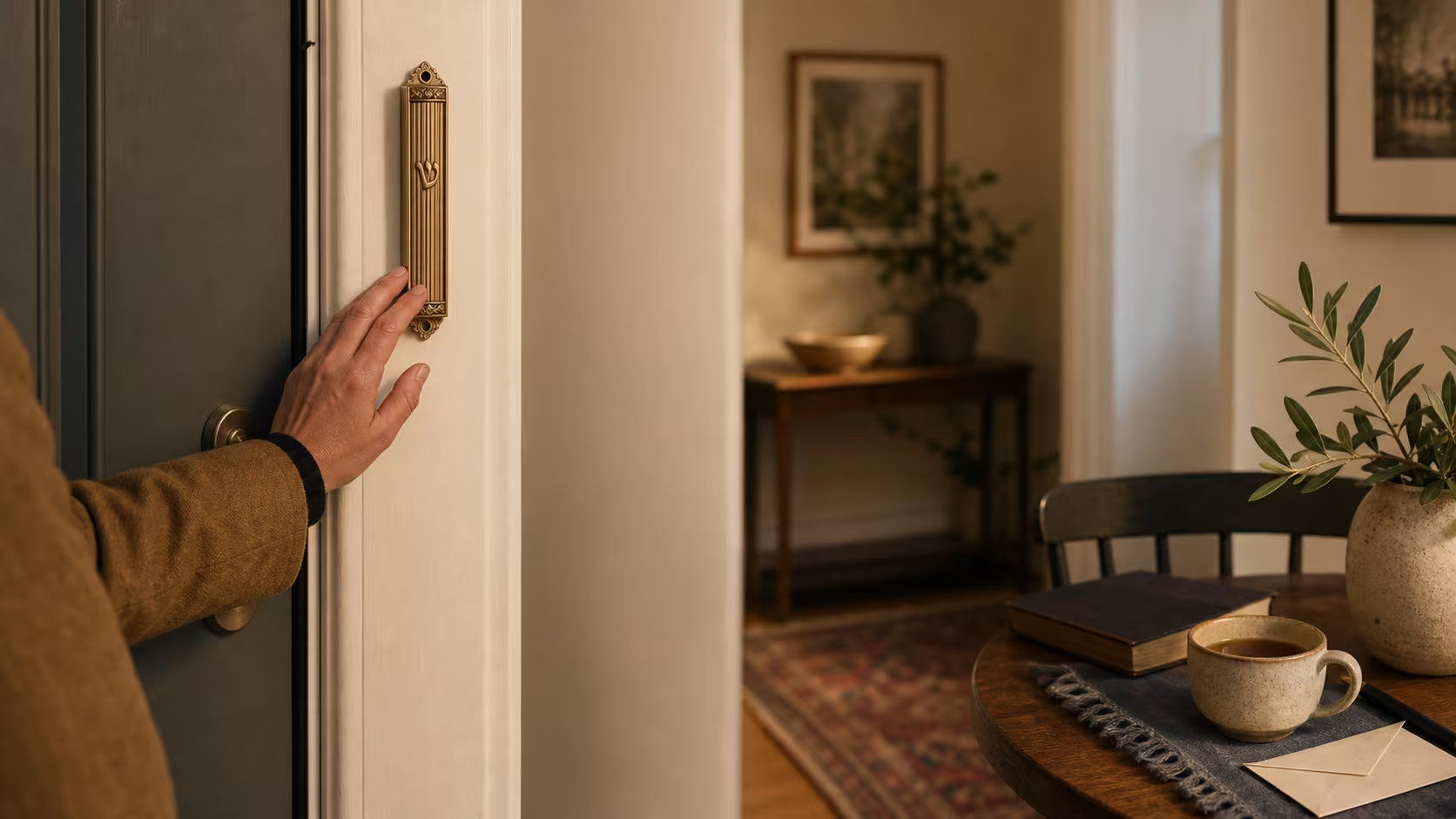
A mezuzah is small enough to miss if you are not looking for it. It sits on a doorpost, often at an angle in many Ashkenazi homes and vertical in many Sephardi and Mizrahi homes, sometimes in a simple case, sometimes in a beautiful one, sometimes weathered by years of hands passing by. Visitors may notice someone touch it lightly and kiss their fingers. A child may run past it without thinking. A person coming home late may see it before they see anyone else.
The visible object is the case, but the mitzvah is not the case. Inside a kosher mezuzah is a parchment scroll handwritten by a trained scribe, containing passages from the Shema and related verses from Deuteronomy. Those words speak of loving God, teaching children, speaking of these things at home and on the way, lying down and rising up, and writing them on the doorposts of the house and gates. The mezuzah turns that instruction into a daily doorway.
For a beginner, the mezuzah can be confusing because it is both ordinary and serious. It is not a charm in the simple magical sense, though people may feel protected or comforted by its presence. It is not merely a Jewish decoration, though cases can be beautiful. It is a ritual object that marks a Jewish home, carries text, and asks the threshold to teach.

A doorway is a place of decision
Doorways are not neutral. They are where people enter and leave, welcome and part, return and depart, bring the outside in and carry the inside out. A home doorway sees errands, grief, groceries, guests, arguments, children leaving for school, relatives arriving with food, someone coming home from the hospital, someone leaving for work before sunrise. A mezuzah sits at that busy edge and quietly insists that these crossings matter.
The power of the ritual is partly repetition. You do not encounter the mezuzah only on holidays or during formal prayer. You encounter it when you are late, distracted, irritated, relieved, lonely, or carrying too many bags. It brings Jewish memory into the ordinary motion of a day.
That is one reason people often touch or notice the mezuzah when passing through a doorway. Customs differ, and not everyone does this. But when people do, the gesture can function as a small return to attention. It is not a performance for guests. It is a way of letting the doorpost interrupt forgetfulness for half a second.
The scroll matters
Because many mezuzah cases are sold as art objects, beginners sometimes assume the case is the whole thing. In Jewish practice, the scroll inside is the essential part. A beautiful empty case may decorate a doorway, but it is not a kosher mezuzah. A printed paper tucked inside a souvenir case is not the same as a properly written scroll.
This distinction matters because Jewish ritual often lives in the relationship between beauty and obligation. A lovely case can honor the mitzvah. It can express family taste, community, craft, memory, or joy. But the beauty is serving the scroll, not replacing it. The words inside are the center even though most people do not see them day to day.
If someone wants to put up a mezuzah as a Jewish ritual object, it is worth buying from a reliable source and asking questions. Is there a kosher scroll? Who wrote it? Is the case suitable for the doorway, especially outdoors? Does it protect the parchment from weather? These questions may feel technical, but they are part of taking the object seriously.
Placement teaches belonging
Traditional mezuzah placement has details: which doorways require one, where on the doorpost it goes, which side, how high, which rooms, how to handle unusual architecture. Different communities and authorities may guide some cases differently. A beginner does not need to memorize every detail before understanding the meaning, but the details show that the ritual is not random.
The mezuzah usually belongs on the right side as one enters a room or home, in the upper third of the doorway. Many Ashkenazi Jews place it slanted, while many Sephardi and Mizrahi Jews place it upright. The familiar slant is sometimes explained as a compromise between opinions, but it has also become a visible marker of custom. In practice, the doorway becomes a small map of Jewish diversity.
That diversity matters. A person visiting Jewish homes may see different cases, angles, placements, and customs. The variation does not mean nobody knows what they are doing. It often means that Jewish life carries many inherited ways of fulfilling the same command.
The blessing marks the act
When a mezuzah is affixed, a blessing may be recited. The moment can be quiet, with one person and a screwdriver, or communal, with family and friends gathered at a new home. People sometimes put up a mezuzah shortly after moving in, turning a practical act of settling into a spiritual act of making the doorway Jewish.
The blessing does not make the home perfect. It does not guarantee peace inside. Jewish homes still have stress, dishes, bills, loneliness, noise, and ordinary human difficulty. The mezuzah does something more modest and more durable. It gives the home a threshold that remembers what the people inside may forget.
That memory can be especially powerful during moves. A mezuzah taken down from one home and placed in another carries continuity. A new case chosen for a first apartment can mark adulthood. A scroll checked and returned can remind a family that ritual objects need care. A doorway without a mezuzah after loss or transition can feel strangely bare.
Guests can notice without performing
If you are visiting a Jewish home and see a mezuzah, you do not need to touch it unless that is your practice or your host invites you into the custom. You also do not need to ask for a full explanation in the doorway while people are holding coats and food. Notice it respectfully. If the setting is right, ask later.
For people who are Jewish but new to practice, the mezuzah can bring up tender feelings. It may feel like a public statement. It may connect to family memories, conversion, return, uncertainty, or the question of what kind of Jewish home one is trying to build. That emotional weight is real. A small object can carry a large threshold.
For people who are not Jewish, the respectful posture is curiosity without possession. A mezuzah is not a general spiritual charm to borrow because it looks meaningful. It belongs to a particular command, text, and people. Respecting that particularity is part of respecting the object.
The doorway keeps teaching
The mezuzah’s quiet genius is that it stands where life keeps moving. It does not ask people to stop for an hour. It asks them to notice for a moment. It does not replace study, prayer, ethics, hospitality, or community. It points toward them every time someone crosses the threshold.
In that sense, the mezuzah is a lesson in scale. Jewish life is not only built from major holidays, long services, lifecycle events, or dramatic stories. It is also built from small repeated recognitions. A doorway. A hand. A line of text hidden in a case. A home that says, before anyone speaks, that entering and leaving can be part of a covenantal life.
The object is small because the practice is large enough to fit into ordinary days.