A Jewish funeral often begins before the funeral itself, in the strange hours when ordinary decisions suddenly feel too large. For background, read Maimonides — Mourning 1 (mourning background) .
Someone has died. A family may be in a hospital hallway, at home, in another city, or gathered around a phone that keeps ringing. People need to notify relatives, reach clergy, speak with a funeral home, find documents, think about cemetery arrangements, and decide who can travel. Even when death was expected, the first practical steps can feel unreal. Grief has arrived, but it is immediately asked to answer questions.
Jewish mourning practice does not remove that difficulty. It gives the difficulty a path. The path is shaped by respect for the dead, care for the mourners, and the conviction that the community should not leave a family alone with the logistics of loss. Customs vary by community, movement, family history, local cemetery practice, and personal circumstance, so a beginner should not treat one description as a universal script. Still, many Jewish funerals share a recognizable moral structure: the dead are treated with dignity, burial happens without unnecessary delay when possible, mourners are held by ritual, and the community begins preparing for shiva.
If you want the wider lifecycle frame, Names, Lifecycle, and Family History places death and mourning beside naming, coming of age, marriage, and family memory. This guide stays close to the funeral threshold itself: the preparation, the room, the cemetery, the first Kaddish, and the movement toward the mourning house.
Dignity Begins With Care for the Body
Many Jewish communities speak about kavod hamet, honoring the dead. The phrase can sound formal, but its meaning is deeply practical. The person who has died is not treated as an object, a problem, or a display. They are treated as someone whose body once carried a life, relationships, speech, work, memory, and obligation.
In traditional practice, a chevra kadisha, a sacred burial society, may care for the body through taharah, a ritual washing and preparation for burial. The details are handled privately and respectfully. The point is not spectacle; it is tenderness and dignity. Some communities use traditional burial garments called tachrichim. Many Jewish burials use a plain wooden coffin, sometimes called an aron, to express simplicity and equality before death. Other communities adapt these practices, and circumstances may require different arrangements.
Beginners sometimes ask whether Jewish funerals avoid viewing the body. In many traditional Jewish settings, open-casket viewing is not part of the funeral because the focus is on dignity, modesty, and burial rather than presentation. Other families or communities may have different customs because of background, mixed family practice, or local expectation. When you are unsure, ask the rabbi, funeral director, or family contact quietly rather than assuming.
There may also be shmirah, the practice of accompanying or watching over the deceased before burial. In some communities, people sit near the body and recite psalms or simply remain present. The practice says that a person is not abandoned between death and burial. Even when a family cannot arrange every traditional element, the underlying value remains clear: the dead are owed care that is not rushed, commercialized, or made casual.
The Funeral Room Has Its Own Restraint
A Jewish funeral may be held at a funeral home, synagogue, chapel, graveside, or another appropriate place. The room may be simple. There may be a coffin, flowers in some communities and not in others, a lectern, prayer books, a memorial candle, a torn ribbon, or just rows of chairs and faces strained by the effort of arriving.
The service is usually not long, but it can carry enormous weight. Psalms may be recited. A rabbi, cantor, family member, or friend may speak. Eulogies often matter because they turn grief toward the actual life that was lived. The best eulogies do not polish a person into marble. They tell the truth with mercy. They remember habits, work, humor, contradictions, loyalties, disappointments, favorite phrases, acts of care, and the ordinary details that made the person recognizable.
If you are asked to speak, the task is not to prove how devastated you are. It is to give mourners and listeners a usable memory. A brief, honest story often does more than a speech full of grand claims. If the relationship was complicated, a funeral does not require false simplicity. It does require restraint. The dead cannot answer, and the mourners should not be forced to manage unresolved conflicts in public.
Some mourners perform kriah, tearing a garment or cutting a black ribbon, before or during the funeral. The tear makes grief visible. It says that loss is not only an idea but a rupture. Practices differ around who tears, where the ribbon is worn, how long it remains visible, and what blessing or words are said. The emotional meaning is direct enough for a beginner to grasp: something has been torn, and the community agrees not to pretend otherwise.
Kaddish Places Grief in a Community
Mourner’s Kaddish may be recited at the funeral or graveside, depending on custom. Beginners are often surprised to learn that Kaddish does not speak directly about death. It praises and sanctifies God’s name. That can feel strange at a moment when the most obvious words seem to be absence, pain, anger, gratitude, or disbelief.
The strangeness is part of its power. Kaddish does not explain why someone died. It does not try to make grief reasonable. It gives mourners a set of inherited words to stand inside when private language is not enough. It also requires, in many communities, the presence of others. The mourner is not left to make meaning alone.
For people who are new to services, the first Kaddish can be disorienting. Someone may indicate when to stand. Others may join in the responses. Hebrew and Aramaic may move faster than expected. If you are there as a supporter and do not know the words, quiet presence is still meaningful. If synagogue prayer itself feels unfamiliar, Synagogue and Prayer for Beginners can help make the communal setting less opaque.
There is no need to perform fluency at a funeral. Jewish mourning has room for people who can recite every word and for people who only know when to stand close.
The Cemetery Is Not a Stage
The graveside portion of a Jewish funeral can be the most difficult and the most grounding. The coffin may be lowered. Prayers may be said. People may place earth into the grave, sometimes with a shovel turned in a distinctive way to show reluctance rather than efficiency. In many communities, helping cover the grave is considered a final act of kindness because the person who receives it cannot return the favor.
This act can unsettle newcomers. Modern life often hides the physical reality of burial, but Jewish practice may ask mourners and community members to encounter it directly. The sound of earth landing can be painful. It can also be clarifying. The funeral is not only a memorial event. It is an act of escorting a person to burial.
Visitors should follow the family’s and clergy’s cues. Some people step forward. Some cannot. Some communities invite everyone to participate, while others have more specific customs. No one should turn the moment into a test of emotional strength. The purpose is not to be dramatic. It is to complete the act with dignity.
After burial, mourners may pass between two rows of people offering words of comfort, or the community may express comfort in another local form. A traditional phrase asks that the mourners be comforted among the mourners of Zion and Jerusalem. If those words are not familiar to you, a simple and quiet expression can still be kind. The important thing is not to fill the air with explanations. Death does not need commentary from every visitor.
The Meal Turns the Mourners Back Toward Life
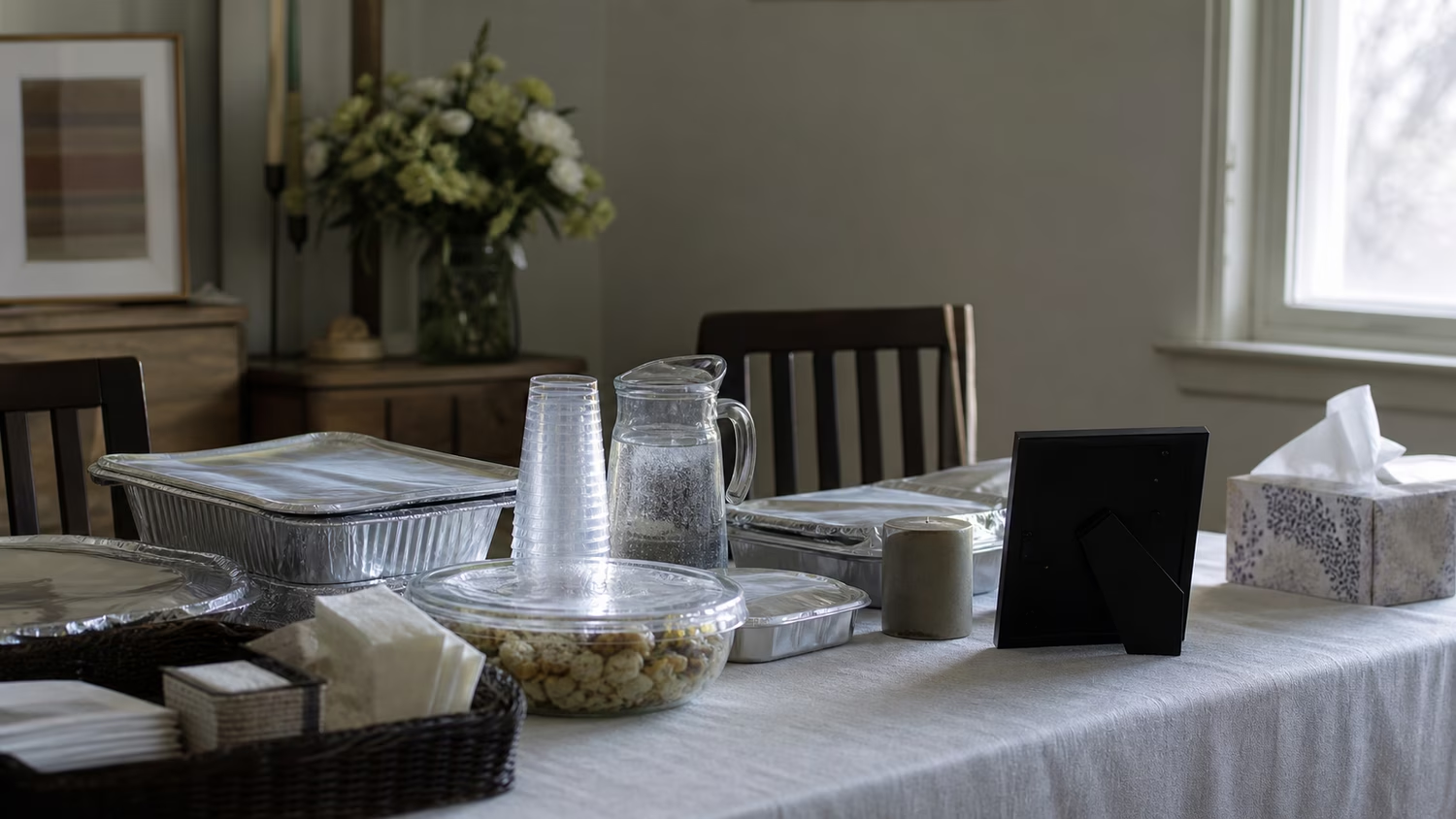
After the burial, many families return to a home for the first meal of condolence, sometimes called seudat havra’ah. The meal is not a reception in the ordinary sense. It is a way of saying that mourners should not have to feed themselves first. The community begins carrying ordinary needs before the mourners have strength to carry them.
Traditional foods may include round foods such as eggs or lentils in some communities, but practice varies. What matters is not an impressive menu. It is that food arrives in a way that fits the household’s standards and reduces work. If a family keeps kosher, the source of the food may matter. If allergies, access needs, travel schedules, or mixed family customs are present, coordination matters more than symbolism.
This is where the funeral begins to turn into shiva. The chairs, food, prayer times, visiting hours, and family communication start to take shape. Visiting Shiva explains how to enter that house with care once the first burial day has passed into the first mourning days. The funeral says goodbye at the grave. Shiva makes room for grief to be witnessed at home.
Complicated Families Need Gentle Guidance
Not every funeral gathers a simple family around a simple story. There may be divorce, estrangement, interfaith relatives, converts, adopted children, chosen family, old wounds, uncertain Jewish status, financial stress, geographical distance, or disagreement about what the person wanted. There may be relatives who know Jewish practice well and relatives who feel like strangers to it. There may be people who loved the deceased in ways that were never publicly acknowledged.
Jewish tradition has structure, but structure still needs pastoral care. A rabbi, cantor, funeral director familiar with Jewish practice, chevra kadisha member, cemetery staff member, or trusted community leader can often help families make decisions without forcing every unresolved issue into the funeral room. The goal is not to erase complexity. The goal is to keep dignity at the center while the living do what can be done honestly.
For beginners, one useful instinct is to avoid turning a funeral into a debate over Jewish authenticity. If the family is working with clergy or a Jewish funeral provider, let those people guide the ritual details. If you are a guest, your role is presence, not correction. If you are part of the family and feel uncertain, ask questions early and privately. Public surprises at a funeral are rarely kind.
The First Days Are Only the Beginning
A Jewish funeral does not finish mourning. It begins a sequence. Shiva may last up to seven days in many traditions, though timing can be affected by holidays and local practice. Sheloshim, the first thirty days, carries another rhythm. For some mourners, especially after the death of a parent, Kaddish may continue for many months according to community custom. Later, yahrzeit and Yizkor give memory recurring dates and communal language.
Yahrzeit and Remembrance at Home belongs later in that arc, after the first room of mourning has emptied and memory begins returning through candles, Kaddish, giving, study, and stories. At the funeral, that later work may be impossible to imagine. The day is too close. The loss may still feel like a fact the mind cannot hold.
That is why the funeral path matters. It does not demand that mourners understand death immediately. It asks the community to do the next right thing. Prepare the body with dignity. Gather the living. Tell the truth with mercy. Tear what has been torn. Carry the dead to burial. Stand with the mourners. Bring food. Open the house for grief without making grief perform.
A beginner who attends a Jewish funeral does not need to master every custom in advance. They need to arrive on time, dress with respect for the setting, silence the phone, follow the room, avoid explanations that flatten grief, and let the mourners be the center. If they can offer a true memory, they can offer it gently. If they have no words, presence is enough.
The funeral is a threshold. On one side is the life that has ended. On the other side are the first days in which the living must learn how to carry that absence. Jewish practice stands at the threshold and refuses two temptations: it does not make death casual, and it does not leave mourners alone. It gives the community work to do, because love after death still needs hands.