Conversion to Judaism usually begins before anyone calls it conversion.
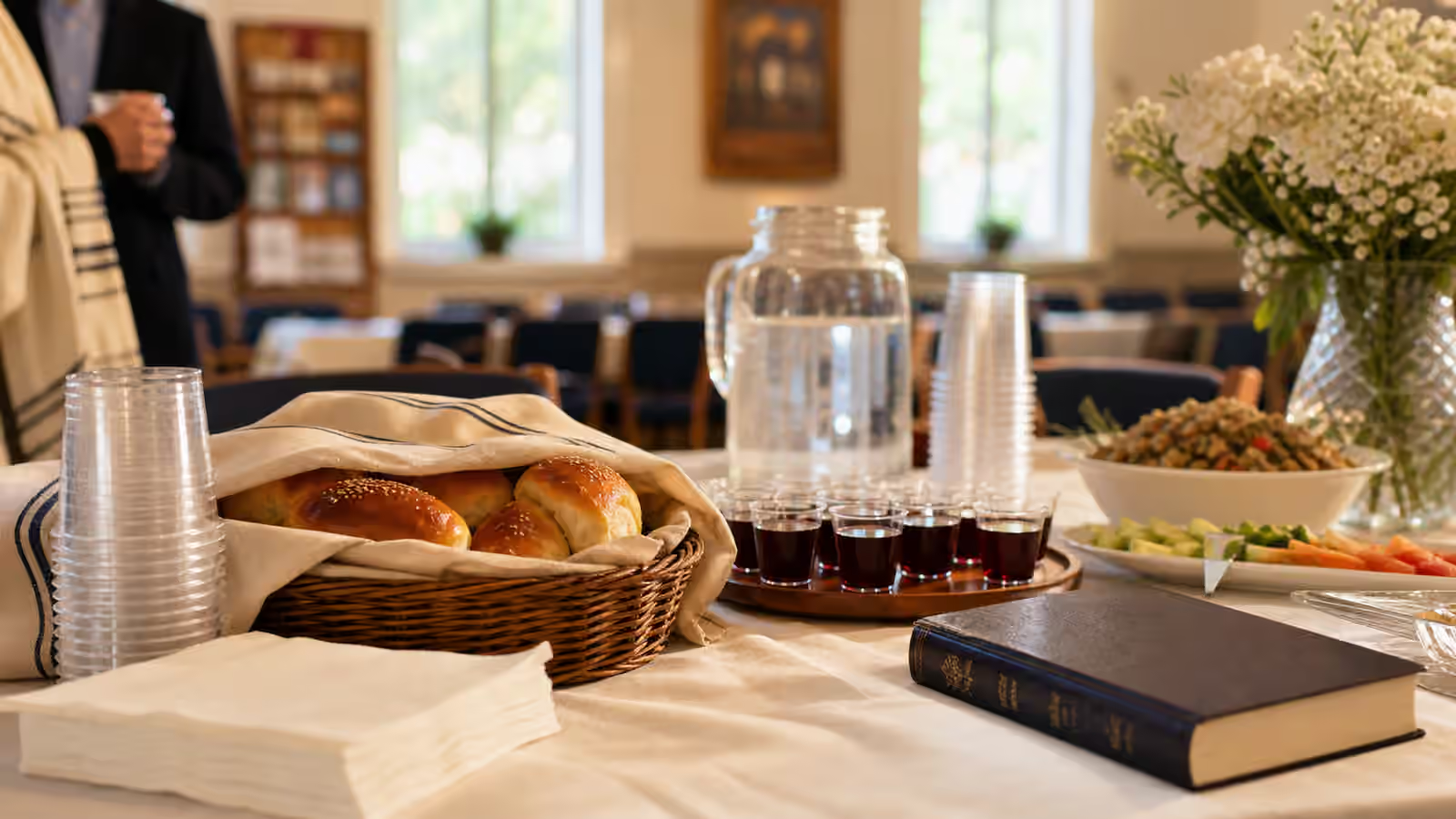
It may begin at a Shabbat table where the room feels strangely familiar. It may begin with a question after a synagogue service, a line in a prayer book, a family story, a college class, a relationship, a grief, a friendship, or the slow realization that Jewish time has begun to organize your attention. At first the question may be private and tentative. You may not know whether you are curious, returning to something that was near your family, building a Jewish household with someone you love, or feeling drawn toward a people and covenant you cannot yet explain. For background, read Yevamot 47a–b (conversion discussions) .
That early uncertainty deserves care. Jewish conversion is not a personality label, a reading project, or a certificate of appreciation for Jewish culture. It is a serious religious and communal process, and the details vary by community and movement. A beginner should not expect one article, one rabbi, one synagogue, or one friend’s story to describe every path. Still, the shape of the journey can be described honestly: study becomes practice, practice becomes relationship, relationship becomes responsibility, and responsibility is tested in a real community.
If you are still finding your first landmarks, Jewish Life Quickstart gives a broad entrance through Shabbat, holidays, kosher, names, lifecycle, and family memory. This guide stays with the specific question of conversion: how a person begins exploring without rushing, how local guidance matters, and why becoming Jewish cannot be separated from living with Jews.
The First Step Is a Real Conversation
A person exploring conversion may be tempted to begin by collecting requirements. How many classes are needed? How long does it take? What books count? Which rituals complete the process? Those questions are understandable, but they are not the best first step. The first step is usually a conversation with a rabbi, cantor, teacher, or conversion program connected to an actual Jewish community.
That conversation does several things. It clarifies which movement or community you are entering. It helps you understand what recognition may mean in that setting. It gives you a guide who can answer practical questions instead of leaving you to assemble Jewish life from fragments. It also lets the community begin seeing you as a person, not as a form to be processed.
Some communities have formal introduction classes. Some rabbis meet individually. Some expect regular synagogue attendance before the process is defined. Some communities will direct you elsewhere if their standards or resources do not fit your situation. This can feel frustrating, especially if your question already feels urgent. But the slowness has a purpose. Conversion is not only learning about Judaism. It is entering Jewish peoplehood, Jewish obligation, Jewish memory, and a particular network of communal practice.
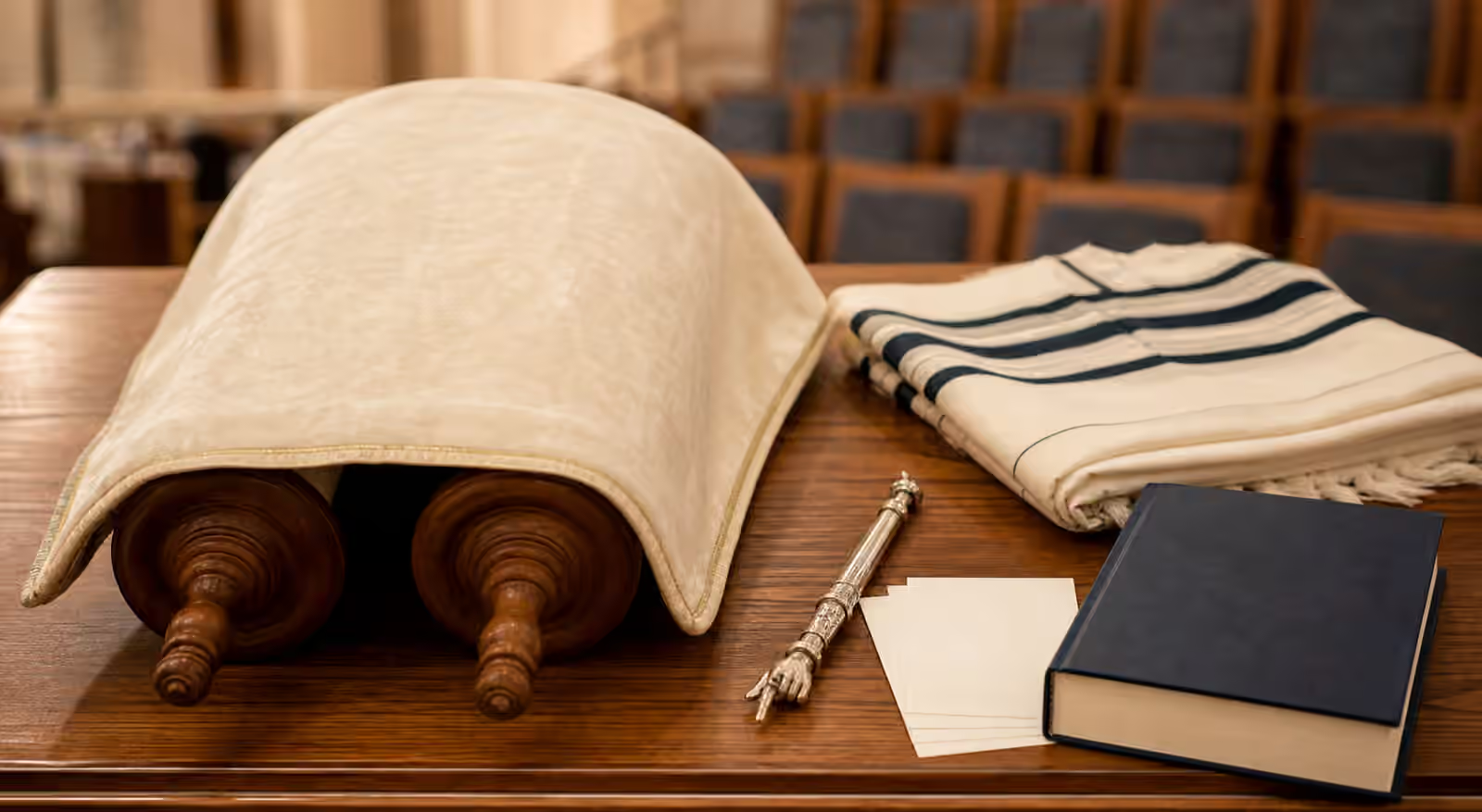
If synagogue life is unfamiliar, Synagogue and Prayer for Beginners is a useful companion. It explains how to enter the room, follow the siddur, notice the Torah reading, and handle the social room without pretending fluency. A person exploring conversion does not need to look like an expert on the first visit. They do need to learn how to show up consistently and respectfully.
Study Is Necessary, but It Is Not the Whole Journey
Jewish conversion requires learning, but the learning is not only academic. You may study Torah, holidays, prayer, Jewish history, ethics, antisemitism, Israel and the Jewish people, lifecycle events, Hebrew basics, Shabbat, kashrut, and the differences among Jewish movements. You may learn words that seemed opaque at first: mitzvah, covenant, halakhah, siddur, Tanakh, Talmud, midrash, minyan, tzedakah, teshuvah, mikveh.
That learning matters. A person should not enter Judaism with only a mood. Jewish life has texts, practices, memories, griefs, arguments, and responsibilities that deserve more than admiration from a distance. Jewish Texts and Learning for Beginners can help you understand why the Jewish library feels layered and why commentary, argument, and repeated reading are part of the tradition’s grammar.
Still, study by itself is not conversion. A person can read many Jewish books and remain outside Jewish life. The books have to meet practice. Shabbat cannot be understood only as an idea about rest. It has to be encountered as candles, meals, services, boundaries, exhaustion, delight, and a Friday afternoon that asks you to stop before you feel ready. Holidays cannot be understood only as names on a chart. They have to be met in rooms where people fast, eat, sing, argue, remember, build, read, and return.
This is why a guide such as Your First Shabbat Table matters. A person exploring conversion needs experiences where the tradition moves from page to body. The cup is lifted. The bread is covered. People bless children, wash hands, pass food, talk too long, sing unevenly, and let the week loosen its grip. No textbook can fully replace that.
Community Is the Classroom
Conversion can feel intensely personal, but Judaism is not entered alone. A person may pray alone, read alone, and make private commitments, yet Jewish identity is carried by community. The community witnesses whether a person is learning, participating, and taking responsibility for more than private meaning.
That does not mean every synagogue will feel easy. Communities have personalities. Some are warm but disorganized. Some are learned but socially hard to enter. Some are musical, quiet, formal, informal, traditional, liberal, multilingual, intergenerational, or shaped by one local history. A person exploring conversion may need time to find a setting where the guidance is serious and the human relationships are real.
The social work can be as important as the classwork. Stay for kiddush or oneg when you can. Ask grounded questions. Notice who sets up chairs, who visits the sick, who teaches children, who makes sure mourners have a minyan, who welcomes newcomers without making them into projects. Judaism is learned from siddurim and commentaries, but also from the way people bring food after a funeral, remember a yahrzeit, make room at a seder, or include a visitor at Shabbat dinner.
There is also a humility to being a learner in public. You may mispronounce Hebrew. You may stand at the wrong time. You may not know whether to kiss a Torah mantle, take a siddur from the shelf, wear a kippah, or answer a line of prayer. These moments can be embarrassing, but they are not failures. They are part of allowing a community to teach you.
Home Practice Makes the Question Concrete
At some point, exploration has to enter the home. A person may begin lighting Shabbat candles with guidance, making kiddush, learning havdalah, giving tzedakah, keeping a Jewish calendar visible, practicing blessings before food, or choosing one small way to make Jewish time durable. Jewish Home Rituals for Beginners is especially useful because it treats the home as a place where Jewish attention is built through small returns.
This is often where the conversion question becomes more honest. It is one thing to love Jewish ideas in a class. It is another to let Friday night rearrange your week. It is one thing to admire a holiday. It is another to clean, shop, ask about kosher standards, invite people, and discover which customs your community actually keeps. It is one thing to say that Jewish memory matters. It is another to mark the Hebrew date of a yahrzeit, learn how mourners are supported, and understand why people keep showing up when joy is not the center.
Food practice can be particularly revealing. Some conversion students gradually learn kashrut according to the standards of their community. Others begin by understanding labels, meat and dairy separation, vegetarian hosting, or how to ask what a host needs. A Beginner Kosher Kitchen gives a practical doorway without pretending that every Jewish household follows one pattern. The conversion learner’s task is not to perform perfection. It is to learn what the community teaches, what the household can honestly sustain, and where guidance is needed.
Differences Among Jewish Communities Matter
One of the first difficult truths is that Jewish communities do not all handle conversion in the same way. Orthodox, Conservative, Reform, Reconstructionist, Sephardi, Mizrahi, independent, secular-adjacent, and local communal settings may have different expectations, authorities, and standards of recognition. Some processes include a beit din, a small rabbinic court or panel, immersion in a mikveh, and, for some candidates, questions connected with brit milah or related covenantal rituals. The details should be handled by qualified local guidance, with appropriate medical and pastoral care where relevant.
This variation can feel unsettling. A person may ask, “Will everyone recognize my conversion?” The honest answer depends on the community, the process, and the context. That is why the first conversation matters. If recognition across communities is important to your future life, say so early. If you are building a household with a partner, planning children, thinking about aliyah, or hoping to participate in a particular synagogue, those realities should be discussed with someone who knows the standards involved.
The point is not to scare a beginner. It is to respect the seriousness of the choice. Jewish conversion is not a private declaration that every community automatically reads the same way. It is an entrance through a particular door, and doors have frames.
Family Questions Need Truth and Patience
Conversion often affects more people than the person converting. Parents, partners, children, grandparents, in-laws, and friends may have feelings that range from joy to confusion to grief. Some relatives worry that conversion means rejection of family. Some do not understand why the process takes time. Some are supportive but awkward. Some are hostile. Some ask questions that are really about love, fear, or identity.
The person exploring conversion does not have to let every relative define the process. They do need to speak truthfully where possible. Conversion to Judaism should not be hidden as a hobby if it is becoming a serious path. At the same time, not every early question needs to become a public announcement. There is a difference between privacy and secrecy. A guide, rabbi, or teacher can help you think about timing, language, and boundaries.
Interfaith family life also needs care. If a partner is Jewish, conversion should not be reduced to pleasing the partner or solving a wedding problem. If a partner is not Jewish, the household will need honest conversations about Shabbat, holidays, children, food, extended family, and communal belonging. The process should make the household more truthful, not less.
The Decision Ripens Slowly
In many conversion journeys, there is no single dramatic moment when uncertainty disappears. Instead, the question ripens. You keep showing up. You begin to know the melodies. The Jewish calendar stops feeling random. You understand why The Jewish Holiday Year is not just a sequence of festivals but an emotional and moral rhythm. You notice that Jewish grief and Jewish joy both ask for community. You stop asking only what Judaism means to you and begin asking what obligations you are willing to accept.
That shift matters. Conversion is not only about finding a tradition that feels meaningful. It is about becoming responsible to a people, a history, a God-language or theology you may still be wrestling with, a set of practices, and a community that will not always be convenient. Some days will feel beautiful. Some will feel ordinary. Some will be uncomfortable because Jewish life includes disagreement, memory, antisemitism, politics, family complexity, boredom, and obligation as well as warmth.
When the formal moment comes, if it comes, it should not feel like the beginning of interest. It should feel like the public recognition of a life already being formed. The person entering the mikveh, standing before a beit din, receiving a Hebrew name, or joining the Jewish people through the form their community requires is not finishing Jewish learning. They are accepting that the learning now belongs to them from the inside.
Afterward, the Work Continues
After conversion, there may be joy, relief, tenderness, and a surprising quiet. The intense process may end, but Jewish life does not become automatic. You still need Shabbat tables, teachers, friends, books, prayer, holidays, practice, mistakes, repair, and time. You may also need patience with how people ask about your story. Some questions will be kind. Some will be clumsy. Some may not deserve an answer.
A convert is not a permanent beginner. Jewish tradition repeatedly warns against mistreating converts, and communities should take that seriously. At the same time, every Jew keeps learning. Birth Jews, converts, returnees, partners, seekers, and lifelong synagogue regulars all have gaps. The difference after conversion is not that you know everything. The difference is that the story is now yours to keep, learn, argue with, and pass on.
The early question may have begun at a table, in a book, in a service, or in a private unease that would not go away. If it becomes conversion, it becomes more than a feeling. It becomes a way of living with Jewish time, Jewish people, Jewish memory, and Jewish responsibility. That is why the path deserves slowness. The goal is not to rush toward a label. The goal is to become truthful enough that when the community asks whether you are ready to enter, your life has already begun answering.