
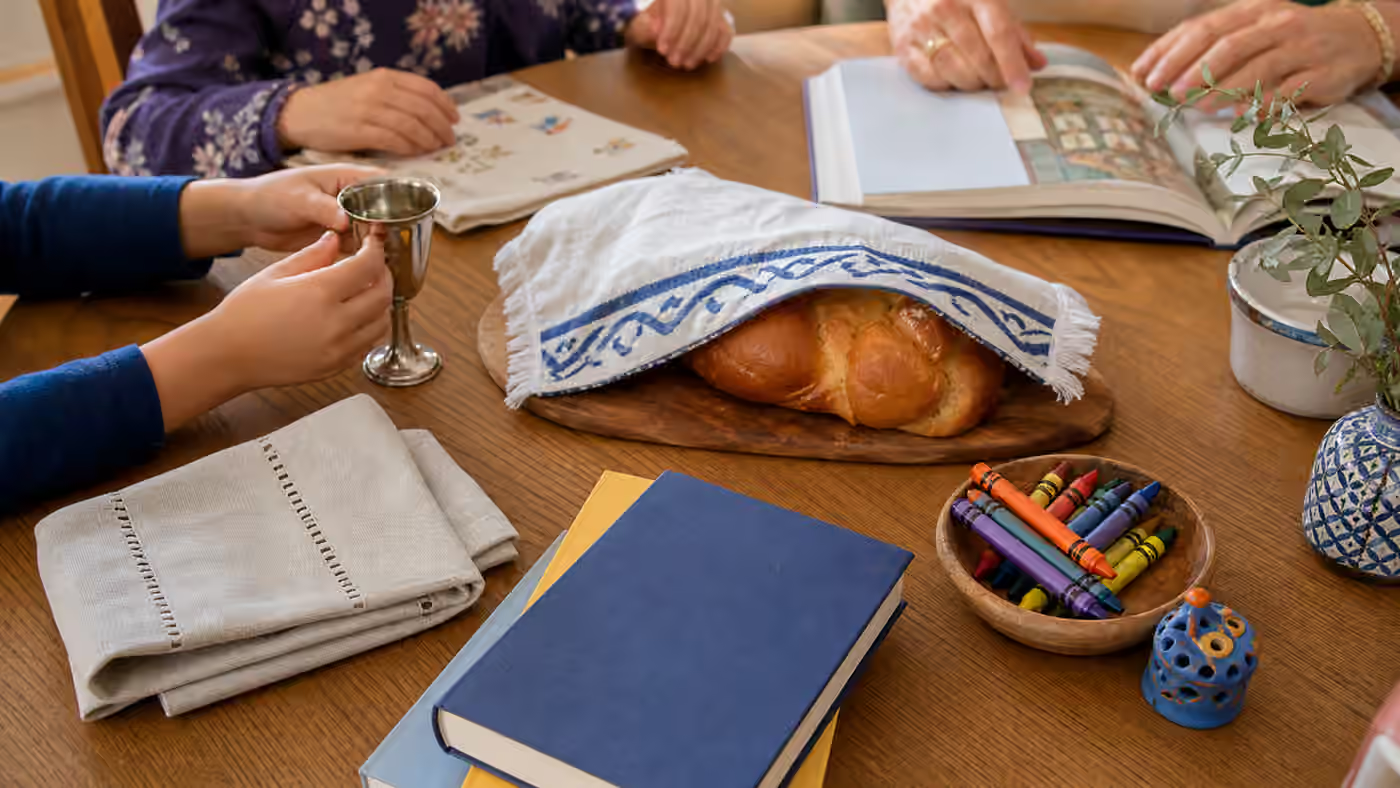
Children learn Jewish life through the table before they learn it through explanations.
They notice who lights candles, who stands for kiddush, who gets impatient before the bread, who sings loudly, who whispers the words, who cleans up, and who is allowed to ask a question. They learn that a book comes out on some nights, that a cup is lifted, that a sweet smell marks the end of Shabbat, that a holiday has foods no ordinary Tuesday has, and that adults sometimes become more serious when the same room has not changed much at all. For background, read Genesis 18:1–8 (hospitality) .
A Jewish home does not need to turn every child into a model participant. It needs to let children encounter practice honestly enough that the rituals become familiar, durable, and connected to people they trust. Jewish Home Rituals for Beginners describes home practice as small returns. Children often make those returns less tidy and more real.
Familiarity Comes Before Mastery
Adults sometimes want children to understand a ritual before they let them participate. Jewish life usually works better in the other order. A child may kiss the mezuzah before understanding the Shema in the parchment. A toddler may shout “amen” at the wrong time before learning what a blessing is. A school-age child may know the tune of Shalom Aleichem before knowing what the words mean. A teenager may roll their eyes and still remember exactly where the havdalah candle is kept.
This is not a reason to avoid teaching. It is a reason to respect embodied learning. Repeated gestures make room for later explanation. The Shema at Home is a good example. A bedtime Shema may begin as a melody, a parent sitting at the edge of the bed, or a few words said through sleepiness. Over time, it can become a language of trust, protection, belief, and memory. The meaning deepens because the practice returned.
Children also learn from seeing adults learn. A parent who reads a transliteration, asks a guest for help, checks a siddur, or admits, “I am still learning this blessing,” teaches something important. Jewish practice is not only inherited fluency. It can also be honest return.
The Table Should Have Real Jobs
Children often participate better when they have concrete roles that matter but do not carry the whole ritual. A child can place napkins, carry a covered challah, choose a song, pour grape juice with help, find the havdalah spices, pass out books, ask one seder question, or put coins in a tzedakah box before Shabbat. The role should be real enough to feel trusted and bounded enough not to collapse the evening if it goes sideways.
Your First Shabbat Table shows how the Friday night meal moves from preparation to candles, kiddush, bread, food, singing, rest, and conversation. Children can enter that movement at many points. The goal is not to make the table child-centered in a way that erases adult prayer. It is to make the table porous enough that children know the rituals belong to the household, not only to the most fluent adult.
This distinction matters. When a child is invited only to perform, the ritual can become a stage. When a child is invited to help, listen, taste, ask, and sometimes be bored, the ritual becomes family life. Boredom is not always failure. Some of the deepest memories form while a child is waiting for the adults to finish and slowly realizing that waiting is part of the shape.
Safety and Dignity Are Ritual Concerns
Children at a ritual table require practical care. Candles, wine cups, knives, hot soup, breakable kiddush cups, matches, glass havdalah sets, and crowded tables are not symbolic challenges. They are real objects. Shabbat Candle Lighting already frames safety as part of the candle’s dignity. That lesson becomes even more important with children nearby.
Safety does not mean making the table sterile. It means placing flames where they can be honored without being grabbed, giving children versions of participation that fit their bodies, and not confusing risk with authenticity. A child can watch candle lighting from a safe distance. A child can smell spices without holding the burning havdalah candle. A child can touch a covered challah more safely than a sharp knife.
Dignity matters too. Children should not be humiliated for not knowing, mocked for mispronouncing, or used as evidence that the family is doing Jewish life correctly. Some children are shy. Some are sensory-sensitive. Some are grieving, tired, hungry, disabled, anxious, or simply done for the day. A ritual table should have enough flexibility to include real children rather than imaginary ones.
Questions Are Part of the Inheritance
Jewish tables have long made room for questions, most famously at the seder. The Passover Seder for Beginners explains how questions teach memory through food, order, and participation. But children do not ask only on Passover. They ask why the bread is covered, why some relatives eat different foods, why a guest wears a kippah, why the holiday starts at night, why Hebrew sounds different in another synagogue, why someone is crying during Yizkor, or why the family gives tzedakah before lighting candles.
Adults do not need perfect answers to every question. They do need a posture that keeps questions from feeling like interruptions to Jewish life. A good answer can be brief, honest, and unfinished. “That is our family’s custom.” “I do not know; let’s ask.” “This reminds us of the Exodus.” “Some Jews do it differently.” “We are quiet now because the blessing is coming.” Such answers teach children that Jewish practice has reasons, histories, and differences without pretending every reason can fit into one sentence.
Minhag for Beginners is especially useful for families because children notice difference sharply. If another household lights more candles, eats different Passover foods, sings a different tune, or uses another pronunciation, a child may think someone is wrong. Adults can teach curiosity before superiority takes root.
Holidays Need Room for Children Without Becoming Only Children’s Events
Many Jewish holidays are introduced to children through crafts, costumes, sweets, songs, fruit, candles, or symbolic foods. These can be wonderful. A child may first love Hanukkah through light, Purim through noise, Tu BiShvat through fruit, Sukkot through branches and a temporary shelter, or Shavuot through late-night excitement they are too young to stay awake for. Sensory entry points matter.
Still, holidays become thin if adults let the children’s version replace the whole holiday. The Jewish Holiday Year gives the wider rhythm of memory, return, liberation, revelation, shelter, grief, joy, and responsibility. Children deserve access to that depth in forms they can receive. They do not need every adult complexity at once, but they can sense when a holiday has real weight.
The best family ritual often layers meaning. A child tastes apple and honey before hearing a long teaching about the new year. A teenager helps build the sukkah and later asks why fragility is a mitzvah. A child gives coins to tzedakah and later learns that giving is not only niceness. The table keeps returning, and the meaning grows with the person.
The Adults Are Also Being Formed
Including children changes adults. It forces simplification, patience, and honesty. It exposes which practices are sturdy and which exist only as ideals. It asks whether a household can recover from spilled juice without losing the blessing. It reveals whether adults treat Jewish life as a fragile display or a living practice strong enough to include noise.
This does not mean children should rule every moment. Adults may need prayer that is not constantly interrupted. Guests may need quiet. A household may need boundaries around behavior, bedtime, food, and safety. The point is not permissiveness. It is formation. Children are being formed by the table, and the table is being formed by their presence.
If you are beginning with children, start small and repeat. Choose one ritual that can return weekly or seasonally. Let children see where the objects live. Let them help before they lead. Explain enough, then let the practice do some teaching. Over years, the child-sized cup may become unnecessary, the questions may become harder, and the songs may become family memory. The table will not have been perfect. It will have been theirs.


