The idea started the way most small food businesses start: someone at a barbecue said, “You should sell this.”
I’d been making hot sauce for three years—fermented habanero, roasted jalapeño-garlic, a smoked chipotle that I aged in old bourbon jars. They were good. Friends requested jars for birthdays. Neighbors knocked on the door in August when the peppers came in. Every batch I made disappeared within a week.
“You should sell this” is a compliment, not a business plan. But it lodged in my brain, and six months later I was standing behind a folding table at the Saturday farmers market with forty-eight bottles, a stack of business cards, and the specific variety of terror that comes from asking strangers to pay money for something you made in your kitchen.
I sold fourteen bottles that first morning. One woman came back an hour later and bought three more.
This is the story of getting from “you should sell this” to a real market stall—and everything I wish I’d known before I started.
Phase one: Making the recipe reproducible
Home cooking is improvisational. You taste, adjust, add a little more of this, a little less of that. That’s fine for a batch you’re giving to friends. It’s a disaster for a product you need to reproduce identically every week.
The first real work was converting my intuitive recipes into precise, documented formulas.
Write everything down
I bought a kitchen scale (a $25 investment that changed everything) and started weighing every ingredient in grams. Not cups, not tablespoons—grams. Weight is consistent; volume is not. A cup of diced habaneros can vary by 30% depending on how finely you dice.
My habanero-mango sauce went from “a bunch of habaneros, some mango, vinegar to taste” to: “400g habanero, 300g mango, 200g white vinegar, 15g salt, 8g garlic, 4g cumin.” Every batch made with those weights tasted the same.
Test the recipe at market scale
Making four bottles at home is different from making forty. Scaling up a recipe by 10x doesn’t always work linearly—fermentation behaves differently in larger volumes, roasting twenty pounds of peppers takes different timing than roasting two pounds, and blending in a commercial blender produces different texture than a home Vitamix.
I did three “scale tests” before my first market day, making full-size batches in a licensed commercial kitchen (more on that below). Each test revealed small adjustments: the salt needed to increase slightly at scale (larger ferments proceed faster), the vinegar ratio needed a slight bump for shelf stability, and the blending time needed to decrease to avoid over-processing the texture.
For each sauce, document:
- Ingredient list with weights in grams
- Process steps with times and temperatures
- pH reading of the finished product (critical for safety—see below)
- Yield in bottles per batch
- Shelf life based on your pH and packaging
- Batch number and date for traceability
This document is your recipe bible. Without it, you can’t reproduce your product, train a helper, or demonstrate food safety compliance.
Phase two: Legal requirements
This is the unsexy part that most hot sauce dreamers skip, and it’s the part that can shut you down before you start.
Cottage food laws vs. commercial licensing
Most US states have “cottage food” laws that allow small producers to make and sell certain food products from their home kitchen without a commercial license. However, hot sauce often falls into a gray area:
Low-acid foods (pH above 4.6) require pressure canning and commercial processing. High-acid foods (pH below 4.6) are generally safer and easier to sell under cottage food laws. Most hot sauces, with sufficient vinegar, fall below pH 4.6—but you must verify this with a calibrated pH meter, not guesswork.
Some states require hot sauce to be made in a licensed commercial kitchen regardless of pH. Some allow home production up to a certain annual revenue limit ($25,000-$75,000 depending on the state). Research your specific state’s cottage food law before making any business decisions.
Getting your pH right
This is non-negotiable. A hot sauce with a pH above 4.6 can harbor Clostridium botulinum, which causes botulism. You need a calibrated pH meter (not pH strips, which aren’t accurate enough) and you need to test every batch.
Target pH for shelf-stable hot sauce: 3.0-3.5. Most vinegar-based sauces hit this range naturally. Fermented sauces typically reach 3.0-3.8 depending on fermentation duration. If your sauce is above 3.5, add more vinegar or citric acid until it’s safely in range.
Labels
Federal and state regulations require specific information on food labels:
- Product name
- Net weight or volume
- Ingredient list in descending order by weight
- Allergen declarations (if applicable)
- Your business name and address
- Nutrition facts (required at certain production levels; may be exempt for very small producers)
Many states require additional disclosures. The FDA’s Food Labeling Guide is the definitive reference.
Insurance
Product liability insurance for a small food business costs $300-$800/year and is often required by farmers markets and retail stores. It protects you if someone claims they got sick from your product. This isn’t optional—it’s a basic cost of doing food business.
Phase three: Branding on a real budget
I had no design budget. What I had was a printer, some kraft paper labels, and the understanding that hot sauce branding needs to accomplish exactly one thing: make someone stop walking and look.
The name
Your sauce name needs to be memorable, searchable, and not already taken. I spent an evening with a notebook:
- Too generic: “Dave’s Hot Sauce” (there are hundreds)
- Too clever: Names that require explanation don’t work on a crowded market table
- Just right: Something that hints at the flavor, the heat level, or your story in two or three words
Check the US Patent and Trademark Office (USPTO) database before committing to a name. Trademark conflicts can force expensive rebrands later.
The label
For my first market, I used kraft paper labels printed on a color inkjet printer. They looked handmade—because they were—and that was fine for a farmers market. Handmade labels signal “small-batch” and “artisan” in a market setting.
What the labels needed:
- Clear sauce name and heat level indicator (people want to know what they’re buying and how hot it is)
- Key flavor descriptors (e.g., “Fermented Habanero + Mango + Cumin”)
- Required regulatory information (ingredients, weight, address)
What they didn’t need: expensive graphic design. That comes later, if the business grows.
Phase four: The first market day
I applied to my local Saturday farmers market in January. The application asked for my cottage food registration (or commercial kitchen license), product liability insurance proof, and a description of my products. I was accepted for a seasonal slot: April through October, $35 per Saturday.
What I brought
- 48 bottles: 16 of each of my three sauces
- A folding table and tablecloth (a clean, solid-color cloth looks more professional than a bare table)
- Tasting station: A bowl of tortilla chips, small tasting cups, and toothpicks
- Price signs: Clear, readable from 10 feet away ($8 per bottle, 2 for $14)
- A card reader: Square reader on my phone for card payments (most sales are cards now)
- Business cards with Instagram handle
- A small chalkboard sign with the sauce names and heat levels
What I learned that first day
Tastings sell sauce. People who tasted bought 60% of the time. People who only looked at the bottles bought 10% of the time. Offering a taste with a smile and a brief description—“This is our fermented habanero with mango, medium-hot with a tropical finish”—was the single most effective sales tool.
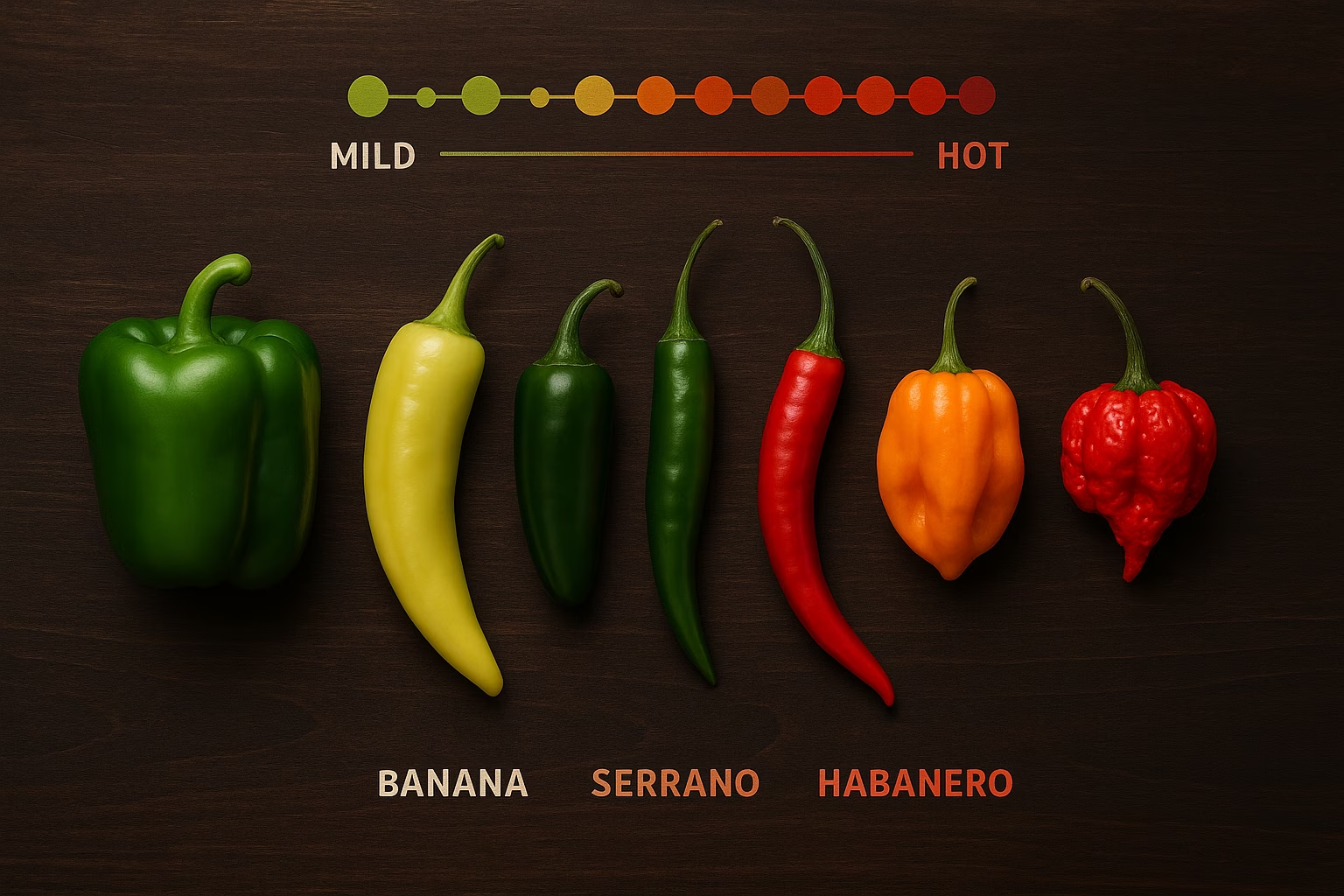
Heat level matters to everyone. The first question every customer asked: “How hot is it?” I learned to categorize clearly: mild, medium, hot, and very hot. No ambiguity. A customer who buys a “medium” sauce and finds it scorching won’t come back.
Repeat customers are the business. Of the fourteen bottles I sold that first Saturday, four went to people who came back the next week. By month three, I had about twenty regular customers who showed up specifically for my table. Those twenty people bought more sauce over the season than all the walk-by impulse purchases combined.
Simple lineup beats complex. I started with three sauces. That was perfect. Customers could taste all three, compare, and choose. Later, when I expanded to five sauces, the decision fatigue was visible—people took longer and sometimes bought nothing because they couldn’t decide. Three to four sauces is the sweet spot for a market table.
The money: what a hot sauce stand actually makes
Transparency on this, because the internet is full of unrealistic “I make $10,000/month selling hot sauce” stories:
Cost per bottle (approximate):
- Ingredients (peppers, vinegar, spices): $1.50-$2.50
- Bottle and cap: $0.80-$1.20
- Label: $0.15-$0.50
- Commercial kitchen rental (prorated): $0.50-$1.00
- Total cost per bottle: $3.00-$5.00
Revenue per bottle: $8 retail, $5-6 wholesale.
A good Saturday at the market: 25-40 bottles sold = $200-$320 revenue, minus $35 market fee and ~$100-$150 in COGS = $50-$135 profit for 3-4 hours of selling (plus 8-12 hours of production time during the week).
Monthly revenue (market-only, first year): $800-$1,500/month in sales during market season. This is a side income, not a salary.
The path to meaningful income requires moving beyond farmers markets into wholesale (restaurants, specialty grocery stores), online sales, and eventually regional distribution. But the farmers market is where you test the product, build the brand, and find your first loyal customers.
What I wish I’d known
Start with three sauces, not ten. A focused lineup is easier to produce, easier to sell, and easier to get right.
Get a good pH meter immediately. Not pH strips. A proper meter with calibration solutions. Food safety isn’t a suggestion—it’s a legal and moral obligation.
Track every expense. From the first packet of seeds to every market fee. You need this for taxes, and you need it to know if you’re actually making money or subsidizing a hobby.
Join the hot sauce maker community. Online forums, Reddit’s r/hotsaucerecipes, and local food business groups are invaluable for sharing knowledge about suppliers, regulations, and market strategies.
Don’t quit your day job yet. The transition from hobby to business to livelihood takes years for most food entrepreneurs. Let the market validate the business before you bet your income on it.
The farmers market isn’t the destination. It’s the laboratory. Every Saturday is a focus group, a taste test, and a business class combined. Pay attention to what sells, what questions people ask, and what brings them back.
And on the mornings when the weather is bad and the crowd is thin and you sell eight bottles instead of thirty—remember that one woman who came back an hour later for three more. She’s the reason you’re there.
Next steps
- Read Making Hot Sauce for the foundational production techniques
- Explore Storage & Safety for shelf stability and food safety requirements
- See Fermentation Flavor Design for developing complex fermented sauces
- Try Sauce Pairing to help customers understand how to use your sauces
- Check Growing Your Own Peppers for controlling your ingredient supply