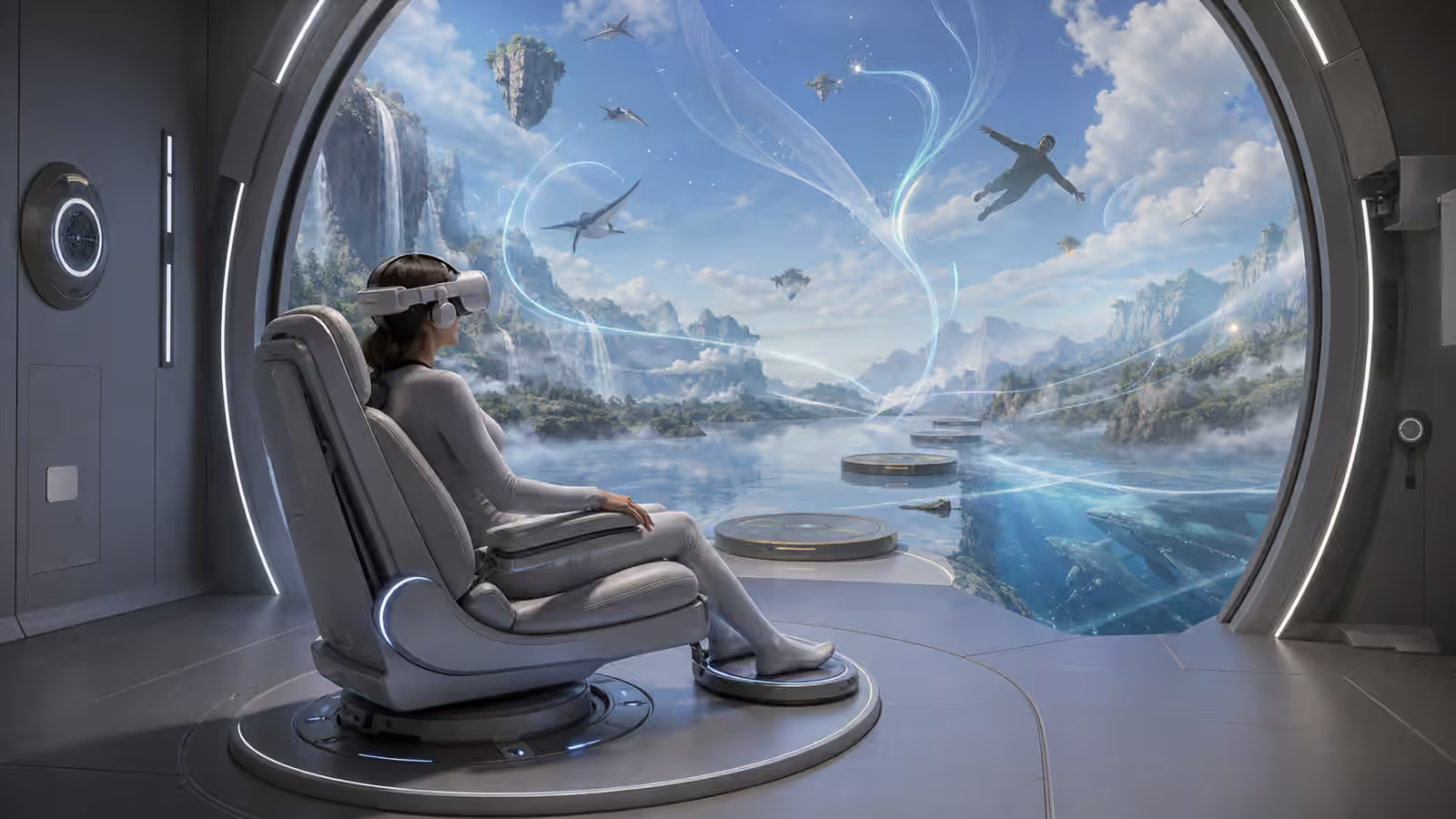
Full dive VR is often described as a hardware problem, but every believable world would also be an authored place. Someone has to decide how the floor feels, how close a stranger can stand, how a door announces itself, whether a training mistake produces a sharp cue or a soft correction, and what happens when the user wants to stop before the scene is finished. Those are not decorations around the technology. They are the experience.
How Full Dive VR Might Work explains the loop between input, output, and the body. World authoring lives inside that loop. A creator is not only arranging images and sounds. They are shaping a temporary relationship between the user’s intentions, senses, avatar body, social context, and return path. That makes full dive authoring closer to architecture, theater, choreography, accessibility design, and safety engineering than to ordinary level design alone.
The best authoring tools would probably make that responsibility visible. A scene builder should not only ask what the user sees. It should ask what the scene is allowed to touch, how intense each sense may become, what happens when timing confidence falls, and how the world explains itself before it asks for trust.
Authorship Becomes Sensory Authority
In ordinary media, creators can startle, persuade, delight, confuse, or bore an audience. Full dive would add a more intimate layer. A scene might simulate weight, pressure, heat, acceleration, proximity, texture, body transformation, or another person’s presence. Even if those signals are carefully limited, they are still closer to the user than a screen.
That closeness changes what authorial freedom means. A horror designer may want sudden contact. A training designer may want a mistake to feel consequential. A social world designer may want hugs, crowded markets, dance floors, and noisy celebrations. None of those ideas is automatically wrong. The problem begins when a world treats sensory access as a blank canvas owned by the creator.
Permission Boundaries in Full Dive VR is the companion idea here. A world can be vivid only inside the permissions the user understands and accepts. The author should know which cues are available, which require warning, which need a fresh prompt, and which are unavailable for this user in this context. That constraint is not a nuisance around art. It is part of the medium.
Good authoring will therefore include restraint as a craft skill. A scene may become more convincing because it chooses one precise pressure cue instead of ten vague ones. It may feel more respectful because it lets the user step toward intensity instead of throwing intensity at them. It may become more memorable because the body trusts the room enough to pay attention.
A Scene Needs a Sensory Budget
Full dive creators will need to think in budgets rather than spectacle. A scene has only so much attention, motion tolerance, tactile intensity, emotional load, and social demand to spend before the user begins to work harder than the experience deserves. A crowded street with spatial audio, shifting smells, warm air, shoulder contact, visual motion, synthetic vendors, and friend messages may be technically impressive. It may also be exhausting.
The budget is not only about comfort. It is about meaning. If every object buzzes, every surface has texture, every character leans in, and every sound asks to be noticed, the world loses hierarchy. The user cannot tell what matters. A quiet workshop with one believable tool in the hand may teach more about embodiment than a city that treats every sense as a fireworks display.
Contact, Weight, and Texture in Full Dive VR shows how tactile cues can become language. Authoring should treat that language with grammar. A railing can have a stable pressure cue because it supports orientation. A fragile glass can have a light, careful contact because it asks for attention. A warning surface can feel distinct without pretending to hurt. A social touch can require a different permission path from a tool touch. The author chooses where sensation earns its place.
The same budget applies to motion and timing. Latency, Drift, and Trust in Full Dive VR makes clear that a delayed or drifting cue can damage confidence. Authoring tools should let creators design fallback states. If a scene depends on perfect timing for a leap, embrace, collision, or balance trick, it should also know what happens when the system is less certain. A less dramatic substitute is often better than a vivid mistake.
The Environment Should Announce Its Terms
A full dive world should tell the body what kind of place it is before demanding action. That does not mean filling the air with instructions. It means using space, pacing, and sensory tone so the user can read the room. A calm calibration garden, a training shop, a public square, a private home, and a competitive arena should not feel like the same interface with different skins.
The opening moments matter. If the scene will involve physical exertion, social visibility, sensory recording, haptic contact, unusual movement, or emotional intensity, the environment should make those terms legible. A training room can begin with familiar tools and stable footing. A social room can reveal who is present before voices arrive close to the ear. A memory archive can keep distance and quiet until the user chooses an object. A movement scene can test balance before it offers speed.
This is where authoring meets Comfort and Reorientation in Full Dive VR . The way a world begins should already contain the way it can end. The user should feel that the room has exits, pauses, softer paths, and ordinary limits. A world that hides its terms until after the user is emotionally invested is not more immersive. It is less honest.
Interactions Need Rehearsal Space
Many full dive interactions would benefit from rehearsal. Before a world asks the user to climb, perform surgery, enter a crowded classroom, handle a heavy tool, or inhabit a nonstandard body, it should give them a low-pressure place to understand the rule. That rehearsal space can be built into the fiction without feeling like a tutorial. A kitchen lets the user test heat cues near a kettle before cooking. A dock lets them feel balance before boarding a boat. A quiet anteroom lets them practice voice range before joining a public conversation.
Full Dive VR for Education and Training makes this especially important for learning. A simulation can feel authoritative because it surrounds the learner. If the authored world hides uncertainty, simplifies a mechanism too aggressively, or makes failure feel morally loaded, the learner may absorb the wrong lesson. Rehearsal lets the system separate practice from judgment. It gives the user a place to make small mistakes before the scene gives those mistakes social or narrative weight.
Rehearsal also protects creativity. Users may be more willing to try unusual bodies, tools, performances, and social roles when they know the world will not punish confusion immediately. The author can still create challenge. The difference is that challenge arrives after orientation, not before.
Multiplayer Scenes Need Choreography
Shared full dive worlds will not be safe or pleasant merely because every participant has an avatar. People need spacing, entrances, exits, lines of sight, quiet corners, and ways to refuse contact without making a public drama. The author of a shared world is designing social choreography as much as scenery.
Shared Worlds in Full Dive VR covers the consent layer, but world authoring decides how often that layer is stressed. A narrow doorway in a busy public room may create accidental closeness. A voice channel that carries whispers too far may create false intimacy. A stage that puts newcomers under bright attention may make leaving feel embarrassing. A dance floor with no clear edge may make refusal harder than participation.
Better worlds give social behavior physical form. A private conversation area can soften outside sound. A public square can make approach visible before contact is possible. A classroom can distinguish instructor authority from peer proximity. A memorial space can keep visitors from crowding the person who owns the memory. These choices do not remove conflict, but they reduce the number of conflicts users must solve with raw nerve and hurried menu choices.
Synthetic Characters Are Authored Environments Too
Synthetic people will often be treated as characters, but in full dive they also become part of the environment. A synthetic guide can control pacing, remember preferences, suggest exits, moderate a room, adjust light, summon objects, and explain what changed while the user was away. The character is not only speaking lines. It is exercising authority over the world.
Synthetic People in Full Dive VR argues for disclosure and limits. Authoring adds another responsibility: the character’s helpfulness should not conceal what power it has. A guide that can change haptic intensity should not behave like a casual companion while quietly editing the user’s sensory field. A tutor that remembers hesitation should not use that memory to push harder without consent. A caretaker in a persistent world should explain changes instead of acting like the room naturally rearranged itself.
Good synthetic characters may need less charm and more manners. They can pause before close approach, state uncertainty, step back when the user is quiet, and hand control to the user instead of making every silence an opportunity. In full dive, warmth without boundaries can become pressure.
Good Worlds Leave Room to Return
Every authored full dive scene should include its own return logic. The return is not only a system feature placed after the credits. It is a design rhythm that begins before the strongest moment. A world that increases sensory intensity should know how to lower it. A world that changes the body should know how to restore it. A world that creates social obligation should know how to let the user leave without humiliation.
Persistent worlds make this harder because they continue after departure. Persistent Worlds in Full Dive VR asks what remains when nobody is inside. Authors should think about that from the beginning. Does a room wait calmly, decay, notify friends, archive changes, or keep a synthetic caretaker active? Does the user’s unfinished work become a hook, a reminder, or a private saved state? A beautiful world can become manipulative if every object is designed to pull the user back.
The strongest full dive authoring may look modest from the outside. It will not always chase maximum realism. It will build scenes with readable terms, restrained sensory budgets, rehearsal spaces, social architecture, honest synthetic characters, and exits that have dignity. That does not make the world less magical. It makes the magic fit for a person who has to come back with a body, a memory, and the right to decide what the next visit means.