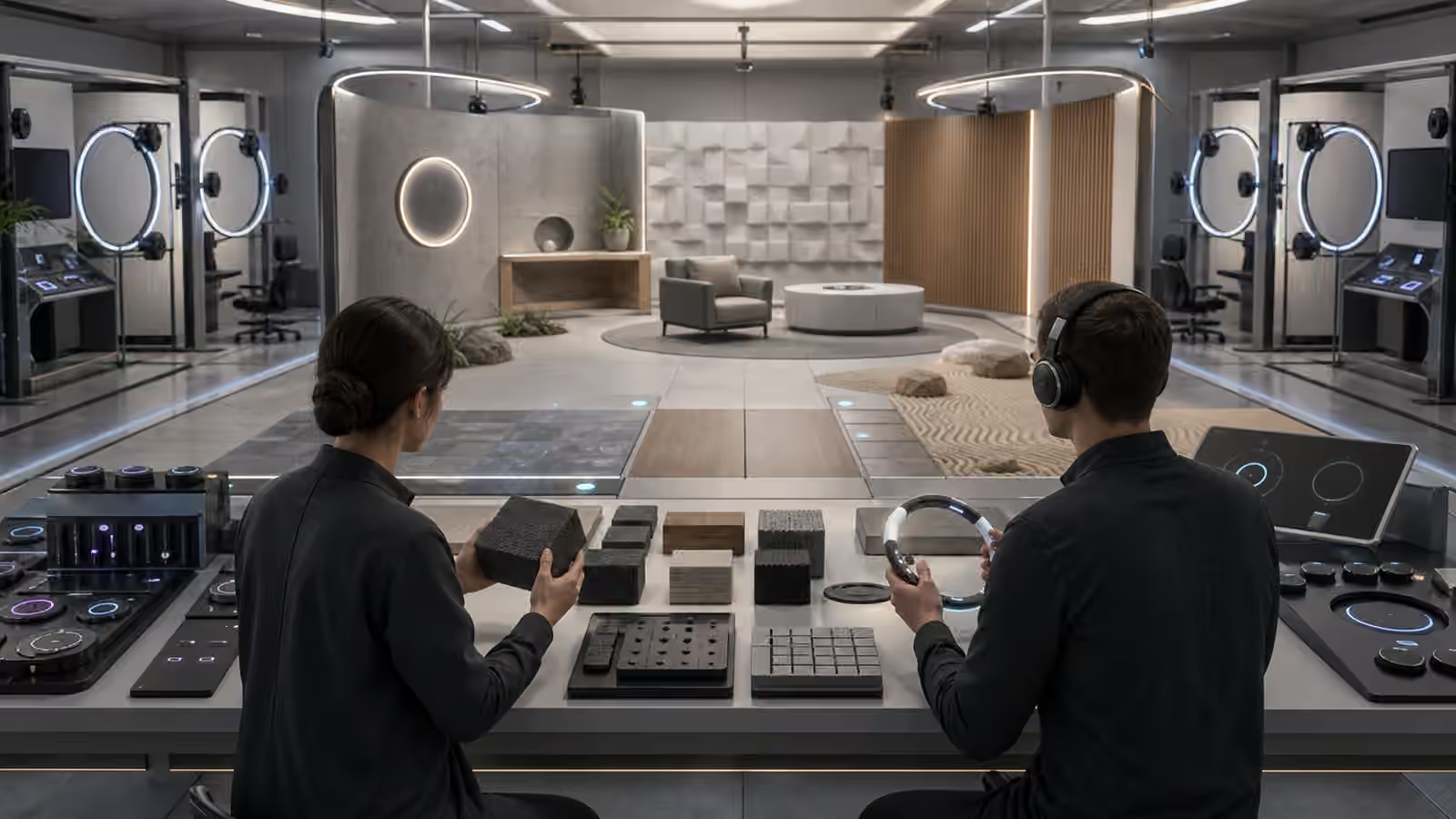
The visual side of full dive VR is easy to underestimate because ordinary VR already looks impressive. A headset can fill the eyes with a city, a forest, a cockpit, or a classroom. Sharper displays and wider fields of view make the fantasy feel closer. Yet full dive VR would not only need better pictures. It would need a better relationship with attention.
Vision is not a camera feed poured into the head. People look, ignore, anticipate, blink, search, and rest. They use peripheral motion to understand a room before they consciously inspect it. They let backgrounds fade while they listen to a person. They notice a bright edge because it might matter, then forget it when it does not. A believable immersive world has to respect those habits instead of treating the eye as an always-open display port.
Latency, Drift, and Trust in Full Dive VR explains why timing errors make a world feel unreliable. Visual overload creates a related problem. If the world asks the eyes to work too hard for too long, trust can fade even when nothing technically fails. The user may not say “the contrast budget is wrong.” They may say the room feels loud, the distance feels false, or they need to leave.
The Center Is Not the Whole View
A common mistake in speculative VR is to imagine visual design as a contest for central focus. The object in front of the user gets the highest detail, the most motion, the clearest light, and the strongest contrast. That matters, but it is not enough. Peripheral vision carries safety, balance, mood, and spatial confidence. A person walking through a virtual corridor may not stare at the walls, but those walls still tell the body whether the space is stable.
Full dive systems would need to handle peripheral cues carefully. Too little peripheral information can make the world feel like a tunnel. Too much motion at the edges can make the body feel watched by every surface. A distant flicker, a shifting pattern, or a high-contrast object outside focus can keep pulling attention away from the task. In a headset this may be annoying. In a stronger immersive frame it could become exhausting.
The design lesson is restraint. A convincing full dive room does not need every surface to perform. Backgrounds can be present without competing. Peripheral motion can support orientation without demanding reaction. The quiet parts of a scene may do more for comfort than the spectacular parts do for awe.
Brightness Is a Bodily Cue
Brightness is often discussed as a display problem, but in full dive VR it becomes a body problem. A scene can look beautiful and still be tiring if highlights keep striking the eyes, if dark areas require constant adaptation, or if transitions from bright to dim spaces happen without preparation. In the ordinary world, people squint, shade their eyes, turn away, wait for adjustment, or choose a different seat. An immersive system should not take those freedoms away.
This connects to Comfort and Reorientation in Full Dive VR . Leaving a world is harder when the last visual state was harsh. A user who exits from a bright white chamber, a flashing social event, or a low-contrast fog scene may need more time to settle than a user who exits from a visually calm room. The final image can linger in the body.
Good visual design would let intensity taper. It would use transition rooms, dimming, stable horizons, and low-demand surfaces before asking for complex action. It would treat visual rest as part of the session, not as a failure to entertain.
Detail Should Follow Meaning
Full dive VR will tempt creators to make everything detailed because detail sells presence. A tabletop could show scratches, dust, woven fibers, tiny reflections, and shifting shadows. A street could carry thousands of signs, faces, windows, leaves, vehicles, and light sources. A kitchen could contain every crumb. At some point the world becomes less believable because the user cannot tell what matters.
The ordinary world solves this through attention. People do not process every detail equally. They use context, habit, and expectation to decide where to look. A full dive world can help by making meaningful detail readable and incidental detail quiet. If every cup, doorway, avatar, tool, and background object has the same visual urgency, the user has to spend energy sorting the scene.
World Authoring and Sensory Scenes in Full Dive VR discusses creator responsibility across the senses. Visual authorship belongs there too. The creator is not only choosing what appears. They are choosing what the user’s nervous system is asked to monitor.
Attention Can Be Manipulated Too Easily
The same techniques that guide comfort can guide persuasion. A full dive world could make a product impossible to ignore by placing it at the edge of safety cues. It could make a synthetic person feel trustworthy through lighting, gaze direction, and spatial framing. It could make an exit feel visually unimportant while a paid path glows warmly. These are not hypothetical design powers. They are extensions of familiar visual persuasion into a stronger medium.
That is why Advertising and Persuasion Boundaries in Full Dive VR belongs beside visual attention. A world that controls light, distance, gaze, contrast, and peripheral motion can shape where a person looks before they have time to decide. The answer is not to ban beauty or guidance. The answer is to make commercial and safety priorities visibly different. An exit should not compete with an ad. A consent prompt should not be visually weaker than a reward.
Visual trust depends on the user believing that the scene is not constantly exploiting their reflexes.
Fatigue Is Feedback
Visual fatigue should be treated as information. If many users leave a scene rubbing their eyes, misjudging distance, asking for lower brightness, or failing to notice important cues, the problem may be scene design rather than user weakness. Full dive VR should not measure success only by how long people stay. It should notice when staying requires silent strain.
Fatigue can also be personal. Some users tolerate motion and contrast well. Others need lower stimulation, larger visual anchors, slower transitions, or simpler scenes. Accessibility in Full Dive VR argues that different bodies should not be handled as exceptions. Visual settings should follow the same principle. The system can offer calmer peripheral motion, reduced flash, softer contrast, stable horizon cues, and simpler object density without making the user feel like they chose a lesser world.
The best visual systems may learn to ask less. A scene can become calmer when the user is tired. It can preserve task clarity without filling every empty surface. It can give the eyes somewhere safe to rest.
Seeing Less Can Make the World More Real
Full dive VR is often imagined as maximum sensation. More detail, more brightness, more field of view, more motion, more realism. The wiser path may be more selective. A world that knows what to leave quiet can feel more inhabitable than one that shouts from every surface.
The question is not only what the user can see. It is what the user can stop watching. A believable room lets the background become background. A safe shared space makes exits and boundaries visually plain. A good training scene directs attention without exhausting it. A humane social world lets a face matter without making every gesture into a signal.
Visual immersion is not the art of filling the eyes. It is the art of giving attention a place to live.