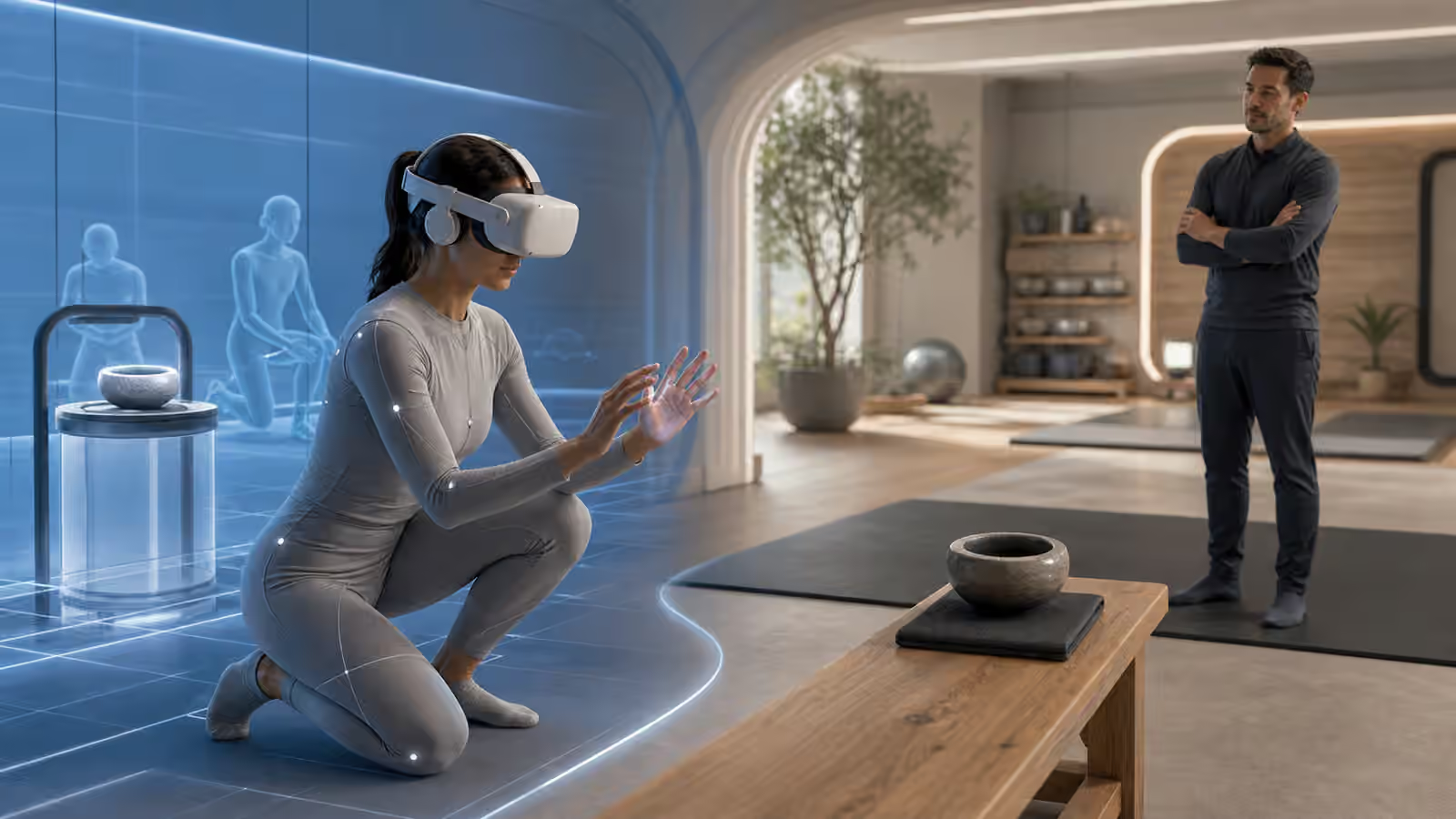
Full dive VR would make training feel unusually persuasive. A trainee could practice inside a machine room, cockpit, kitchen, negotiation room, disaster drill, language environment, care scenario, or dangerous workplace without the ordinary cost of staging the real setting. The body could rehearse timing, posture, attention, tool use, and social response. That promise is valuable. It also creates a temptation to treat immersive completion as proof of competence before anyone has asked what was actually learned.
Full Dive VR for Education and Training draws the first boundary: practice should not pretend to be mastery. Assessment makes that boundary operational. If a platform issues badges, certificates, workplace records, school credit, or hiring signals, those records should describe the conditions of practice clearly enough that nobody confuses a vivid simulation with an unlimited real-world qualification.
Practice Is Not Proof by Itself
Immersive practice can teach. It can also flatter. A world can make a trainee feel skillful by smoothing timing, simplifying tools, reducing social difficulty, guiding attention, or preventing consequences from becoming too messy. Those supports may be appropriate for learning. They become misleading when the final record hides them.
Embodied Skill Transfer in Full Dive VR explains why transfer back to ordinary settings is the central question. A trainee who performs well with perfect virtual lighting, simplified weight, patient synthetic partners, and reversible mistakes may still need supervised real-world practice. The credential should not erase the difference. It should say what conditions were present and what evidence was observed.
This does not make full dive training weak. It makes it honest. A flight simulator, lab rehearsal, language immersion scene, or emergency drill can be meaningful without claiming more than it measured. The point of a credential is not to advertise the deepest illusion. It is to tell the next person what the learner can reasonably be trusted to attempt.
A Good Record Describes Conditions
Useful assessment records are specific. They do not simply say that a user completed a module. They explain the scenario type, assistance level, sensory settings, allowed retries, time pressure, instructor presence, safety overrides, and whether the trainee performed with prompts or independently. The record can stay concise, but it should not compress every condition into a glossy completion mark.
Session Logs and Incident Response in Full Dive VR matters because training records sit between evidence and privacy. A program may need proof that a trainee completed a procedure, responded to a fault, communicated clearly, or respected a boundary. It usually does not need every raw body trace, private hesitation, facial reaction, or emotional inference.
The best record keeps the evidence close to the claim. If the claim is tool sequence, record the tool sequence. If the claim is communication under pressure, record the relevant communication markers. If the claim is safe exit behavior, record that behavior. Do not collect a full intimate archive merely because the system can.
Assessments Should Reveal Assistance
Full dive systems will use assistance constantly. A synthetic guide may cue the next step. Haptics may steer a hand. The world may slow time, highlight relevant objects, reduce noise, translate speech, or dampen fear cues. These features can make learning more humane and accessible. They can also blur assessment.
An assessment should make assistance visible. A trainee may deserve credit for completing a first aided rehearsal and different credit for completing an independent scenario. A user with accessibility settings should not be punished for using them, but the assessment should still describe what the setting changed. The goal is not to rank bodies. It is to keep the meaning of the record clear.
Accessibility in Full Dive VR belongs here because equal training access may require different sensory channels, pacing, or input methods. A fair credential does not pretend everyone used the same body. It explains which competencies were demonstrated in a way that respects the learner and the task.
Instructors Need Boundaries Too
Teachers, trainers, supervisors, and evaluators hold power in ordinary settings. Full dive can intensify that power because the instructor may control the room, the scenario, the pacing, the replay, or the trainee’s embodied role. Facilitators and Operator Roles in Full Dive VR offers a broader model of narrow authority. Training assessment needs the same restraint.
A trainee should know when a session is practice, when it is assessment, who can see the record, and what happens if they stop. An instructor should not be able to turn a practice run into a scored event after the fact because the data looked interesting. A workplace should not use a voluntary learning scene as hidden performance monitoring. A school should not preserve embarrassing early attempts longer than the learning purpose requires.
Clear roles protect instructors as well. If the rules are explicit, an evaluator can focus on the task instead of improvising what counts. Disputes become easier to resolve because the session had declared terms before the trainee entered.
Failure Should Support Learning
Training systems often talk about safe failure. Full dive should take that phrase seriously. A failed scenario can be valuable when the user understands what happened, can recover, and can try again under better conditions. It becomes harmful when failure is preserved as a humiliating body record or used as a permanent mark outside its proper context.
Debriefing and Session Notes After Full Dive VR is important because the conversation after a training run may do more teaching than the run itself. A good debrief separates technical mistakes, sensory overload, unclear instructions, equipment faults, and genuine knowledge gaps. It does not treat every hesitation as character evidence.
The record should also distinguish between a failed performance and a failed environment. If latency drift confused a tool, if a haptic cue arrived late, if a synthetic partner behaved inconsistently, or if the user had an unaddressed accessibility need, the assessment should mark the scenario as compromised. A platform that lets bad simulation become bad credentialing will lose trust quickly.
Credentials Can Create Pressure
The more valuable full dive credentials become, the more pressure users may feel to tolerate uncomfortable sessions. An employee may stay inside because a certification is required. A student may hide discomfort because classmates are advancing. A trainee may accept strong haptics, public replays, or intense scenarios because refusal looks like weakness.
Workplace Boundaries in Full Dive VR is a necessary companion. Full dive assessment should not become a back door for constant monitoring or coercive training. Refusal, accommodation, appeal, and alternative assessment paths should exist where the stakes are real. The platform should make stopping a session procedurally safe, not merely technically possible.
An honest credential can still matter. It can say that a person practiced a scenario, demonstrated a skill under declared conditions, and understands certain risks. It can help learners prepare and organizations trust preparation. But it should remain humble. Immersion can make practice vivid; it cannot make proof unlimited. The strongest training record will be the one that tells the truth about what the world measured, what it did not measure, and what should still be verified outside the simulation.