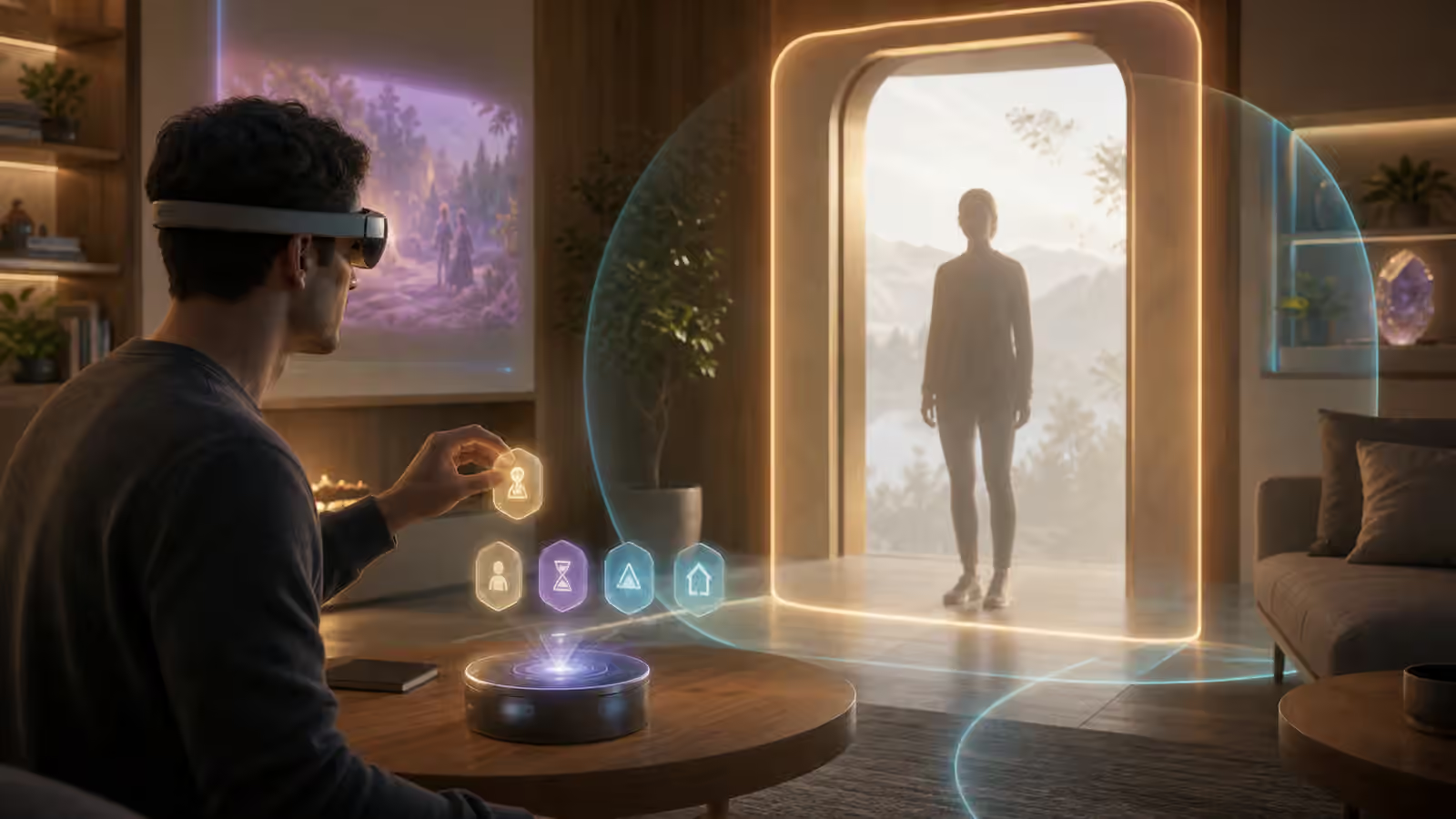
The moment full dive VR becomes interesting, someone will want to watch. A teacher may observe a student. A coach may review a practice session. Friends may want to see a shared adventure from the outside. A performer may invite an audience. A platform may offer highlights. A support team may need to inspect a problem. Spectatorship will not be an edge case. It will be one of the first pressures placed on immersive worlds.
Ordinary streaming already changes behavior. People speak differently when a camera is on. They play for chat, manage embarrassment, and turn private mistakes into content. Full dive VR would raise the stakes because the session may include body signals, emotional timing, sensory thresholds, personal space, avatar identity, and reentry. A camera aimed at the screen is one thing. An audience peering into an embodied world is another.
Privacy and Consent in Full Dive VR explains why body data deserves stricter treatment than ordinary interaction data. Spectatorship is where that principle becomes visible. The viewer may not receive raw sensor files, but they can still see hesitation, flinching, social choices, voice changes, movement style, and what the world asks of the user. A spectator layer should never be treated as harmless just because it looks like video.
Live Viewing Changes the Session
A live audience changes the meaning of presence. If the user knows they are being watched, the world becomes partly a stage. That can be welcome. Performance, teaching, competitive play, guided tours, and collaborative creation all benefit from spectators. The problem begins when observation becomes implicit, hard to understand, or socially difficult to refuse.
A full dive session should make live viewing obvious to the person inside. The signal should be available inside the world, not only on an outside dashboard. The user should know who is watching, what they can see, what they can hear, whether they can speak into the session, whether they can record, and whether they can see the user’s physical body. The answer may change over time. A coach might observe a drill but not recovery. A friend might watch a scenic exploration but not a private conversation. A parent might have emergency status visibility without live scene access.
Permission Boundaries in Full Dive VR offers the central rule: consent should be specific enough to matter. “Allow spectators” is too vague for a medium that can separate world view, avatar view, first-person sensation, body telemetry, audio, haptics, emotional inference, replay, and physical room status. Each layer deserves its own caution.
Observation Is Not Always Surveillance
There are good reasons to observe. In Full Dive VR for Education and Training , instructors may need to see whether practice transfers to real skill. In workplace simulations, supervisors may need to confirm that a safety procedure was learned. In accessibility testing, designers may need feedback from participants who navigate a world differently. In incident response, support staff may need a bounded view of what failed.
The difference between observation and surveillance is purpose, scope, and power. A coach watching hand position during a practice task does not need access to private emotional responses. A teacher assessing a group exercise does not need to preserve every sensory setting. A support engineer diagnosing a haptic delay does not need a user’s social conversation. The observer should see what the role requires and no more.
Workplace Boundaries in Full Dive VR is especially relevant because employment can make consent feel thin. A worker may technically agree to observation while knowing that refusal has consequences. The system should not hide behind a checkbox. It should make observation limited, documented, and proportionate to the task. The stronger the power relationship, the more careful the spectator layer needs to be.
The Audience Should Not Own the Replay
Live viewing often becomes recording. A funny moment, a frightening moment, a beautiful moment, a mistake, a confession, a near incident, a strange avatar gesture, a training failure, or a touching reunion may all look clip-worthy from the outside. The user inside may experience the same moment as private, confusing, exhausting, or unfinished.
Memory Rights in Full Dive VR argues that immersive records can behave like memory objects, not ordinary media files. A spectator clip is part of that problem. It may flatten a lived session into a shareable angle. It may remove the consent context. It may preserve a body state the user did not intend to make public. It may show a synthetic person, another participant, or a shared room whose owners did not agree to distribution.
Recording rights should not automatically follow viewing rights. A person invited to observe should not necessarily be able to save, clip, remix, annotate, or stream. A world might allow a delayed, privacy-filtered replay for learning while blocking public clips. It might let the user mark moments as private after the session before any highlight is released. It might preserve technical incident data while preventing social spectators from turning an exit problem into entertainment.
Session Logs and Incident Response in Full Dive VR shows why replay can be useful and risky. Spectator systems should borrow that restraint. Evidence, teaching, memory, and content are not the same thing.
Privacy Filters Need Honest Names
Platforms will be tempted to solve audience privacy with filters. Blur the physical body. Use an avatar instead of the user’s face. Hide the haptic layer. Remove private audio. Replace sensitive objects. Delay the stream. These can help, but they should not be oversold.
A filtered stream can still reveal a lot. Movement can identify a person. Silence can say something. A room choice can imply a relationship. A repeated hesitation can become a profile. A synthetic companion’s behavior can reveal what it remembers. A public audience may not see raw body telemetry, yet still infer vulnerability from timing, posture, and context.
Honest privacy design should say what the filter hides and what it cannot hide. It should avoid theatrical promises of anonymity when the world remains socially recognizable. It should let users preview the spectator view before opening it. It should treat changes in avatar, voice, scene, and body display as meaningful consent choices, not cosmetic toggles.
Identity Continuity and Impersonation in Full Dive VR belongs here because spectatorship can detach action from identity. A performer may want a stage body. A teacher may need role verification. A private user may want friends to see only a symbolic representation. A bad actor may use spectator mode to watch without being socially present. The system has to make those differences understandable.
Performance Pressure Can Become Design Pressure
Audiences pull worlds toward spectacle. If a platform rewards watched sessions, users may choose higher intensity, sharper emotion, riskier scenes, more dramatic avatars, or longer durations because those play better from the outside. Advertising and Persuasion Boundaries in Full Dive VR warns that immersive persuasion can hide in pacing and environment. Audience metrics can do the same thing.
This does not mean full dive performances are wrong. Theatre, sport, art, teaching, guided travel, and collaborative building could become powerful forms. The important boundary is that performance should be chosen. A world should not gradually turn private presence into public content by making sharing the default, highlighting social approval, or making the user feel rude for closing the audience window.
Time and Duration in Full Dive VR matters because an audience can make leaving harder. A streamer may stay longer because people are watching. A student may continue because the teacher is present. A user may accept a replay review because refusal feels suspicious. Good spectator design should make exit, pause, and privacy normal even when others are waiting.
Reentry Is Not for the Audience
The audience may want a reaction. After a powerful session, viewers may ask what it felt like, why the user paused, whether a moment was real, or what they saw during a private transition. The user may not be ready. Social Reentry After Full Dive VR argues that coming back to people needs restraint. Spectators need that lesson first.
A spectator system should separate the end of the stream from the user’s reentry. The viewing layer can close before recovery begins. The user can return to a private room. Any post-session conversation can be opt-in, delayed, and limited. The physical body should not become a reaction shot unless the user clearly chose that format.
Full dive VR will create moments people want to share. Some should be shared. A beautiful guided performance, a public game, a class demonstration, or a collaborative build can deserve an audience. But an audience is not a neutral window. It changes consent, memory, identity, pacing, and return.
The safest question is not “Can this be streamed?” It is “What part of this experience is the user actually offering to others?” A system that can answer that question carefully will make better performances and better private worlds. It will let people be seen without making every immersive moment available for viewing.