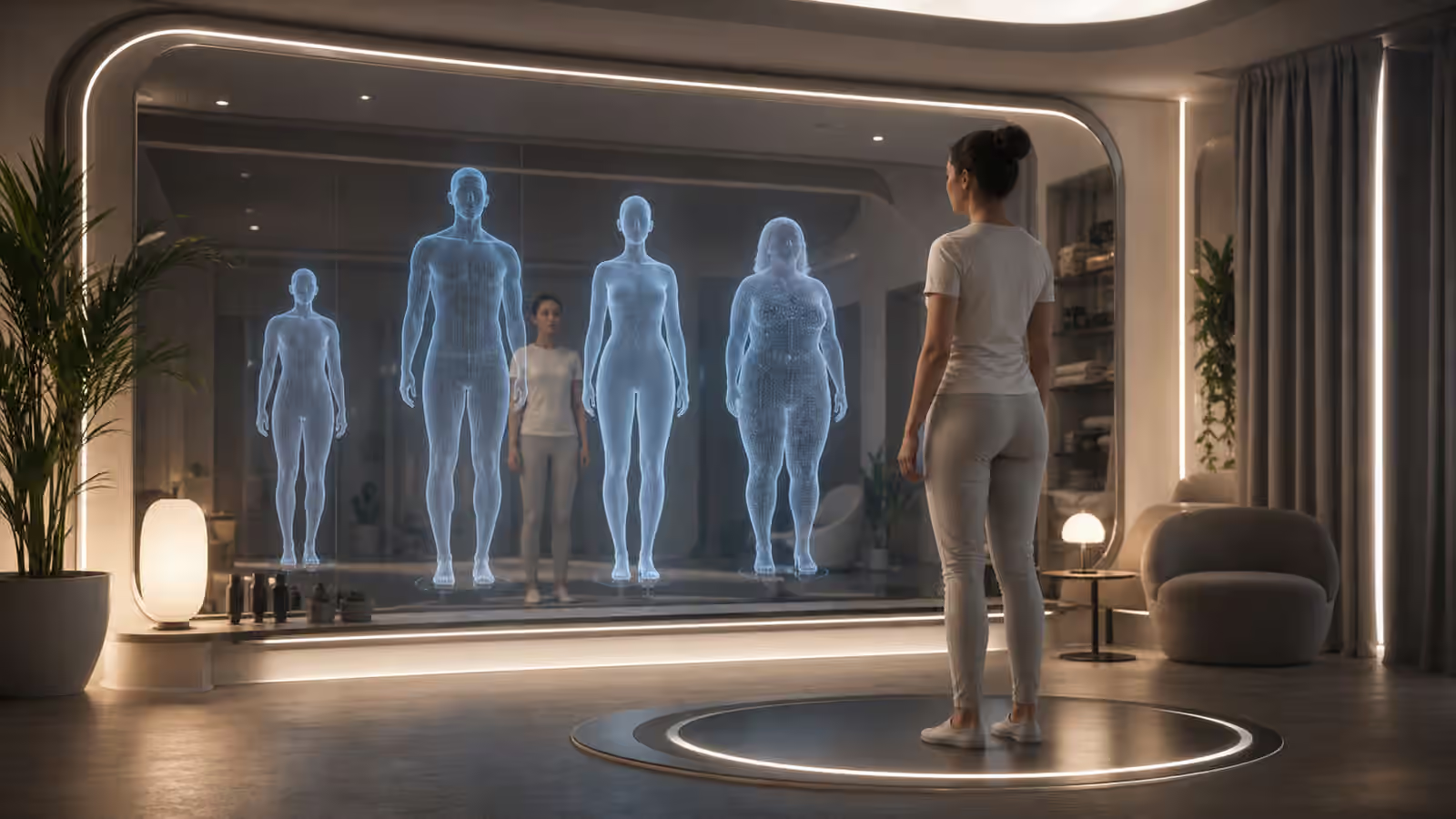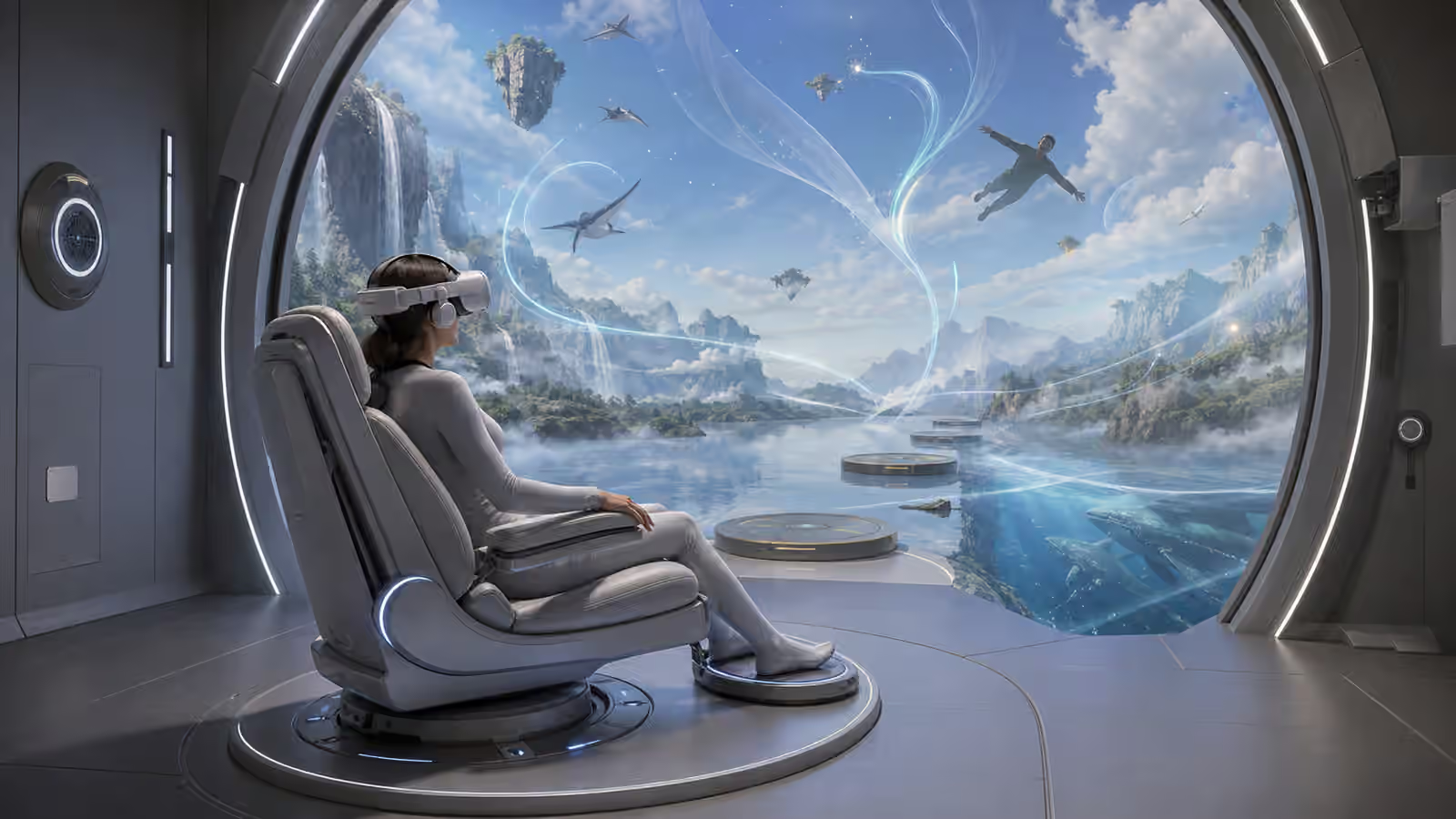
The most tempting full dive worlds will not be ordinary rooms. They will offer flight without an aircraft, cities larger than weather systems, bodies with unfamiliar senses, slow walks through underwater light, and impossible changes of scale. The problem is not imagining those places. The problem is translating them into signals a human body can accept without losing trust.
Neural Bandwidth and Sensory Compression in Full Dive VR explains why future systems would need to choose which signals matter most. Sensory translation is the creative side of that constraint. A world may want to make the user feel like they are gliding through cloud, hearing magnetic fields, or holding a star the size of a marble. The system cannot simply pour impossible sensation into the nervous system and call it presence. It has to decide what human-scale cues will carry the experience.
The Body Needs a Reference Frame
People can accept strange worlds when the body has enough anchors. A dream can place a person in a house that is also a train station, and the scene may still feel locally coherent. Games already let players double-jump, teleport, shrink, or see through walls when the interface gives them stable rules. Full dive VR would make that bargain more intimate because the signals may arrive as balance, touch, pressure, temperature, body position, and motion intention rather than as a screen convention.
A reference frame does not have to be realistic. It has to be learnable. If a flight world gives the user a chest-pressure cue for lift, a subtle foot cue for direction, and a soft horizon cue for orientation, those signals can become a language. If every gust, turn, and height change arrives through a different sensory channel, the body may treat the scene as noise. Translation is not about maximum stimulation. It is about repeatable meaning.
Locomotion and Balance in Full Dive VR is useful here because balance is where fantasy often meets resistance. Flight is thrilling in imagination, but the inner ear is conservative. A system that wants to suggest soaring may use visual flow, sound, pressure, and muscular intention while deliberately avoiding cues that imply an uncontrolled fall. The goal is not to fake every physical force. The goal is to give enough structure that the user can relax into the rule set.
Impossible Touch Should Still Have Edges
Touch is another translation problem. If a user reaches toward a virtual waterfall made of light, what should the hand feel? A literal answer may be impossible. A better answer may be a shaped coolness, a slight pressure rhythm, and a texture that changes as the hand moves. The sensation does not need to exist in the ordinary world to become meaningful. It needs boundaries, timing, and consent.
Contact, Weight, and Texture in Full Dive VR treats touch as a matter of trust. Impossible objects still need that trust. A floating stone should not suddenly grab the hand unless the user agreed to forceful contact. A giant creature’s breath should not become overwhelming heat because the artist wanted scale. A nonhuman body should not rewrite the user’s body map so quickly that exit feels disorienting.
The art of impossible touch may be restraint. The system can imply mass through delay, imply distance through air pressure, imply energy through vibration, and imply danger through visual and acoustic cues before using strong haptics. When sensation becomes too literal, it can trap the user in the designer’s enthusiasm. When it is translated with care, the user gets room to interpret.
New Senses Need Old Explanations
Science fiction often imagines extra senses as if they could be added like interface panels. In full dive VR, a new sense would need a bridge from existing perception. A person cannot immediately know what “magnetic north in the bones” or “social temperature in the skin” means. They need a training space where the signal is paired with visible events, repeated patterns, and safe mistakes.
This makes impossible sensory design closer to language learning than spectacle. The first version may be simple. A faint pull means the hidden object is nearby. A colorless pressure means another participant is requesting attention. A low vibration means the world boundary is close. Over time, the user may stop translating consciously and begin to feel the cue directly. That is powerful, and it is also why designers should be cautious.
World Authoring for Full Dive VR argues that creators need sensory budgets. New senses deserve a budget of their own. They should not compete with balance, pain boundaries, personal space, and exit signals. A beautiful invented sense that makes emergency cues harder to notice is not well designed.
Scale Is a Negotiation
Changing scale may be one of the richest full dive experiences. A user might walk through a microscopic garden, stand beside a mountain-sized machine, or hold a city as if it were a model. Scale can create awe without violence. It can also confuse the body if reach, sound, gravity, and time do not agree.
The system has several choices. It can keep the user’s body at ordinary size and change the world around them. It can make the avatar feel larger or smaller while preserving comfortable movement. It can use a transitional room where the user’s senses adjust gradually. It can keep touch local even when sight suggests vastness. Each choice tells the body a different story.
The safest impossible worlds may announce their translation style early. They show the user how motion works, what distance feels like, how strong touch can become, and how to return to a familiar body. They let the person practice before awe becomes the main event.
Wonder Needs a Return Path
Full dive VR will be judged partly by wonder. That is fair. The medium would be poorer if every world stayed close to ordinary physics. But wonder should not become an excuse to ignore the person who has to come back. Reality Testing and Grounding in Full Dive VR matters most when a world is intentionally unreal.
Good sensory translation leaves breadcrumbs. It gives the user stable cues inside the fantasy and a gentle way back to ordinary scale, ordinary gravity, ordinary skin, and ordinary time. The impossible world can be magnificent without pretending the body has no limits. It can offer flight, strange senses, and impossible objects while still treating the human nervous system as the home address.