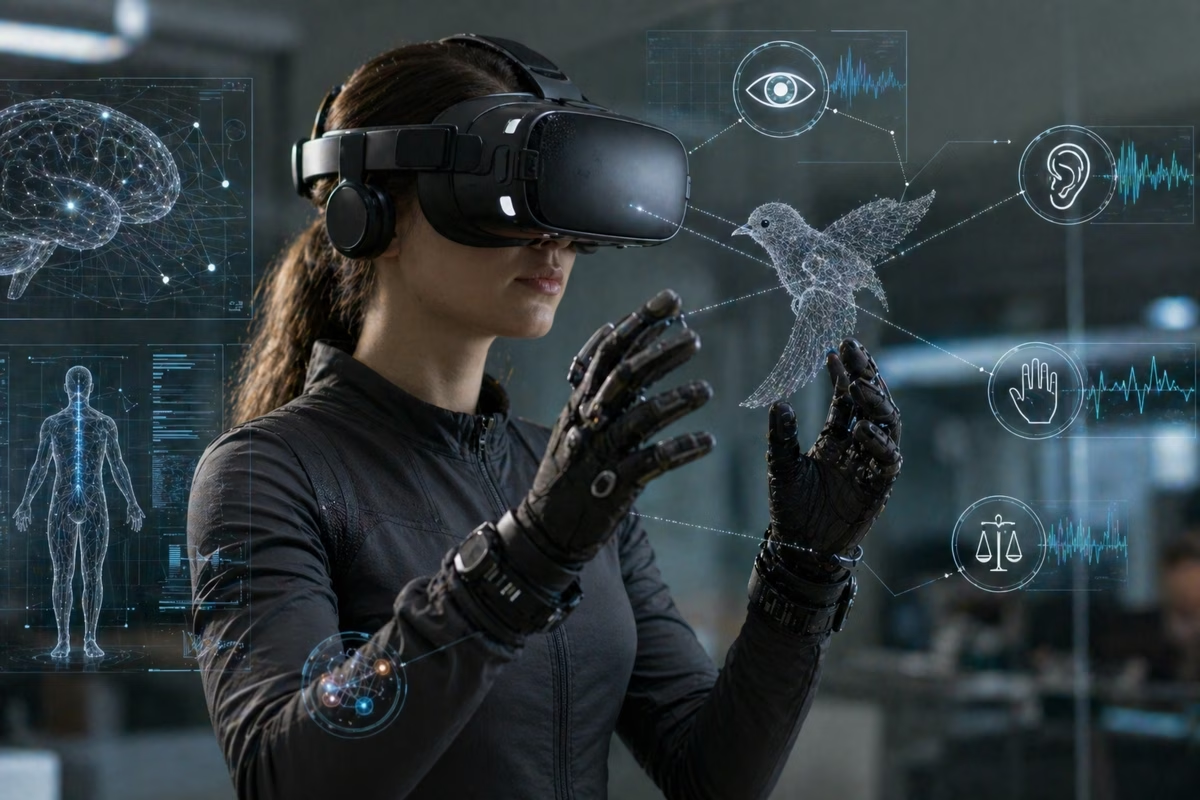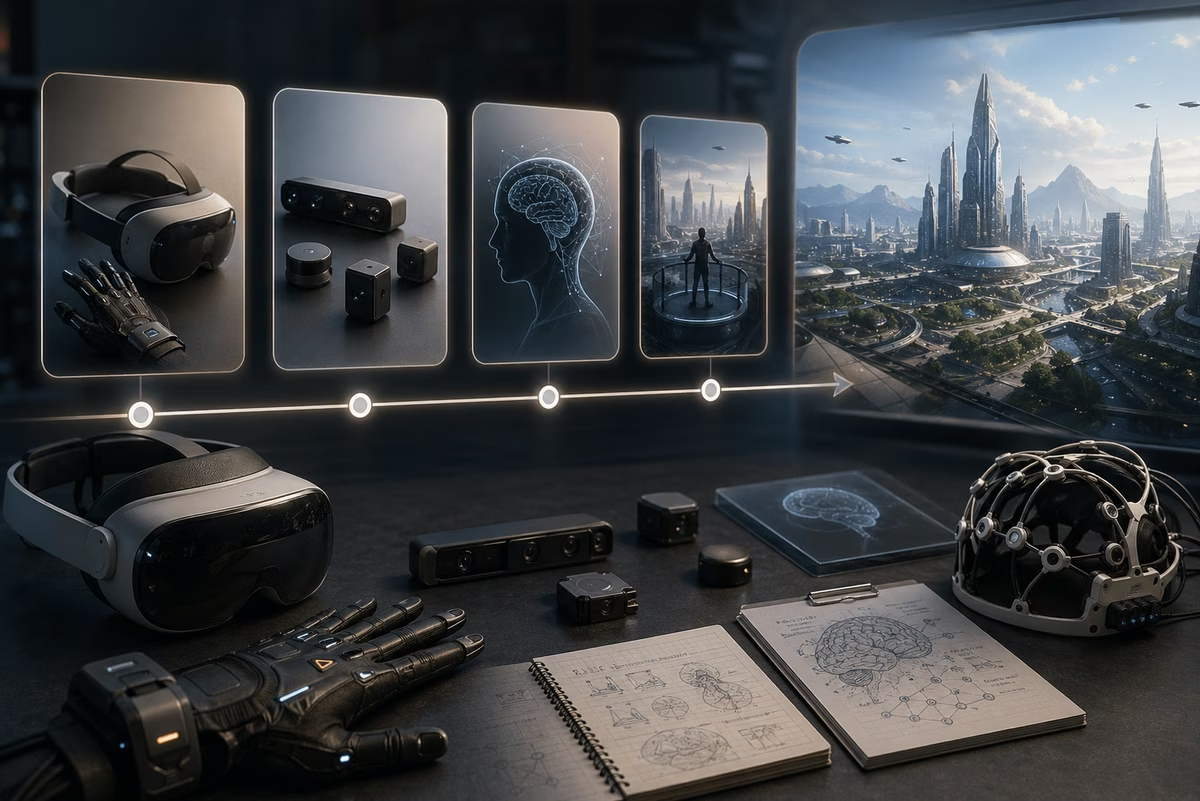
Full dive VR will probably not arrive all at once.
That is not as disappointing as it sounds. Most major technologies sneak up on people in pieces. The internet did not arrive as social networks, streaming video, cloud work, online games, and smartphones on day one. It arrived as plumbing, protocols, terminals, modems, browsers, search, payment systems, cameras, batteries, and habits.
Full dive VR is the same kind of problem. It needs many pieces to mature at the same time, and the pieces do not all mature at the same speed.
This guide is a practical roadmap. Not a prediction calendar. A map of the stepping stones.
Step 1: Headsets Become Normal Tools
The first step is boring: headsets have to become lighter, clearer, cheaper, and easier to wear.
That matters because adoption changes the entire field. When only enthusiasts use VR, developers build for enthusiasts. When more people use it for work, learning, fitness, design, meetings, games, therapy, and entertainment, the design language improves. Comfort settings improve. Accessibility improves. Social rules improve. Content gets less gimmicky.
Today’s headsets still have obvious friction:
- Weight on the face.
- Heat.
- Battery life.
- Lens glare.
- Eye strain for some users.
- Motion sickness for some experiences.
- Setup friction.
- Limited reasons to wear the device every day.
Full dive does not begin by ignoring these problems. It begins by solving them so well that wearing a headset stops feeling like an event.
The first big milestone is not “sword art world.” It is “people can spend useful time in spatial computing without thinking about the hardware every minute.”
That is why practical buyers should care about comfort accessories early. A battery head strap often changes whether a headset becomes a habit, and a carrying case makes it easier to keep the setup ready instead of buried in a drawer.
Step 2: Avatars Get Human Enough
Full dive is not only about landscapes. It is also about other people.
Social presence requires more than a floating cartoon head. Humans read tiny signals: gaze, posture, facial timing, hand rhythm, personal space, hesitation, turn-taking, and expression. If those signals are wrong, the experience feels stiff or creepy.
The roadmap here includes:
- Eye tracking.
- Face tracking.
- Better inverse kinematics for body movement.
- Hand tracking with fewer failures.
- More expressive avatars.
- Personal space tools.
- Voice moderation.
- Identity controls.
This stage matters because virtual worlds become believable faster when people inside them feel present. A simple room with a convincing person can feel more real than a beautiful empty planet.
The danger is that better avatars also make impersonation easier. A future that can reproduce your face, voice, gestures, and emotional timing needs strong identity rules. “Who is really here?” becomes a core interface question.
Step 3: Haptics Stop Being a Buzz
Haptics are often marketed badly. A vest rumbles when you get hit, and suddenly people act as if touch has been solved. It has not.
But haptics still matter. They are one of the most realistic bridges between current VR and deeper immersion.
The near-term haptic roadmap is likely practical:
- Better controller vibration.
- Gloves with finger tracking and resistance.
- Wearables that create pressure cues.
- Temperature feedback in limited contexts.
- Fans for wind and direction.
- Seats and platforms for vehicle motion.
- Fitness and rehab systems with careful body feedback.
The trick is not to simulate every sensation. The trick is to give the brain useful anchors. If a virtual object stops your fingers at the right moment, your brain may accept more of the illusion. If a vibration arrives exactly when a tool touches a surface, the tool feels less fake.
Timing matters as much as strength. A small cue at the right millisecond can be more convincing than a strong cue that arrives late.
Step 4: Locomotion Gets Less Awkward
Moving through virtual space is still one of VR’s deepest design problems.
There are several imperfect options:
- Joystick movement is simple but can cause discomfort.
- Teleportation is comfortable but breaks embodiment.
- Room-scale walking feels natural but requires space.
- Treadmills solve space but add hardware complexity.
- Redirected walking is clever but limited.
- Vehicle cockpits work because sitting matches the fiction.
Full dive needs a better answer to locomotion because the fantasy includes movement that real rooms cannot support. Running, climbing, flying, falling, swimming, shrinking, and changing gravity all create sensory conflicts.
The likely roadmap is a mix. Some experiences will use physical movement. Some will use comfort-preserving locomotion tricks. Some will use neural or muscle intent. Some will choose dreamlike transitions instead of realistic movement.
The winning designs may not be the most realistic. They may be the ones that preserve agency without making people sick.
Step 5: Intent Input Improves
Intent input is the bridge from “I operate a device” to “my virtual body acts.”
This does not require full brain reading at first. There are many useful signals outside the skull:
- Eye gaze.
- Hand pose.
- Muscle activity.
- Voice.
- Breathing.
- Posture.
- Facial expression.
- Controller pressure.
A system can combine these signals to infer intent. If you look at a cup, reach toward it, and close your fingers, the system can make the grasp feel more natural. If your shoulder tenses and your gaze snaps to a threat, the system can adjust comfort or timing. If your speech slows, it might reduce cognitive load.
This is powerful and sensitive. Intent data can reveal things the user did not choose to say. A responsible roadmap has to include privacy from the beginning, not after the platform becomes addictive.
Step 6: Medical BCI Progress Teaches the Field
Brain-computer interfaces are already being explored for serious medical needs, especially restoring communication or control for people with paralysis or limb loss. That work is not the same as consumer full dive. But it may teach important lessons.
The lessons include:
- How stable neural signals remain over time.
- How much training users need.
- How devices behave in real homes, not only labs.
- Which materials last safely.
- How software should adapt to a person.
- What users actually value.
- What risks regulators and clinicians consider unacceptable.
This stage should be watched with respect. Medical BCI users are not beta testers for entertainment. They are people seeking function, independence, and communication. Consumer full dive should not borrow the glamour of medical progress while ignoring the seriousness of the work.
Step 7: Sensory Writing Becomes Narrow First
If direct sensory feedback arrives, it will probably begin narrowly.
A system might provide a simple tactile cue. Or restore a limited kind of sensation for a prosthetic limb. Or help a user feel whether a cursor has selected something. It is much easier to imagine specific, bounded feedback than a whole artificial world written into the nervous system.
This is how hard technologies often grow: not by doing everything, but by doing one small thing reliably.
For full dive, narrow sensory writing might eventually support:
- Touch confirmation.
- Direction cues.
- Balance aids.
- Prosthetic feedback.
- Pain-free warning signals.
- Presence cues for virtual objects.
The important word is “bounded.” A safe system needs clear limits on what can be stimulated, how strongly, for how long, and under whose control.
Step 8: Standards and Trust Catch Up
The road to full dive is not only hardware. It also needs standards.
A believable future needs answers to plain questions:
- What data can an immersive system collect?
- Can users export or delete identity data?
- Can another person impersonate your avatar?
- How does consent work for touch in VR?
- What counts as harassment when embodiment is strong?
- What safety testing is required for sensory devices?
- Who can inspect an invasive system?
- What happens during a crash?
These questions sound dull until they are missing. Then they become the whole story.
Full dive VR without trust would be a trap. Full dive VR with trust could become one of the most important creative and educational media ever built.
A Sensible Timeline Mindset
Instead of asking “what year will full dive arrive?”, ask which capability is improving.
Can headsets be worn comfortably for longer? Are haptics becoming more precise? Are avatars becoming more expressive without becoming easier to fake? Are BCI systems becoming safer and more stable for medical users? Are regulators publishing clearer expectations? Are designers building better exit controls?
Those are better questions because they show progress without pretending the final destination is around the corner.
Full dive VR is not one finish line. It is a ladder. Some rungs are already here. Some are in labs. Some may require breakthroughs we do not have yet. The future will be easier to understand if you learn to see the ladder instead of staring at the top.
How to use this guide well
A strong guide is not only a reference page. For The Roadmap from Headsets to Full Dive VR, the useful work is to connect the idea to a real choice, routine, object, place, or conversation. Read the page once for orientation, then return to the part that changes what you will do next.
Start with the situation in front of you. What are you trying to decide, fix, buy, compare, build, maintain, or understand? The clearer the situation, the less likely you are to treat every detail as equally important.
Then look for the tradeoff. Most good Full Dive Vr decisions involve comfort, cost, effort, timing, skill, maintenance, risk, or taste. A guide becomes practical when it shows what you gain, what you give up, and what evidence would change your mind.
Keep one small note after you act. Write what you tried, what happened, and what you would repeat. That habit turns the guide from a page you read into a skill you carry.
The Roadmap from Headsets to Full Dive VR should leave you with more than facts. It should make the next step easier to see and easier to do.
What to notice after you use this guide
After you finish this roadmap, choose one next action that can be observed. A guide becomes more valuable when it changes a real choice, not only when it adds more facts.
Name the context. Where are you, what are you trying to improve, and what would count as a good result? The answer keeps the advice grounded in daily life.
Change one variable first. A small controlled change teaches more than a dramatic reset because you can tell what mattered.
Keep one note. Write the date, the choice, the outcome, and the thing you would repeat. The note can be plain and still useful.
Look for tradeoffs. Better full-dive VR decisions often involve cost, time, maintenance, comfort, fit, risk, or skill. Seeing the tradeoff makes the decision calmer.
If the result is unclear, wait before adding another fix. Some lessons need a second use, a different day, or a quieter comparison.
If the stakes are high, use qualified sources and professional guidance where appropriate. A guide can organize the question, but it should not pretend to replace expertise.
The goal is practical confidence. The Roadmap from Headsets to Full Dive VR should make the next step easier to choose and easier to repeat.