
Full dive VR cannot be humane if it treats pain as just another intensity slider. The fantasy of total immersion often focuses on pleasure, flight, impossible worlds, perfect touch, and bodies that move beyond ordinary limits. But any system that can convincingly shape sensation will eventually face the harder question of discomfort. What should happen when a world wants to simulate impact, strain, heat, cold, pressure, fear, fatigue, or pain?
The answer cannot be left to genre expectations or user bravery. Pain has a complicated role in human life. It warns, teaches, overwhelms, protects, harms, and sometimes becomes entangled with memory and emotion. Discomfort can make training more realistic, but it can also make a system coercive. A little resistance in a haptic glove may help a person understand weight. A sudden painful signal may break trust. A simulated injury may feel temporary to the software and very real to the nervous system.
If full dive ever becomes possible, sensation boundaries will need to be built into the foundation. They cannot be hidden in a settings page after the world is already running.
Discomfort Is Not One Thing
A system designer might be tempted to group all unpleasant sensation under one control. That would be a mistake. Pressure, fatigue, dizziness, heat, cold, sharp pain, dull ache, restraint, vibration, imbalance, startle, and emotional distress are different experiences. A person may tolerate one and strongly reject another. A training scenario that uses muscle fatigue is not the same as one that uses a sharp pain cue. A horror game startle is not the same as persistent bodily discomfort.
This matters because consent must be specific enough to mean something. A user agreeing to “realistic haptics” has not agreed to every form of pain. A trainee agreeing to pressure has not agreed to humiliation or panic. A patient in a therapeutic setting has not agreed to the platform experimenting with intensity because engagement metrics rise.
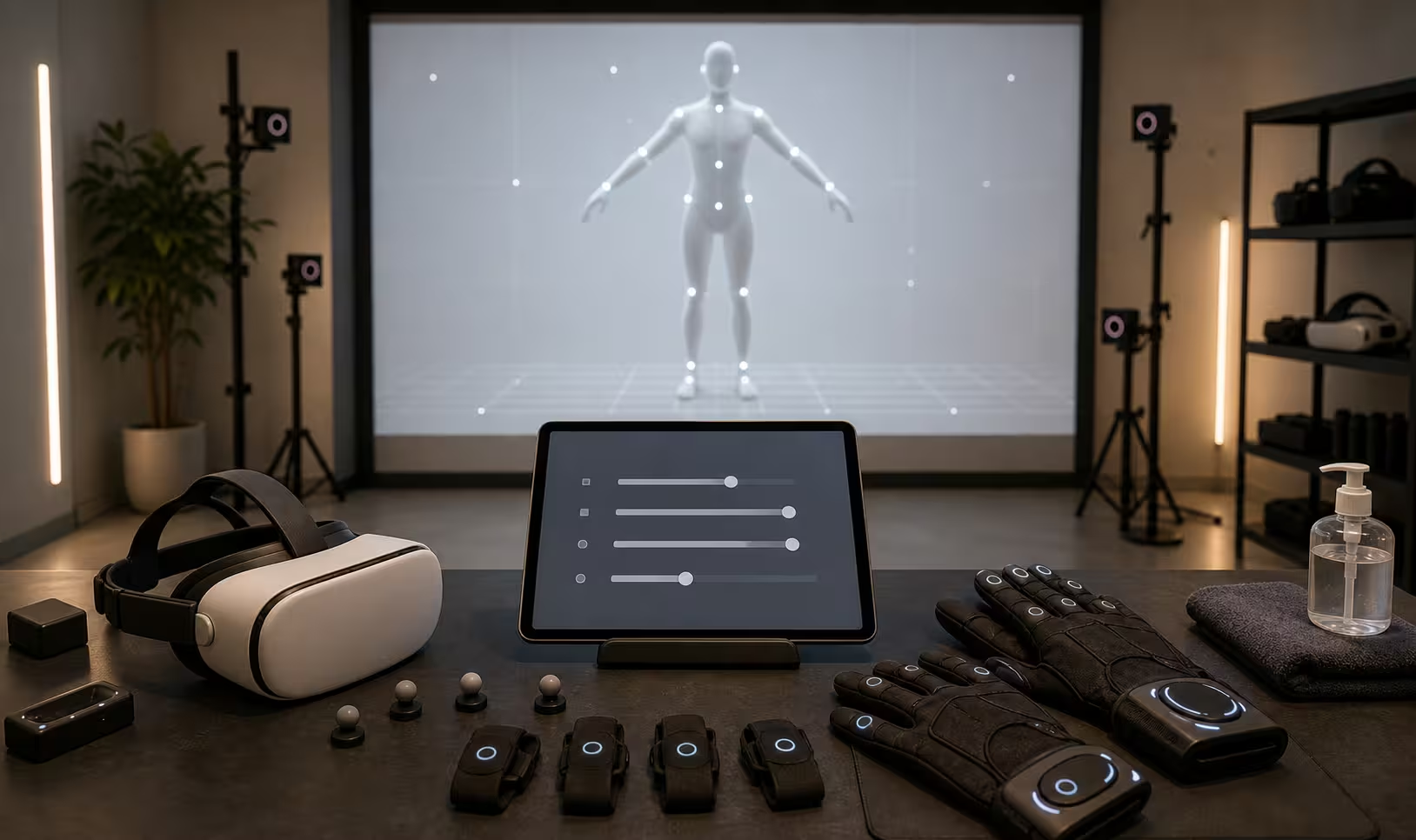
The system should describe sensation in plain language before the session begins. It should let users set limits by category, not only by a global mild-to-extreme scale. It should also remember that people may not know their limit until they meet it. That makes quick reduction, pause, and exit essential.
Pain Should Not Prove Seriousness
Training cultures sometimes confuse pain with authenticity. If it hurts, it must be real. If it is easy, it must be fake. Full dive systems could inherit that mistake and amplify it. A military, athletic, medical, workplace, or educational simulation might be tempted to use discomfort as proof that the user is committed.
That logic is dangerous. Realistic training does not require unlimited suffering. It requires the right feedback at the right intensity for the right purpose. A pilot simulator does not need to injure the trainee to teach emergency procedure. A rehabilitation tool does not need to shame the body to encourage effort. A self-defense scenario does not need to traumatize the user to teach decision-making.
Pain can narrow attention. It can also impair learning. If the user’s mind is consumed by escaping sensation, the training may teach panic rather than skill. Discomfort may have a place in carefully bounded contexts, but it should always answer a clear question: what learning or safety function does this sensation serve?
If the answer is spectacle, punishment, or retention, the system should not use it.
The Emergency Stop Has to Override the Story
Immersive worlds often depend on continuity. The scene keeps going. The story asks for completion. Other participants expect the user to stay. A full dive system that includes discomfort must give the user’s stop signal more authority than the narrative, the instructor, the game, the employer, or the social group.
An emergency stop should be easy to trigger, available in multiple forms, and respected instantly. It should not require navigating a menu while distressed. It should not ask the user to justify the exit before reducing intensity. It should not punish the user with social exposure, lost progress, or public labels unless safety requires some limited notification.
There is also a softer version of stopping: reduce, mute, pause, narrow, or return to a safe room. Not every discomfort requires full exit. Sometimes the user needs the temperature off, the pressure reduced, the crowd muted, or the scene paused. The more nuanced the controls, the less likely users are to endure too much because the only alternative is ending everything.
Records of Pain Are Sensitive
A system that tracks discomfort thresholds, flinch responses, recovery times, avoided sensations, or pain tolerance would hold intimate data. That information could improve safety and personalization. It could also be misused by employers, insurers, advertisers, schools, competitive platforms, or abusive people.
Pain data should be treated as sensitive by default. The user should know what is measured, what is stored, who can see it, and when it expires. A training supervisor may need to know that a session was stopped for safety. They do not automatically need a detailed map of the user’s bodily responses. A platform may need local calibration. It does not automatically need a permanent profile of vulnerability.
The closer a system comes to the body, the stronger the privacy standard should become. Pain and discomfort are not ordinary engagement signals.
Aftercare Is Part of the Boundary
The end of a difficult session matters. A user who has experienced intense discomfort, fear, or body disruption may need a gradual return. The system should reduce intensity, reintroduce ordinary body sensation, check orientation, and give the user time before asking for ratings or decisions. If another person is present, they should be trained to support without interrogation.
Aftercare should not be reserved only for extreme sessions. Even mild discomfort can linger if it surprises the user or connects to memory. A humane system gives people language for what happened and a way to adjust future limits. It also gives them permission not to repeat an experience simply because they completed it once.
This is where consent becomes ongoing. The user’s boundary after the session may differ from the one before it. A setting that seemed acceptable in theory may not be acceptable again. The system should treat that change as valid information, not as user inconsistency.
Humane Immersion Needs Refusal
The deepest issue is not whether full dive can simulate pain. It is whether it can honor refusal. A technology that makes worlds feel real must also make boundaries feel real. The user’s no should be stronger than the designer’s ambition. Their pause should be stronger than the story. Their privacy should be stronger than the platform’s curiosity.
Pain and discomfort are not forbidden topics. Some future experiences may use carefully bounded sensation for training, accessibility, therapy, embodiment research, or art. But the burden should always be on the system to justify, explain, limit, and stop. The user should not have to prove that their boundary is reasonable.
Full dive VR will be judged not only by how much it can make people feel. It will be judged by how reliably it lets them decide what they do not want to feel.