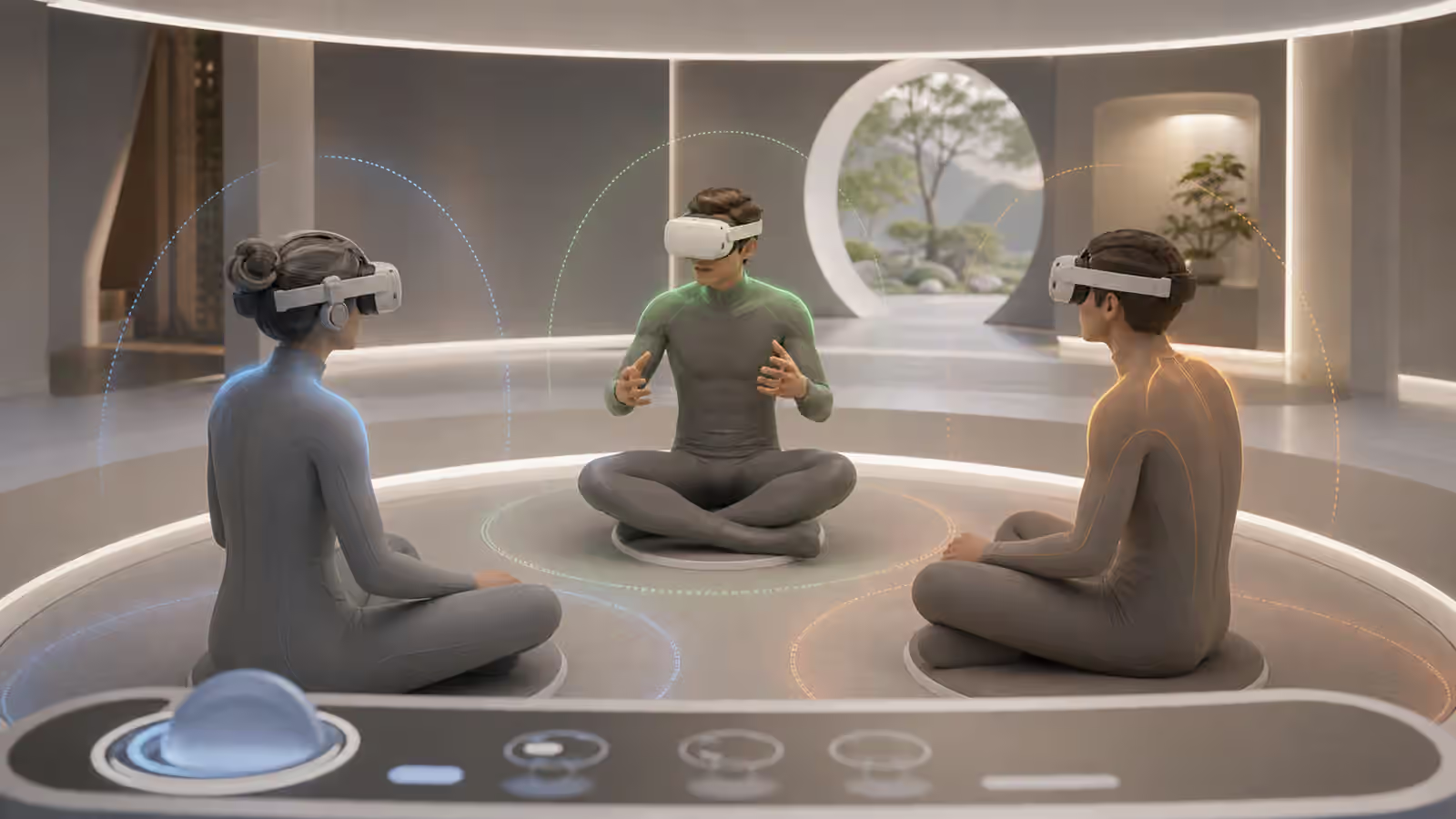
Shared full dive VR will not be social because avatars can talk. It will be social because people can notice one another. A pause before answering, a shoulder turning away, a hand kept close to the body, a gaze that does not quite meet yours, a step backward, or a silence after a synthetic guide speaks can all carry meaning. In a deeply immersive world, those cues may feel less like interface signals and more like presence.
Shared Worlds in Full Dive VR covers consent, identity, moderation, and exits at the social layer. Nonverbal communication sits inside that layer. It asks how a world should represent attention, hesitation, refusal, warmth, fatigue, humor, discomfort, and invitation when the user’s real body, virtual body, and privacy needs may not line up perfectly.
Presence Is Not the Same as Exposure
The easiest design mistake is to treat every body signal as a social cue. If the system can see eye movement, breathing rhythm, posture, hand tension, reaction time, or facial expression, it may be tempting to render all of it. More signal can make avatars feel alive. It can also expose things the user did not mean to share.
A person may look away because they are thinking, because they are overwhelmed, because their virtual body is miscalibrated, because a real-world sound distracted them, or because they are deliberately refusing contact. The raw movement is not enough. The system should avoid turning every involuntary detail into public performance. Presence should be expressive, but it should not become compulsory emotional disclosure.
Body Data Minimization in Full Dive VR makes this point from the privacy side. Nonverbal design makes it from the social side. The world should decide which cues are necessary for mutual understanding and which should remain private, softened, or under user control. A visible “away” state may be enough. The room does not need to expose the reason.
Distance Is a Language
Personal space may become one of the clearest nonverbal languages in full dive VR. In ordinary life, distance is negotiated through culture, relationship, room size, task, and mood. In a virtual world, distance can also be shaped by interface rules. The system can prevent unwanted closeness, show approach requests, soften sudden movement, or let users define personal-space defaults that travel between worlds.
The danger is making distance feel mechanical. A visible boundary ring can help in a training room, but it may feel crude in a dinner, classroom, memorial, or performance. Better systems may translate boundaries into environmental behavior. The other person slows slightly as they approach. A doorway widens to reduce crowding. A shared object appears between participants before direct contact is possible. The world makes respect feel natural rather than turning every interaction into a warning sign.
Intimacy and Relationship Boundaries in Full Dive VR is closely related, but distance is not only intimate. It matters in workplace meetings, games, classrooms, worship spaces, fan events, grief rooms, and casual conversation. A person should not need a dramatic refusal tool for ordinary spatial preference.
Gesture Needs Context
Gestures are tempting because they feel universal. They are not universal. A wave, bow, point, shrug, open hand, crossed arms, or lowered head can mean different things across cultures, communities, relationships, and worlds. Full dive VR may add gestures that have no ordinary equivalent: permission touches, sensory dampening signals, shared-object invitations, memory playback requests, and reentry cues.
The system should teach new gestures gently. It should not assume every user has the same motor range, cultural background, or comfort with expressive movement. Accessibility in Full Dive VR matters here because a gesture language that only works for a narrow body becomes a social barrier. A user should be able to say no, ask for space, accept help, or signal confusion without performing a gesture their body does not easily make.
World designers can also separate private intent from public gesture. A user might privately select a refusal command that the world renders as a calm step back, a dimmed invitation, or a change in object availability. The social signal is clear enough, but the user’s exact physical limitation or emotional state remains protected.
Silence Has to Be Allowed
In immersive social spaces, silence can feel heavy. A synthetic host may try to fill it. Other participants may assume something is wrong. A platform may encourage constant responsiveness because engagement metrics like activity. Full dive VR should resist that pressure. Silence is a legitimate state.
Silence can mean attention, grief, rest, concentration, disagreement, awe, fatigue, or privacy. It can also mean the user is taking a moment to reconnect with the real body. A well-designed room gives silence a shape that does not demand explanation. It might show that the person is present but not available for touch. It might reduce social prompts. It might let a user listen without being treated as absent.
Sound, Voice, and Silence in Full Dive VR treats silence as part of the acoustic body. Nonverbal design treats it as part of the social contract. A world that punishes silence will make some users perform comfort they do not feel.
Synthetic People Should Be Legible
Nonverbal cues become more complicated when synthetic people share the room. A human participant may read warmth, hesitation, flirtation, authority, or distress into a synthetic guide’s posture. That can be useful for storytelling and instruction, but it can also manipulate. Synthetic People in Full Dive VR explains why disclosure matters. Body language needs disclosure too.
A synthetic person should not exploit nonverbal intimacy without boundaries. It should not hold eye contact, move close, mirror breathing, or perform vulnerability in ways the user cannot easily interpret. It should show what kind of agent it is, what memory it carries, and how the user can reduce or end its presence.
The future of social full dive may depend less on perfect realism than on honest legibility. People need enough nonverbal richness to feel met, and enough control to avoid being exposed. The best shared worlds will not make every body signal public. They will help people understand one another while leaving room for privacy, ambiguity, and rest.