The easiest way to misunderstand full dive VR is to imagine one cable going into the brain and carrying an entire world.
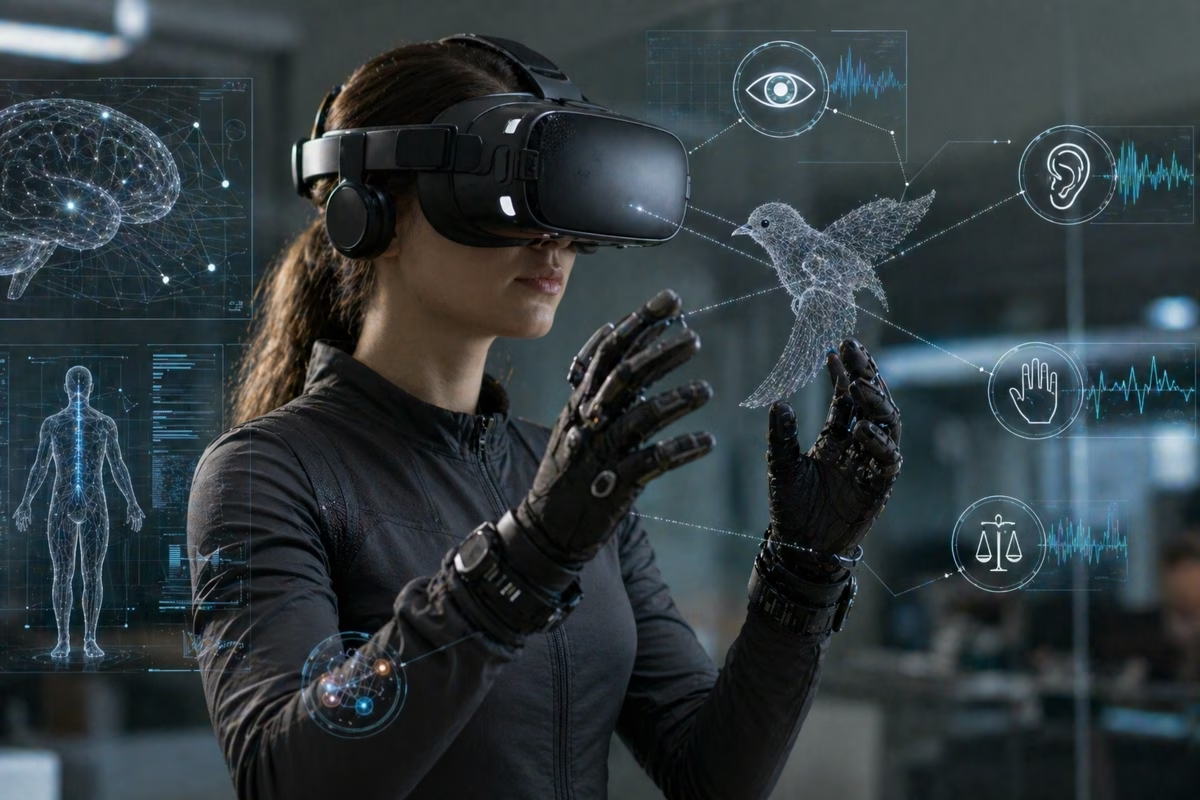
The better way is to imagine a loop.
You intend something. The system reads that intention. The virtual world changes. The system sends sensory feedback. Your brain updates its sense of where you are, what your body is doing, and what just happened. Then you intend the next thing.
That loop already exists in ordinary life. You reach for a mug. Your eyes guide your hand. Your fingers feel the ceramic. Your muscles sense weight. Your inner ear tracks balance. Your brain predicts what should happen next and corrects when the prediction is wrong.
Full dive VR has to build an artificial version of that loop.
Start with the Body, Not the Headset
Most people start with the display because displays are visible. A better headset feels like progress, and it is. But full dive VR is mostly a body problem.
Your brain is not just watching the world. It is constantly asking, “Where am I? Where are my limbs? What can I do next? What is touching me? Am I safe?”
A normal headset answers only part of that. It gives your eyes and ears a convincing scene. But the rest of the body keeps reporting from the real room. Your feet are on carpet. Your hands hold plastic controllers. Your stomach says you are not accelerating. Your skin says there is no rain, no heat, no fabric, no wall, no person standing next to you.
The full dive challenge is to make those reports line up well enough.
There are two broad approaches:
- Add more physical feedback around the body.
- Interface more directly with the nervous system.
The first path is easier to imagine as consumer technology. The second path is where the science fiction version lives, but it carries much higher safety and ethical stakes.
Output: Sending a World to the User
Output means everything the system sends to you.
Vision
Vision is the most mature piece. Headsets already provide stereoscopic images, wide fields of view, high refresh rates, and increasingly good eye tracking. Future displays need to become lighter, sharper, brighter, more comfortable, and better at focus cues.
The focus problem matters. In real life, your eyes converge on an object and focus at the same distance. In many headsets, your eyes converge on a virtual object while the physical display remains at a fixed optical distance. That mismatch can contribute to discomfort. Better optics, varifocal displays, light-field displays, and other approaches may help.
For full dive, vision has to be not only sharp but effortless. If the display constantly reminds you of its limits, the illusion leaks.
Hearing
Audio is quietly powerful. Humans use sound to judge distance, material, room size, danger, and attention. A footstep behind you can feel more present than a beautifully rendered wall.
Full dive audio would need precise spatial placement, realistic room acoustics, and personal calibration. Ears and head shapes differ. A sound engine that works for one person may be less convincing for another.
Touch
Touch is where things get messy.
Touch is not one sense. It includes pressure, vibration, texture, temperature, pain, stretch, itch, and more. Your hands are especially dense with receptors. That is why a simple controller buzz cannot feel like cloth, glass, rain, fur, skin, gravel, and hot metal.
Haptic gloves try to solve part of this with vibration, force feedback, or resistance. Haptic suits can add impact and vibration across the torso. Ultrasonic haptics can create mid-air sensations. Electrical stimulation can trigger muscles or nerves. None of these is a complete skin replacement.
For today’s consumer setups, the most reliable upgrade is usually not a sci-fi glove. It is a better fit and control setup: a Quest battery head strap for balance and runtime, plus controller grips if hand presence matters to the games you play.
The practical future may be layered. A glove gives finger resistance. A suit gives impact cues. A fan gives wind. Heat pads give warmth. The brain fills in part of the rest.
Balance and Motion
Balance may be the hardest ordinary sense to fake.
Your vestibular system, inside the inner ear, tells you about acceleration, rotation, and gravity. If VR says you are flying but your inner ear says you are sitting still, some users get sick. This conflict is one major reason VR comfort design matters so much.
Motion platforms can tilt, vibrate, or move the user. Omnidirectional treadmills can let users walk while staying in place. Redirected walking can subtly bend virtual space so the user walks in circles while thinking they are walking straight. These are clever, but limited.
A full dive system would need a safe answer for impossible movement: falling from a cliff, accelerating in a spaceship, being hit, swimming underwater, or changing body size. It may not reproduce every sensation. It may choose stylized sensations that the brain accepts without panic.
Input: Reading What the User Wants
Input is the other half of the loop.
Controllers and Hands
Controllers are crude but reliable. Buttons, sticks, triggers, and tracked positions give clean signals. Hand tracking feels more natural but can fail when hands occlude each other, lighting is poor, or the gesture is ambiguous.
If you want to test the higher-fidelity side of today’s loop, a Quest Link cable is the practical bridge into PC VR without pretending current hardware is full dive.
For many experiences, this is enough. Full dive asks for more. You do not want to press a button to walk, another button to grip, and another button to smile. You want the system to understand intent.
Eyes, Face, and Voice
Eye tracking can reveal where attention is pointed. Face tracking can drive avatar expression. Voice can carry language, emotion, hesitation, and identity. These inputs make social VR feel less stiff.
They also create privacy questions. Eye movement can reveal interest and confusion. Voice can reveal mood. Facial expression can reveal reactions a user did not intend to publish. Full dive input is not just control data. It can become intimate behavioral data.
Muscles and Nerves
Muscle sensors can read electrical activity before or during movement. This could let a system detect a gesture without needing a camera to see the hand. Peripheral nerve interfaces might someday offer richer control or sensation for prosthetics and virtual bodies.
This path is interesting because it does not always require going straight to the brain. The body has many signal points. If a wrist sensor can read enough intent for a virtual hand, it may be safer and more practical than an implant.
Brain Signals
Brain-computer interfaces try to read activity from the nervous system and translate it into commands. Some are non-invasive, like EEG. Some are implanted. Signal quality, invasiveness, training time, stability, and safety vary widely.
For full dive, the dream is obvious: think “move my hand” and the virtual hand moves. But real BCI control is not magic telepathy. It is signal decoding. The system learns patterns. The user learns the system. Performance can drift. Fatigue matters. Calibration matters.
Even if intent reading becomes excellent, sensory writing is still a separate problem.
The Harder Problem: Writing Sensation Directly
Reading brain signals is difficult. Writing believable experience into the nervous system is harder because the system must trigger the right signals without creating harm, confusion, pain, or long-term side effects.
Consider touch. It is not enough to say “activate the touch area.” Your brain’s body map is detailed. The system would need to create a pattern that feels like pressure on the right finger, at the right strength, with the right timing, while not interfering with real sensory signals.
Now consider pain. A virtual world may need danger feedback, but nobody wants entertainment software with uncontrolled pain output. Temperature has burn risks. Balance stimulation can cause falls. Emotional or memory-linked stimulation would raise even deeper concerns.
This is why full dive cannot be treated like a normal console upgrade. The more direct the interface, the more it resembles medical or neurotechnology, even if the content is entertainment.
The Safety Layer
A believable full dive system needs a safety layer that is always more trusted than the experience itself.
That layer should handle:
- Session limits and breaks.
- Emergency exit.
- Physical body monitoring.
- Distress detection.
- Content boundaries.
- Identity and consent rules.
- Data minimization.
- Clear recovery after the session.
The safety layer cannot be a tiny menu hidden inside the simulation. If a user is disoriented, frightened, asleep, overloaded, or unable to speak, the system still needs ways to return them safely.
The Body Simulation Layer
Finally, full dive needs a body model.
The system has to decide what your virtual body is doing, how it collides with the world, what it feels, and how it differs from your real body. If your avatar jumps, does your real body tense? If your avatar loses an arm, what sensation is allowed? If your avatar is taller, how long before your brain adapts? If you enter a non-human body, what counts as comfort?
This is not only technical. It is design.
Many future experiences may avoid perfect realism on purpose. They may use simplified bodies, comfort filters, and symbolic feedback because those are safer and easier to understand. A gentle pulse can mean damage. A pressure band can mean contact. A color shift can mean danger. Realism is not always the goal. Control is.
A Believable Stack
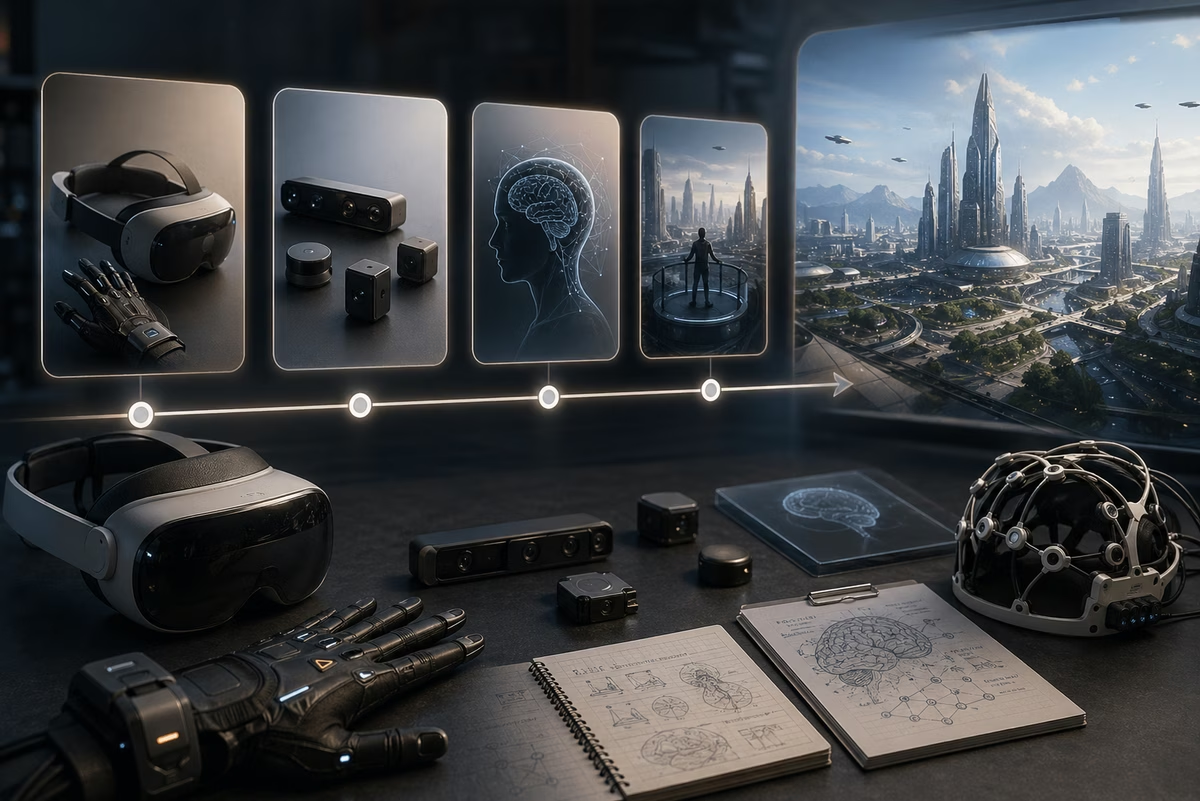
A realistic path toward full dive may look like this:
- Better headsets and spatial audio.
- Better hand, eye, face, and body tracking.
- Lightweight haptics for hands and torso.
- Muscle or nerve input for natural control.
- Optional medical-grade neural interfaces for specific needs.
- Richer sensory feedback, introduced slowly and safely.
- Strong identity, consent, and exit systems.
That stack is less dramatic than “upload me into a game.” It is also more plausible.
Full dive VR will not be one breakthrough. It will be a long negotiation between the machine, the body, and the brain.