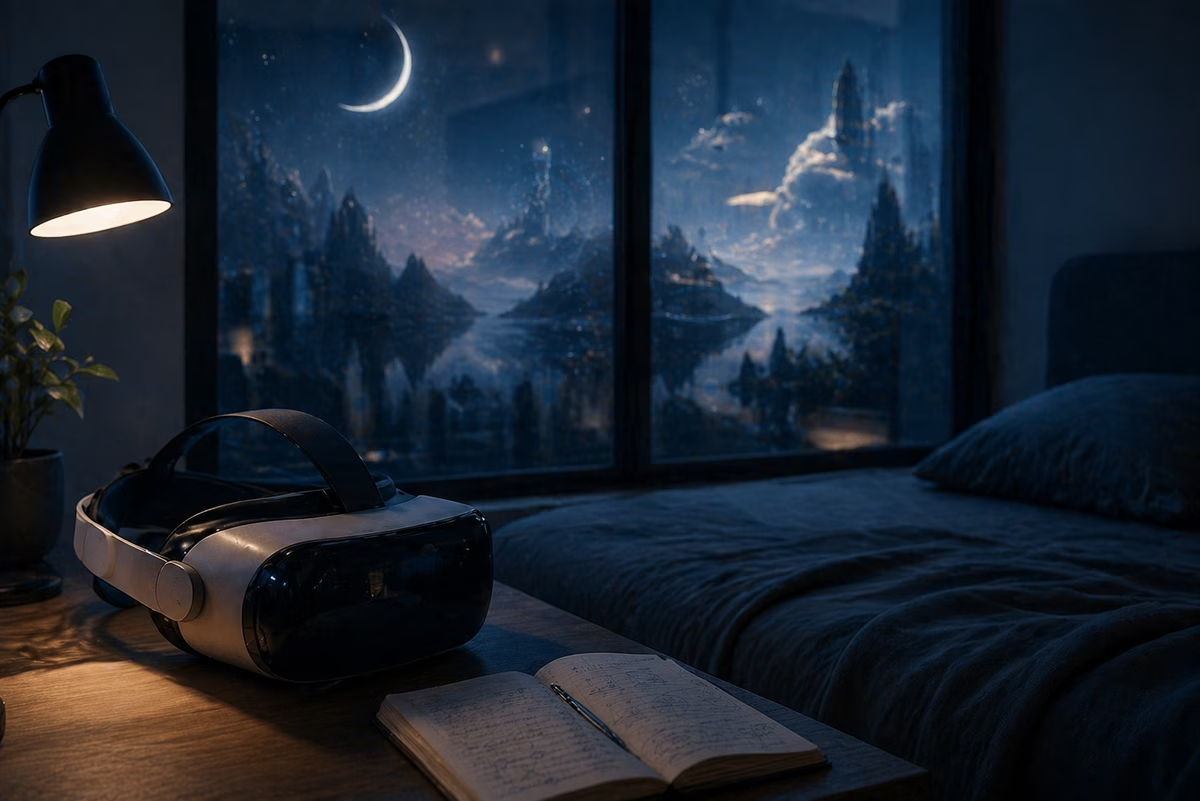
Mara woke before the room did.
For a few seconds there was only the old world: cotton against her shoulder, winter light at the edge of the curtains, the small ache in her left hand where the tendons had learned to complain before the rest of her body. The apartment was quiet except for the rain ticking against the balcony rail. Somewhere below, a delivery drone made its polite electric sigh and moved on.
Then the room asked if she wanted to enter.
Not with a voice. She had turned the voice off years ago. Voices at waking felt too much like being summoned.
Instead, the silver band on the bedside table warmed by one degree. The old habit came back through her fingertips before thought did. Mara touched the band, and a pale line crossed its surface, soft as milk in tea.
The wall beside her bed brightened with three words.
Ready when ready.
She smiled despite herself.
That phrase had survived eleven software generations, six safety audits, two public scandals, one worldwide recall, and the endless redesign committees that tried to make everything sound more elegant. People kept choosing it in the settings. Ready when ready. It was not beautiful, exactly. It was kind.
Mara sat up. Her knees clicked. The rain continued. The kitchen window was fogged in the lower corners because the building still had the same old insulation problem no one could solve without tearing open half the wall. The real world remained stubborn in all the places no one had managed to make it graceful.
On the chair by the closet lay her entry wrap: a thin, dull-gray fabric with sensor threads at the wrists, collar, ribs, and calves. Beside it sat the neural crown, a flexible loop no heavier than a sleeping mask, and the haptic cuffs for her hands. Twenty years earlier the equipment would have looked miraculous. Now it looked like laundry that had learned patience.
She dressed slowly.
The wrap tightened across her shoulders, not enough to restrict, only enough to understand where she was. The cuffs recognized the bones of her hands. The crown settled along the ridge behind her ears and found the clean places in the signal, the old patterns, the small private weather of attention.
No implants. Mara had never wanted them. Some people had medical interfaces now, miraculous ones. A boy in Kyoto could feel the shape of a cup through a prosthetic hand. A woman in Toronto, who had not spoken aloud in twelve years, could choose words at conversation speed. Those systems were sacred in the way tools become sacred when they return a person to themselves.
Mara’s device was not sacred. It was consumer hardware, carefully limited, occasionally annoying, and very good at what it was allowed to do.
It could read intention from muscle signals, gaze, breath, and the shallow storms of the scalp. It could write back through light, sound, pressure, temperature, vibration, balance cues, and a hundred small cheats the brain accepted if they arrived at the right time. It did not put a world directly into the mind. It built one around the body until the body agreed to step in.
On the wall, the entry line changed.
Session: Garden With Weather.
Duration: 42 minutes.
Intensity: Low.
Touch: Trusted circle only.
Exit: hand clasp, voice, blink pattern, external override.
The list had seemed patronizing when she was young. She had wanted the future to be seamless. She had wanted to fall through a door and wake in a second sky. She had once complained, in a comment thread she hoped no one had archived, that consent screens ruined immersion.
Then she had gotten older. Older people loved railings, labels, handles, backups, and lights that told you whether something was on. The future had not become less magical to her. It had become magical in different places.
She pressed two fingers to her palm.
Enter.
The apartment did not vanish. That was the first kindness.
It loosened.
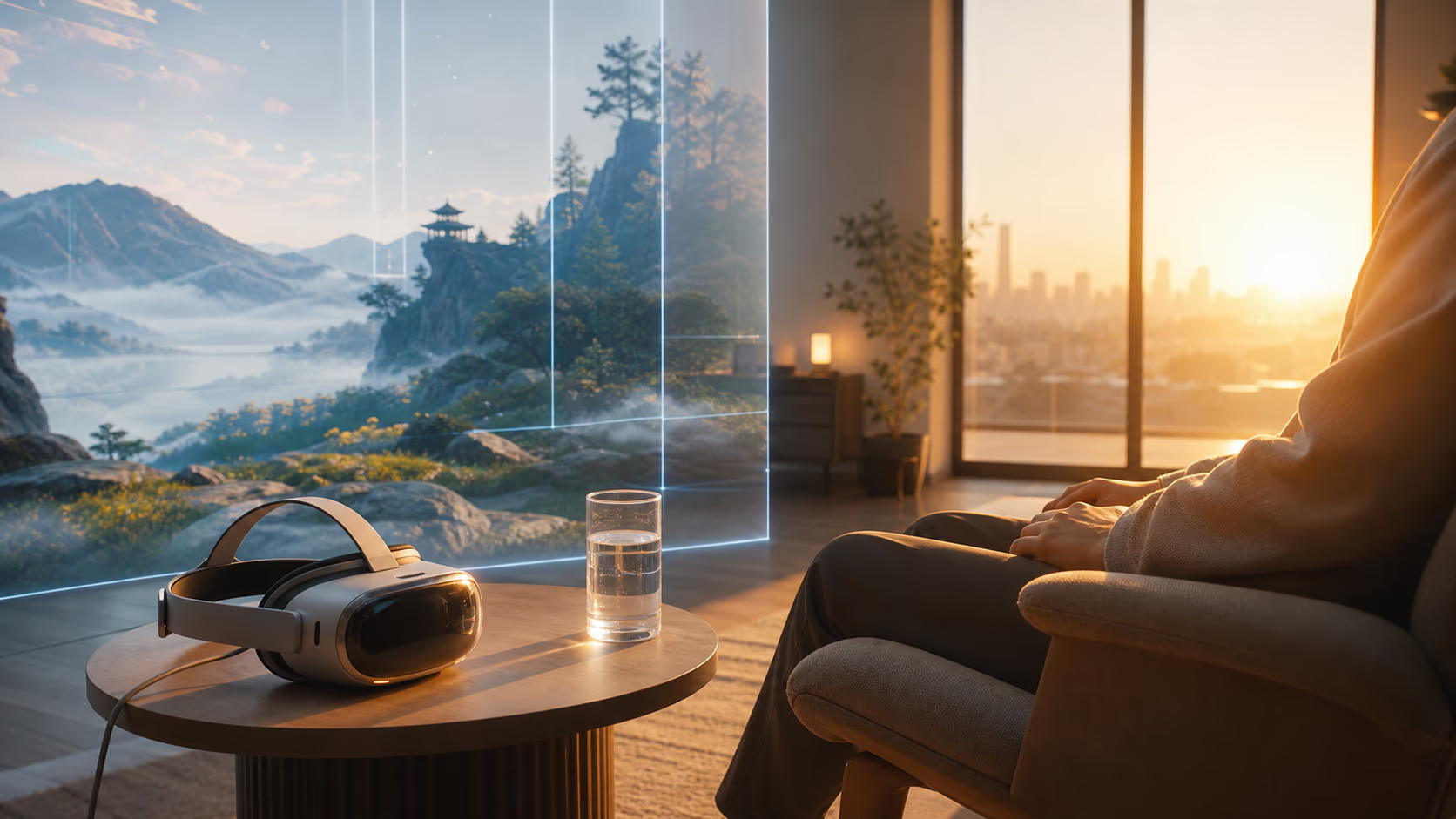
The window stretched into brightness. The rain flattened into a silver mist. The floor beneath her feet kept its real pressure, but the wrap introduced another texture, a sun-warmed path of compacted earth. The bedroom walls softened into shadowed trees. The ceiling lifted until it was no longer ceiling but morning.
For a breath, Mara stood in both places.
Then the garden took her.
The Garden That Remembered Her

The path always began with thyme.
Not because thyme was important to the simulation, but because it was important to Mara. Her grandmother had grown it in cracked clay pots on a balcony in Haifa. When Mara was seven, she had rubbed the leaves between her fingers until the smell lived in her skin for hours. The garden remembered this because Mara had told it to remember. Not by writing a profile field. By returning to the scent over and over until the system learned that thyme was a door.
Now it rose around her in the damp air: green, peppery, sunlit despite the rain outside her apartment. Her feet stood on a path that wound between low stone walls and blue flowers shaped like cups. Bees moved lazily above them, each with a thin halo of impossible gold. The sky was not realistic. It was too deep, too clear, blue shading into violet as if morning had not yet decided what century it belonged to.
Mara lifted her right hand.
The haptic cuff tightened across the knuckles as her virtual fingers brushed the stone wall. The stones were not truly there. Her real hand moved through empty air, safely inside the mapped space between bed and closet. But the cuff stopped her fingers with a line of resistance, and the wrap tugged gently at her forearm, and the audio placed the scrape of skin against grit exactly where touch expected sound to be.
Her brain, old collaborator, accepted the bargain.
Stone.
She rested her palm there and felt the warmth.
At the far end of the path, a gate opened.
“You came early,” said Eli.
He stood beneath an olive tree that had never existed, wearing the blue sweater he had owned in college and the silver beard he had earned much later. In the garden he always chose both ages at once. The system could make him any shape he wanted, but Eli liked contradictions. Young shoulders, old eyes. The posture of the boy who had once climbed rooftops, the face of the man who now checked the weather before leaving home.
Mara had known him for forty-three years. She knew the way he shifted his weight before making a joke. She knew the soft click in his jaw. She knew the exact pause he used when he was pretending not to be worried.
The garden rendered all of it with uncomfortable accuracy.
“I woke up before the room,” Mara said.
“Show-off.”
“You are late.”
“I am exactly on time. You are early. This is an old conflict between us.”
They hugged.
This was still the part that startled her.
The embrace did not feel like real arms. Not exactly. No fabric bunching, no complex warmth of another body, no smell of coffee on his shirt. But it had weight and boundary. The wrap pressed across her back. The cuffs guided her hands against the remembered shape of him. His voice vibrated through the space near her ear. For a moment the system gave her enough.
Enough was a beautiful word.
It had saved the technology from its own marketing. The first companies had promised perfect. Perfect touch, perfect worlds, perfect presence, perfect lives. They had burned billions and public trust in equal measure. The second wave promised enough. Enough presence to learn. Enough touch to care. Enough embodiment to practice. Enough safety to leave.
Mara let go first, because she always did.
Eli pointed toward the hill. “Leah is already at the river.”
“Of course she is.”
“She says the river is wrong.”
“It is always wrong.”
“She says this time it is morally wrong.”
Mara laughed, and the garden answered by scattering a flock of tiny white shapes from the grass. They were not birds. They were not butterflies. They were a decorative artifact from an old build, something between petals and sparks, and the family had refused every patch that tried to remove them.
Eli began walking.
They moved at the garden pace, which was not quite walking. Mara’s real steps remained small inside the apartment, redirected by the floor cues and the careful bending of space. The path curved when the room needed her to curve. A low branch encouraged her to turn her shoulders. A patch of wet moss asked her to slow. If she looked too long at the horizon, a bird crossed the path and brought her attention back before she reached the boundary.
Once, in the early years, she had hated this too.
“I know what you are doing,” she had told the garden after a boundary correction. “You are lying about the path.”
The garden, in its earlier and less tactful interface, had replied: Yes.
Now she understood. Architecture had always lied. Stairs made height negotiable. Doorways made walls polite. Gardens made land into invitation. Full dive spaces were not different because they lied. They were different because the lies had to include the nervous system.
At the hilltop, the world opened.
Below them, the river moved through a valley of impossible green. A city rose beyond it, glass towers braided with trees, transit lines sliding silently between terraces, rooftop farms bright with morning. The river was too wide for the valley and too slow for its own slope. Leah would hate that.
“Beautiful,” Mara said.
“Wrong,” said Eli.
“Both.”
The River Engineer
Leah stood knee-deep in the river, arguing with physics.
She was twelve in the real world, though in the garden she had given herself antlers made of clear crystal and a cloak that behaved like smoke underwater. Children were still not allowed into high-intensity full dive systems without supervision, and most worlds for minors were aggressively bounded, but family gardens had a different license. Low intensity. Known participants. No strangers. No strong fear loops. No biometric advertising. No synthetic companions pretending to be friends. No touch without permission.
Leah had read the rules and immediately asked whether rivers counted as strangers.
“The flow field is lazy,” she announced as Mara and Eli approached.
“Good morning to you too,” Mara said.
“Look at it.” Leah kicked at the water. The haptic response was mild, a cool pressure around her calves and a crisp little spray against Mara’s cheek when droplets crossed the family zone. “It wants to be a lake but it is cosplaying as a river.”
Eli whispered, “Morally wrong.”
“I heard that.”
Mara crouched at the bank. Her knees did not hurt here, unless she asked them to. She usually asked for a little pain, because total relief made returning strange. “What would you change?”
Leah’s face sharpened. The antlers filled with light.
This was why Mara came.
Not for escape, though escape had its place. Not for beauty, though beauty was no small thing. She came because here, a child could point at a river and the world would listen.
Leah opened her hands. A translucent model rose from the water: current lines, sediment, rainfall, stone, root systems, fish migration, flood risk, footpaths, bridges. She had been building the river for weeks as part of a school project on watershed design. The garden version was not homework, exactly. It was the place where homework became weather.
“The bend should narrow here,” Leah said, pulling the current with two fingers. “And the bank needs roots, not these decorative grass noodles. And if the city is there, the overflow terrace has to be lower.”
The valley changed.
Not instantly. That was another safety rule for shared worlds. Sudden environmental transformation could disorient people. Instead, the river breathed. The bank darkened. Roots entered the mud like patient hands. The water gathered speed along the new bend, and sunlight broke into moving fragments.
Mara felt the shift through the soles of her feet.
“Better,” Leah said.
“Much better,” Eli said.
Leah looked suspicious. “Do you actually know?”
“No.”
“Then say ‘prettier.’”
“Prettier.”
The child nodded, satisfied.
Mara watched the river find its new body. This was the part of the future that old science fiction had often missed. It had imagined people fleeing into private fantasies, endless games, rented heavens. There was some of that, of course. Humans brought all their hungers into every medium. But the deeper transformation had happened in practice.
Architects rehearsed buildings with their hands. Surgeons learned rare procedures with instruments that pushed back. Musicians stood inside compositions and adjusted the brass section as color and pressure. Climate students walked through centuries of watershed choices. Therapists helped patients rehearse difficult conversations in rooms that could pause without judgment. Families built places that held memory without pretending memory was simple.
Full dive had not replaced the world.
It had given the world more handles.
Leah stepped out of the river, and the water fell from her smoke-cloak in silver ribbons that evaporated before touching the grass.
“Grandma,” she said, “can we go to the archive?”
Eli’s expression changed.
There it was: the pause.
Mara looked at him, then at Leah. “Which archive?”
Leah became very interested in the mud between her toes. “The apartment one.”
The garden quieted.
Not dramatically. The bees continued. The river moved. The city shone beyond the valley. But the system had learned the family’s emotional weather, and it lowered the wind.
Eli said, “We said we would wait.”
“You said,” Leah replied.
“Leah.”
“I know it is sad. I am not a baby.”
“No one said you were.”
“Then why is everyone acting like sadness is acid?”
Mara sat on a stone that had not been there a moment before. The garden offered support without asking. She accepted it.
The apartment archive belonged to Mara’s sister, Nomi, who had died the previous spring. Not a simulation of Nomi. That was important. The law was clear now, though it had taken grief and lawsuits to make it clear. A person’s likeness could not be made interactive after death unless they had consented in specific terms while alive. Nomi had not.
What she had left was a place.
A scan of her old apartment. Public objects removed. Private letters locked. Voice disabled. Photos present only where the family had permission to see them. The archive could not speak as Nomi. It could not guess what she would say. It could not hug anyone. It was not a ghost.
It was rooms.
Mara had not entered them yet.
Eli sat beside her. Leah remained standing, antlers dim.
“I want to see the yellow kitchen,” Leah said. “Mom said she painted the cabinets herself and got paint on the cat.”
Mara closed her eyes.
In the real apartment, rain touched glass.
In the garden, the river carried the new current around the bend.
Nomi had painted those cabinets in a heat wave with a fan balanced on a stack of books. She had called Mara at midnight, laughing so hard she could barely explain the cat. Yellow paint on paws. Yellow prints on the counter. Yellow on Nomi’s left cheek because she had tried to carry the animal away and the animal had objected.
The memory arrived not as an image but as weather.
“All right,” Mara said.
Eli looked at her.
“All right,” she repeated.
Leah did not cheer. She was a good child in the presence of fragile doors.
Mara opened the family menu with a hand clasp. The garden dimmed at the edges. A simple panel appeared, plain gray, no animation.
Destination: Nomi Apartment Archive.
Mode: Observational.
Participants: Mara, Eli, Leah.
Emotional intensity: Low.
Memorial safeguards: Active.
Exit: Always available.
Mara read every line.
Then she entered.
The Yellow Kitchen
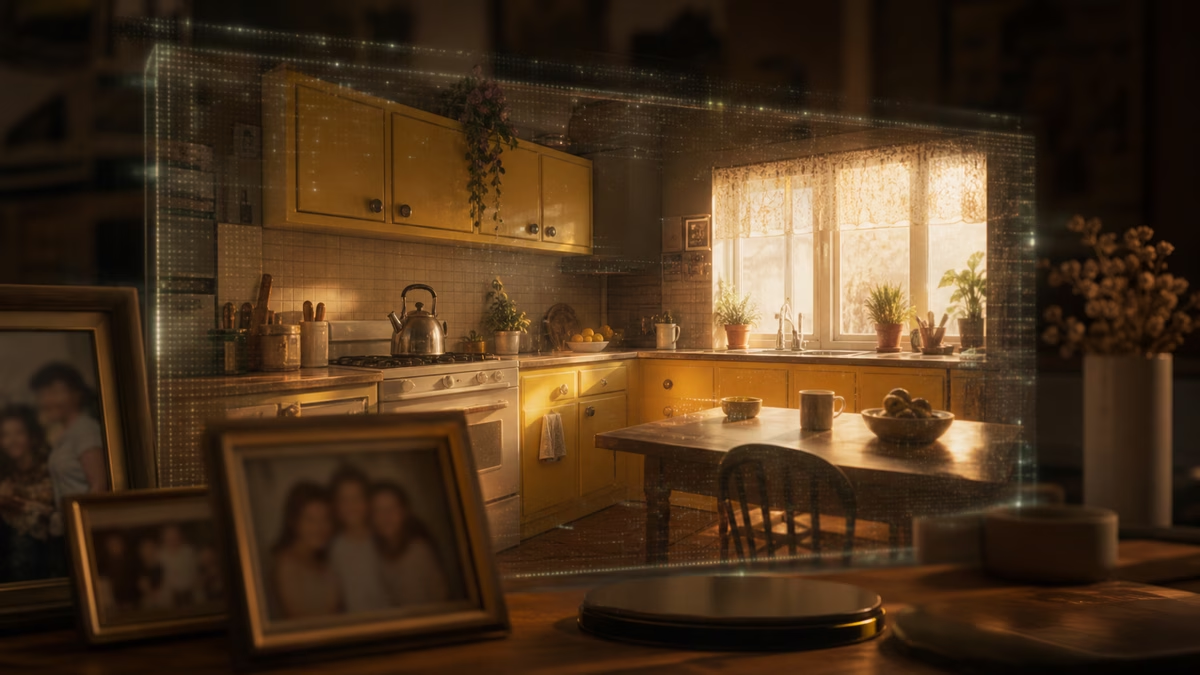
The kitchen was smaller than memory.
That was the first betrayal and the first mercy.
Real rooms often are. Childhood bedrooms shrink. Old schools lose their cathedral height. Places that grief has enlarged return with rude measurements. Nomi’s kitchen had room for a table, two chairs, a narrow stove, a sink, and not much else. The cabinets were indeed yellow. Not tasteful yellow. Not careful yellow. A reckless, stubborn, almost comic yellow that made the whole room feel like it had decided to survive winter by force.
Leah stepped in first.
“Wow,” she whispered.
No one asked whether she meant beautiful or terrible.
Mara stood by the doorway. The archive held itself still. No ghost moved through it. No algorithm staged a sentimental moment. The kettle did not whistle. The chair did not scrape. The cat, long dead too, did not appear with painted paws.
Thank God, Mara thought.
And then, unexpectedly: I wish it would.
The system did not respond to that wish. It was not allowed to.
Eli walked to the sink. “She kept the chipped mug.”
Mara looked. There it was on the drying rack, blue with a white handle, a tiny crack near the rim. Nomi had stolen it from their mother when she moved out. Their mother had pretended not to notice for twenty years.
Leah stood in front of the cabinets. “Can I touch?”
The archive displayed a small halo around the cabinet doors.
Touch: surface texture only. No object movement.
“Yes,” Mara said.
Leah ran her fingers over the paint. The simulation gave her brush marks, a drip hardened near the hinge, a rough patch where Nomi had sanded badly and painted anyway. Leah laughed once, quietly.
“She was bad at this.”
“She was enthusiastic,” Eli said.
“That is what adults say when someone is bad.”
“Often.”
Mara finally stepped into the kitchen.
The floor creaked.
She stopped.
The creak had no right to be there. It was too exact. A small complaint between sink and table, pitched like a question. The scan must have captured it from an old maintenance recording, or the archive had modeled it from floor structure, or Nomi herself had included it in the environmental notes before anyone knew the notes would matter.
Mara stepped again.
The floor asked the same question.
She covered her mouth.
Eli turned, but did not come to her. Good man. Good old friend. He knew that comfort sometimes stole the shape of a feeling before it could be held.
Mara walked to the table.
On it sat a bowl of oranges. They were not fresh oranges. They were archive oranges, reconstructed from a thousand ordinary breakfasts, textured from photographs, placed there because Nomi had tagged the bowl as “always there unless I forgot groceries.” The system marked them as representative. Not evidence. Not memory. Representative.
Even grief had metadata now.
Mara touched one. Surface only. Cool, dimpled, faintly waxy. She remembered Nomi peeling oranges with a knife in one long spiral, then dropping the peel into tea. She remembered arguing in this kitchen about money, about their father, about a man Nomi should not have loved, about whether forgiveness was a virtue or a trap. She remembered laughing here so hard she had to sit on the floor.
The room did not make her younger.
That was good.
Full dive had once been sold as a way to become anything. Younger, stronger, taller, prettier, winged, armored, adored. It could do those things. Sometimes those things were healing. Sometimes they were play. Sometimes they were masks so lovely they became cages.
But the best worlds did not erase the self. They made the self more available.
Mara stood in her old sister’s kitchen as the woman she was now: seventy-one, widowed, stubborn, increasingly forgetful about names, still good with engines, still afraid of deep water, still unable to throw away glass jars, still angry at Nomi for dying before they had finished forgiving each other.
Leah sat in one of the chairs. “I like it here.”
“She would have liked that,” Mara said.
“Do you miss her more in here?”
Mara looked at the yellow cabinets. The awful brave yellow.
“Not more,” she said. “More clearly.”
The archive accepted that. Or rather it did nothing, which was better.
They stayed twelve minutes. The system offered a break at ten. Mara declined. At twelve, Eli touched his palm twice, the family signal for enough.
The kitchen folded gently into gray.
Not gone. Put away.
The City Under the Skin
They returned to the garden by way of the hill.
Mara needed air, so the garden gave air. Wind came up from the valley, carrying thyme, river water, and the mineral smell of imaginary rain on imaginary stone. Leah dismissed her antlers and sat cross-legged in the grass. Eli walked a little distance away, pretending to inspect the olive tree while he wiped his eyes.
The city beyond the river brightened.
It had not been there when the family first built the garden. Back then there had only been hills, a place to meet during the pandemic years when physical travel was expensive and everyone was tired of flat video calls. Then Leah had added a train. Eli had added a library. Nomi had added a market with too many lamps. Mara had added the old engine house, because every paradise needed somewhere to repair things.
Over time, the additions connected.
The city became the place where their private world touched the public one.
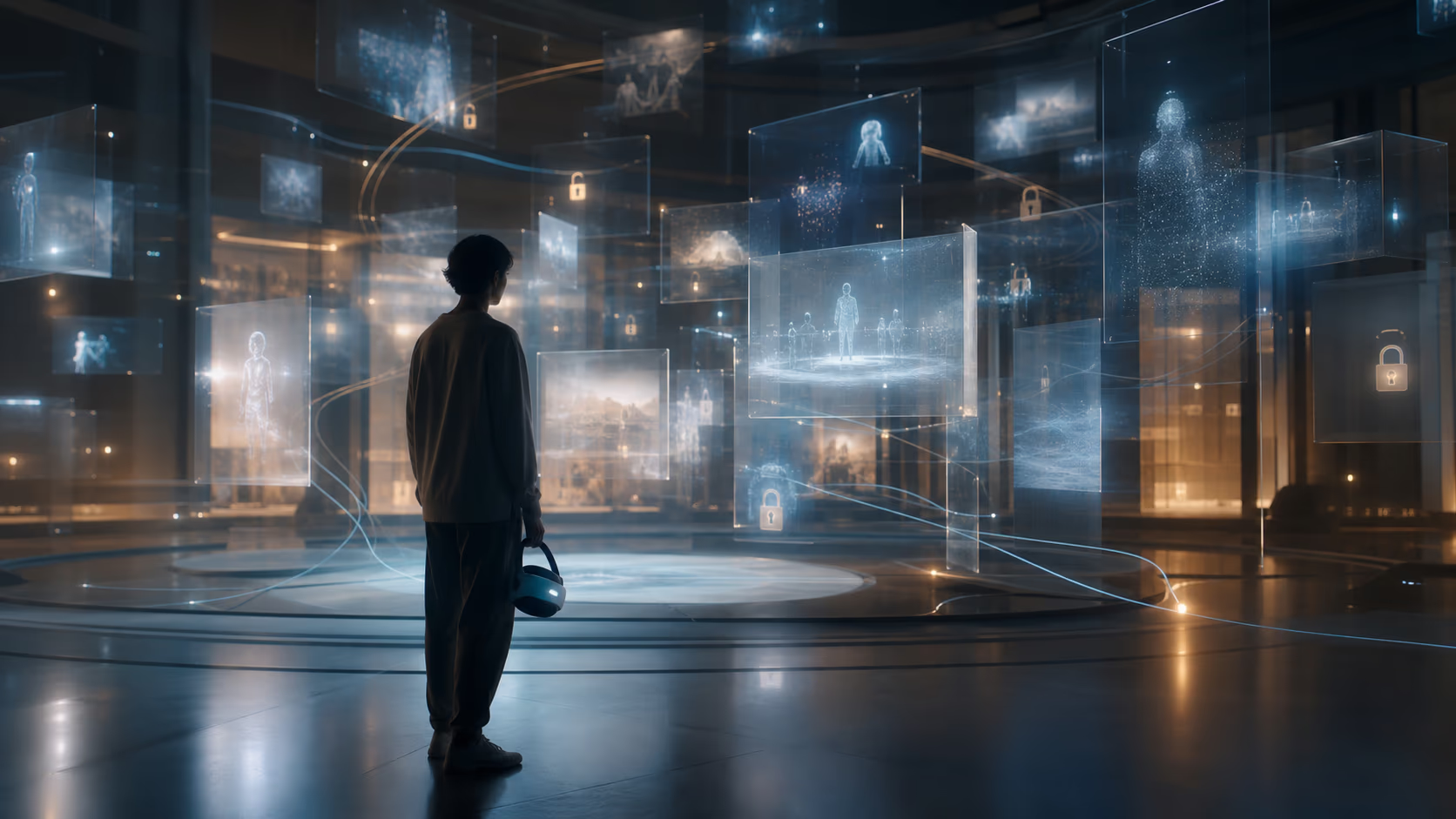
You could walk from the family garden into licensed common spaces: museums, classrooms, concerts, clinics, civic halls, theaters, workshops. The gates were visible and plain. Every gate showed who operated it, what data crossed, what identity rules applied, what sensory range was allowed, and whether commercial tracking existed inside.
Most people ignored the labels until something went wrong. Then they became grateful the labels were there.
Mara opened the city gate.
The three of them stepped onto a bridge of dark wood. Beneath it, Leah’s corrected river moved with convincing purpose. Halfway across, the family permission zone ended and the public layer began.
A soft chime sounded.
Public space ahead.
Personal touch disabled by default.
Identity verified.
Commercial capture: none.
Mara watched Leah read the notice. Good.
The city received them with bells.
Not church bells. Bicycle bells, elevator tones, glass chimes under awnings, the little bell from Nomi’s market stall, all braided into a sound that meant arrival without shouting. Avatars moved along the terraces: a man with a cane and a crown of floating equations, two teenagers practicing dance steps in low gravity, a group of medical students carrying a transparent model of a lung the size of a room, an old woman in a red coat feeding digital fish that wore tiny lanterns.
Some bodies were realistic. Some were symbolic. Some were very silly. Everyone carried identity markers, not as ugly labels above the head but as subtle signals woven into the body: verified human, synthetic guide, recorded lecture, private avatar, masked but accountable, child account, caregiver linked, public official, artist mode.
Trust had become part of fashion.
Leah ran ahead to the fountain, where water rose in slow cubes and fell as rain. The public system gave her extra boundary space because she was a minor. Other bodies flowed around the invisible margin without noticing unless they tried to cross it.
Eli came back to Mara’s side.
“You all right?”
“No.”
“Good.”
“Good?”
“If you said yes, I would worry.”
She took his arm. Public touch required a request even between friends, but family circle permissions carried through. The system pressed his sleeve into her hand.
They watched Leah try to catch cubic water.
“I used to think this would make us less human,” Mara said.
“Did it?”
“No. It made being human harder to lie about.”
Eli considered that. “Put it on a poster.”
“Absolutely not.”
Across the plaza, a school group entered the Museum of Weather. The children wore field skins for a lesson on monsoons. Their teacher, a synthetic guide clearly marked as such, explained that the room would simulate wind pressure but not fear intensity. A few children raised their settings. One lowered hers. No one mocked her. The system would not have allowed it to become a social event.
Mara remembered classrooms from before, where the loudest children owned the air.
Here, if designed well, air could be shared differently.
Not perfectly. Nothing human was perfect. People still found ways to manipulate, exclude, posture, sell junk, chase status, and confuse novelty with meaning. There were black-market worlds that stripped safeguards and called it freedom. There were grief pirates who built illegal ghosts. There were companies forever trying to turn attention into inventory. There were politicians who wanted memory archives subpoenaed, advertisers who wanted pupil data, and lonely people who trusted synthetic affection too easily.
The future had not solved desire.
It had made desire immersive.
That was why the boring layers mattered. Standards. Audits. Local processing. Consent. Exit. Age rules. Medical boundaries. Identity law. Public education. Slow defaults. The right to be untracked. The right to be unreachable. The right to leave the beautiful room.
Leah returned with wet hands that were not wet.
“Can we go to the engine house?” she asked.
Mara smiled. “Now you are speaking my language.”
The Engine House
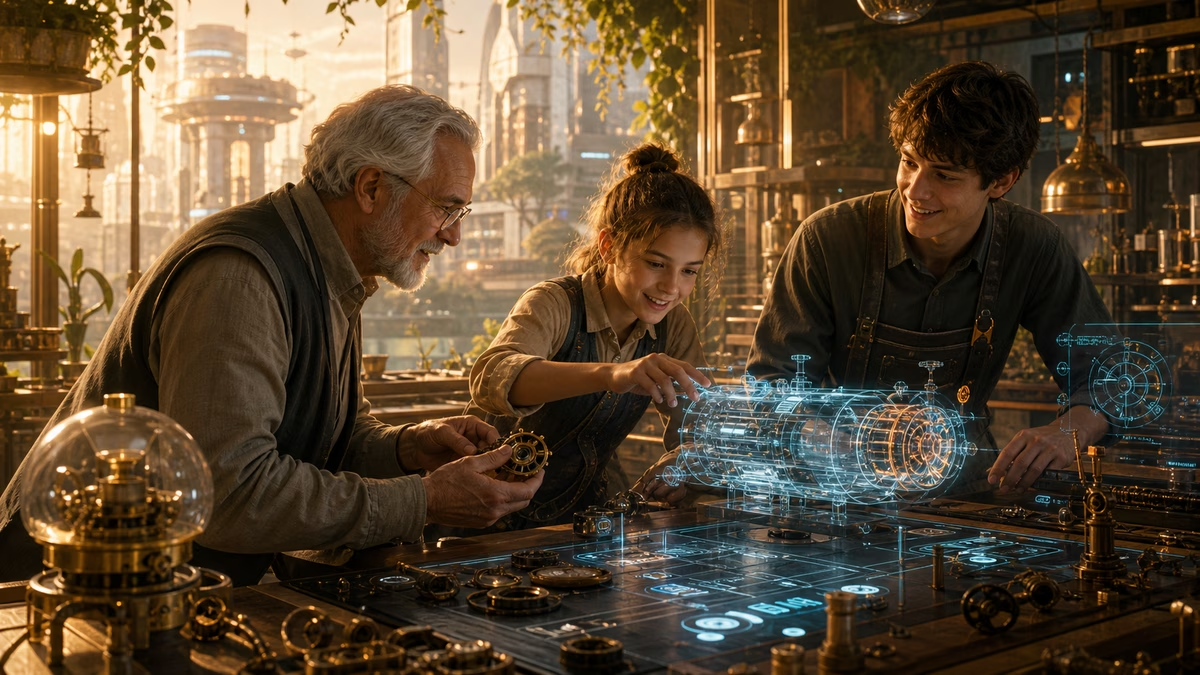
The engine house sat under the city, where no city needed engines.
It had brick walls because Mara liked brick walls. It had skylights even though it was underground. It smelled faintly of oil because she had insisted the smell be included, then reduced it by 40 percent after everyone complained. Along one wall hung tools from different centuries: wrench, torque driver, soldering iron, neural calibration wand, haptic timing probe, antique oscilloscope, a hammer no one needed but everyone respected.
In the center of the room floated the day’s project.
It looked like a bird made of clockwork and rain.
“Still broken?” Eli asked.
“Resting,” Mara said.
“It exploded yesterday.”
“Energetically resting.”
Leah clapped her hands. “Can I do the wing timing?”
“You may observe the wing timing.”
“That means no.”
“That means not yet.”
Mara opened the diagnostic layer. The bird unfolded into systems: lift surfaces, balance logic, gesture controls, haptic feedback, safety limits, failure states. It was not a real machine, but it behaved like one. The engine house was Mara’s favorite proof that virtual did not mean consequence-free. If you built badly, things failed. If you ignored constraints, the model punished you. If you understood, the impossible became temporarily obedient.
She handed Leah a timing probe.
“What is the first rule?”
“Do not increase intensity to hide bad timing.”
“Second?”
“If the body says no, the world listens.”
“Third?”
“Grandma gets dramatic when teaching.”
“Accepted.”
They worked.
Eli adjusted the balance field. Leah mapped wing response to wrist motion. Mara tuned the haptic cues so the bird would feel present without becoming too heavy in the hand. The first test failed. The bird launched, flipped, and turned into a wet metallic scarf across the ceiling.
Leah howled with laughter.
The second test failed more elegantly.
The third test flew.
It rose from Mara’s palm with a shiver of silver feathers. The cuffs gave her the smallest pressure, the delicate suggestion of claws. The bird circled the room once, twice, then passed through a shaft of underground sunlight and became briefly transparent, all its logic visible: lift, intention, correction, trust.
Mara looked at Leah’s face.
There it was again. The future, not in the machine, but in the attention the machine made possible.
“Can I hold it?” Leah whispered.
The system checked permissions. Mara approved. The bird crossed to Leah’s hand.
Her fingers trembled as it landed.
“It feels alive,” she said.
“It is not,” Mara said gently.
“I know.”
“Say it anyway.”
Leah rolled her eyes, but she obeyed. “It is not alive.”
“And?”
“Feeling is not the same as being.”
“And?”
“But feeling still matters.”
Mara nodded.
This was the line every full dive child had to learn. Feeling was not proof. Presence was not truth. A synthetic guide could comfort you without loving you. A memory archive could move you without containing the dead. A virtual animal could tremble in your hand without being alive. A simulated cliff could frighten you without being dangerous, unless you forgot the real coffee table.
The old internet had taught people to distrust images. The immersive age had to teach them to understand experiences.
Leah held the bird until it folded its wings and slept.
Then the session timer chimed.
Five minutes.
No one argued. This was one of the family rules. The first timer was a gift. The second was a boundary. The third ended the session whether anyone liked it or not.
Eli stretched. “Tea after?”
“Real tea,” Mara said.
“Obviously.”
Leah looked disappointed, then tried to hide it, then failed.
Mara touched the child’s shoulder. “You can come over next Sunday. We will make the river faster.”
“And the bird?”
“If your homework is done.”
“That is emotional blackmail.”
“That is grandparenting.”
The engine house dimmed.
Mara took one last look at the brick walls, the impossible skylights, the sleeping bird, the tools that had never existed beside tools that had outlived empires. Then she pressed two fingers to her palm.
Exit.
Waking Well
The real apartment returned by degrees.
First the floor. Then the weight of the wrap. Then the rain. Then the fog in the window corners. The garden withdrew without snapping shut. For ten seconds, the room held a soft outline of the path so Mara’s balance could move from one world to the other. The system lowered scent, then touch, then audio, then peripheral light.
Session complete.
Reorientation: 30 seconds.
Recommended: water, seated rest.
Mara sat on the edge of the bed.
Her left hand ached. The apartment was too small. The kitchen needed cleaning. A message from the building manager blinked on the wall about the insulation inspection being moved again. The future, having performed its miracle, returned her to chores.
Good, she thought.
Any heaven that cannot return you to dishes is not a place for humans.
She removed the cuffs, crown, and wrap. Her skin cooled where the fabric had touched it. She flexed her fingers, then walked to the kitchen and filled the kettle. Real water struck metal. Real steam rose. Real tea would be too hot, then just right, then forgotten on the counter if she got distracted.
Her wall showed a session summary. She had chosen the plain version.
Participants: 3.
Session length: 42 minutes.
Emotional intensity: moderate during archive.
Motion comfort: stable.
Boundary events: none.
Commercial data: none.
Memorial safeguards: maintained.
She read the last line twice.
Then she dismissed it.
Eli called on the flat screen because they always did that after immersion. It was another family rule. After the beautiful world, ordinary video. After simulated presence, a small rectangle with bad lighting. It helped the mind remember that people were not only their most vivid renderings.
His face appeared, older than in the garden, softer around the mouth.
“Tea?” he asked.
“Kettle is on.”
“You did well.”
“I cried in a fake kitchen.”
“It was a real cry.”
Mara leaned against the counter.
Outside, the rain thickened, blurring the city into watercolor. Somewhere in another apartment, Leah was probably telling her mother the river had been fixed and the adults had been emotionally difficult.
“Do you think Nomi would have hated it?” Mara asked.
Eli thought for a while. He gave real questions real silence.
“She would have hated parts of it,” he said. “Then she would have used it more than all of us.”
Mara laughed.
The kettle clicked off.
How We Get There From Here
This future does not begin with a magic cable into the brain.
It begins with less glamorous work.
It begins with headsets becoming lighter, clearer, cheaper, and easier to wear. It begins with optics that cause less strain, displays that hold stable frame rates, and passthrough good enough that users do not feel sealed away from their rooms. It begins with audio that understands space, controllers that track reliably, hand tracking that fails less often, and body tracking that respects privacy.
It begins with comfort.
Comfort sounds small until you remember that the body is the gate. If the headset hurts, the world fails. If motion makes people sick, the world fails. If setup is annoying, the world remains a demo. Better straps, batteries, lenses, calibration, locomotion, ventilation, and room boundaries are not accessories to the future. They are the first stones of the road.
It begins with haptics that tell the truth modestly. Not “feel everything.” Feel contact. Feel resistance. Feel timing. Feel direction. A small cue at the right moment can teach the brain more than a loud cue arriving late. Gloves, cuffs, vests, chairs, treadmills, fans, temperature elements, and muscle sensors will matter most when they become boring enough to trust.
It begins with input that understands intention without pretending to read the soul. Eyes, hands, voice, posture, breathing, muscle signals, and careful non-invasive neural signals can make virtual bodies more natural. But every new input is also a new privacy risk. The path forward has to treat attention, stress, gaze, and body signals as sensitive from the start.
It begins with medical technology staying honest about what it is for. Brain-computer interfaces may restore movement, communication, or sensation for people who need them. That work can teach the field about signal stability, training, materials, safety, and adaptation. But entertainment should not borrow the language of medicine to sell risk to healthy users. If consumer full dive ever uses direct neural interfaces, the safety bar should be high enough to slow everyone down.
It begins with worlds designed around exit.
The exit button is not the opposite of immersion. It is what makes immersion humane. Users need physical exits, voice exits, gesture exits, distress detection, session limits, recovery phases, and clear consent around touch, fear, motion, identity, and data. The deeper the world becomes, the stronger the way out must be.
It begins with children being protected before platforms become dependent on them. It begins with identity systems that make impersonation harder. It begins with memorial rules before grief becomes a business model. It begins with public spaces where people know who is human, who is synthetic, what is recorded, what is transformed, and what can follow them home.
And it begins with better stories.
Not hype. Not countdowns. Not fantasies that skip the body and call it freedom. Better stories about what we actually want from presence: to learn with our hands, to rehearse courage, to visit distant people without flattening them into windows, to build impossible classrooms, to preserve memory without counterfeiting the dead, to make play more embodied, to make care more reachable, to make tools that return us to the real world with more attention than we had when we left.
Full dive VR, if it ever becomes worthy of the name, will not be one invention.
It will be a treaty between hardware and nerves, between software and consent, between imagination and limits, between the room we leave and the room we return to.
The work starts now in every ordinary improvement that makes immersion clearer, safer, more comfortable, more honest, and easier to leave.
Ready when ready.