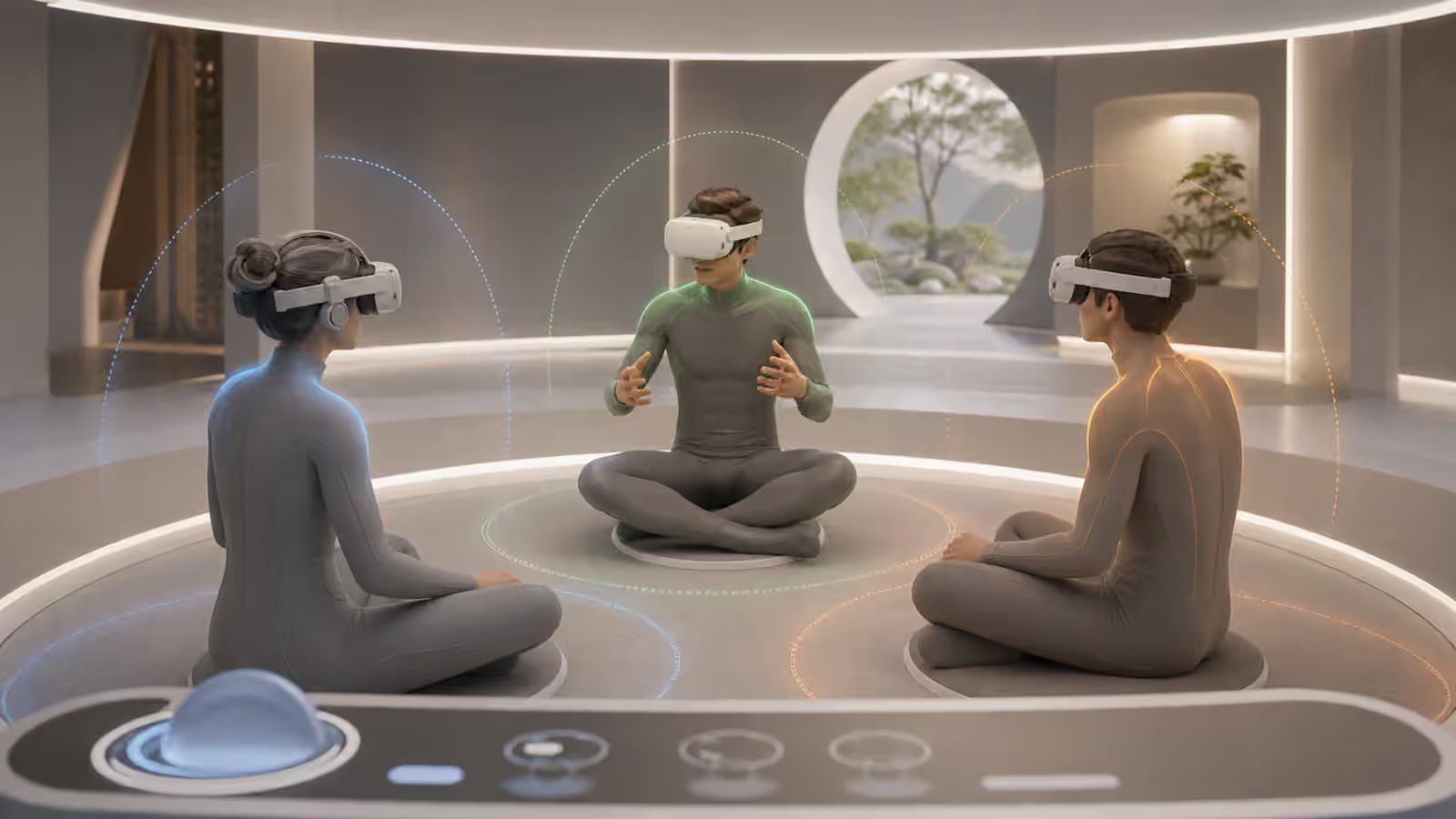
Shared full dive VR worlds will not be governed by vibes. A room that feels embodied, social, and persistent will need rules long before anything dramatic happens. People will disagree about proximity, touch, identity, recording, performance, speech, synthetic companions, commercial activity, access, and repair. Some conflicts will be ordinary community friction. Some will involve the body more directly because a full dive system can make space, sound, timing, and contact feel personal.
Shared Worlds in Full Dive VR explains why multiplayer immersion needs personal space and consent built into the room. Governance begins after that point. Consent tools can prevent many harms, but they cannot answer every question a community will face. Who sets the rules of a public plaza? Who decides whether a copied room violates a group’s memory? What happens when an avatar looks like a trusted person but is not them? When does moderation protect a user, and when does it become surveillance?
Rules Need to Be More Than Text
Flat online communities often bury rules in terms, pinned posts, or moderator announcements. Full dive VR should not rely on that habit. If the world can shape perception, then rules should shape the architecture. A personal boundary can appear as distance, softness, silence, resistance, or a fading avatar. A recording limit can be built into the room rather than left as a social request. A public forum can make exits easy and private rooms clear. A training space can limit who may touch tools, alter scenarios, or observe.
This does not mean every rule should become a glowing barrier. Heavy-handed rule design can make a world feel suspicious and overmanaged. The better goal is legibility. A user should understand what kind of space they entered. A quiet archive, a classroom, a competitive arena, a family room, a memorial, and an open market should not all feel governed by the same invisible switchboard.
Permission Boundaries in Full Dive VR offers the right frame. A world should be clear about what it can do to the user’s attention, body, memory, and social presence. Community governance adds another layer: the world should also be clear about what other people can do, what moderators can do, and how disputes will be handled when permissions collide.
Moderators Need Limits as Much as Power
A moderator in full dive VR may need stronger tools than a text moderator. They might separate avatars, freeze an object, mute a sensory channel, preserve a narrow technical log, move someone to a neutral room, or interrupt a scene that is escalating. Those powers can protect people. They can also become frightening if they are invisible or personal.
Moderation should be role-bound and visible enough to trust. Users should know when they are speaking to a moderator, a synthetic helper, an automated safety system, or another ordinary participant. A moderator should not quietly enter private rooms, inspect body traces, replay intimate scenes, or override exits without a serious reason. The ability to intervene is not the same as permission to watch everything.
Session Logs and Incident Response in Full Dive VR is central here. Community safety will sometimes require records, but the record should explain what happened without exposing more than necessary. A moderator may need to know that a boundary was crossed. They do not need to turn a user’s flinch, breath, or hesitation into community evidence unless that information is truly necessary and handled with restraint.
Identity Disputes Will Be Community Disputes
Identity in a full dive world is not only a login problem. It is how people recognize each other through voice, movement, body shape, social history, and the felt continuity of presence. A user may change avatars for expression, privacy, performance, or play. Another user may copy an appearance to confuse, mock, flirt, sell, or harass. A synthetic person may resemble someone real. A moderator may need to decide whether the problem is impersonation, parody, fan behavior, memorial use, roleplay, or a private agreement gone wrong.
Identity Continuity and Impersonation in Full Dive VR covers the trust problem directly. Governance turns that trust problem into procedure. A community needs ways to verify trusted roles without forcing everyone into public identity. It needs ways to let people explore bodies without making recognition meaningless. It needs policies for public figures, deceased people, teachers, clinicians, moderators, and synthetic hosts that borrow authority from real relationships.
Appeals matter because identity conflicts are not always obvious. A user may be wrongly accused of copying a body. A moderator may misunderstand a cultural signal, disability accommodation, or private roleplay context. A platform may overcorrect by making everyone carry a rigid identity mark. A mature community should be able to pause, review, and repair without treating every dispute as proof that anonymity or embodiment has failed.
Synthetic Hosts Should Not Become Governments
Synthetic people will be useful in shared worlds. They can welcome newcomers, explain local norms, translate conflicts, run practice spaces, and remind people of consent settings. They can also become the soft face of authority. If a synthetic host remembers everyone, adjusts the room, suggests who belongs, and reports violations, users may experience it as the community’s caretaker even if a platform controls it.
Synthetic People in Full Dive VR argues that artificial presence needs disclosure and limits. Governance should treat synthetic hosts the same way. A host should say what it is allowed to remember, when it is acting for moderators, when it is offering advice, and when it is enforcing a rule. It should not create the impression of friendship while collecting evidence for punishment. It should not resolve conflict by quietly steering vulnerable users away from public view without telling them why.
The strongest synthetic governance tools may be modest. A guide can explain room norms before entry. It can help a user find a lower-intensity version of a space. It can help write a report without interpreting private emotion. It can remind a moderator that a replay includes sensitive layers. It can step aside when a human decision is required.
Persistent Worlds Need Civic Memory
Persistent Worlds in Full Dive VR asks what remains after users leave. Governance has to answer the same question socially. If a conflict changes a world, the community may need a memory of what happened. If a room is vandalized, restored, forked, archived, or renamed, the change should be understandable. If a moderator removes a user from a shared home, the remaining users may need a record of the decision without receiving private evidence.
Civic memory is different from total memory. A healthy community does not need to preserve every gesture, conversation, sensory response, or hesitation. It needs enough history to make rules consistent and repair possible. It needs authorship markers, version history, transparent role changes, and clear boundaries around what cannot be replayed. The community should be able to remember decisions without turning all participants into permanent exhibits.
Memory Rights in Full Dive VR belongs near every governance discussion because records can become power. A platform that stores everything can always claim later that the evidence supports its choice. A platform that stores nothing may leave users unable to show harm. The careful middle is harder, but it is where trust lives.
Repair Is Not Only Removal
Moderation often becomes a removal story. Someone violates a rule, the system removes them, and the room continues. Full dive communities will need more forms of repair. A user may need a boundary changed, a replay sealed, a synthetic host corrected, an object restored, a public clarification, a private apology, or a new version of the room. A group may need to admit that a rule was unclear. A platform may need to say that the world allowed a behavior it should have prevented.
Repair should not force unwanted contact. A person who was harmed should not have to meet the person who harmed them inside an embodied space to make the community feel healed. Repair can be procedural, architectural, and practical. The room can change. The permissions can change. The logs can be limited. The moderator role can be reviewed. The affected person can be given time to return or not return.
The purpose of governance is not to make full dive worlds feel bureaucratic. It is to make social immersion survivable at human scale. A world can be playful, strange, intimate, and creative while still having clear rules. In fact, it may need those rules in order to make play possible. People take more risks when they believe the room knows how to stop, explain, and repair.
The best shared worlds will not be the ones with the loudest moderation tools. They will be the ones where rules are felt as careful architecture, authority is limited, identity can be trusted without being flattened, and conflict does not automatically become spectacle. A community that can govern itself with restraint may be one of the first signs that full dive VR is becoming a medium, not just a sensation machine.