The first room in full dive VR should not be a dragon arena, a moonbase, or a perfect copy of Paris.
It should be quiet.
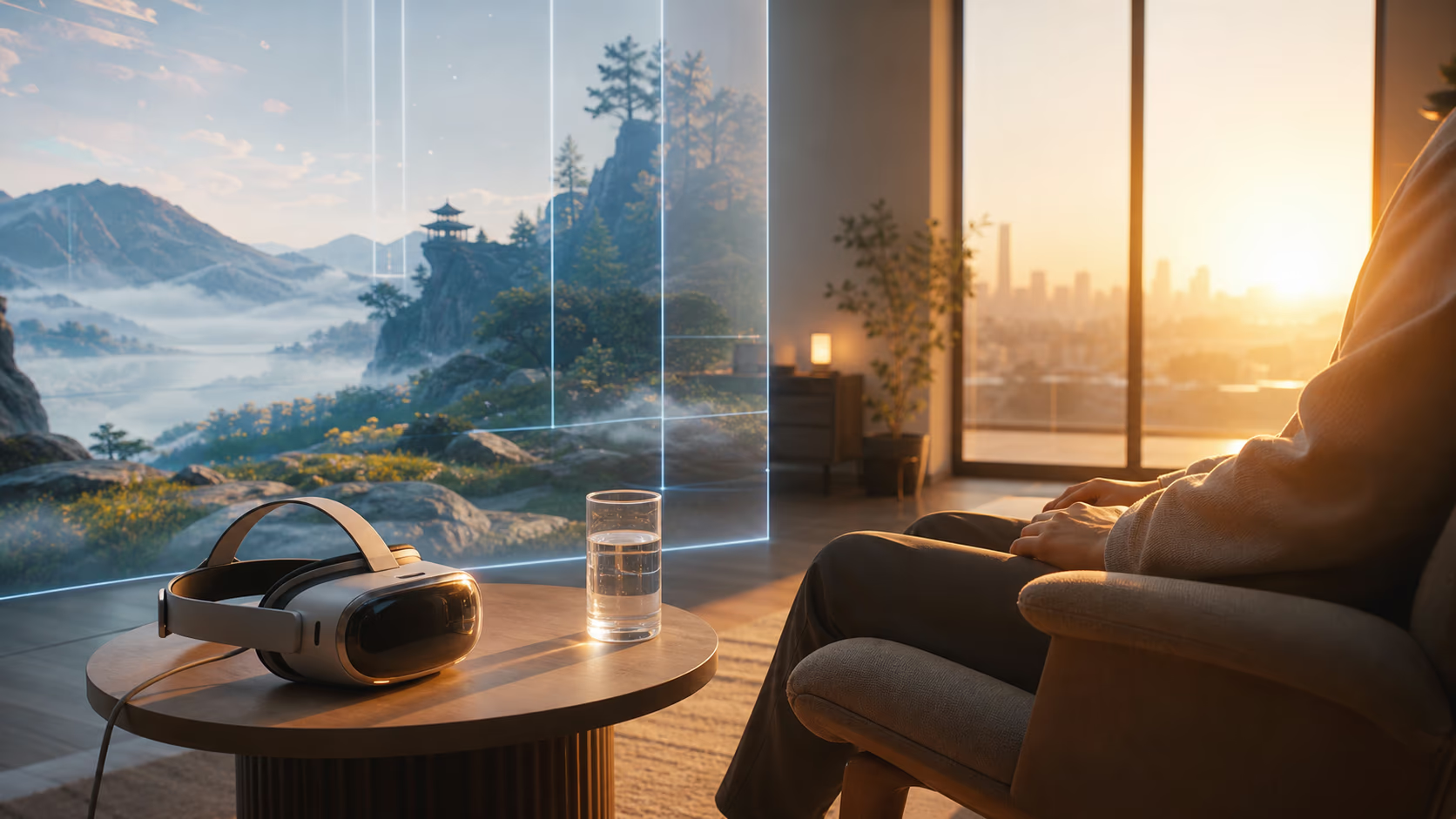
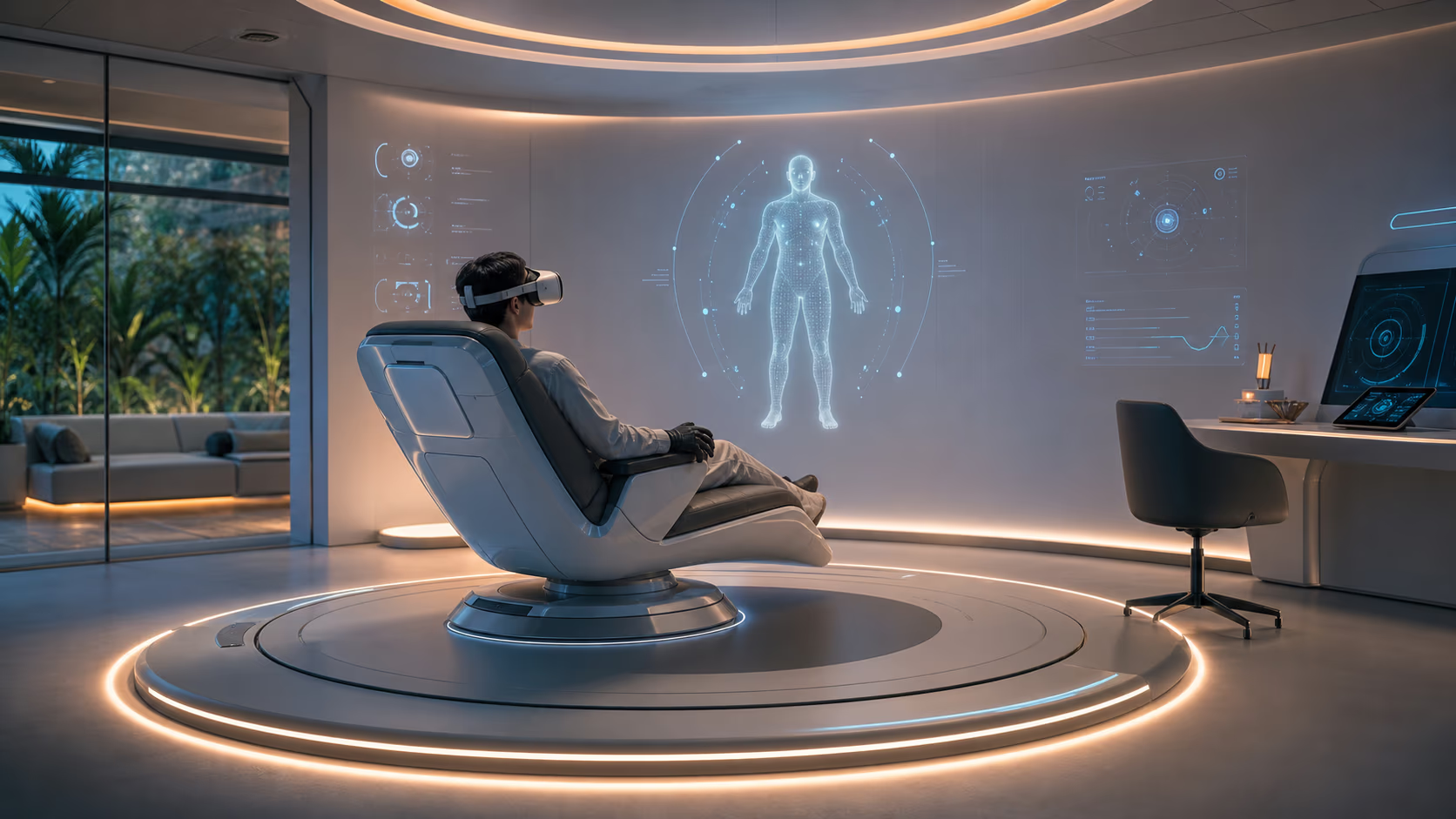
Imagine a small room with warm light, a soft floor, a chair that does not look like medical equipment, and a wall that behaves like a mirror without pretending to be one. You put on the headset. The system does not ask you to save the world. It asks you to lift your hand.
The virtual hand rises a fraction too late.
You notice it immediately.
That is the beginning of the calibration problem. Before a full dive system can offer a believable world, it has to learn the person who is entering it. Your arm length, reaction time, balance tolerance, sensory sensitivity, fear of falling, hand dominance, neck range, breathing rhythm, and comfort boundaries are not decorative details. They are the foundation of the experience.
Full dive VR is often imagined as a door. Calibration is the hinge.
The System Has to Learn Your Shape
Current VR already calibrates more than people think. It sets floor height. It finds controllers. It estimates guardian boundaries. It may track your hands, eyes, face, or torso. If the floor is wrong by a few inches, the whole world feels false.
Full dive pushes that idea much further.
A deeper system would need a body map. Not a perfect medical replica, but a working model of how your body usually moves and what it can safely tolerate. How far can your shoulder rotate before strain? How quickly do you turn your head? Do you get uncomfortable when virtual objects enter personal space? Does artificial movement make you sick? Do you need low-intensity haptics on one hand and stronger cues on the other?
Those questions are not small. They decide whether the system feels like it is helping you inhabit a world or pulling you around inside one.
The calibration room should treat your body as the source of truth. If the system and the user disagree, the user wins.
Calibration Is a Conversation
A bad calibration flow feels like filling out a form. Stand here. Press this. Look there. Continue.
A good one feels more like a conversation.
The room might ask you to reach for a floating lantern. At first the lantern is close. Then it drifts just outside your usual reach. The system watches how you compensate. Do you lean? Step? Stretch? Hesitate? Does your breathing change when the floor appears to move? Does your hand slow down near a virtual flame, even though you know it is not real?
None of this has to be creepy. In fact, the less theatrical it is, the better. The system can explain what it is measuring in ordinary language:
- Range of motion.
- Reaction delay.
- Motion comfort.
- Touch sensitivity.
- Social distance.
- Emergency exit practice.
- Preferred intensity limits.
The important part is that calibration is not a trick. The user should know when the system is learning, what it is saving, and how to reset it.
The First Test Is Latency
Latency is the delay between what you do and what the world shows.
In flat software, a little delay is annoying. In immersive systems, delay becomes physical. If you turn your head and the room follows late, your body notices. If your virtual fingers close after your real fingers, the hand stops feeling like yours. If a haptic pulse arrives after the visual contact, the touch becomes a reminder that the illusion is made of machinery.
The calibration room should make latency visible before the real experience begins.
It might show a simple mirror body and let you move slowly, then quickly. It might ask you to tap virtual droplets that appear at different distances. It might tune animation smoothing for comfort instead of pretending the same setting fits everyone.
Full dive does not need every response to be mathematically perfect. It needs the loop to feel trustworthy. The body is forgiving when delays are stable and understandable. It is much less forgiving when delay changes without warning.
The Second Test Is Comfort
Comfort is not a luxury setting.
Comfort is the system admitting that the user has a nervous system.
Some people can fly through a virtual canyon without nausea. Others feel unsteady from a slow artificial turn. Some people enjoy strong impact cues. Others want only gentle vibration. Some people can handle narrow virtual rooms. Others need open space, visible exits, and stable horizons.
A full dive system should learn these limits early, before content pressure begins. It should not wait until the user is already in a story, a game, or a social room to discover that the motion profile is wrong.
The calibration room can test comfort with small scenes:
- A stable room.
- A slow elevator.
- A short step forward.
- A nearby avatar.
- A soft hand contact.
- A height cue with a visible rail.
- A fade-out and return.
Each test should have an easy refusal. Refusal is data too. If a user says no to a sensation, the system has learned something useful.
The Third Test Is Intent
Input is not only motion. It is intention.
You may intend to wave, grab, point, push, shrug, sit, hide, or leave. Current VR asks controllers and cameras to infer those intentions from buttons and movement. Future systems may add muscle signals, eye tracking, voice, or neural interfaces.
That does not make intent reading magical.
Intent is messy. A person can imagine moving without moving. They can tense because they are afraid, not because they want an action. They can look at something because it is interesting, threatening, confusing, attractive, or distracting. They can say “stop” as a joke, a command, or a panic response.
The calibration room is where the system should learn conservative defaults. When in doubt, it should choose the interpretation that protects the user, not the one that creates the most dramatic scene.
If a user flinches, the world should not assume consent to fight. If a user stares, the world should not assume desire. If a user tenses, the world should not punish them for being afraid.
The Fourth Test Is Exit
The exit should be practiced before it is needed.
This may be the most important part of calibration. A user should know the physical control, voice command, gesture, and automatic timeout path. They should experience a gentle exit once, in a calm state, so it is not mysterious during stress.
The system might say: “We are going to leave now. The room will dim. Your hands will return first. Then the headset view will show your physical space.”
Then it does exactly that.
No drama. No penalty. No scolding. No “are you sure?” loop when the user has already chosen to stop.
Practiced exits build trust. Trust makes deeper immersion possible.
The Data Should Have a Short Leash
Calibration creates intimate data.
A body map may reveal injury, disability, reaction patterns, stress, attention, motion tolerance, and personal boundaries. If future systems include biometric or neural signals, the calibration profile becomes even more sensitive.
The user should be able to answer simple questions:
- What is stored?
- What stays local?
- What can other people infer?
- What can be deleted?
- Can one profile be used across apps?
- Can an app request extra permissions?
- Does the platform train models on this data?
If those questions require legal archaeology, the system is not ready for deep trust.
Full dive calibration should be powerful because it is narrow. It should learn what it needs to keep the user comfortable and embodied. It should not become a general-purpose file of human vulnerability.
The Best Calibration Feels Almost Boring
The dream version of full dive begins with spectacle. The responsible version begins with patience.
A good calibration room should feel calm, legible, and respectful. It should be beautiful enough that the user relaxes, but not so theatrical that the user forgets what is being measured. It should give control early, explain itself plainly, and let the user revise choices later.
That first room teaches the system a lesson too.
It teaches the system that the body is not an obstacle between the user and the world. The body is the way in.
If full dive VR ever becomes real, the first great product may not be the world with the most impossible mountain range. It may be the room that asks you to lift your hand, notices that it got the timing wrong, and quietly fixes itself before asking for anything more.