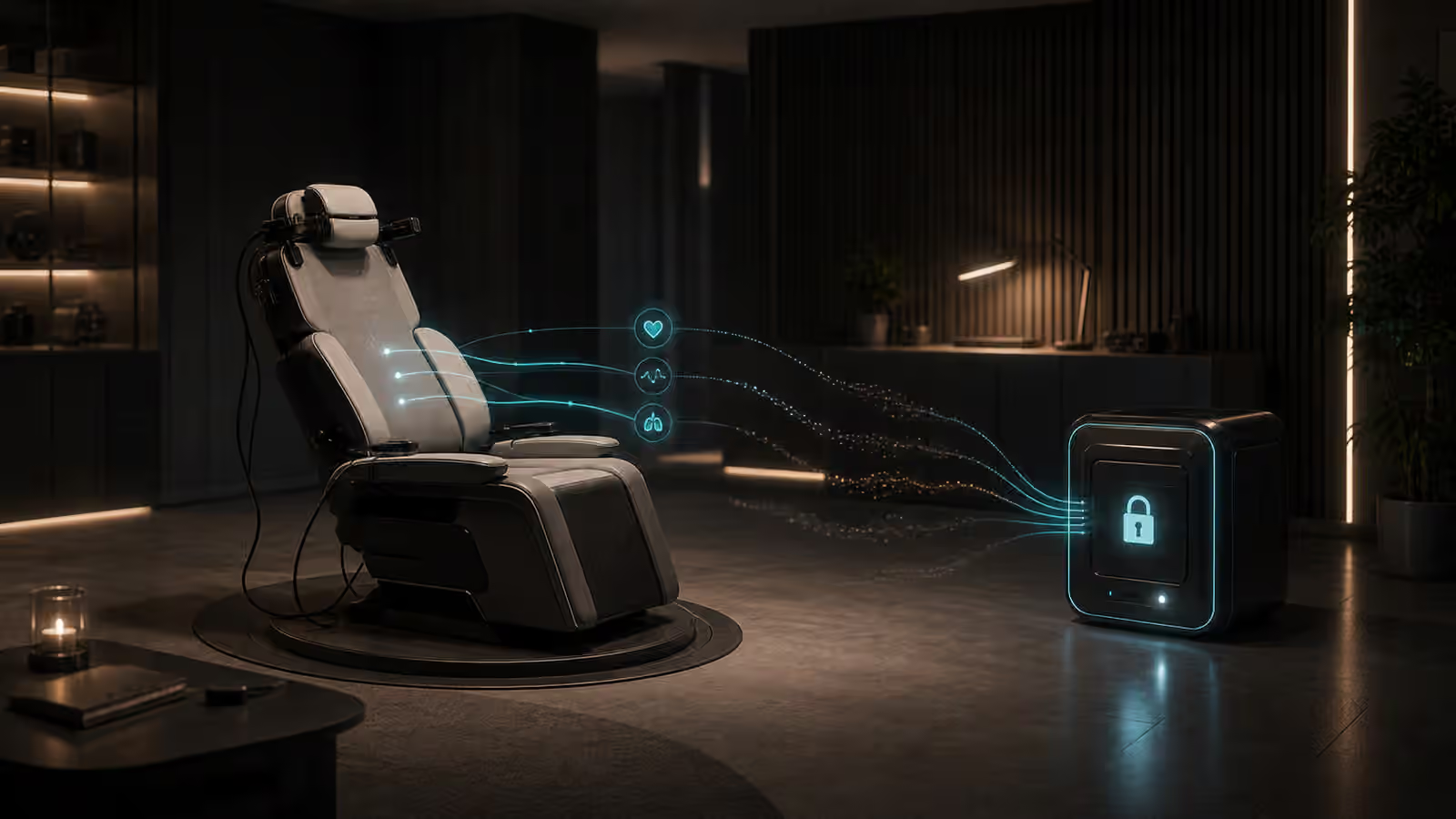
A full dive system would learn the user long before it could serve the user well. It would learn comfortable motion ranges, sensory thresholds, avatar proportions, preferred exits, assistive mappings, social distance, haptic limits, voice settings, fatigue patterns, and the small timing corrections that make a virtual body feel less foreign. The obvious question follows quickly: should that knowledge travel with the user from one world to another?
The answer is not a simple yes or no. A portable calibration profile could make full dive VR more humane. It could spare users from repeating the same sensitive setup in every classroom, social room, training shop, game, and recovery space. It could carry accessibility needs without forcing public explanation. It could keep a world from asking for sensations or movements the user has already rejected.
The same profile could also become one of the most intimate records a platform holds. The Calibration Room treats calibration as the first act of trust. Portability asks what happens after that first act, when the system wants to reuse the body’s map again and again.
A Profile Is Not Just Preferences
The word profile sounds harmless because ordinary software uses it for names, pictures, themes, and notification settings. A full dive calibration profile would be different. It might include how quickly the user tolerates acceleration, which hand motions are comfortable, whether touch should be symbolic or literal, what kinds of voice proximity feel intrusive, whether balance cues should be reduced, how fatigue changes control, and which emergency exits are easiest to trigger.
Some of that information is practical. Without it, every world starts by guessing. A user who needs seated locomotion, lower sensory intensity, a stable horizon, or a specific assistive input path should not have to argue with each new room. Accessibility in Full Dive VR makes this point broadly: different bodies should be expected from the beginning, not treated as exceptions.
But the same information can reveal more than the user intends. A movement limit may hint at disability or injury. A sensory refusal may suggest a private association. A fatigue pattern may expose work habits, sleep patterns, stress, or recovery needs. A social distance setting may reveal vulnerability in public rooms. The profile is useful because it is personal. It is risky for the same reason.
Portability Should Reduce Repetition, Not Remove Consent
The strongest argument for a portable profile is simple dignity. Repeating calibration can be tiring and exposing. A person should not have to explain in every world that they prefer no sudden touch, cannot tolerate fast rotation, need captions or voice alternatives, use a nonstandard input path, or want a slower reentry sequence. If the profile can carry those terms quietly, the user enters with less friction.
That convenience should not become silent permission. A world should not inherit every setting simply because the user crossed a threshold. Permission Boundaries in Full Dive VR is useful here because permissions are contextual. A user may allow rich hand texture in a craft studio but not in a public party. They may accept voice closeness from selected friends but not from a synthetic host. They may use an intense motion profile during flight training in a supervised room and a much softer profile late at night.
Portable calibration should therefore behave more like a negotiator than a keyring. It can tell a new world what the user’s baseline is, what is never allowed, what is allowed only in certain contexts, and what requires a fresh question. The world can then adapt or explain why it cannot support the session under those limits. That is different from treating the profile as a universal consent form.
The Most Sensitive Pieces Should Stay Close
A profile does not need to travel as one object. Some parts can move between worlds because they are necessary and low risk. Other parts should stay on the device, in the room, or under tighter user control. The difference matters.
A basic height range, preferred locomotion mode, caption preference, or default exit gesture may be safe enough to share with many experiences. A detailed body response record, neural signal map, pain threshold, fatigue history, emotional reaction pattern, or private reentry note deserves stronger protection. A platform that exports all of it because portability is convenient has confused service with possession.
Privacy and Consent in Full Dive VR argues that embodied data is close to the self. Calibration data is one of the clearest examples. The platform may need enough information to adapt the world, but it does not automatically need to reveal why adaptation is needed. A public room can know not to allow surprise tactile contact without knowing the story behind that boundary. A training simulator can know to reduce rotation without receiving a medical explanation. A synthetic tutor can know which input path works without seeing years of body history.
This is also where Memory Rights in Full Dive VR becomes practical. A calibration profile is not exactly a memory, but it can become a trace of lived sessions. It may remember which worlds caused drift, which scenes were ended early, which body forms felt stable, and which social settings required withdrawal. Those records can help the user. They can also become a quiet biography if left to accumulate without limits.
Worlds Should Ask What They Need
A responsible full dive world should ask for the smallest useful part of a profile. A classroom may need accessibility mappings, attention-friendly audio settings, and a safe motion range. A climbing simulation may need balance tolerance, haptic limits, and a supervised exit plan. A quiet social room may need voice distance, touch permissions, and identity preferences. A recovery room may need reentry pace and low-stimulation defaults.
The world should not ask for everything because it might help later. That habit already weakens trust in ordinary software. In full dive, it would be worse because the data describes the user’s embodied limits. The better pattern is contextual disclosure. The world declares what it intends to do, the profile offers only the relevant boundaries, and the user can see the exchange in plain terms.
The exchange should also be graceful when the answer is no. If a world cannot run without fast motion, intense haptics, or public voice, it can say so before entry. It should not shame the user for refusing. It should not pretend the settings are compatible and then degrade the experience into confusion. Latency, Drift, and Trust in Full Dive VR shows why this matters. A system that runs outside a reliable body model is not merely less polished. It is asking the user to trust a mismatch.
Profiles Need Context and Time
Bodies change. A profile captured on a calm afternoon may not fit a tired evening. A user who enjoys strong motion in a short private session may reject the same motion after a long workday. An accessibility mapping may change after injury, recovery, aging, practice, or a new device. A social boundary may change depending on who is present. A profile that treats the user as fixed will eventually become rude.
Portable calibration should include context without turning context into surveillance. It can remember that the user prefers lower stimulation late in a session without reporting private sleep habits to every world. It can offer a gentler reentry when fatigue is likely without labeling the user for others. It can invite recalibration after repeated mismatch without forcing a public explanation.
Sleep, Rest, and Recovery in Full Dive VR and Social Reentry After Full Dive VR both point toward this need for timing. The profile should know that a session is not isolated from the life around it. A body that has to return to family, work, food, sleep, or quiet should not be treated as a machine that resets whenever a new world loads.
The User Needs Editing Rights
If a profile travels, the user needs to inspect and edit it without becoming a systems engineer. They should be able to retire an old body map, lower a sensory ceiling, delete a private note, split work and leisure settings, reset a synthetic character’s memory access, and choose which worlds can remember what. These edits should feel like ordinary care, not like breaking a hidden contract.
Change should be especially easy after a bad session. If a user discovers that a motion setting was too strong, a social boundary too loose, or a haptic cue too literal, the system should help them turn that experience into a future boundary. It should not demand that they revisit the scene that caused the problem. It should not bury the relevant setting under technical language. It should not assume that because a user once agreed, they remain the same person forever.
There is a dignity in being allowed to become more cautious, more confident, more private, or more adventurous over time. A portable profile should support that movement. It should not preserve an old version of the user as a platform asset.
A Humble Profile Travels Best
The best portable calibration profile may be humble. It would carry enough to prevent avoidable discomfort, protect core boundaries, support accessibility, and make new worlds intelligible. It would keep the most sensitive details close. It would share context only when context is necessary. It would ask again when a world crosses from ordinary adaptation into bodily authority.
That kind of profile would not make every world seamless, and that is fine. Friction is sometimes useful. A pause before intense haptics, a visible explanation before body transformation, or a clear refusal from a world that cannot support the user’s limits may be more trustworthy than a smooth entry that hides the cost.
Full dive VR will need memory, but it should remember with manners. A calibration profile can be a passport, a comfort map, an accessibility layer, and a boundary record. It should not become a dossier. What travels with the user should help the user arrive as themselves, not give every world a deeper claim on the body that made arrival possible.