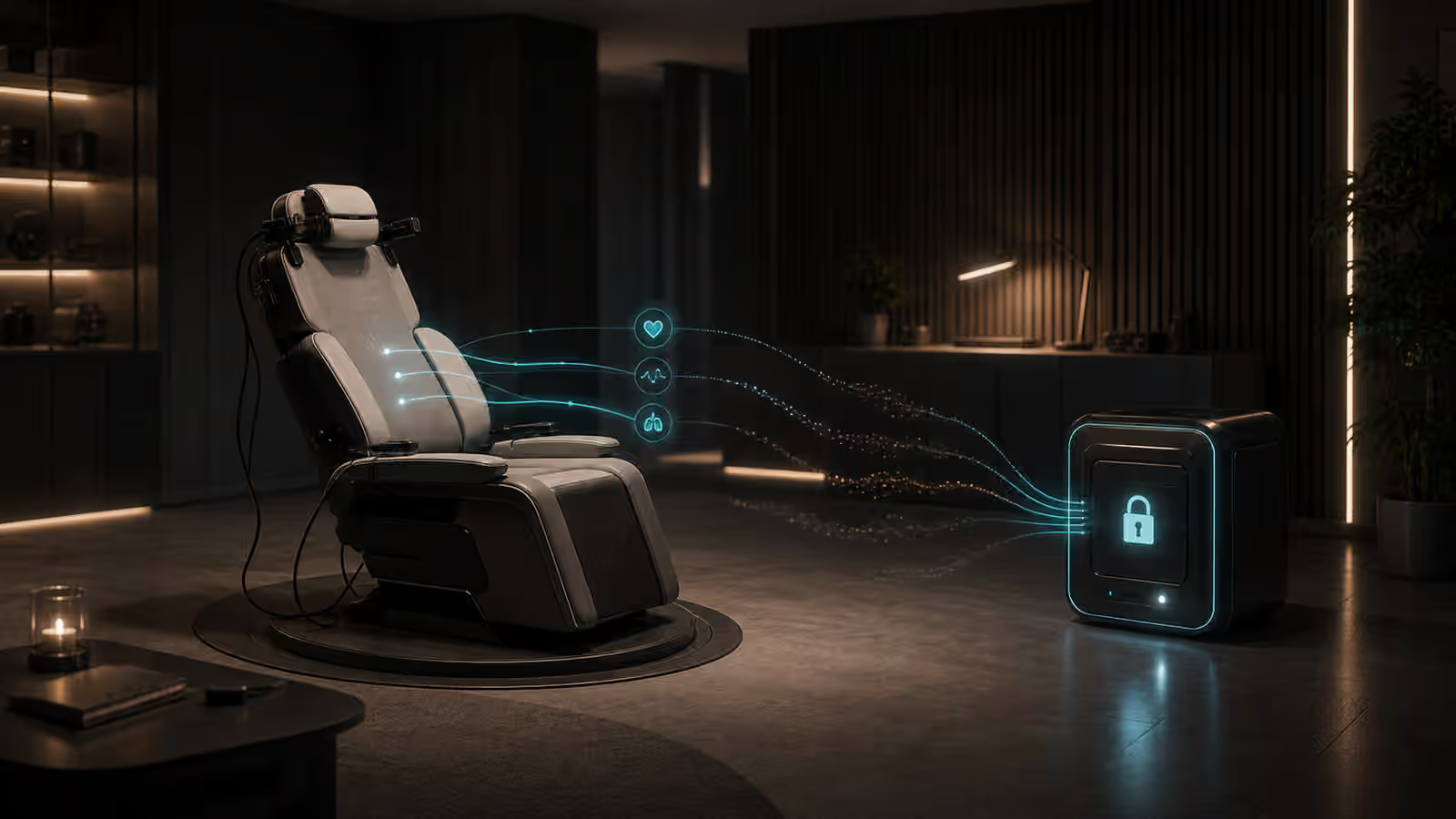
The most private data in full dive VR would not look private at first. A head turn, a delayed reach, a soft refusal, a change in breathing, a preference for lower touch intensity, a moment of hesitation near a synthetic person, or a repeated return to the same quiet room could all become useful signals. The system may need some of them to make immersion stable. It does not follow that the platform should keep all of them.
Privacy and Consent in Full Dive VR explains why body data sits close to the self. This guide asks a narrower operational question: what should a responsible system refuse to collect, refuse to retain, or refuse to make legible even when collection is technically possible? A full dive world can be vivid without becoming an archive of every nervous response. In fact, it may become more trustworthy when it proves that usefulness and appetite are not the same thing.
The Smallest Useful Signal
Data minimization begins with a plain discipline. The system should ask what signal is needed for the task in front of it, how precise that signal must be, how long it must remain available, and who needs to see it. A reach correction during a workshop may require short-lived hand-position data. It probably does not require a permanent record of every tremor, grip correction, and hesitation. A reorientation room may need to know that the user is coming back from a high-intensity scene. It does not need to keep a lifelong emotional map of which textures made the user tense.
Full dive VR will tempt designers because rich signals can improve everything. Calibration can feel smoother. Characters can respond with more timing. Safety systems can notice trouble earlier. Training worlds can grade performance more precisely. The temptation is real because the benefits are real. The mistake is treating every possible improvement as permission to preserve the underlying signal.
Calibration Profiles in Full Dive VR is useful here because calibration needs memory, but not unlimited memory. A profile can store durable preferences and ranges without keeping raw traces from every session. It can remember that a user prefers lower thermal intensity without preserving the scene where that preference first became obvious. It can know that a seated mode is usual without turning mobility details into a broad identity file.
Raw Signals Should Age Quickly
Raw body signals are often most useful in the moment. They help the system align a virtual hand, soften a sound, reduce drift, or pause a scene. After that moment passes, the value changes. A raw trace that once helped keep the body comfortable can become a sensitive record of attention, fatigue, disability, distress, pleasure, fear, or social vulnerability.
The system should therefore treat raw signals as perishable by default. Some data may need to survive briefly for debugging, incident review, or user-visible session continuity. Some may need to be summarized into less revealing settings. Some should disappear as soon as the local process no longer needs it. The important shift is that retention must be justified, not assumed.
Session Logs and Incident Response in Full Dive VR makes the same point from the perspective of failure. Logs should explain without exposing. A normal session should be held to an even higher standard. If nothing went wrong, the platform should have fewer reasons to keep intimate traces. The user’s ordinary comfort should not become an accidental evidence file.
Personalization Should Be Narrow
People will want full dive worlds to remember them. A system that forgets every preference would be tedious and sometimes inaccessible. The user should not have to explain every session that a certain sound range is tiring, that a particular chair angle is better, that visual overload arrives quickly, or that a slower exit helps. Good personalization can be humane.
The question is what kind of memory personalization uses. A narrow setting says, “this person prefers a calmer reentry.” A broad behavioral model says, “this person tends to become compliant after a warm voice and a dark room.” The first helps the user. The second can become a persuasion tool, a risk score, or a commercial asset. Both may begin from the same observations. The difference is the shape of the stored conclusion.
Advertising and Persuasion Boundaries in Full Dive VR matters because personalization can slide into influence. A platform that knows the user’s sensory thresholds, attachment patterns, and fatigue windows can make offers, characters, and worlds feel uncannily well timed. Data minimization should interrupt that slide. The system can support comfort without handing every comfort signal to every commercial surface.
Shared Worlds Need Less, Not More
Shared worlds create pressure to reveal. Other participants may want proof that someone is present, attentive, authorized, comfortable, or safe. Moderators may want enough context to resolve disputes. Creators may want analytics. Friends may want continuity. In full dive VR, those social desires can become demands on the body.
A shared room should expose the least sensitive status that solves the social problem. It can show that a person is unavailable without saying whether they are in recovery mode. It can show that a touch request was refused without revealing the user’s sensory threshold. It can let a moderator know that a boundary was crossed without showing everyone the user’s reaction. It can permit a facilitator to protect physical safety without giving them casual access to private replays.
Shared Worlds in Full Dive VR argues that consent depends on knowing who is present and what they can do. Data minimization adds another layer: people also need to know what they are not revealing simply by being there. Presence should not mean involuntary disclosure.
Deletion Should Be Understandable
Deletion is often treated as a button. In full dive VR, it should be a promise with boundaries the user can understand. Deleting a replay, clearing a calibration trace, closing a synthetic companion memory, or leaving a persistent world may affect different systems. The user should not have to guess whether deletion means hidden from view, removed from search, detached from the account, retained for safety review, or kept in a backup nobody mentions.
The platform should explain deletion at the level that matters to the person, not at the level convenient to the database. A memory-like replay deserves different language from a cache file. A body profile deserves different language from a public room decoration. A synthetic person’s memory deserves different language from a render setting. Memory Rights in Full Dive VR is the broader home for that principle.
Data minimization makes deletion easier because there is less to unwind. A system that collected carefully can delete honestly. A system that copied signals into analytics, training data, social graphs, safety scores, and personalization models will struggle to tell the user what leaving actually means.
Refusal Is a Feature
The most trustworthy full dive platforms may be remembered for what they refuse to know. They refuse to keep raw signals after local use. They refuse to turn every reaction into a profile. They refuse to reveal body-derived status in shared rooms unless the user has a reason to understand it. They refuse to let commerce, moderation, or entertainment claim every signal just because the sensors can produce it.
That refusal is not a lack of imagination. It is the condition that lets imagination remain livable. A full dive world will ask the body for attention, movement, trust, and sometimes vulnerability. The least it can do in return is collect with restraint, summarize with care, forget by default, and make every longer memory earn its place.