I had the ring. I had the plan. I had the restaurant reservation and the speech and the photographer hiding behind a potted palm. What I did not have was the right ring size.
I’d guessed. I’d guessed because asking felt like it would ruin the surprise, and because I’d read somewhere online that “the average woman’s ring size is 6” and she seemed average-sized and how different could fingers really be?
Very different, it turns out.
When I slid the ring onto her finger at the restaurant—after the speech, after the tears, after she said yes—it sailed past her knuckle and wobbled loosely around the base of her finger like a hula hoop on a flagpole. She had to close her hand into a fist to keep it from falling into the risotto.
She laughed. I died a little inside. The photographer got an excellent shot of her holding the ring in place with her thumb.
The ring was a size 6. She was a size 4.5.
This is the story of everything I learned about ring sizing after learning it the hard way.
Why ring size matters more than you think
A ring that doesn’t fit isn’t just an inconvenience. It’s a safety risk (loose rings fall off and get lost), a comfort issue (tight rings restrict circulation and swell fingers), and—for engagement rings specifically—an emotional one. The moment of putting a ring on someone’s finger is weighted with meaning. If the ring slides on perfectly, that meaning lands. If it doesn’t fit, the moment is still beautiful, but there’s an asterisk.
Jewelers will tell you that sizing issues are the single most common post-purchase problem they handle. Not quality complaints. Not buyer’s remorse. Sizing. And most of it is preventable.
Ring sizes in the US are measured on a numerical scale where each whole number represents a 0.032-inch (0.8mm) increase in inside diameter:
| Size | Inside Diameter | Inside Circumference |
|---|---|---|
| 4 | 14.9mm | 46.8mm |
| 5 | 15.7mm | 49.3mm |
| 6 | 16.5mm | 51.9mm |
| 7 | 17.3mm | 54.4mm |
| 8 | 18.1mm | 57.0mm |
Half-sizes and quarter-sizes exist and matter enormously. The difference between a size 6 and 6.5 is less than a millimeter—but on a finger, you’ll feel it immediately.
International sizing varies: The UK uses letters (L = US 6), Europe uses circumference in mm (52 = US 6), and Japan uses a completely different number system. Always confirm which standard your jeweler uses.
The five ways to find someone’s ring size (without ruining the surprise)
1. Borrow an existing ring
The most reliable covert method. Take a ring they already wear on the correct finger (the ring finger of the left hand) and either:
- Bring it to a jeweler for measurement
- Trace the inside circle on paper
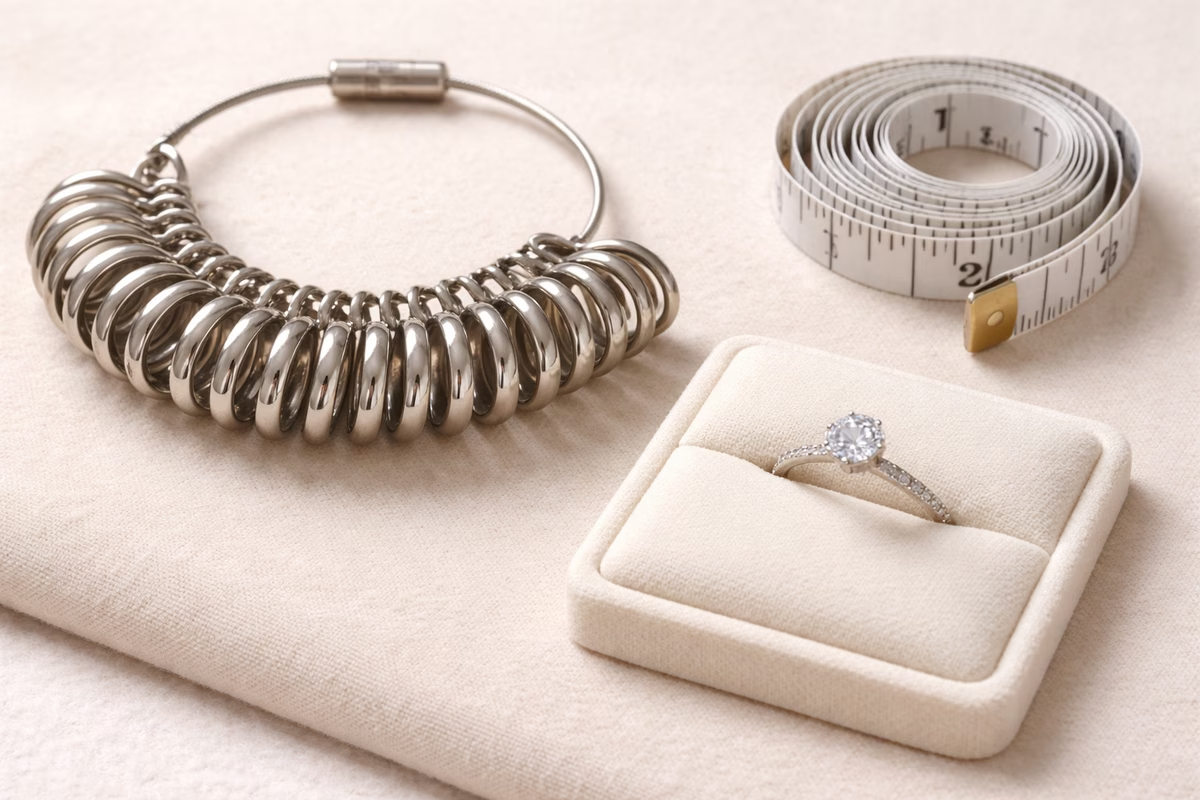
- Slide it onto a ring mandrel (a tapered measuring stick, available for $5-$10)
The catch: Make sure it’s a ring they wear on the right finger. A ring from the index finger or right hand will give a different size. Also, some rings stretch over time—a well-worn band may be larger than their actual finger.
2. Ask their friends or family
The second most reliable method. Someone close to them likely knows, especially if they’ve discussed it. The risk is that the secret leaks, but a trusted friend or sibling can often get this information naturally—“I was looking at rings for my birthday, what size are you?”
3. The string-while-sleeping method
Wrap a thin piece of string or paper around their finger while they sleep, mark where it overlaps, and measure the length. This sounds romantic in theory. In practice, it requires your partner to sleep deeply, your hands to be steady, and neither of you to have had wine at dinner. Accuracy is… variable.
4. Use a ring sizing app
Several apps let you place a ring on your phone screen and match it to an overlay for sizing. These are better than guessing but less accurate than a jeweler’s measurement. Use them as a sanity check, not a primary method.
5. Just ask
This is the method that feels least romantic and is the most reliable. Many couples discuss ring preferences before the proposal—style, metal, stone preferences. Adding “What’s your ring size?” to that conversation is practical, not unromantic. The proposal can still be a surprise even if the ring size isn’t.
Every jeweler I spoke with after my sizing disaster gave the same advice: when in doubt, go slightly larger. A ring that’s a half-size too big can be sized down easily and cheaply ($20-$50). A ring that’s too small requires sizing up, which is more complex, more expensive, and sometimes impossible depending on the setting design and stone configuration.
The one exception: if the ring has stones set around the entire band (an eternity band), it often cannot be resized at all. Know the size before ordering this style.
What affects ring size (it’s not just your finger)
Ring size isn’t a fixed number. It changes—sometimes within the same day.
Temperature: Fingers swell in heat and shrink in cold. A ring fitted perfectly in July may spin freely in January. Most jewelers recommend measuring in moderate temperature (not immediately after outdoor exercise or a cold walk).
Time of day: Fingers are smallest in the morning (cool from sleep) and largest in the late afternoon (warm, active, gravity pulling fluid to extremities). The ideal measuring time is mid-afternoon.
Hydration and salt intake: Dehydration shrinks fingers. A salty meal the night before swells them. Measure on a “normal” day—not after a flight, a big night out, or a long fast.
Pregnancy and weight fluctuation: Significant body changes affect ring size, sometimes permanently. If your partner is pregnant or in a period of active weight change, consider that the current measurement may not be their long-term size.
Knuckle vs. base: Some people have knuckles significantly larger than their finger base. The ring needs to be big enough to slide over the knuckle but snug enough not to spin at the base. This is where comfort-fit bands (slightly rounded inside) help—they slide more easily over knuckles while staying put at the base.
Resizing: what’s possible and what isn’t
The good news: most rings can be resized. A skilled jeweler can adjust a simple solitaire up or down by 1-2 sizes without visible alteration.
Sizing down is generally simpler. The jeweler removes a small section of the band, solders it closed, and refinishes. The ring looks and feels identical.
Sizing up requires adding metal. The jeweler cuts the band, inserts a matching piece, solders, and refinishes. If the size increase is small (half a size), this is seamless. For larger increases, it may affect the band’s proportions or the position of side stones.
What’s difficult or impossible to resize:
- Eternity bands (stones all the way around) — no metal to cut without disturbing stones
- Tungsten and ceramic rings — these materials can’t be worked by traditional jewelers
- Heavily engraved or filigree bands — the engraving may not survive the cut-and-solder process
- Titanium rings — technically resizable but requires specialized equipment
Cost of resizing: $30-$100 for a simple gold or platinum ring. $100-$300+ for complex settings. Most reputable jewelers include one free resizing with purchase.
The proposal-ready sizing strategy
Here’s the approach I wish I’d used, assembled from the jeweler who fixed my mistake and a dozen conversations with people who got it right:
Step 1: Get a baseline. Use any covert method—borrow a ring, ask a friend, use the string method. Accept that this measurement might be off by half a size in either direction.
Step 2: Order the ring a half-size larger than your baseline. The “go slightly big” rule. If your measurement says 5, order 5.5. If it says 6.5, order 7.
Step 3: Propose with confidence. If the ring is slightly loose, your partner wears it proudly for a few days and then you visit the jeweler together for a perfect fit. This is actually a lovely post-proposal activity—your first errand as an engaged couple.
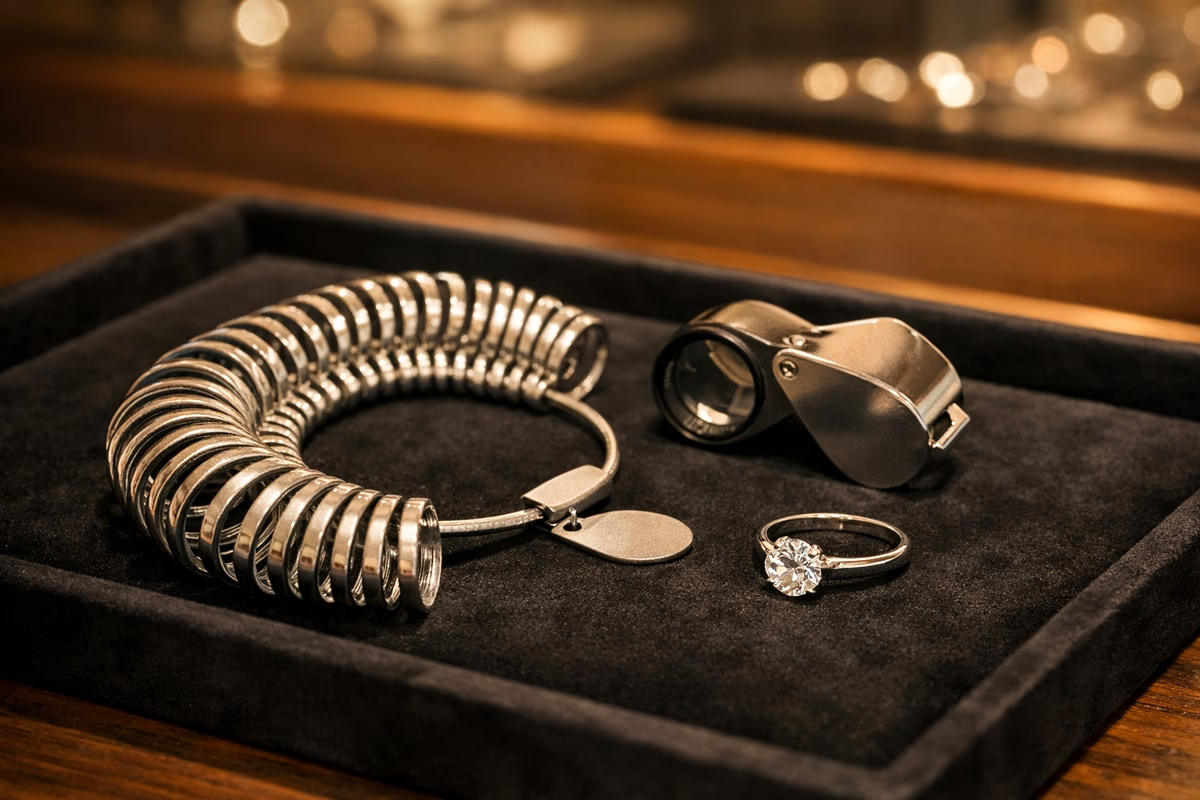
Step 4: Get professionally sized. At the jeweler, they’ll use a proper ring mandrel and account for finger shape, knuckle size, and band width. The final fit will be exact.
Step 5: After resizing, test the fit over a week. Wear the ring through different temperatures, activities, and times of day to confirm it feels right in all conditions. Most jewelers allow one free adjustment if the first resize isn’t perfect.
The ring I got back
Three days after the proposal, we went to the jeweler. He measured her finger (4.5, as I now know forever), sized the ring down, and returned it two days later. When she put it on at the jeweler’s counter—snug, secure, perfectly centered on her finger—she held her hand up to the light and smiled in a way she hadn’t quite managed at the restaurant, because now it felt right. Not just symbolically. Physically. Like it belonged there.
The photographer’s picture from the restaurant is still my favorite photo from that night. Her laughing, hand closed into a fist, ring wobbling. But the photo she took herself, three days later, of the resized ring on her hand with a cup of coffee—that’s the one she posted.
Some things are worth getting exactly right. Ring size is one of them. And if you get it wrong the first time, like I did, at least you’ll have a good story.
Next steps
- Read Quickstart Guide for the essentials of engagement ring shopping
- Explore The 4Cs of Diamonds for understanding diamond quality
- See Ring Settings for how settings affect fit and sizing
- Read Ring Metals for how metal choice affects resizing options
- Check Ring Care for maintaining a perfect fit over time