Engagement Ring Insurance: Appraisals, Coverage, and Claim-Proof Documentation
Buying an engagement ring feels like the finish line. You’ve done the research, agonized over diamonds and settings, and finally made the purchase. But from a practical standpoint, the moment you swipe your card is also the moment you become personally responsible for protecting that little box of sparkle.
Here’s the thing nobody likes to talk about at the jewelry counter: rings get lost. Stones get chipped. Prongs wear down so gradually you don’t notice until a diamond is rattling loose. Travel happens, gym lockers happen, gardening happens. And the worst losses—the truly gut-wrenching ones—are almost never dramatic heists or house fires. They’re the small, dumb moments. A ring slipped off to wash hands, set on a sink ledge in a restaurant bathroom, and gone five minutes later when you rush back to grab it.
Insurance isn’t romantic. Nobody daydreams about policy riders and appraisal forms. But it is one of the most loving “future-proofing” steps you can take for something that’s supposed to be worn every single day of your life. This guide explains how ring insurance actually works, in plain language, and gives you a documentation checklist that will make any future claim dramatically easier to handle.
The quick answer: should you insure it?
If replacing the ring out-of-pocket would hurt—financially or emotionally—then yes, insure it.
Think of it this way. If the ring cost enough that you’d feel a genuine sting writing that check a second time, that’s your answer. Beyond raw dollar value, consider your lifestyle. If the ring is likely to come off your hand regularly because of work, gym sessions, travel, or tasks that involve gloves or chemicals, you’re increasing the window for something to go wrong each time. The same goes for delicate settings like thin bands, pavé designs, or micro-prong halos that are gorgeous but inherently more vulnerable to snagging and stone loss.
Most real-world insurance claims aren’t dramatic stories. They’re the tiny everyday moments where a ring was set down “just for a second.” If that possibility makes your stomach tighten, insurance buys you the peace of mind to actually enjoy wearing it.
What ring insurance typically covers
Policies vary from company to company, but a solid jewelry insurance policy generally covers the situations you’d most worry about. Loss is the big one—whether you misplaced the ring somewhere or it simply vanished and you have no idea how. Theft is covered too, including home burglary and, in many policies, robbery while you’re out and about. Accidental damage rounds out the core protections, so if a stone chips, a prong snaps, or the band gets bent, you’re taken care of. Many better policies also include what’s called “mysterious disappearance,” which is exactly what it sounds like: the ring is gone, and you genuinely cannot explain when or where it happened. And most modern jewelry policies extend coverage worldwide, so your ring is protected whether you’re at home or on vacation in another country.
The important part, though, is not the marketing line on the insurer’s website. It’s the exclusions and the specific claim requirements buried deeper in the policy. We’ll get to those shortly.
The two main ways people insure rings
When it comes to actually getting coverage, you essentially have two paths. Each has legitimate advantages, and the right choice depends on your existing insurance situation and how much flexibility you want.
Option 1: Add a “scheduled” rider to homeowners or renters insurance
If you already carry a homeowners or renters policy, your insurer likely offers the option to “schedule” specific high-value items like jewelry. You might see this called a scheduled personal property endorsement, a jewelry rider, or a valuable items endorsement—different companies use different names for the same basic concept.
The appeal here is convenience. You’re already paying for a policy, and adding a rider is often just a phone call or a quick form. It can also be cheaper in some cases because the insurer is bundling your coverage. On the flip side, there are meaningful trade-offs to consider. If you file a jewelry claim through your homeowners or renters policy, that claim goes on your homeowners history, which could theoretically affect your rates or renewability down the road. Coverage for mysterious disappearance is sometimes narrower or excluded entirely under these riders. There’s usually a deductible that applies, and the replacement process can feel more rigid, with fewer options for choosing your own jeweler.
Option 2: A standalone jewelry insurance policy
The alternative is a policy that exists solely to cover your jewelry. These are offered by specialty insurers who focus on nothing but jewelry and watches.
Standalone policies often provide clearer, more explicit coverage for loss and accidental damage because that’s their entire reason for existing. Claims typically stay completely separate from your homeowners or renters history, which is a big deal if you want to keep those records clean. Some standalone policies also offer better replacement flexibility, letting you choose your own jeweler rather than being funneled through a network. The downside is that it’s another policy to manage, another bill to track, and each insurer has its own documentation requirements around appraisals, receipts, and photographs.
Replacement types: the detail that decides satisfaction
Here’s where a lot of people get surprised at claim time. You assumed you’d get your ring back—or the money to buy a new one—and then the insurer explains how replacement actually works under your specific policy. Understanding this upfront saves a world of frustration later.
Repair or replace through the insurer’s network
Some policies direct you to specific jewelers within the insurer’s network when it’s time to repair or replace. This is often cost-controlled on the insurer’s side, meaning they’ve negotiated rates with those jewelers. It can work perfectly well, and you may end up with a beautiful replacement. But some people dislike the limited choice, especially if they had a strong relationship with the original jeweler or want a very specific design replicated exactly.
Cash payout
Other policies offer a cash payout up to your policy limits, which gives you the flexibility to shop wherever you want. That sounds ideal, but there’s a catch: the payout amount may be based on what the insurer can source the replacement for at wholesale or negotiated cost, not what you originally paid at retail. So you might receive less than you expect if you’re planning to walk back into a retail store.
“Like kind and quality” replacement
This is one of the most common phrases you’ll encounter in jewelry insurance, and it sounds wonderfully reassuring. The insurer promises to replace your ring with something of “like kind and quality.” But in practice, this term is surprisingly ambiguous.
Before you sign anything, make sure you understand exactly how your insurer defines “like kind and quality.” Ask whether you get to choose the replacement jeweler or whether you’re assigned one. And here’s a detail that matters more than ever in today’s market: confirm whether lab-grown versus natural diamond origin is matched. If your original ring had a natural diamond and the policy replaces it with a lab-grown stone of similar specs, that’s a fundamentally different item in many people’s eyes—and the resale and sentimental implications are real.
The appraisal: what it is and what it isn’t
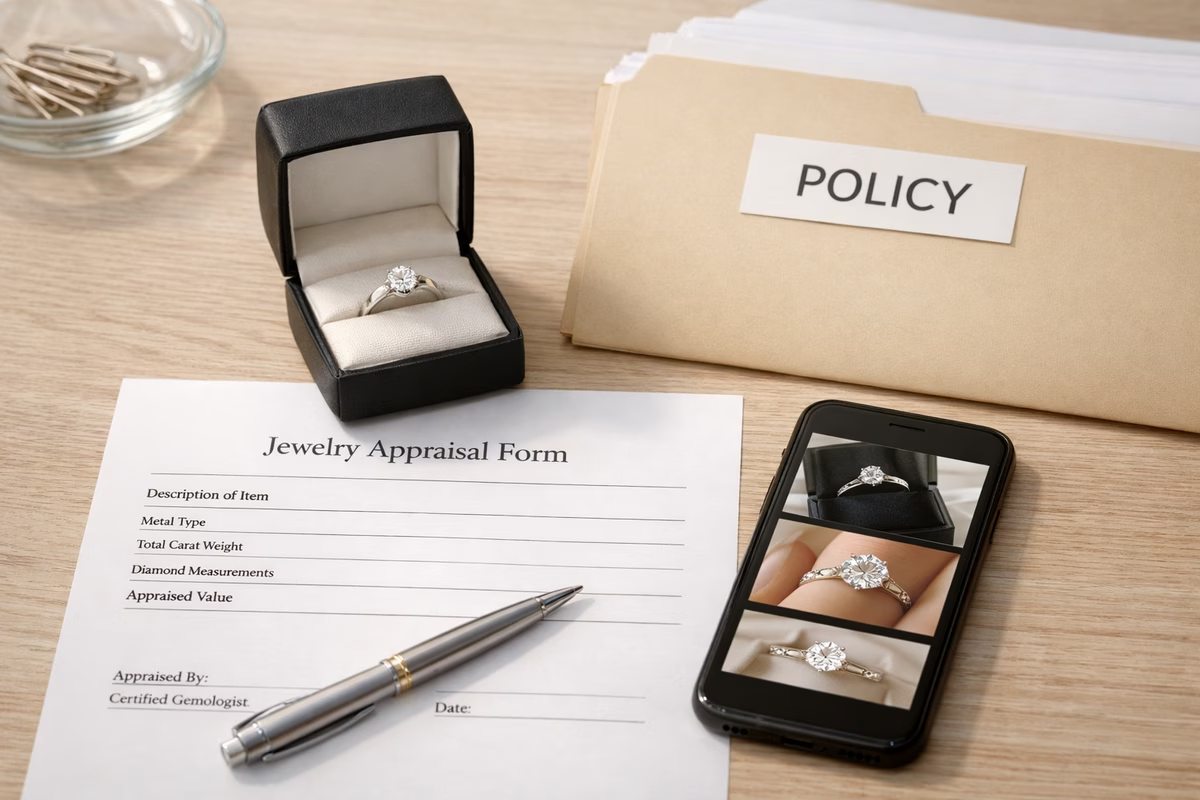
An appraisal is essentially a formal document that describes your ring in detail and estimates its value for insurance purposes. Think of it as a profile sheet for your ring—measurements, materials, characteristics, and a dollar figure attached.
Here’s the thing that trips people up: appraisals can be inflated, and they frequently are, especially when written specifically for insurance. A jeweler might appraise your ring at a higher value than you actually paid, which sounds like a bonus until you realize that an inflated appraisal mainly raises your premiums without meaningfully improving your real-world replacement outcome. You end up paying more each month to insure a number that doesn’t reflect what you’d actually spend to replace the ring. A good, honest appraisal that closely tracks actual replacement cost is far more useful than an impressive-sounding but inflated one.
What a good appraisal includes
A thorough appraisal should clearly document the metal type and purity—whether that’s 14K gold, 18K gold, or platinum. It should note the ring’s weight and give a clear description of the design. For the center stone, you want the shape, precise measurements, carat weight, color grade, clarity grade, and cut quality all recorded. The certification details matter too: the GIA or IGI report number should be referenced so the stone is traceable. If there are side stones, those should be described separately. Good appraisals also include photographs of the ring and clearly state both the replacement value and the date of valuation.
When you need an appraisal
Many insurers require a formal appraisal once a ring exceeds a certain value threshold, but the specific number varies. Some insurers, however, are perfectly happy to accept a detailed purchase receipt combined with a diamond grading report in lieu of a separate appraisal, at least initially. So if you already have a GIA or IGI grading report for the diamond and a thorough receipt from the jeweler that describes the setting, check with your insurer before paying for an additional appraisal. You may not need one right away, and you can always get one later if required.
Documentation: the part that makes claims painless
If you do absolutely nothing else after buying a ring, do this one thing: build what I like to call a “claim-proof packet.” It takes about thirty minutes, and if you ever need to file a claim, it will be the single best investment of time you’ve made.
Keep every document
Start by gathering every piece of paper and every digital file related to the purchase. Your purchase receipt or invoice is the foundation—it proves what you paid and where you bought it. The diamond grading report (sometimes called a certificate) is next, providing independent verification of the stone’s characteristics. If you’ve had an appraisal done, include that too. And don’t forget any warranty or maintenance paperwork that came with the ring, as some policies factor ongoing maintenance into coverage eligibility.
Photograph the ring like you’re documenting evidence
Think of this less like an Instagram shoot and more like a forensic exercise. You want photos taken on a plain, neutral background in natural daylight so colors are accurate. Get a close-up of the setting and prongs—this is critical because prong condition often comes up in damage claims. Capture a side profile that shows the ring’s height and structural details. Flip the ring over and photograph any hallmarks stamped inside the band, like the metal purity stamp. And if the diamond has a laser inscription on its girdle that’s visible under magnification, try to capture that too. These details are what separate a smooth claim from a drawn-out negotiation.
Record identifying numbers
Write down every number that could help identify your specific ring. The diamond grading report number is the most important—it’s essentially a serial number for your stone. If there’s a laser inscription number on the diamond itself, record that separately. And note the jeweler’s SKU or invoice number from your purchase so the ring can be traced back to the original transaction.
Store it safely
Once you’ve assembled everything, make a digital copy and store it in cloud storage—Google Drive, iCloud, Dropbox, whatever you use. Email a copy to yourself as a backup, because email is one of those things that tends to survive even when everything else gets lost. And keep any physical originals in a secure place, whether that’s a home safe, a fireproof box, or a safety deposit box at your bank.
What insurers commonly exclude (read this carefully)
Every policy has exclusions, and this is where careful reading pays off. While the specifics vary between insurers, certain exclusions show up again and again.
Normal wear and tear is almost universally excluded. Prongs gradually thinning over years of daily wear, for example, is considered expected degradation rather than a coverable event. Manufacturing defects are similarly excluded once the original warranty period has passed—if a structural flaw shows up three years later, that’s generally on you. If your policy doesn’t explicitly include “mysterious disappearance” coverage, then unexplained losses—where you simply cannot account for when or where the ring went missing—may not be covered at all. Damage resulting from intentional acts is always excluded, and some policies won’t cover loss if the ring was left unattended in certain scenarios, though the definition of “unattended” varies from policy to policy.
Here’s the huge practical takeaway: some policies technically cover loss, but only if you can describe when, where, and how it happened. If you can’t tell a coherent story—“I took it off at the gym, set it in my locker, and it was gone when I came back”—the claim may be denied. That’s precisely why “mysterious disappearance” coverage is so valuable. It fills the gap for those genuinely inexplicable losses where the ring simply vanished and you have no idea how.
Maintenance: how to reduce claim risk
Insurance is the financial backstop. Maintenance is the prevention strategy. Together, they make ring ownership far less stressful.
Prongs and settings
A surprising number of insurance claims begin with a loose stone, and loose stones almost always trace back to worn or damaged prongs. Getting your prongs professionally inspected every six to twelve months is one of the simplest and most effective things you can do. This is especially important for pavé settings, where dozens of tiny stones are held by minuscule prongs that are more vulnerable to wear. In daily life, be mindful of snagging prongs on sweaters, towels, and hair—each snag weakens the metal slightly, and over time those small stresses add up.
Take it off for the high-risk list
There are certain activities where wearing your ring dramatically increases the chance of damage or loss. The gym is a big one—gripping barbells and dumbbells puts enormous pressure on bands and prongs. Rock climbing, gardening, and heavy-duty cleaning with harsh chemicals are all scenarios where the ring should come off. Swimming deserves special mention because cold water causes fingers to shrink, and more rings are lost in oceans and pools than most people realize. Travel is another high-risk window, especially if you’ll be removing the ring frequently for security screenings or activities.
The simplest prevention tool is a dedicated ring dish in one or two consistent spots—your nightstand, your bathroom counter—combined with a habit of always placing the ring in the same spot. Consistency is what prevents the “I set it down somewhere and now I can’t remember where” scenario that accounts for so many losses.
How much coverage should you buy?
The standard approach is to insure the ring for its replacement value—meaning the amount it would cost to replace it with something equivalent if it were lost or destroyed today.
If you bought the ring recently, insuring it for the purchase price is usually appropriate unless your insurer specifically requires an appraisal that may come in at a different figure. Over time, though, replacement values can shift, so it’s worth re-evaluating your coverage every two to three years to make sure you’re neither underinsured nor overpaying.
For lab-grown diamonds, there’s an additional nuance worth noting. Lab-grown diamond prices have been declining over time as production scales up, which means the replacement cost of your ring could actually decrease. Depending on your policy terms, you may be able to reduce your insured value accordingly, which would lower your premiums. It’s a small but meaningful financial benefit of staying engaged with your policy rather than setting it and forgetting it.
How to compare policies (a buyer’s checklist)
When you’re shopping for insurance, the goal is to ask the questions that determine whether you’ll actually be satisfied if you ever need to file a claim. Start with the basics of coverage scope: does the policy cover loss, theft, accidental damage, and—ideally—mysterious disappearance? Is coverage worldwide, or are there geographic limitations? What’s the deductible, and will a jewelry claim affect your homeowners or renters insurance history?
Then dig into the replacement mechanics, because this is where satisfaction is won or lost. Can you choose your own jeweler, or are you required to use a network? How does the insurer define “like kind and quality,” and will they match lab-grown versus natural origin if that distinction matters to you? Finally, confirm exactly what documentation the insurer requires upfront and whether there are any ongoing maintenance requirements—like annual prong inspections—that could affect your coverage eligibility down the road.
What to do immediately after you buy the ring
The best time to set up your insurance and documentation is right now, while the details are fresh and all the paperwork is in hand. Don’t wait until after the proposal—if the ring is in your possession, it’s at risk from the moment you walk out of the store.
Start by saving your purchase receipt and diamond grading report as PDFs. Then photograph the ring from multiple angles following the documentation guidelines above. If your chosen insurer requires an appraisal, schedule that promptly, but check first whether your existing documents are sufficient. Purchase the insurance policy before the proposal if possible—there’s no reason to carry an uninsured ring around while you’re planning the perfect moment. And finally, assemble your complete documentation packet and store it in the cloud so it’s accessible from anywhere, anytime.
If you ever need to file a claim
Nobody wants to be in this situation, but if it happens, the goal is to be calm, organized, and honest. If the ring was stolen, file a police report first—most insurers require one as part of the theft claim process. Then provide your insurer with the documentation packet you prepared (and now you understand why that thirty-minute investment was worth it). Be straightforward and truthful about the timeline of events—when you last saw the ring, when you noticed it was missing, and what happened in between. And before agreeing to any replacement, ask the insurer to explain your replacement options in writing so you can evaluate them clearly rather than making a rushed decision.
The bottom line
Ring insurance is not about expecting the worst. It’s not about being pessimistic or paranoid. It’s about giving yourself permission to actually enjoy the ring without that low-level hum of anxiety every time it leaves your sight for a moment.
If you insure it well, document it once, and maintain it occasionally, you transform a high-stakes object into what it was always meant to be: a symbol you can actually wear every day, through dishes and dog walks and airport security, without holding your breath.