Lab-Grown vs Natural Diamonds: A Practical Decision Guide
If you’ve started shopping for engagement rings, you’ve already discovered a modern fork in the road: lab-grown or natural diamond.
Both can be visually stunning. Both can be graded by the same labs. Both can be “real diamonds” in the scientific sense: crystalline carbon with the same hardness and optical properties.
So why does this choice feel so loaded?
Because you’re not just buying sparkle. You’re buying a bundle of expectations—about cost, meaning, ethics, long-term value, and how you’ll feel about the decision ten years from now.
This guide is meant to remove the fog. It won’t tell you what you “should” buy. It will help you decide confidently.
The 60-second answer
Here’s the short version, for those of you reading this on your lunch break. If you want maximum size and quality for your budget and you’re comfortable with lower or uncertain resale value, lab-grown is probably your lane. On the other hand, if you care deeply about rarity, tradition, and stronger resale expectations, and you’re willing to pay a premium for those intangibles, natural is likely the better fit.
Still on the fence? That’s completely normal. Treat this like a values-and-budget decision, not a physics decision—because the physics are essentially identical.
First: what “lab-grown diamond” actually means
Let’s clear something up right away. A lab-grown diamond is not a fake diamond. It’s not cubic zirconia. It’s not moissanite. It’s a real, honest-to-goodness diamond—just one that was created in a controlled environment rather than pulled from the earth. Think of it like ice: whether it forms in a glacier over centuries or in your freezer overnight, it’s still ice. Same crystal, different origin story.
There are two main methods scientists use to grow these diamonds, and understanding them helps you know what you’re actually buying.
CVD (Chemical Vapor Deposition)
Imagine placing a tiny diamond “seed” inside a sealed chamber, then flooding that chamber with a carbon-rich gas. When the gas is energized—usually with microwaves or another energy source—carbon atoms break free and drift down onto the seed, settling into the diamond’s crystal structure one layer at a time. It’s almost meditative when you think about it: atom by atom, a diamond literally grows from a whisper of gas.
CVD has become hugely popular because it offers excellent control over growth conditions and can produce truly stunning stones. One thing worth knowing: many CVD diamonds undergo a secondary HPHT treatment afterward to improve their color, which is a perfectly standard practice as long as it’s disclosed.
HPHT (High Pressure High Temperature)
If CVD is the gentle, layer-by-layer approach, HPHT is the brute-force method—and it’s beautifully dramatic. This process mimics the extreme pressure and searing heat that form natural diamonds deep within the Earth. Carbon is dissolved in a metal flux, and under crushing force, it crystallizes onto a diamond seed. The result can be just as gorgeous as any CVD stone, and HPHT is often the go-to method for producing certain fancy-colored diamonds.
Here’s the key takeaway: whether a diamond was grown via CVD or HPHT matters far less than its final quality as graded—cut, color, clarity—and whether any post-growth treatments are fully disclosed. Don’t get caught up in the method; focus on the result.
Are lab diamonds “real”? (Yes, but let’s define “real”)
This question comes up constantly, and the answer depends entirely on what you mean by “real.” If you mean real as in the material itself, then absolutely yes—lab-grown diamonds are diamonds in every measurable, scientific sense. Same carbon lattice, same hardness, same fire and brilliance. If you mean real as in naturally occurring and geologically rare, then no—they’re manufactured, and that distinction matters to some people. And if you mean real as in socially recognized and accepted, the answer is an increasingly confident yes, though opinions still vary by family, culture, and generation.
The question isn’t whether a lab-grown diamond is legitimate. It’s whether it matches what you want the ring to represent. That’s a deeply personal call, and there’s no wrong answer.
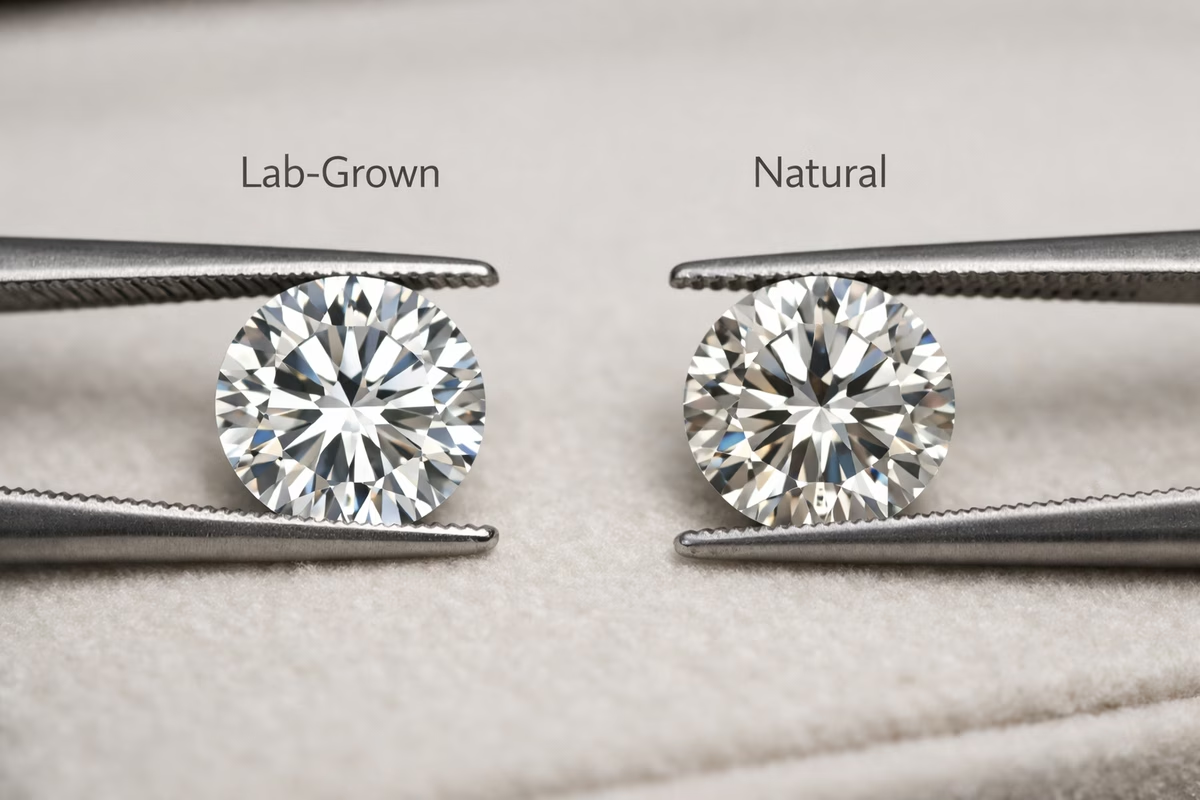
Visual difference: can you tell them apart?
Here’s the part that surprises most people: in normal, everyday wear, most people cannot distinguish a lab-grown diamond from a natural diamond just by looking at the ring. Not your friends, not your coworkers, not your eagle-eyed mother-in-law. Even trained gemologists typically need specialized equipment or full lab analysis to identify the subtle growth features that separate the two.
What you can see with the naked eye—regardless of whether the stone grew underground or in a lab—comes down to the qualities that actually make a ring beautiful. The sparkle and light performance come from cut quality. The visual impact comes from the stone’s size and shape. Color tint might be noticeable in certain lighting conditions. And if there are visible inclusions, you’ll spot those too, no matter the diamond’s origin.
So if your main goal is simply “a ring that looks absolutely amazing on my partner’s hand,” origin is rarely the limiting factor. Cut quality is. A brilliantly cut lab diamond will outshine a poorly cut natural diamond every single time—and vice versa.
The comparison that actually matters
Let’s move past the science and into the practical categories where the decision actually lives. This is where your wallet, your values, and your gut feelings all come into play.
1) Cost and size: where lab-grown changes the game
This is the biggest and most obvious difference, and it’s the reason lab-grown diamonds have exploded in popularity over the last few years.
In general, lab-grown diamonds cost significantly less than natural diamonds of similar visible quality. We’re not talking about a modest discount here—the savings can be dramatic. That extra breathing room in your budget often lets you upgrade in ways that genuinely change the look and feel of the ring. You might go bigger on carat size for more visual presence on the hand. You could invest in a superior cut grade that makes the stone absolutely sing with light. You might step up in color and clarity for that pristine, “icy white” look. Or you could pour those savings into a better-crafted setting, because a gorgeous diamond in a flimsy mounting is nobody’s dream ring.
The “smart use” of lab-grown savings
If you decide to go the lab-grown route, resist the urge to simply max out the carat weight. Instead, the savviest approach is to keep cut quality at Excellent or Ideal—that’s non-negotiable if you want real sparkle. Choose a shape that flatters your partner’s hand and personal style. Buy a size that looks balanced and proportional rather than cartoonishly large. Then channel whatever’s left in the budget toward a durable, well-made setting and proper insurance coverage.
The goal isn’t “the biggest rock money can buy.” The goal is a ring that’s proportionally beautiful, comfortable to wear every day, and built to last.
2) Resale value: don’t guess—assume lower for lab-grown
This is where a lot of buyers get blindsided, so let’s be upfront about it.
Natural diamonds have a long-established resale and trade-in ecosystem. It’s not perfect—you’re unlikely to recoup what you paid at retail—but the market is mature, predictable, and widely understood by jewelers and buyers alike. Lab-grown diamonds are a newer player in that ecosystem, and their pricing has been trending downward over time as manufacturing technology improves and production scales up.
That doesn’t mean lab-grown is a “bad buy.” Not at all. It simply means you should walk in with the right expectations. For natural diamonds, resale value tends to be more stable, even if it’s still less than what you originally paid. For lab-grown, resale can be significantly lower and quite a bit less predictable. If you think of a lab-grown diamond the way you’d think of a beautiful piece of technology—valuable for what it gives you, not for what you can sell it for later—you’ll never feel disappointed.
Upgrade policies matter
Speaking of upgrade policies, this is a conversation you absolutely want to have with your jeweler before you buy. If you think there’s any chance you might want to upgrade the diamond down the road—say, for a milestone anniversary—ask about lifetime upgrade terms. Many jewelers offer these for natural diamonds, but the policy may not extend to lab-grown stones. Find out what the required spend increase is (a common structure is that you need to spend at least twice the original purchase price). And ask whether the setting itself can be reused with a new stone, which can save you a surprising amount of money later.
3) Ethics and sourcing: both require nuance
Here’s where the conversation gets a little more complicated than the internet would have you believe. The popular narrative is clean and simple: natural diamonds are unethical, lab diamonds are ethical. But the reality? It’s a whole lot more nuanced than that.
Natural diamond ethics
Natural diamond sourcing varies enormously depending on the region, the mine, and the company behind it. There are suppliers doing extraordinary work in responsible sourcing—creating jobs, investing in communities, adhering to strict environmental standards. And there are others who… aren’t. If ethics weigh heavily in your decision, don’t just assume the worst about natural diamonds. Instead, ask pointed questions. Does the jeweler have chain-of-custody documentation? Are they part of responsible sourcing programs? Can they specify where the diamond actually came from? A reputable seller should be able to answer all of these without breaking a sweat.
Lab diamond ethics
Lab diamonds neatly sidestep the mining conversation, and that’s a genuine advantage. But they’re not a zero-impact product. Growing diamonds requires significant energy, and the environmental footprint depends heavily on whether that energy comes from coal-fired power plants or renewable sources. There are also manufacturing supply chains and labor practices in production facilities to consider—just like with any manufactured good.
If ethical sourcing is your top priority, do your homework on the lab-grown side too. Ask where the stone was actually grown. Find out whether the producer uses renewable energy. Look for certifications or third-party disclosures that back up any “green” claims. The best move, whether you’re shopping natural or lab, is to choose a vendor who can explain their sourcing clearly, confidently, and without dodging your questions.
4) Quality pitfalls: what to watch for with lab-grown
Lab-grown diamonds can absolutely be exceptional—some of the most gorgeous stones on the market right now were grown in a lab. But “lab-grown” isn’t a magic word that guarantees perfection. There are real pitfalls worth knowing about.
Cut quality is still king
This might be the most important paragraph in this entire guide. Many shoppers walk into the lab-grown market assuming that because these diamonds are engineered, they must be automatically perfect. They’re not. A poorly cut lab diamond will look just as dull and lifeless as a poorly cut natural diamond. Light won’t bounce the way it should, the stone will look smaller than its carat weight suggests, and you’ll be left wondering why your ring doesn’t have that movie-magic sparkle. Prioritize Excellent or Ideal cut grades whenever they’re available. This is the one area where you should never compromise.
Color nuances and growth artifacts
Some lab diamonds—particularly certain CVD stones—can exhibit subtle quirks that are worth watching for. You might notice a slight brown or grayish tint that isn’t fully captured in the grading report. Some stones show strain patterns when viewed under certain conditions. Others may have unusual fluorescence effects. Most of this is genuinely subtle and won’t bother the average wearer, but if you’re someone who’s sensitive to that “icy white” diamond look, it’s worth examining stones carefully in person or requesting detailed imagery from your vendor.
Treatments and disclosure
Here’s a fact that catches some buyers off guard: some lab diamonds receive post-growth treatments to improve their color. This is a perfectly acceptable practice in the industry—as long as it’s disclosed. The issue isn’t the treatment itself; it’s transparency. What you want is a grading report that clearly notes any treatments, and a seller who brings this up proactively rather than burying it in fine print.
5) Social and emotional factors (the part people pretend isn’t real)
Let’s talk about the elephant in the room. In a world that loves to optimize everything with spreadsheets and comparison charts, it can feel almost embarrassing to admit that feelings play a role in this decision. But they do—and you’re absolutely allowed to care about meaning.
Some people gravitate toward natural diamonds because they love the poetry of geological time—the idea that their stone spent a billion years forming deep in the Earth before finding its way to a ring. Family expectations might play a role too, especially if engagement rings carry generational significance in your household. And for some, the tradition simply feels right in a way that’s hard to articulate but impossible to ignore.
Others are drawn to lab-grown for equally valid reasons. They value practicality and love the idea of getting a showstopper of a ring without taking on financial strain. They want a larger, more impressive stone and don’t see the point of paying extra for underground origin. Or they genuinely prefer to avoid anything connected to mining, full stop.
None of these motivations are “wrong.” They’re preferences, and they deserve to be honored rather than argued away.
Here’s a useful gut-check exercise. First, ask yourself: if nobody knew what you chose, what would you choose? That strips away the social pressure and gets to what actually matters to you. Then ask a second question: if your partner’s parents were critical of your choice, would that bother you? This isn’t about caving to others’ opinions—it’s about honestly anticipating real emotional friction so your decision doesn’t become a lingering source of annoyance or regret.
How to decide: a simple decision framework
If you’ve made it this far and still feel torn, here’s a straightforward three-step process to cut through the noise.
Step 1: Pick your priority
Read through these statements and notice which one resonates most strongly. If “I want the best-looking ring for the budget” feels most true, lab-grown is probably your path. If “I want rarity and tradition” speaks to you, natural is likely the better call. If “I want ethical sourcing above all” is your guiding star, either option can work—but you’ll need to shop carefully and ask lots of questions. And if “I care about future trade-in or upgrade potential” is high on your list, natural diamonds often have the edge in that department.
Step 2: Set your constraints
Before you start browsing stones, get crystal clear on your non-negotiables. Know your budget ceiling and commit to it. Decide on a minimum cut grade (Excellent or Ideal, please—your future self will thank you). Settle on your preferred diamond shape, whether that’s a classic round brilliant, an elegant oval, or something more distinctive. And choose your metal preference for the setting, because that affects the overall look more than most people realize.
Step 3: Compare two stones side by side
The single best way to make this decision is refreshingly low-tech: look at actual diamonds. Find one lab-grown stone in your target size and one natural stone in your target size—or the best natural diamond you can afford within budget. Then compare them in real-world conditions. View them in natural daylight, where nothing is hidden. Check them under warm indoor lighting, which is how you’ll see the ring most of the time. And most importantly, look at them on the hand, not sitting on a jeweler’s tray, because a diamond looks completely different when it’s being worn.
If the lab-grown stone makes you feel a rush of relief and excitement—that feeling of “wow, I can actually have this?"—pay attention to that. It’s a real signal. And if the natural stone gives you that quiet, certain feeling of “this is it”—pay attention to that too. Your gut is smarter than you think.
What grading report should you insist on?
Regardless of which path you choose, always ask for a grading report from a respected laboratory. GIA and IGI are the most commonly referenced, and some shoppers have a strong preference for GIA specifically. The important thing is consistency and clear disclosure—you want to know exactly what you’re getting.
When you’re reviewing the report, zero in on the details that actually affect what you see. The cut grade tells you how well the stone handles light, and it’s arguably the most important number on the page. For round brilliants, check the table and depth percentages, which influence how the stone balances brilliance and fire. Polish and symmetry grades should ideally be Excellent or Very Good. Note the fluorescence level, since strong fluorescence can occasionally make a diamond look hazy in certain lighting. And look at the clarity characteristics—specifically, whether any inclusions are likely to be eye-visible in normal wear.
For lab-grown diamonds specifically, verify a few extra things. The report should clearly state “laboratory-grown”—this isn’t optional; it’s required by industry standards. Any post-growth treatments should be fully disclosed. And depending on the lab and the report format, the growth method (CVD or HPHT) may be noted as well.
Smart “sweet spots” for each choice
If you go lab-grown
Here’s the formula that tends to produce the happiest buyers. Start with an Excellent or Ideal cut—this is where the magic lives. Choose eye-clean clarity, which often means VS2 or SI1 depending on the specific stone and shape. For color, the near-colorless range of G, H, or I typically looks beautifully white in most setting metals, especially white gold and platinum. Then take whatever budget remains and invest it in a high-quality setting built to last and comprehensive insurance coverage. That combination will give you a ring that punches well above its price point.
If you go natural
The sweet-spot strategy for natural diamonds follows a similar philosophy but accounts for the higher per-carat cost. Prioritize an Excellent cut, especially for round brilliants where cut quality makes the most dramatic visual difference. Near-colorless grades like G or H often represent the best value zone—they face up beautifully white without the premium of D, E, or F grades. Eye-clean clarity in the VS2 to SI1 range keeps costs reasonable while still looking flawless to the naked eye. And don’t forget to ask about upgrade policies and keep all your documentation organized—you’ll be glad you did if you ever want to trade up.
Common mistakes to avoid
Let’s wrap the practical advice section with the traps that snag well-meaning buyers over and over again. The most common mistake is chasing a bigger carat weight while compromising on cut—you’ll end up with a large stone that looks surprisingly lifeless. Closely related is overpaying for microscopic clarity perfection that literally no one will ever see without a loupe. On the ethics front, don’t fall into the trap of assuming “lab-grown” automatically means ethical, or that “natural” automatically means unethical—both claims are oversimplifications that collapse under scrutiny. Take a moment to honestly consider how you’ll feel about family and social opinions, because pretending you don’t care when you actually do is a recipe for quiet regret. And finally, never skip insurance and proper documentation. Rings get lost, damaged, and stolen every day, and the cost of protection is trivial compared to the cost of replacement.
The bottom line
Lab-grown diamonds are a modern gift to diamond shoppers: they let you buy more beauty per dollar, plain and simple. Natural diamonds are a traditional luxury that carries geological rarity and a more established long-term market behind it.
Your job isn’t to pick the “objectively right” answer—because there isn’t one. It’s to pick the diamond that aligns with your budget, your values, and how you want to feel every single time your partner glances down at their hand and smiles.
If you want the simplest possible rule to walk away with, here it is. If you’d rather put your money into building a life together than into geological rarity, choose lab-grown. If rarity and tradition are genuinely part of the meaning for you—if they make the ring feel more significant—choose natural.
Either way, prioritize cut above all else, buy from a transparent seller who answers your questions without flinching, and document everything. Do those three things, and you’ll end up with a ring you’re proud of—no matter which fork in the road you take.