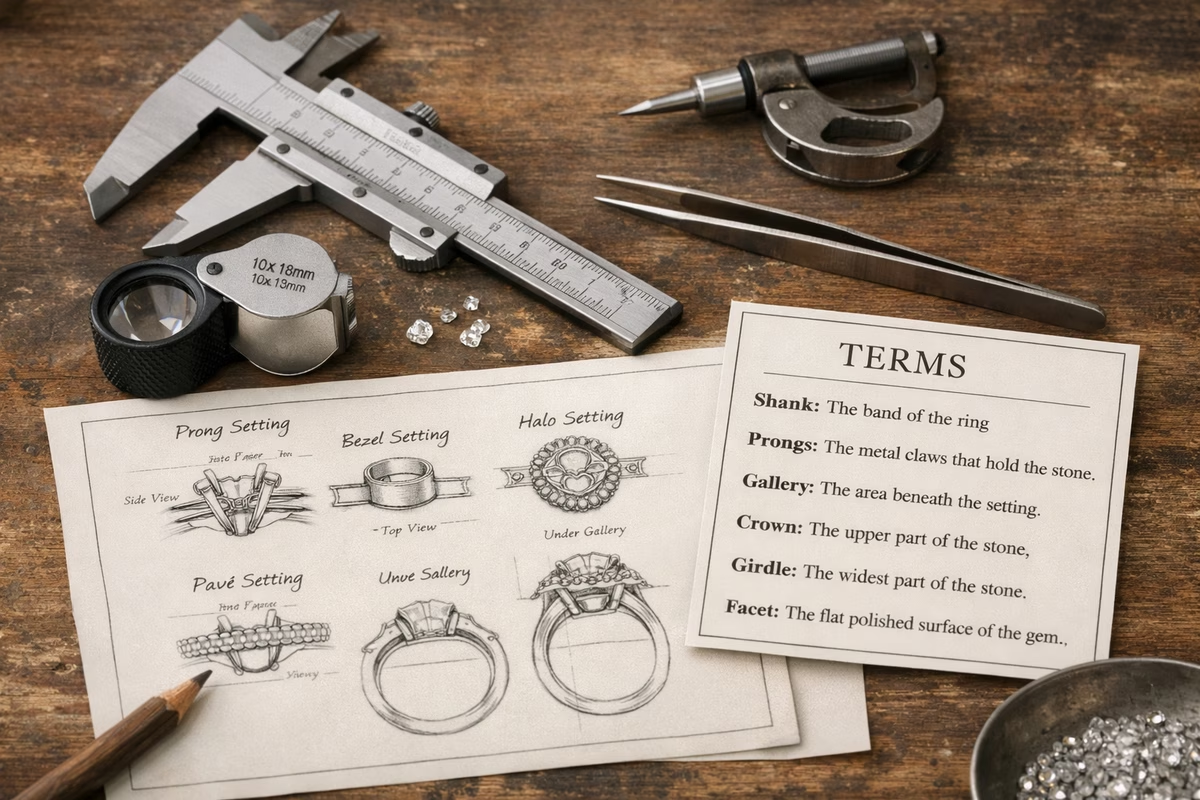
Engagement Ring Glossary
Every field has its language—words that carry precise meanings to those who know them and mystery to those who don’t. The world of engagement rings is no exception. Jewelers speak of pavé and pavilions, of brilliance and bezels, of terms that emerged from centuries of craftsmanship and the science of gemology.
This glossary serves as your translator. When you encounter an unfamiliar term in your ring search, return here to decode it. When a jeweler uses vocabulary that confuses you, this reference clarifies. Knowledge of terminology builds confidence, and confidence leads to better decisions.
The entries below are arranged alphabetically, but they tell a connected story—the story of how diamonds are evaluated, how rings are constructed, how precious objects are described by those who make and sell them. Browse through, and you’ll find your vocabulary expanding in ways that serve you throughout your engagement ring journey.
A
Accent Stones — The supporting cast in your ring’s drama. These smaller diamonds or gemstones surround or complement the center stone, adding sparkle and visual interest without competing for the starring role. Accent stones appear in halos, along pavé bands, and as side stones in three-stone settings.
Alloy — Pure gold is too soft for everyday wear; pure platinum needs hardening for optimal workability. Alloys blend metals together to create materials with improved properties. Your 14k gold ring contains 58.3% gold mixed with other metals—copper, silver, zinc, palladium—that contribute strength and durability while allowing the gold’s beauty to shine through.
Appraisal — A professional evaluation documenting your ring’s characteristics and estimated replacement value. Insurance companies require appraisals; smart owners commission them regardless. The appraiser examines your ring in person, recording specifications, measuring dimensions, and assigning a value based on current market conditions. Update appraisals every three to five years as prices fluctuate.
Asscher Cut — Named for Joseph Asscher, who developed this distinctive shape in 1902, the Asscher cut presents a square step-cut diamond with dramatically cropped corners. The geometric precision creates a hall-of-mirrors effect, all clean lines and art deco elegance. Asscher cuts demand higher color and clarity grades than brilliant cuts because their large, open facets hide nothing.
Asymmetrical — Designs that intentionally lack mirror-image balance. Bypass settings, where band ends pass each other without meeting, exemplify asymmetrical beauty. These rings appeal to those who find traditional centered symmetry too predictable.
B
Band — Simply the circular metal portion that wraps around your finger. The band might be plain or adorned, wide or narrow, but it serves the fundamental purpose of making the ring wearable. Band width affects sizing—wider bands feel tighter than narrow ones at the same measured size.
Basket Setting — The cage-like metal framework beneath a center stone that supports it from below while allowing light to enter. Picture a small basket cradling a precious egg, and you understand the visual. The basket connects to prongs rising above and the shank extending around the finger.
Bead Setting — A technique for securing small stones using tiny metal beads pushed over their edges. Pavé settings rely on bead setting; skilled craftspeople raise these minute beads from the surrounding metal to hold each stone in place without visible prongs.
Bezel Setting — A collar of metal encircling the stone’s girdle, holding it through continuous contact rather than discrete prongs. Bezels offer exceptional security—stones cannot catch or snag—and create sleek, modern aesthetics. The trade-off: slightly less light enters the diamond from the sides.
Birthstone — Gemstones traditionally associated with birth months. Some couples incorporate birthstones as accent stones or alternative center stones, adding personal significance beyond diamonds. Sapphires for September, rubies for July, emeralds for May—each carries its own meaning.
Brilliant Cut — A cutting style optimized for maximum light return, featuring triangular and kite-shaped facets arranged to bounce light within the stone before returning it to the viewer’s eye. The round brilliant, with its 57 or 58 facets, represents the pinnacle of this style, though ovals, cushions, and other shapes can also be cut in brilliant style.
Briolette — An elongated teardrop shape covered entirely in triangular facets, with no flat table facet. Briolettes appear more often in earrings and pendants than engagement rings, but their distinctive silhouette occasionally graces unique designs.
Burnish Setting — Stones set flush with the metal surface, with the surrounding metal pushed over their edges to secure them. This creates a smooth, contemporary look where diamonds appear embedded in the band rather than rising above it.
C
Cabochon — A gemstone cut with a smooth, domed surface rather than facets. The curved top catches light differently than faceted stones, creating a different kind of beauty. Cabochons work well for opaque or translucent gems but rarely appear in diamond engagement rings.
Calibrated — Gemstones cut to precise standard dimensions for uniform appearance when set together. Channel settings and halo designs rely on calibrated stones that match exactly, creating seamless visual flow rather than irregular spacing.
Carat — The unit of weight for gemstones, where one carat equals 200 milligrams or one-fifth of a gram. Carat measures weight, not size, though the two correlate for stones of similar proportions. The word derives from carob seeds, once used as counterweights for gem scales.
Cathedral Setting — A design where the band’s shoulders arch upward like Gothic cathedral buttresses to meet the center stone. The arches elevate the diamond, protect its sides, and create an elegant profile visible from every angle.
Certification — An independent laboratory report documenting a diamond’s characteristics. GIA (Gemological Institute of America) and AGS (American Gem Society) provide the most respected certifications, offering unbiased assessment of cut, color, clarity, and carat weight. Certification enables informed comparison shopping.
Channel Setting — Diamonds set in a groove between two parallel metal walls, their tops flush with the surface. No prongs are visible; the stones sit protected within their channel. The clean lines appeal to modern sensibilities and active lifestyles.
Clarity — The assessment of internal inclusions and external blemishes in a diamond. The scale runs from FL (Flawless) through various grades of inclusion to I3 (heavily Included). Most inclusions require magnification to see; “eye-clean” stones appear perfect to unaided vision regardless of technical grade.
Claw Prong — A prong style with pointed tips resembling animal claws. Traditional and elegant, claw prongs grip stones securely while showing minimal metal from above.
Cluster Setting — Multiple smaller diamonds arranged together to create the appearance of a single larger stone. Popular in vintage designs, clusters offer substantial visual impact at accessible prices.
Color — In white diamonds, the measure of how little tint is present. The scale runs from D (perfectly colorless) to Z (noticeably yellow or brown). Near-colorless grades (G-J) appear white to most observers while costing significantly less than colorless grades.
Crown — The upper portion of a diamond, above the girdle. The crown contains the table and the upper facets that capture light and direct it into the stone’s interior.
Culet — The small facet at the bottom point of a diamond’s pavilion. Modern ideal cuts typically have no culet or a very small one; larger culets can appear as visible dots when viewed from above.
Cushion Cut — A square or rectangular shape with rounded corners and larger facets creating a soft, pillow-like appearance. Cushion cuts evoke vintage charm while maximizing brilliance within their romantic profile.
Cut — The precision of a diamond’s proportions, symmetry, and polish—the factor that most dramatically affects beauty. Cut grade also refers colloquially to shape, though the two concepts are technically distinct.
D
Depth Percentage — The ratio of a diamond’s depth (from table to culet) to its diameter. Depth percentage affects how light travels through the stone; ideal proportions maximize light return rather than retaining weight in unseen areas.
Diameter — The measurement across a diamond’s widest point, typically taken from girdle edge to girdle edge. Diameter indicates how large a diamond will appear when viewed from above.
Dispersion — The separation of white light into its component spectrum colors as it passes through a diamond, creating the rainbow flashes known as “fire.” Dispersion occurs because different wavelengths bend at slightly different angles.
Dome — A curved, convex surface on a ring band or setting element. Domed bands offer comfort by reducing edge pressure against adjacent fingers.
Doublet — A composite stone created by fusing two materials together, often to imitate more valuable gems. Doublets should be disclosed; discovering one masquerading as a solid gemstone indicates either error or fraud.
Durability — A stone’s ability to withstand wear without damage. Durability encompasses hardness (scratch resistance), toughness (resistance to chipping and breaking), and stability (resistance to environmental factors). Diamonds excel in hardness but can chip if struck at certain angles.
E
Emerald Cut — A rectangular step-cut with truncated corners, creating a hall-of-mirrors effect through parallel facets. Named for the cut traditionally used for emeralds, this shape emphasizes clarity and color over brilliance. Emerald cuts suit those drawn to architectural elegance.
Engraving — Text or designs etched into metal surfaces, often personalizing the inside of bands with dates, names, or meaningful phrases. Modern laser engraving allows intricate detail; traditional hand engraving offers artisanal character.
Enhanced — A diamond or gemstone treated to improve its appearance through processes like heat treatment, fracture filling, or laser drilling. Enhancement should always be disclosed; untreated stones of equivalent appearance command higher prices.
Eternity Band — A ring with diamonds or gemstones encircling the entire circumference—no beginning, no end, hence “eternity.” Often chosen as wedding bands or anniversary rings, eternity bands maximize sparkle while symbolizing unending commitment.
Euro Shank — A band that flattens or squares off at the bottom to prevent rotation on the finger. The shape provides stability, particularly for rings with heavy or asymmetrical heads.
Eye-Clean — A diamond that appears flawless to the naked eye despite containing inclusions visible under magnification. Eye-clean stones offer exceptional value; you pay less for technical imperfection while enjoying apparent perfection.
F
Facet — A flat, polished surface on a cut gemstone. Facets are precisely angled to capture, refract, and return light. The round brilliant’s 57 or 58 facets represent centuries of refinement in maximizing optical performance.
Fancy Color — Diamonds with distinct body color—yellow, pink, blue, green, orange, red—graded on a different scale than white diamonds. Fancy colors result from trace elements or structural anomalies; intense hues are exceptionally rare and valuable.
Fancy Shape — Any diamond shape other than round: princess, oval, marquise, pear, emerald, Asscher, cushion, radiant, and others. Fancy shapes often cost less per carat than rounds while offering distinctive aesthetics.
Filigree — Delicate, lacy metalwork created from thin wires twisted and soldered into intricate patterns. Filigree appears extensively in vintage-inspired designs, adding texture and artisanal character.
Findings — Small metal components used in jewelry construction—clasps, pins, bails, and similar functional elements. In rings, findings might include mechanisms in complex settings.
Finish — The overall quality of a diamond’s surface refinement, encompassing polish (how smooth the facets are) and symmetry (how precisely facets align). Finish contributes to cut grade.
Fire — The rainbow-colored light flashes produced when a diamond separates white light into its spectral components. Fire complements brilliance (white light return) and scintillation (sparkle) in creating a diamond’s optical personality.
Fluorescence — The visible glow some diamonds emit under ultraviolet light, rated from None through Faint, Medium, Strong, to Very Strong. Fluorescence can appear blue, yellow, or other colors. Strong blue fluorescence may make some diamonds appear slightly milky in sunlight, but it can also make slightly tinted diamonds appear whiter.
Four Cs — The universal framework for evaluating diamonds: Cut, Color, Clarity, and Carat weight. Developed by GIA, the four Cs enable standardized communication about diamond quality across the global market.
French Pavé — A variation of pavé setting where small V-shaped cuts between stones create a distinctive pattern. The technique allows more light to reach diamonds from the sides while adding vintage character.
G
Gallery — The decorative metalwork visible beneath a center stone, between the setting head and the band. Gallery designs range from simple openwork to elaborate patterns, adding visual interest from side and profile views.
Gemstone — Any mineral, rock, or organic material valued for beauty and durability, cut and polished for use in jewelry. Diamonds are gemstones; so are sapphires, rubies, emeralds, and hundreds of others.
GIA — The Gemological Institute of America, the world’s foremost authority on diamond grading and gemological education. GIA developed the four Cs framework and maintains the most trusted certification standards. A GIA certificate provides reliable, unbiased assessment.
Girdle — The widest perimeter of a diamond, where the crown meets the pavilion. The girdle may be polished, faceted, or bruted (rough). Extremely thin girdles chip more easily; extremely thick girdles add weight without visible size.
Gold — The precious metal that has symbolized value and beauty across human history. Pure gold (24k) is too soft for rings; jewelry uses gold alloyed with other metals to achieve strength while retaining beauty.
Grain — An archaic unit equal to one-quarter carat, occasionally seen in vintage documentation. Four grains equal one carat.
Guard — Small diamonds flanking a center stone, protecting it while adding visual presence. Guards may also refer to rings worn above or below engagement rings to protect settings.
H
Halo — A circle of small diamonds surrounding the center stone, amplifying its apparent size and adding substantial sparkle. Halos can make a one-carat diamond appear closer to one and a half carats while costing far less than that difference in center stone weight.
Hand-Forged — Metalwork shaped by hammer blows rather than casting or machining. Hand-forged rings carry artisanal character and slight irregularities that distinguish them from mass-produced work.
Head — The portion of a ring that holds the center stone—the prongs or bezel and their supporting structure. The head connects to the shank and determines how the diamond sits above the finger.
Hearts and Arrows — A pattern visible in exceptionally well-cut round diamonds: eight hearts visible through the pavilion, eight arrows through the crown. The pattern indicates precise symmetry and optimal light performance.
Hidden Halo — Small diamonds set beneath the center stone, visible only from side angles. Hidden halos add surprise sparkle without altering the ring’s face-up appearance.
Hypoallergenic — Metals that don’t trigger allergic reactions. Platinum, palladium, and titanium are naturally hypoallergenic; some white gold alloys contain nickel, which affects sensitive wearers.
I
Ideal Cut — A diamond cut to proportions that maximize light return. Different grading laboratories define “ideal” slightly differently, but all versions represent the top tier of cut quality where craftsmanship has prioritized beauty over retaining maximum carat weight.
Illusion Setting — A technique designed to make a center stone appear larger, typically using reflective metal surfaces or setting details that visually extend the stone’s boundaries.
Inclusion — An internal characteristic within a diamond—a tiny crystal, a feather-like fracture, a cloud of microscopic particles. Inclusions are natural birthmarks formed during the diamond’s creation billions of years ago. Their presence and visibility determine clarity grade.
Inscription — Text etched on a diamond’s girdle, often the certification report number for identification purposes. Laser inscription is microscopic and invisible to the naked eye but readable under magnification.
Invisible Setting — Stones set so closely together that no metal shows between them. The technique requires precisely grooved stones that lock together like puzzle pieces, creating a seamless diamond surface.
J
Jeweler’s Loupe — A small magnifying device, typically 10x power, used to examine diamonds and jewelry. Gemological grading standards specify 10x magnification; what appears under a loupe determines technical grades, while what appears to the naked eye determines practical beauty.
K
Karat — The measure of gold purity, abbreviated K or kt. 24 karat equals pure gold; 18k contains 75% gold; 14k contains 58.3% gold; 10k contains 41.7% gold. Higher karat means more gold but softer metal; lower karat means less gold but greater durability.
Knife Edge — A band profile that tapers to a thin edge, creating an elegant cross-section but potentially feeling sharper against adjacent fingers than rounded profiles.
L
Lab-Created / Lab-Grown — Diamonds manufactured in laboratories using processes that replicate natural diamond formation. Lab diamonds have identical chemical composition and optical properties to mined diamonds; they simply formed in months rather than millions of years. Pricing runs substantially below natural diamonds of equivalent specifications.
Laser Inscription — Microscopic text etched onto a diamond’s girdle using laser technology. Inscriptions typically include certification numbers, enabling identification and verification.
Length-to-Width Ratio — The proportional relationship between a fancy-shaped diamond’s longest and shortest dimensions. This ratio dramatically affects appearance: a ratio of 1.0 produces a square shape; higher ratios create increasingly elongated rectangles.
Loupe Clean — A diamond showing no inclusions visible under 10x magnification—equivalent to FL (Flawless) or IF (Internally Flawless) clarity grades. These stones are exceptionally rare.
M
Marquise — An elongated diamond shape with pointed ends, reminiscent of a boat or football. Legend holds that Louis XV commissioned this shape to match the lips of his mistress, the Marquise de Pompadour. The elongated profile can make fingers appear longer and stones appear larger than their carat weight suggests.
Melee — Small accent diamonds, typically under 0.20 carats, used in halos, pavé bands, and other decorative settings. The term comes from the French word for “mixture” or “crowd.”
Micro-Pavé — An exceptionally refined version of pavé setting using very small diamonds (often under 0.01 carats) and nearly invisible beads. Micro-pavé creates the most seamless diamond surfaces but requires exceptional craftsmanship.
Milgrain — Tiny beaded edging on metal surfaces, adding texture and vintage character. The technique dates to ancient jewelry making and remains beloved in designs evoking earlier eras.
Moissanite — A lab-created gemstone that resembles diamond but has different optical properties, including more fire (colored light dispersion). Moissanite offers diamond-like appearance at a fraction of the price.
Mounting — The metal setting and band without the center stone—the framework waiting to receive its diamond. Couples sometimes purchase mountings first, then select center stones separately.
N
Natural — A diamond formed by geological processes over millions to billions of years, as opposed to lab-created stones. Natural diamonds command premium prices, particularly those certified as conflict-free through established protocols.
Nickel — A metal often alloyed into white gold to achieve its characteristic color. Nickel causes allergic reactions in some people; those with sensitivities should choose nickel-free palladium-based white gold, platinum, or palladium.
None — The lowest fluorescence grade, indicating a diamond shows no visible glow under ultraviolet light.
O
Old European Cut — The precursor to the modern round brilliant, popular from the 1890s through the 1930s. Old European cuts feature higher crowns, smaller tables, and larger culets than modern cuts, creating a distinctive vintage sparkle pattern. Antique diamonds often display this cut.
Old Mine Cut — An antique cushion-shaped cut common from the 1700s through the 1800s, predating the Old European cut. Old mine cuts were hand-cut by candlelight, resulting in irregular facet patterns that create romantic, flickering light return.
Oval Cut — An elongated brilliant cut creating an elliptical outline. Ovals appear larger than rounds of equal weight due to their extended profile and suit those seeking presence without the traditional round shape.
P
Palladium — A platinum-group metal used in jewelry for its natural white color, hypoallergenic properties, and lighter weight than platinum. Palladium offers many of platinum’s advantages at lower cost and reduced heft.
Pavilion — The lower portion of a diamond, below the girdle, coming to a point (or small culet) at the bottom. The pavilion’s angles determine how light reflects back through the crown.
Pavé — From the French word for “paved,” describing small diamonds set so closely that they seem to cover the metal surface like cobblestones cover a street. Pavé adds sparkle across the entire ring rather than concentrating it in the center stone alone.
Pear Shape — A diamond combining round and marquise characteristics into a teardrop silhouette. The pointed end typically points toward the fingertips; the rounded end toward the palm.
Platinum — The densest and most naturally white precious metal, typically used at 95% purity in jewelry. Platinum costs more than gold but never requires replating, holds stones more securely, and develops a distinguished patina with wear.
Polish — The smoothness of a diamond’s facet surfaces. Polish grades (Excellent through Poor) assess whether facets are clear and reflective or show surface marks from the cutting process.
Princess Cut — A square or rectangular brilliant cut with pointed corners, featuring distinctive chevron-shaped facets. Princess cuts offer modern aesthetics and excellent sparkle at lower per-carat prices than round brilliants.
Prong — A metal projection rising from the setting to grip and secure the center stone. Four prongs show more of the diamond; six prongs provide greater security. Prong shapes vary from pointed claws to rounded tips to flat tabs.
Proportion — The relationships between a diamond’s dimensions—table size relative to diameter, crown angle, pavilion depth, and other measurements that determine light performance.
Q
Quadrillion — A square or rectangular brilliant-cut diamond similar to the princess cut but with additional facets for enhanced brilliance. The term appears less frequently than “princess” in common usage.
R
Radiant Cut — A rectangular or square brilliant cut with trimmed corners, combining emerald cut’s outline with brilliant cut’s light return. Radiants offer the best of both worlds: geometric shape with fiery sparkle.
Recycled Gold — Gold reclaimed from old jewelry, industrial applications, or other sources, refined and returned to the precious metals supply. Recycled gold is chemically identical to newly mined gold.
Repoussé — Decorative metalwork created by hammering from the reverse side to produce raised patterns on the front. The technique adds dimension and texture to ring designs.
Rhodium Plating — A thin coating of rhodium—a platinum-group metal—applied to white gold to achieve brilliant white color. Rhodium wears away over time, typically requiring replating every one to three years.
Rose Cut — An antique cutting style with a flat bottom and domed, faceted top. Rose cuts predate brilliant cuts and create soft, subtle sparkle rather than intense brilliance. They appear in vintage jewelry and modern designs seeking old-world character.
Rose Gold — Gold alloyed with copper to achieve a warm pink color. The copper content makes rose gold harder than yellow or white gold while maintaining gold’s beauty and workability.
Round Brilliant — The most popular diamond shape, featuring 57 or 58 precisely arranged facets optimized through decades of mathematical analysis to maximize light return. Round brilliants command premium prices but offer unmatched sparkle.
S
Scintillation — The sparkle effect created when a diamond, light source, or viewer moves. Scintillation produces the dancing flashes that make diamonds so captivating—distinct from brilliance (white light return) and fire (colored light).
Setting — Both the technique used to secure a stone and the physical structure that holds it. Common settings include prong, bezel, channel, and pavé.
Shank — The portion of a ring that encircles the finger—the band. Shanks may be plain or decorated, narrow or wide, round or shaped (like euro shanks that flatten at the bottom).
Shoulder — The areas of the shank approaching the center setting, often decorated with accent stones, engraving, or other design elements.
Side Stones — Accent diamonds flanking a center stone, as in three-stone settings. Side stones add visual weight and symbolic meaning while complementing the center diamond.
Simulant — Any material that resembles diamond but has different chemical composition—cubic zirconia, moissanite, white sapphire, and others. Simulants are legitimate alternatives but should be disclosed; misrepresenting simulants as diamonds constitutes fraud.
Solitaire — The most classic engagement ring design: a single center diamond in a simple setting. Solitaires let the diamond speak for itself without distraction.
Split Shank — A band that divides into two or more strands as it approaches the center stone. Split shanks add visual interest and can make center stones appear larger by contrast.
Step Cut — A cutting style featuring parallel, rectangular facets arranged in steps up the crown and down the pavilion. Emerald and Asscher cuts exemplify step cutting, which emphasizes clarity and geometric precision over brilliant fire.
Symmetry — How precisely a diamond’s facets align with each other and with the overall shape. Symmetry grades (Excellent through Poor) affect light performance and overall beauty.
T
Table — The large, flat facet on top of a diamond—the window through which you view the stone’s interior. Table percentage (table width relative to overall diameter) affects how light enters and exits the diamond.
Table Percentage — The ratio of table diameter to total diamond diameter, expressed as a percentage. Optimal table percentages vary by shape; round brilliants typically target 54-57%.
Tension Setting — A mounting technique where the diamond is held by the pressure of the band squeezing against it. The stone appears to float, suspended between the band’s ends.
Three-Stone — A setting featuring three prominent diamonds—the center larger than or equal to its flanking partners. The symbolic meaning is often cited as past, present, and future.
Tiffany Setting — The iconic six-prong solitaire introduced by Tiffany & Co. in 1886, which elevated the diamond above the band to maximize light entry. The design revolutionized engagement rings and remains influential today.
Treated — A diamond enhanced through processes like fracture filling, laser drilling, or high-pressure/high-temperature treatment to improve appearance. Treatments should always be disclosed.
Trillion / Trilliant — A triangular diamond shape, often used as side stones in three-stone settings. The three-sided geometry creates distinctive presence.
Triple Excellent — A diamond graded Excellent for cut, polish, and symmetry—the highest grades in all three finish categories. Triple Ex diamonds represent the pinnacle of cutting craftsmanship.
Tungsten — An extremely hard metal used in modern jewelry, offering exceptional scratch resistance. Tungsten cannot be resized and requires special tools for emergency removal.
U
Undergallery — The metalwork beneath a center stone, supporting its structure while often adding decorative detail visible from side angles.
Untreated — A natural diamond or gemstone that has not been enhanced through any artificial process—the stone appears exactly as nature created it.
V
V-Prong — A prong shaped like the letter V, specifically designed to protect the pointed corners of princess, marquise, or pear-shaped diamonds. The V’s geometry cups the vulnerable point, shielding it from chips.
Vintage — Generally, jewelry 20-100 years old. (Pieces over 100 years old qualify as “antique.”) Vintage engagement rings carry history; vintage-inspired designs incorporate historical elements in new construction.
W
Wax Model — A carved wax prototype of a ring, created during custom design processes before metal casting. The wax allows designers and clients to evaluate proportions and details before committing to precious materials.
Wedding Set — An engagement ring and matching wedding band sold together, designed to fit harmoniously. Purchasing as a set ensures compatibility and often offers better value than buying pieces separately.
White Gold — Gold alloyed with white metals (palladium, nickel, silver, zinc) and typically plated with rhodium to achieve bright white color. White gold offers platinum’s appearance at lower cost, with periodic replating required.
Wire — Thin metal strand used decoratively or structurally in jewelry construction. Wire wrapping and filigree both employ wire in ornamental ways.
X
X-Prong — Four prongs arranged to form an X pattern over the diamond when viewed from above, providing secure hold while creating geometric visual interest.
Y
Yellow Gold — Gold alloyed with copper and silver, maintaining gold’s characteristic warm yellow color. The most traditional choice for engagement rings, yellow gold requires no plating and complements warm skin tones beautifully.
Yield — The percentage of rough diamond weight retained after cutting. Higher yield means more carat weight preserved; optimal cutting often sacrifices yield for beauty, removing material that would detract from light performance.
Z
Z+ — Diamonds with more color saturation than Z on the standard scale enter fancy color territory, evaluated on different criteria that value color intensity rather than absence.
Zircon — A natural gemstone that should not be confused with cubic zirconia (CZ), which is synthetic. Zircon is a legitimate mineral with its own beauty; CZ is manufactured specifically as a diamond simulant.
Common Abbreviations
Throughout your ring search, you’ll encounter abbreviations that compress industry terminology:
ct — Carat, the unit of gemstone weight
ctw / tcw — Total carat weight (all stones in a piece combined)
GIA — Gemological Institute of America, the premier certification authority
AGS — American Gem Society, another highly respected certification laboratory
EGL — European Gemological Laboratory (generally considered less stringent than GIA or AGS)
IGI — International Gemological Institute
SI — Slightly Included (clarity grades SI1 and SI2)
VS — Very Slightly Included (clarity grades VS1 and VS2)
VVS — Very Very Slightly Included (clarity grades VVS1 and VVS2)
IF — Internally Flawless (clarity grade)
FL — Flawless (clarity grade)
K / kt — Karat, the measure of gold purity
pt — Platinum
pd — Palladium
The language of engagement rings evolved over centuries of craftsmanship, trade, and science. Each term represents accumulated knowledge—how to evaluate diamonds fairly, how to describe metals precisely, how to communicate clearly across the global jewelry market.
Now that vocabulary belongs to you as well. When you walk into a jewelry store, you speak the language. When you read descriptions online, you understand what they mean. When someone talks about pavilion depth or rhodium plating, you nod with genuine comprehension.
This knowledge serves you throughout your engagement ring journey and beyond. Return to this glossary whenever you encounter unfamiliar terms, and watch your fluency grow with each visit.