The engagement ring is one of the most universal symbols in Western culture. Nearly 80% of American brides receive one. The average American spends over $5,000. The diamond solitaire is so deeply associated with proposals that people assume the tradition is ancient—that humans have always marked engagements with diamond rings.
They haven’t. The diamond engagement ring as we know it is barely a century old. The engagement ring as a concept is older, but its meaning has shifted dramatically across eras—from property contract to romantic symbol to personal expression.
Understanding this history doesn’t diminish the ring. It enriches it. Knowing why the tradition exists helps you decide how—and whether—to participate in it on your own terms.
Ancient Rome: the ring as contract (2nd century BCE – 5th century CE)
The earliest engagement rings were Roman, and they were not romantic.
Roman betrothal practice involved the groom giving the bride an iron ring—anulus pronubus—as a public symbol of a binding agreement between two families. The ring didn’t represent love. It represented a contract: a legally recognized promise that the woman was spoken for and that property and dowry arrangements were in motion.
Iron was practical, not precious. Wealthier Romans sometimes used gold rings for the ceremony while giving iron rings for daily wear. The circle shape—without beginning or end—may have carried symbolic meaning, though Roman sources are more concerned with the legal function than the poetry.
The tradition of wearing the ring on the fourth finger of the left hand comes from a Roman belief (inherited from the Greeks and Egyptians) that a vein ran directly from that finger to the heart—the vena amoris, or “vein of love.” Anatomically, this is false. Culturally, it persisted for two thousand years.
The Middle Ages: rings of devotion (500 – 1400 CE)
The church steps in
As Christianity spread across Europe, the church gradually absorbed betrothal practices into its marriage rituals. By the 9th century, Pope Nicholas I declared that a ring of gold was required for engagement, formalizing the ring as a religious and social requirement rather than just a private agreement.
Medieval engagement rings were simple gold bands, sometimes engraved with religious inscriptions. The ring’s value was in the gold itself and in the promise it represented.
Posy rings
By the 12th and 13th centuries, “posy rings” (from poésie, the French word for poetry) became popular across Europe. These were gold bands engraved with short romantic inscriptions on the inside: “Mon coeur avez” (“You have my heart”), “Amor vincit omnia” (“Love conquers all”), or simply a pair of initials.
Posy rings were the first engagement rings designed to express personal sentiment rather than contractual obligation. They were still functional—plain gold bands worn daily—but the hidden inscription turned them into private love letters worn on the hand.
Gimmal rings
Another medieval innovation: the gimmal ring (from gemellus, Latin for “twin”). Two or three interlocking bands that fit together to form a single ring. During the engagement, each partner wore one band. At the wedding, the rings were joined on the bride’s finger.
Gimmal rings were clever, symbolic, and deeply personal. They represented the idea that marriage was a joining—two separate lives becoming one. Some surviving gimmal rings feature a pair of clasped hands that appear only when the bands are united.
The first diamond engagement ring (1477)
The earliest recorded diamond engagement ring was given by Archduke Maximilian of Austria to Mary of Burgundy in 1477. The ring featured flat-cut diamonds arranged in the shape of an “M.”
This was not a tradition. It was a one-off gesture by a wealthy aristocrat. Diamonds were rare, extraordinarily expensive, and available only to royalty and the highest nobility. The idea that ordinary people would give diamond engagement rings was centuries away.
For the next four hundred years, diamond engagement rings remained exclusively a luxury of the very wealthy. Most engagement rings—when rings were given at all—were plain gold bands, colored gemstone rings (rubies, sapphires, emeralds), or pearl rings.
The Victorian era: sentiment and symbolism (1837 – 1901)
Queen Victoria’s marriage to Prince Albert in 1840 unleashed a wave of romantic sentiment that transformed jewelry, including engagement rings.
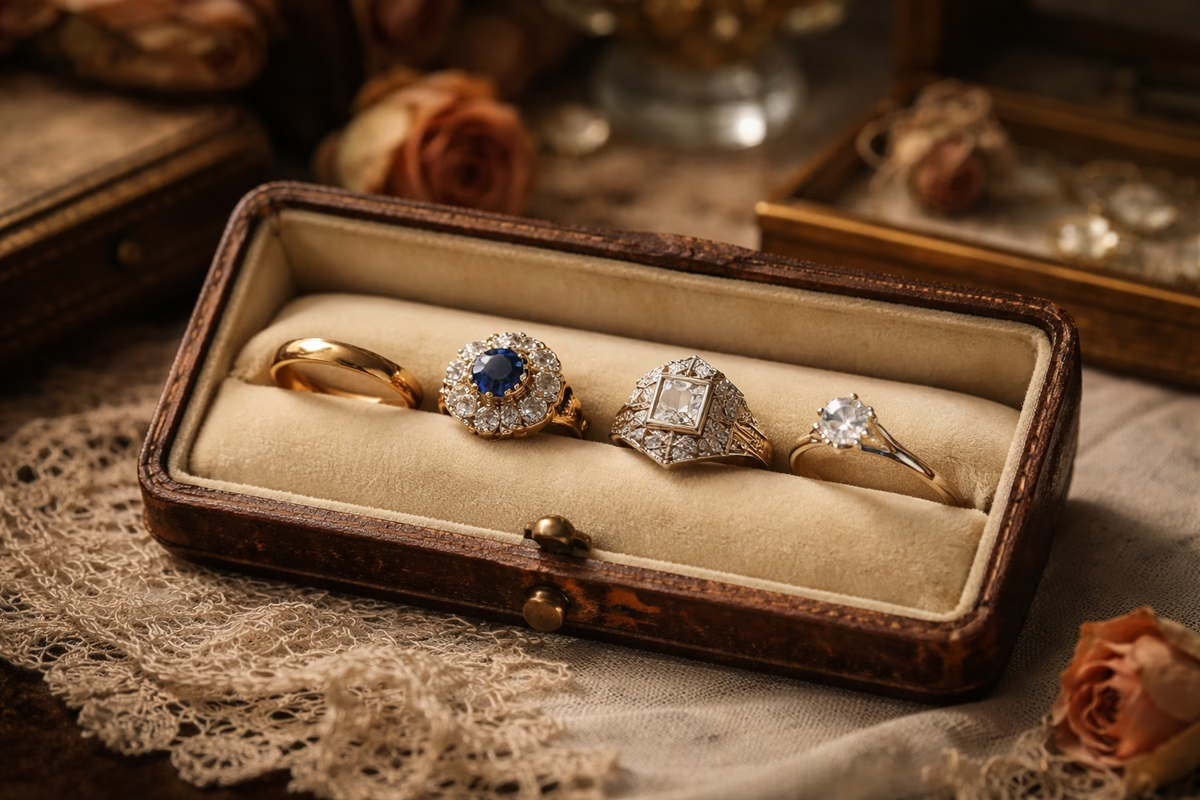
Victorian engagement rings were ornate and symbolic. Popular styles included:
- Cluster rings: a central stone surrounded by smaller gems, creating a floral effect
- Acrostic rings: gems whose first letters spelled a word (e.g., Ruby, Emerald, Garnet, Amethyst, Ruby, Diamond = REGARD)
- Snake rings: coiled serpent designs symbolizing eternal love (Queen Victoria herself received a snake engagement ring from Albert)
- Toi et moi rings: two stones side by side, representing the couple
The Victorian era established the engagement ring as a romantic object—not just a contract marker but an expression of feeling, personality, and taste. Colored gemstones were as prestigious as diamonds, and rings were valued for their design and sentiment as much as their materials.
De Beers and the diamond century (1938 – 2000)
“A Diamond Is Forever”
The modern diamond engagement ring is, to a significant degree, the product of one of the most successful marketing campaigns in history.
In the 1930s, diamond sales were declining. The De Beers diamond company, which controlled roughly 80% of the world’s diamond supply, hired the advertising agency N.W. Ayer to reverse the trend.
The campaign, launched in 1938, didn’t sell diamonds directly. It sold the idea of diamonds: that a diamond engagement ring was the only proper way to propose, that the size of the diamond reflected the depth of love, and that diamonds were rare, eternal, and irreplaceable.
In 1947, copywriter Frances Gerety wrote the tagline “A Diamond Is Forever”—four words that became the foundation of the modern engagement ring industry. The slogan accomplished two things: it associated diamonds with eternal love, and it discouraged resale (if you never sell a diamond, the secondhand market stays small, and prices stay high).
The two-month salary “rule”
In the 1980s, De Beers introduced the suggestion that an engagement ring should cost two months’ salary. This was not a tradition. It was an advertising invention—a manufactured social norm designed to increase average spending.
It worked. By the 1990s, roughly 80% of American brides received diamond engagement rings, up from about 10% in 1940. The diamond solitaire—a single round brilliant diamond in a simple setting—became the culturally expected default.
The modern era: choice, ethics, and personal expression (2000 – present)
Lab-grown diamonds
Lab-grown diamonds—chemically identical to mined diamonds, produced in controlled environments—entered the engagement ring market in the 2010s and grew rapidly. By the mid-2020s, lab-grown diamonds account for a substantial and growing share of the engagement ring market.
The appeal is straightforward: lab-grown diamonds are typically 60–80% less expensive than mined diamonds of equivalent quality, and they avoid the ethical concerns associated with diamond mining. The Lab-Grown vs. Natural guide covers the full comparison.
The colored gemstone return
Colored gemstones—sapphires, emeralds, rubies, morganite—have experienced a resurgence in engagement rings. This is partly a return to pre-De Beers tradition (colored stones were the norm for centuries) and partly a desire for individuality.
Kate Middleton’s sapphire ring (originally Princess Diana’s) gave cultural permission for sapphire engagement rings in a diamond-dominated market. But the trend is broader: couples increasingly want rings that reflect personal taste rather than industry convention.
Alternative materials
Moissanite (a lab-created gemstone with exceptional brilliance), vintage and antique rings, non-traditional metals, and minimalist designs all reflect a shift away from the one-size-fits-all diamond solitaire.
The meaning shift
The most significant change in modern engagement rings isn’t material. It’s meaning.
For Romans, the ring was a contract. For Victorians, it was sentiment. For the De Beers era, it was a socially required proof of financial commitment.
Today, increasingly, the engagement ring is a personal choice—an expression of a specific relationship, a specific aesthetic, and a specific set of values. Some couples choose diamonds. Some choose sapphires. Some choose no ring at all. The tradition is becoming flexible enough to hold all of these choices.
What history teaches the modern ring shopper
The “traditional” diamond ring is newer than you think. The diamond solitaire tradition is about 80 years old—younger than sliced bread. Every era before it used different stones, different metals, and different symbols. Your ring doesn’t need to match a convention invented by a mining company.
Meaning outlasts material. The rings that survive in museums are valued for their stories—the posy ring inscriptions, the gimmal ring mechanics, the royal provenance. A ring’s significance comes from the relationship it represents, not its resale value.
Every era adds something. Romans added the circle. Medieval lovers added the inscription. Victorians added personal symbolism. The modern era is adding choice. What you add to the tradition is up to you.
Next steps
- Read Understanding the 4Cs of Diamonds for the practical knowledge behind diamond selection
- See Lab-Grown vs. Natural Diamonds for the modern decision every buyer faces
- Explore Complete Guide to Ring Metals for choosing the right metal for your ring
- Try Ring Settings and Styles Guide to understand the design options
- Read Buying an Engagement Ring Without Losing Your Mind for a narrative guide to the shopping experience