I knew three things about the ring I wanted to give her.
One: she didn’t want a diamond. She’d said it casually, once, while we were walking past a jewelry store. “I’d rather have something with color.” Then she changed the subject, and I pretended I wasn’t filing the information in a mental folder labeled “IMPORTANT.”
Two: she wore silver jewelry, never gold. Every ring on her hand, every necklace she owned—all silver or white metal. This wasn’t a stated preference. It was a pattern.
Three: she liked simple things. Not minimalist—she appreciated detail—but she gravitated toward objects that were clean and deliberate rather than ornate. A ring that was trying too hard would feel wrong.
Armed with these three observations and no design skills whatsoever, I walked into a custom jeweler’s shop on a Saturday morning and said: “I want to make a ring. I have no idea what I’m doing.”
The jeweler, a woman named Mira who had been making rings for twenty-two years, smiled and said: “That’s how every good custom ring starts.”
Why custom? (And when it makes sense)
Not everyone needs a custom ring. The jewelry industry makes beautiful rings in every style, and choosing from existing designs is faster, cheaper, and eliminates the decision fatigue of starting from zero.
Custom makes sense in specific situations:
When you want something that doesn’t exist. If you’ve looked at hundreds of rings and nothing feels right—close, but not it—custom lets you create the thing that’s missing.
When you have a specific stone. If you’ve chosen (or inherited) a particular gemstone, a custom setting ensures the design serves the stone rather than forcing the stone into a generic mount.
When the ring needs to tell a particular story. Some rings carry meaning beyond aesthetics—a specific engraving, a stone from a particular place, a design that references something personal. Custom is the only way to embed that meaning.
When existing rings feel too generic. Mass-produced rings, even beautiful ones, are designed for the broadest possible appeal. Custom rings are designed for one person.
My reason was the first one. Nothing I’d seen in stores or online felt right for someone who wanted color, wore silver, and preferred simplicity. The three-way intersection of those preferences narrowed the field to almost nothing on the retail shelf—but opened it wide in a jeweler’s sketch pad.
The first meeting: discovering what you want
Mira’s shop was small and calm. No display cases of rings for sale—just a workbench, a desk with paper and pencils, a loupe, a tray of loose stones, and a wall of tools I couldn’t name.
She asked me four questions:
What does she wear? I described the silver jewelry, the preference for simplicity, the absence of diamonds. Mira nodded and wrote “white metal, colored center stone, clean lines.”
What does she do with her hands? This question surprised me. Mira explained that a ring worn daily encounters everything its wearer does—doorframes, keyboards, gardening, cooking. A ring with a high-set stone catches on things. A ring with a bezel setting (stone surrounded by metal rather than held by prongs) is more protective. Knowing how the ring will be lived in matters as much as how it will be looked at.
What’s your budget? Mira asked this directly, without awkwardness. “Custom doesn’t have to be expensive,” she said. “It has to be intentional. I can work with almost any budget—the design just changes to match.” I gave her a range. She said it was workable.
What feeling do you want the ring to give? Not what it should look like—what it should feel like. I thought for a moment and said: “Quiet confidence. Like it belongs on her hand and always has.”
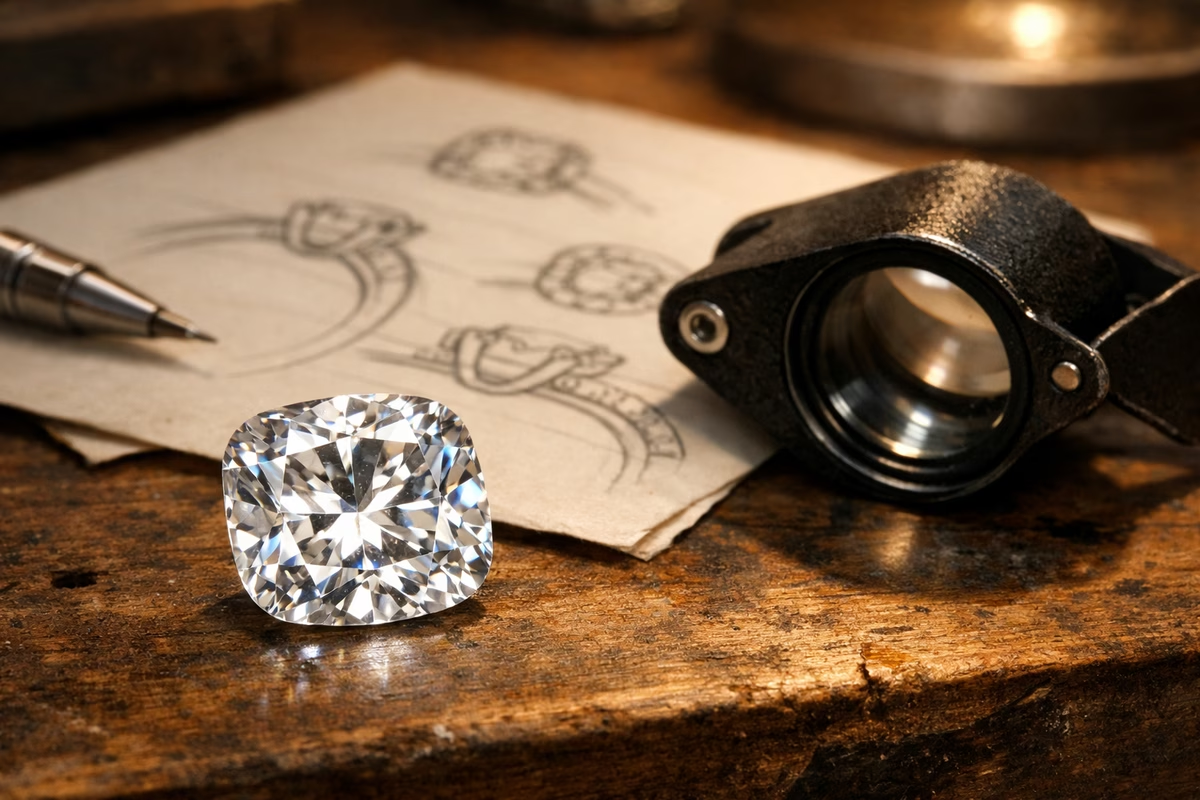
Mira drew three rough sketches in about ten minutes. Not detailed drawings—quick outlines that captured different directions:
- Option A: A low-profile bezel-set oval stone, flush with a simple band. Very modern, very clean.
- Option B: A stone set between two thin bands that split and rejoin—a “bypass” design. Slightly more architectural, more visual movement.
- Option C: A classic four-prong setting, but with the prongs worked into the band so seamlessly that they almost disappeared. Traditional, but with the “quiet” quality I’d described.
I stared at the sketches. Option A felt too plain. Option C felt too expected. Option B had something—the two bands gave the ring a subtle sense of motion without being busy.
“Let’s develop B,” I said.
Choosing the stone: where color becomes personal
Mira set out a velvet tray with a dozen loose stones: sapphires (blue, green, teal, pink), tourmalines, aquamarines, spinels, and two Montana sapphires that were a color I’d never seen in a gemstone—a blue-gray-green that shifted depending on the light.
“Try not to think about what engagement rings are ‘supposed’ to look like,” she said. “Think about what color makes you think of her.”
I picked up the Montana sapphires. In direct light, they leaned teal-blue. In shade, they shifted to a soft gray-green. The color was quiet and changeable—like the light on water.
“Those are unheated Montana sapphires,” Mira said. “They’re unique because they shift color depending on lighting. Each one is a little different. They’re also extremely durable—9 on the Mohs scale, same as any sapphire.”
For more on gemstone choices, see Colored Gemstone Rings and The 4Cs of Diamonds (the principles apply to colored stones too, with some modifications).
I held one between my fingers and tilted it. Blue. Gray. Green. Blue again.
“That one,” I said.
The design process: from sketch to wax to metal
Refined sketches
Over the next two weeks, Mira and I exchanged sketches and photos. She refined the bypass design: two thin bands in platinum (white metal, durable, hypoallergenic) that diverged near the top to cradle the sapphire, then rejoined on the other side. The stone sat low—barely rising above the finger—protected between the bands.
She adjusted proportions three times based on my feedback:
- “The bands feel too thick”—she thinned them by 0.3mm
- “The gap between the bands near the stone feels wide”—she tightened it
- “Can the bands have a subtle texture?"—she added a very fine brushed finish
Each adjustment was small. Each one mattered. The ring was emerging from a series of tiny decisions, and the cumulative effect was a design that felt specific—not generic, not random, but chosen.
The wax model
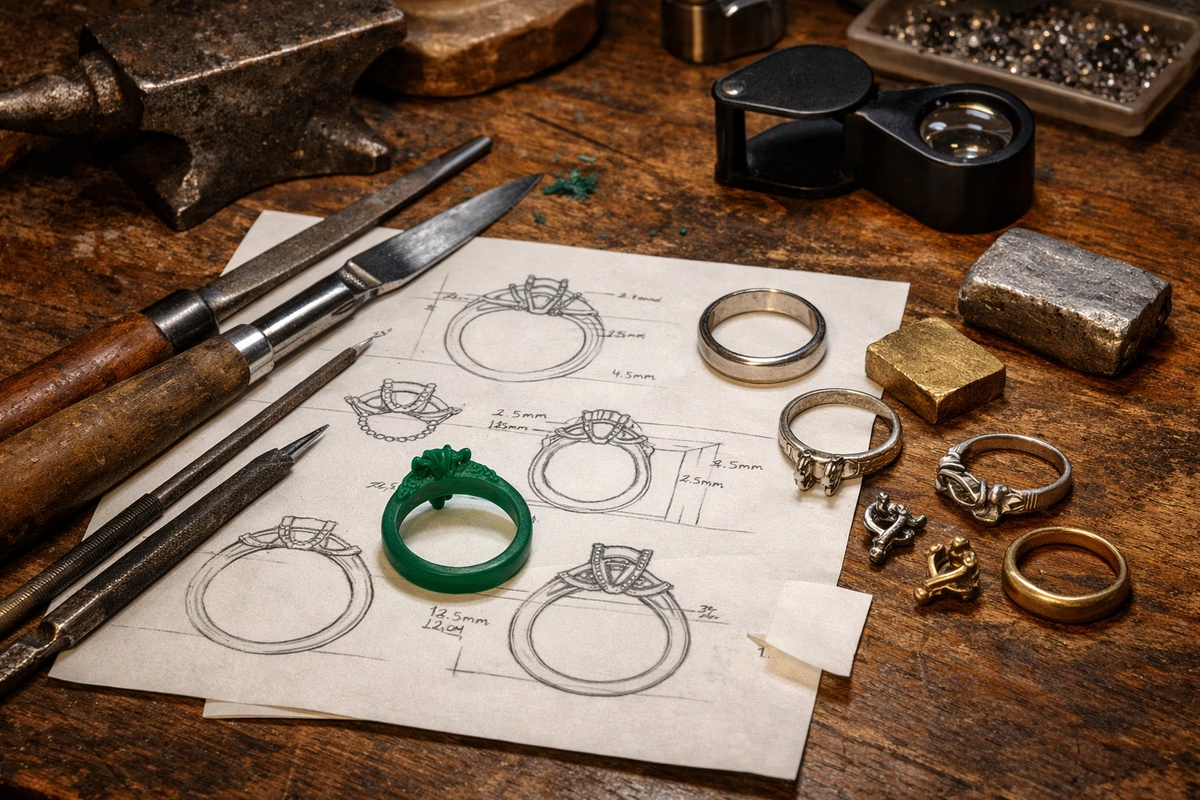
Before committing to metal, Mira carved a wax model of the ring. Wax is easy to shape and modify, and it shows you the ring’s proportions in three dimensions—something no sketch can fully convey.
She handed me the wax model and I slipped it onto my own finger (roughly the same size as my partner’s). The design worked. The low setting felt comfortable. The bypass bands created a gentle visual motion without being distracting. The space where the sapphire would sit was proportioned correctly.
“This is the last chance to change anything for free,” Mira said. “Once we cast, changes cost time and metal.”
I looked at the wax model from every angle. I turned it in the light. I imagined it on her hand during a normal Tuesday—typing, cooking, holding a coffee cup.
“It’s right,” I said.
Casting and setting
Mira cast the ring using the lost-wax process: the wax model was encased in plaster, heated until the wax burned away, and molten platinum was poured into the resulting cavity. After cooling, the plaster was broken away, revealing a raw platinum ring in the exact shape of the wax.
Then she finished it: filing, sanding, polishing the surfaces, brushing the texture into the bands, and finally setting the sapphire—pressing the metal gently around the stone to hold it securely in its seat.
The whole process, from first sketch to finished ring, took six weeks.
The pickup: holding the finished ring
Mira called on a Thursday afternoon. “It’s ready.”
I went to the shop after work. She set a small box on the desk and opened it.
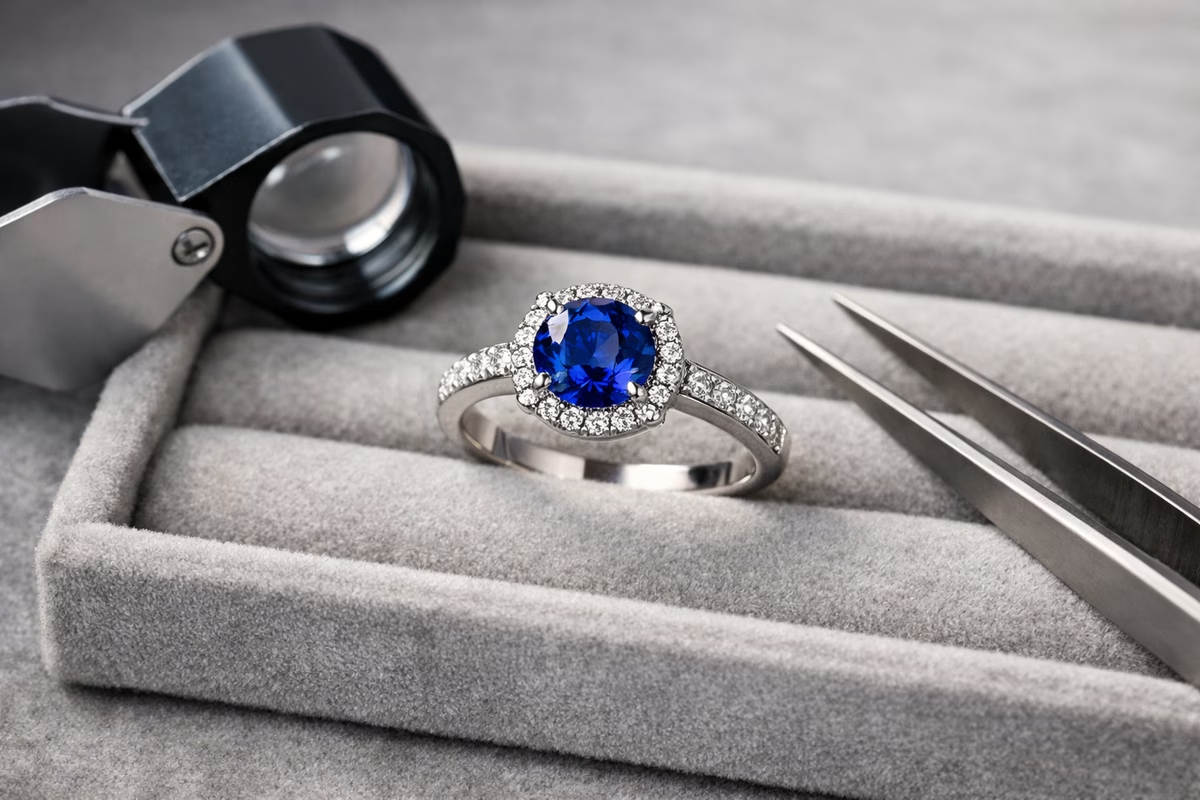
The ring was smaller than I expected—engagement rings always look bigger in photos than they are in person. But it was exactly right. The platinum bands caught the light with a soft, matte sheen. The Montana sapphire sat between them, glowing blue-gray-green, shifting color as I tilted the box.
It looked like the ring had always existed. Like it had been waiting in a drawer somewhere and Mira had just found it. That was the feeling I’d described in the first meeting—“quiet confidence”—and seeing it realized in metal and stone was the most satisfying moment of the entire process.
I slipped it back into the box, put the box in my jacket pocket, and carried it home with my hand over the pocket the entire way.
What the custom process teaches you
Design is editing. A custom ring doesn’t get better by adding things. It gets better by removing things—thinning bands, simplifying settings, choosing one stone instead of three. The best custom rings are the ones where every element earns its place.
Materials are not interchangeable. Platinum, white gold, and silver all look “silver-colored,” but they feel different on the hand, age differently, and protect stones differently. The choice of metal is a design decision, not just a budget decision. See Ring Metals for the full comparison.
The jeweler is a collaborator. I didn’t design this ring. Mira didn’t design it either. We designed it together—my knowledge of what my partner wanted, her knowledge of what metal and stone could do. The best custom experience is a conversation, not a commission.
Perfection is a feeling, not a specification. The ring wasn’t flawless under a loupe—there was a tiny tool mark inside the band, invisible when worn. But it was perfect in the sense that mattered: it felt like it belonged to one specific person, and no other ring in the world looked exactly like it.
Next steps
- Read Ring Settings for understanding the setting styles Mira showed me
- Explore Ring Metals for the platinum-vs-gold decision
- See Colored Gemstone Rings for the narrative of choosing color over diamonds
- Try Ring Sizing for getting the fit right (especially important for custom)
- Check Ring Care for maintaining the ring after the proposal