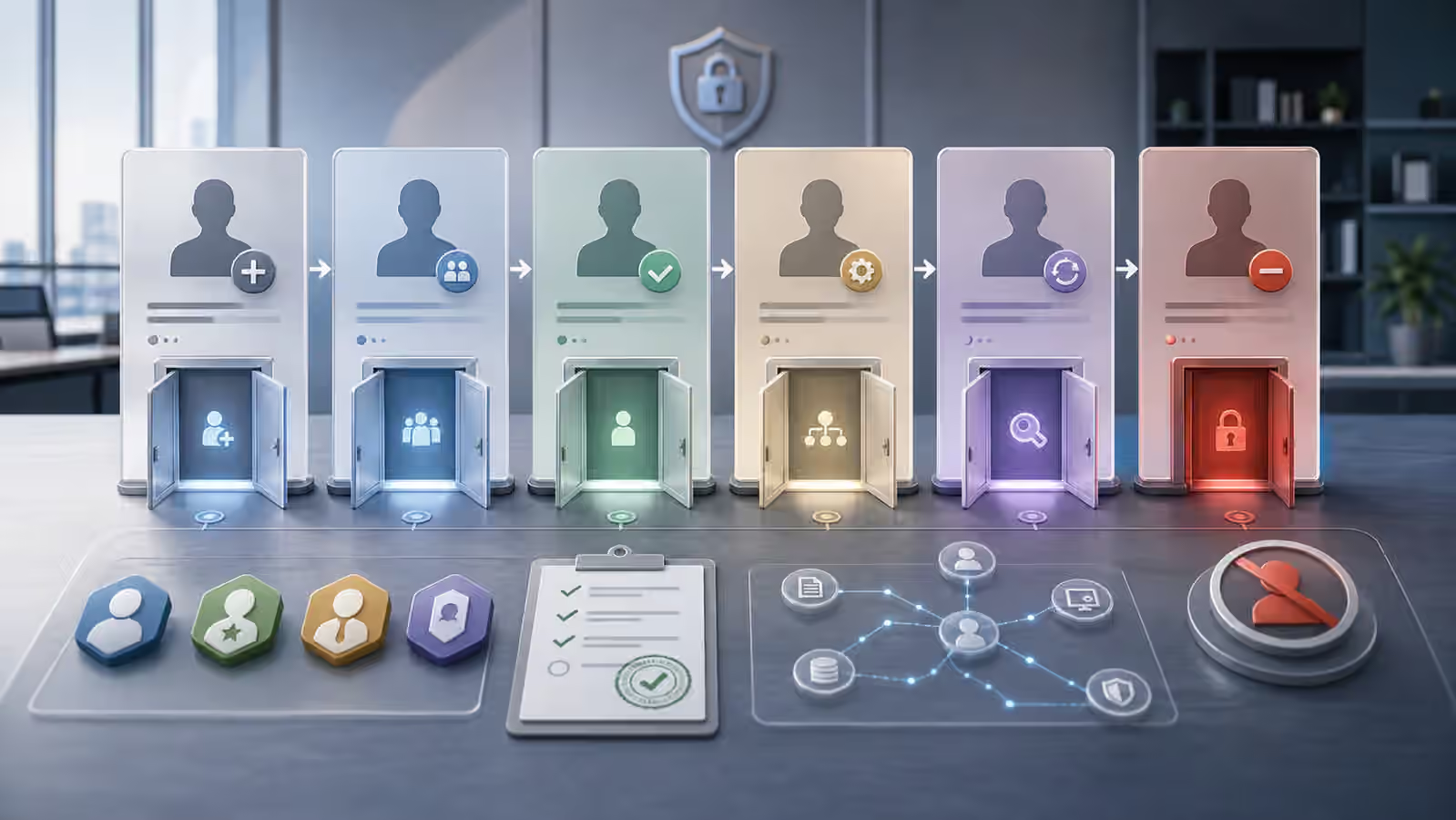
A secret found in a source repository is not just a string to delete. It is evidence of possible access, ownership, history, and blast radius. The safest defensive question is not “how do we hide this line?” It is “what did this secret allow, where did it travel, who owns it, when was it valid, and what proof shows it has been replaced?” For background, see NIST — Secure Software Development Framework, SP 800-218 .
This topic sits between Service Accounts and Secrets and software supply-chain guides such as SBOMs, Signatures, and Attestations . A repository secret may belong to a cloud account, a SaaS integration, a database, a deployment job, a webhook, or a testing environment. The code repository is only the place where the evidence appeared.
This guide is defensive education. It uses toy examples, observable evidence, and safe reasoning. It does not provide exploit instructions, malware code, credential theft steps, evasion playbooks, target scanning procedures, or operational offensive workflows. If you are handling an active incident, preserve evidence, follow your organization's incident-response plan, and involve qualified responders and legal counsel where appropriate.
Why repository secrets are evidence problems
Repository history changes the response. Removing a secret from the latest version may not remove it from earlier commits, forks, caches, build logs, package artifacts, container layers, or developer machines. Some of those locations may be low risk, and some may be inaccessible to outsiders, but a careful note should separate cleanup from revocation. Cleanup changes where the old value is visible. Revocation changes whether the old value still works.
The first useful record is the discovery note. It should identify the repository, the branch or review context, the approximate time found, the kind of secret if known, the likely owner, and the current exposure of the repository. It should not copy the secret into chat, tickets, screenshots, or documentation. If a ticket needs evidence, record a redacted fingerprint, a file path, and a source reference that authorized responders can inspect.
Public exposure is not the only concern. Private repositories can still have wide collaborator access, automation access, mirror access, or vendor access. Internal exposure may be enough to require rotation if the secret grants broad permissions. The Impact and Blast Radius guide helps keep that decision tied to what the secret could actually reach.
Defensive mental model
Treat the secret as an identity key with a lifecycle. It was created somewhere, granted access somewhere, stored somewhere, used somewhere, and eventually should be rotated or revoked. Repository review begins in one location but should follow the identity relationship back to its owner and forward to its permissions.
The second part of the model is history. A repository is not a single file tree. It is a record of changes, branches, releases, and automation. A secret introduced yesterday in a short-lived branch is different from a secret that lived for years in a widely cloned project. Neither case should be exaggerated, but neither should be dismissed without checking exposure, validity, and privileges.
The third part is replacement. Rotating a token without updating the dependent service can cause outages. Updating the dependent service without revoking the old value leaves risk behind. Good remediation pairs a technical change with evidence: the new secret is stored in an approved place, dependent jobs work, old credentials are invalid, logs show no suspicious use during the exposure window, and the owner accepted the residual risk if some evidence is unavailable.
What evidence matters?
A useful review starts with secret type. Is it a password, API token, signing key, webhook secret, database connection string, cloud access key, private key, or test fixture that resembles a secret but is inert? Defenders should avoid guessing based on shape alone. Some fake values intentionally look real, and some real values look bland.
Next comes scope. What system accepts the value? What actions could it perform? Was it read-only, write-capable, administrator-level, environment-limited, or tied to a short lifetime? Scope determines urgency more than embarrassment does. A stale test token in a private repository is not the same as a production deploy credential in a public repository.
Then comes use evidence. Authentication logs, audit logs, deployment history, repository access logs, and secret manager records may show whether the value was used during the exposure window. Absence of evidence is not always reassuring, because logging may be incomplete. The note should say what was checked and what the checked source can prove.
Toy example
Imagine a fictional startup where a code review finds a cloud storage token in a configuration file. The repository is private, but many contractors have read access. The first response is not to paste the token into the incident chat. A defender records the file path, commit reference, repository visibility, suspected service, and owner, then asks the owner to rotate the token through the approved secret manager.
After rotation, the team checks whether the old value is disabled, whether the application still deploys, whether related storage access logs show unusual activity, and whether the repository history needs additional cleanup. The final note says what was found, what was rotated, what logs were checked, what remains unknown, and whether any follow-up owner action is required.
Common mistakes and false positives
The most common mistake is treating deletion as remediation. Deletion may reduce accidental exposure, but it does not prove that the credential is unusable. Another mistake is widening exposure by copying the secret into every discussion about it. The response should protect evidence without reproducing the sensitive value.
False positives are common in repository scanning. Documentation examples, generated test strings, placeholder values, and intentionally invalid fixtures can look secret-like. A false positive still teaches something if it improves naming, test-data conventions, or scanner tuning. The right outcome may be a clearer fake value, not an emergency rotation.
What to do next
When a suspected secret is found, preserve a minimal redacted record, identify the owner, determine validity and scope, rotate or revoke through the approved path, and check use evidence appropriate to the risk. If the repository is public, broadly shared, or tied to privileged production access, involve the incident-response process early.
For routine engineering cleanup, pair detection with prevention. Use approved secret storage, pre-commit scanning where appropriate, code review habits, least privilege, and clear ownership. The best repository secret response leaves behind a smaller blast radius and a clearer engineering path, not only a cleaner file.
How this guide was made
This page was written as defensive education for secure engineering review. It avoids publishing example secrets, replay steps, and credential testing procedures. The focus is ownership, rotation evidence, repository history, and measured response.
Official references
For orientation, compare this topic with the NIST Secure Software Development Framework , CISA Secure by Design , and CIS Critical Security Controls v8 . Those references support secure development practices, controlled secrets, logging, and accountable remediation.
Related guidebooks
Repository secret review pairs with Service Accounts and Secrets , SBOMs, Signatures, and Attestations , Container Image Trust , and Impact and Blast Radius .