When something goes wrong, the first question everyone asks is “how bad is it?” Blast radius is the discipline of answering that question carefully. It borrows the image of an explosion: the point of detonation is the initial problem, one compromised laptop or one exposed account, and the blast radius is everything that problem can plausibly reach from there. The reason it matters is that response effort is finite, and where you spend it depends entirely on how far the damage could spread. A single infected machine on an isolated network is a contained event; the same machine holding keys to shared systems and sensitive data is something else. Learning to draw that circle honestly, neither too small nor too large, is one of the most practical defensive skills there is.
This guide is written for people early in their security journey, and it keeps the idea concrete. We are not trying to predict every possible consequence. We are trying to answer four grounded questions: which systems, which data, which identities, and which business functions could be affected, and to answer them from evidence rather than fear.
This guide is defensive education. It uses toy examples, observable evidence, and safe reasoning. It does not provide exploit instructions, malware code, credential theft steps, evasion playbooks, target scanning procedures, or operational offensive workflows. If you are handling an active incident, preserve evidence, follow your organization's incident-response plan, and involve qualified responders and legal counsel where appropriate.
The four circles of impact
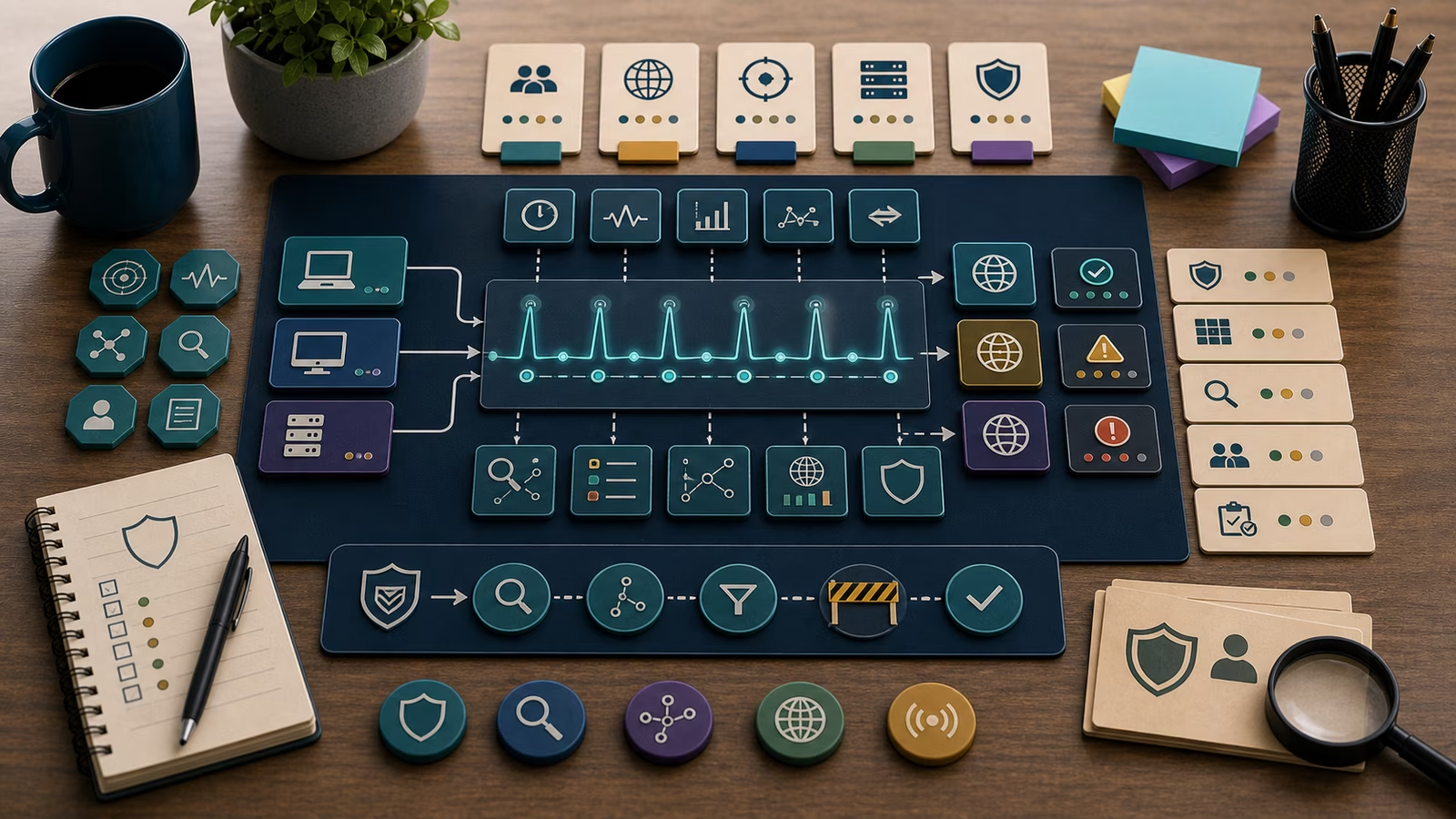
A useful way to estimate blast radius is to draw four overlapping circles and fill each one from what you can actually observe. The first circle is systems: the machines, servers, and services the problem directly touched, plus the ones connected closely enough to be reached next. The second is data: the information those systems hold or can read, and how sensitive it is. The third is identities: the accounts and credentials involved, and crucially, what else those identities can unlock elsewhere. The fourth is business functions: the real-world activities that depend on the affected pieces, such as taking orders, paying staff, or serving customers.
These circles are worth separating because they do not always grow together. A compromised machine with little data and a low-privilege account has a small radius even if the machine itself is important-sounding. A modest-looking account that happens to be an administrator, by contrast, can have a huge radius because of what it can reach. Estimating impact well means resisting the instinct to judge by how dramatic the starting point feels and instead following the connections outward.
Why the radius comes from connections, not size
The single most important idea in blast-radius thinking is that reach follows relationships. What makes a small starting point dangerous is not its own size but what it is connected to: shared credentials that work across many systems, a flat network where one machine can talk to everything, an identity with broad permissions, or a service that many other services trust. This is why two incidents that look identical at the start can have wildly different impact. The determining factor is usually the design of the environment around the affected asset.
That insight is also empowering, because connections are something an organization can measure and reduce ahead of time. An environment with strong segmentation, least-privilege accounts, and unique credentials shrinks its own blast radii before any incident happens. The reasoning behind those defenses lives in Network Segmentation and Flat Networks , IAM Roles and Least Privilege , and Password Managers and Credential Reuse , and an accurate picture of what connects to what depends on the habits in Asset Inventory Drift .
Toy example
Imagine the fictional design studio Marlowe & Finch discovers that one laptop, “reception-02,” has been behaving oddly and may be compromised. Instead of panicking or shrugging, a defender draws the four circles. Systems: reception-02 itself, plus whatever it can reach on the network. Data: the files stored on it and the shared folders it can open. Identities: the account signed into it, and anywhere that account’s credentials are also valid. Business functions: whatever work stops if the laptop or those shared folders are unavailable.
Filling the circles from evidence changes the picture quickly. If reception-02 is on an isolated guest segment, uses a unique low-privilege account, and only opens a single non-sensitive folder, the radius is small and the response can be measured. If instead the same laptop is on a flat network, its account is reused by several staff, and it can reach the customer database, the radius is large and the urgency climbs. The starting point was identical; the connections told the real story.
What evidence matters?
A blast-radius estimate is only as good as the evidence behind it, and the most useful evidence describes connections rather than drama. For systems, network and access records show what the affected asset can actually reach, which is far more reliable than assuming. For data, a classification scheme tells you whether the reachable information is public, internal, or sensitive, so the estimate reflects real consequence. For identities, directory and permission records reveal what the involved accounts can unlock elsewhere, turning a vague worry into a specific list.
For business functions, the map between technical assets and the work they support turns a technical finding into something leaders can act on. The strongest estimates cite timestamped, exported evidence and name their sources, so another person can check the reasoning. Two neighboring guides make this evidence sharper: Data Classification for Cyber Defense turns “some files” into a real sensitivity judgment, and Assets, Identities, Exposures, and Controls supplies the underlying model for connecting those four things together.
Common mistakes and false positives
The most frequent mistake is overestimating out of fear. A worrying alert on one machine becomes, in the retelling, “the whole company is compromised,” and that exaggeration is not harmless: it wastes response effort, alarms leadership, and erodes trust in the security team when the truth turns out to be smaller. A blast-radius estimate should be a circle drawn from evidence, and if the evidence only supports one machine and one folder, the estimate should say so plainly.
The opposite mistake is underestimating by looking only at the point of detonation. A single compromised account can feel minor until you notice it is an administrator or that its password is reused across a dozen services. The fix for both errors is the same: state confidence as a level and keep observation separate from inference. “This laptop is compromised” may be well evidenced, while “customer data was accessed” is a separate claim that needs its own proof. Keeping those apart, and revising the estimate as evidence arrives rather than clinging to the first guess, is what makes the number trustworthy.
Worked defensive review
Return to reception-02. A careful reviewer writes the narrow claim, then fills each circle from records rather than assumption: they check the network segment to see what the laptop can reach, review the account’s permissions and whether its credentials are reused, and consult the data classification of any folders it can open. Suppose the evidence shows the laptop is isolated, the account is low-privilege, and the reachable data is non-sensitive. The estimate is a small radius, and the note says so with the sources attached. Suppose instead the account turns out to be reused by several people and can reach a sensitive share; the radius widens, the note is revised, and the finding moves into the incident process where containment can be authorized. Throughout, the reviewer records confidence as a level and marks which parts are proven versus assumed, so the estimate can be trusted and updated.
What to do next
Let the size of the honest estimate guide the response. A small, well-evidenced radius supports a calm, measured next step: confirm with the owner, preserve the relevant logs, and document what you found. A large radius that touches sensitive data, privileged identities, or a critical business function calls for escalation into the formal incident process, where the people who can authorize containment take over. Because impact estimation sits near the end of the attack story, it connects naturally to what came before and after: trace how data might have left through Exfiltration Paths , and if availability is at stake, walk the sequence in Ransomware Timeline .
For anything active, do not experiment. Preserve evidence, follow the incident-response plan, communicate through approved channels, and involve qualified responders. For learning, keep the systems and accounts fictional and practice the core reflex: draw the four circles, fill them from evidence, follow the connections rather than the drama, and revise the estimate honestly as you learn more.
How this guide was made
This page is defensive education, drawn from public frameworks such as the NIST Cybersecurity Framework, NIST incident-handling guidance, and MITRE ATT&CK, and illustrated with invented systems and toy data. It makes no claim to certification, legal advice, incident-response authority, or complete coverage, and it deliberately avoids operational offensive detail so that it stays useful for safe study.
Official references
As orientation rather than certification, the MITRE ATT&CK Enterprise Matrix describes impact techniques that shape how far damage can spread, the CISA Known Exploited Vulnerabilities Catalog tracks the flaws that often widen a radius, and the NIST Cybersecurity Framework 2.0 frames the risk and response functions that put impact estimation in context.
Related guidebooks
To place impact estimation within the wider story, pair this with Exfiltration Paths for how data loss factors into the radius and Ransomware Timeline for how availability damage unfolds. To shrink your radii before anything happens, Network Segmentation and Flat Networks and IAM Roles and Least Privilege are the most useful next reads.