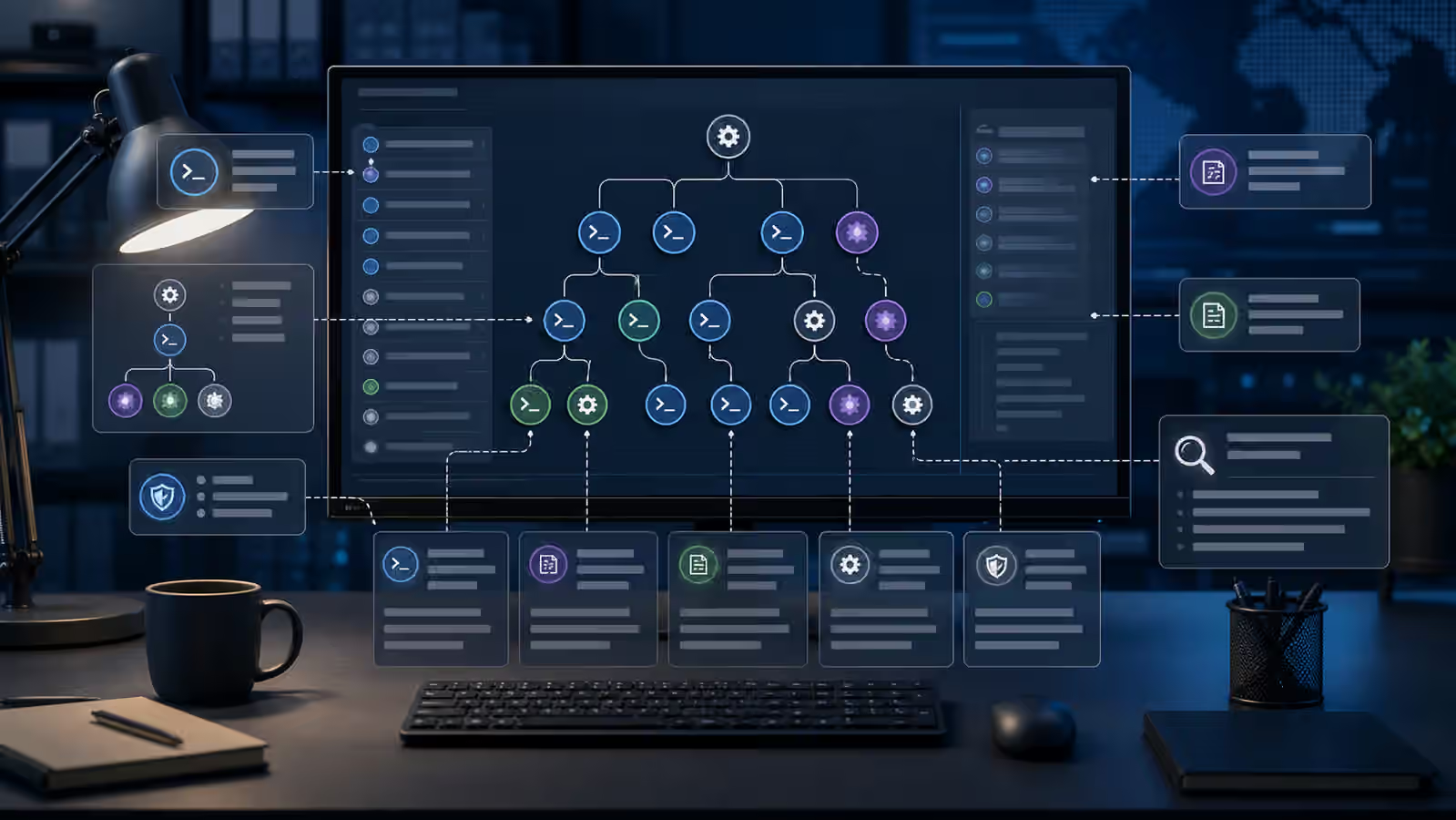
Detection tuning is the practice of making alerts more useful without making the organization less able to notice harm. It is not the same as silencing annoying messages. A noisy alert may be poorly written, poorly scoped, missing context, or firing on behavior that is normal in one environment and suspicious in another. Tuning asks what the alert is trying to protect, what evidence it uses, why it fires too often, and what should remain visible after the change. For background, see CIS — Critical Security Controls v8 .
This guide builds on Security Alerts Without Panic . That guide helps a reader respond to an alert calmly. This one asks what happens after the tenth, hundredth, or thousandth similar alert, when the team must decide whether the detection itself needs improvement.
This guide is defensive education. It uses toy examples, observable evidence, and safe reasoning. It does not provide exploit instructions, malware code, credential theft steps, evasion playbooks, target scanning procedures, or operational offensive workflows. If you are handling an active incident, preserve evidence, follow your organization's incident-response plan, and involve qualified responders and legal counsel where appropriate.
What Tuning Is For
A good alert points to a question worth asking. It does not need to prove an incident by itself. It should give a defender enough reason to look at a process, identity, network connection, file behavior, configuration change, or access pattern. Tuning improves that question. It may narrow the alert to better evidence, add suppression for a known administrative pattern, raise severity when sensitive assets are involved, or attach context that helps triage.
The danger is overcorrection. A team exhausted by noise may remove the very signal that would matter in a future incident. The safer approach is to preserve the detection’s intent before changing mechanics. Write down what the rule is meant to catch in plain language. Then write which examples are noisy, which examples remain concerning, and which evidence would distinguish the two.
Detection tuning is easier when the organization has Known-Good Baselines . A process that looks strange on one workstation may be normal on a build server. A login pattern that looks unusual for most staff may be expected for an on-call administrator. Baselines do not excuse everything. They help tuning stay specific.
Noise Is Not Always Useless
Noise can reveal missing ownership, poor deployment hygiene, unstable tools, or incomplete logging. If a legitimate management script triggers a suspicious-process alert every night, the answer may not be to ignore the script forever. The answer may be to document the script, confirm the owner, constrain where it runs, and tune the detection to recognize that known behavior while still catching similar behavior in unexpected places.
Some noisy alerts are weak because they use a single signal. A command-line pattern may be risky in one context and harmless in another. A rare process name may be suspicious on a user laptop and normal on a specialized server. A connection to an unfamiliar domain may be meaningful if it follows a new process launch and meaningless if it belongs to approved software. Tuning often means combining signals rather than raising or lowering a threshold blindly.
There is also emotional noise. An alert name can sound severe even when the evidence is thin. A detection can use dramatic language that leads people to assume a verdict. Good tuning includes language review. The alert title, severity, and description should match the confidence of the evidence. Evidence-First Triage is useful here because it keeps the team from confusing a detection hypothesis with a finished conclusion.
Preserving Detection Intent
Before changing a rule, a defender should be able to explain what the rule should still catch afterward. That explanation can be short, but it should be concrete. If the rule watches for suspicious child processes from an office application, tuning should not simply remove the office application from scope. It may need to recognize known automation, approved plugin behavior, or a specific software update while still leaving unexpected child processes visible.
Tuning records matter because future responders inherit past decisions. A suppression that made sense during a migration may look mysterious a year later. A threshold raised during a noisy week may hide a real change in behavior. A record should say what changed, why it changed, which examples were reviewed, who approved it, and when the decision should be revisited. That record does not need to be elaborate; it needs to be findable.
Detection quality also depends on telemetry quality. If the logs do not include parent process, user, host, command-line, network destination, or timestamp details, the rule may be forced to guess. The answer may be better logging, not just a different rule. The guide on Suspicious Process Indicators shows why context changes interpretation.
A Defensive Review Example
Imagine a fictional software company where an alert fires whenever a build worker launches a compression utility. The alert was written because compression can appear before data movement. In this environment, however, the build system compresses artifacts many times a day. Analysts are tired of closing the same alert and ask to suppress it completely.
The safer review begins with the detection intent. The team wants to notice unusual compression of sensitive files, especially from user machines or unexpected service contexts. The build worker behavior is expected, owned, and logged. The tuning change can reduce alerts for the approved build path while keeping the same behavior visible on laptops, file servers, and sensitive repositories. The note records the source examples, the owner confirmation, and the assets where the detection should still fire.
The review also finds that the original alert lacked data sensitivity context. Compression on a public documentation folder is different from compression near customer records. The improved detection may add asset tags or data classification where available. If those tags are incomplete, the tuning note should say so. Honest limits are part of good detection work.
Connections to Other Guides
Detection tuning touches incident response, endpoint telemetry, and control design. It helps analysts focus, but it can also create blind spots if done casually. When a tuning request appears during an incident, responders should be especially careful. It may be better to preserve the current signal until the incident timeline is understood, then make the change afterward with a clear record.
Tuning is also a learning loop. Every repeated false positive teaches something about normal behavior. Every missed event teaches something about telemetry gaps or assumptions. The point is not to reach a world with no alerts. The point is to make alerts worth attention and to make their limits clear.
A Careful Tuning Habit
The careful habit is to tune with a before-and-after story. Before the change, describe the signal, the noise, and the risk the detection was meant to cover. After the change, describe what will be quieter, what will still be visible, and what should trigger a revisit. That small discipline prevents tuning from becoming a memory hole.
Good tuning does not promise certainty. It improves the relationship between evidence and attention. When a team can explain why an alert exists, why it changed, and what remains visible, it has made defensive work calmer and more reliable.