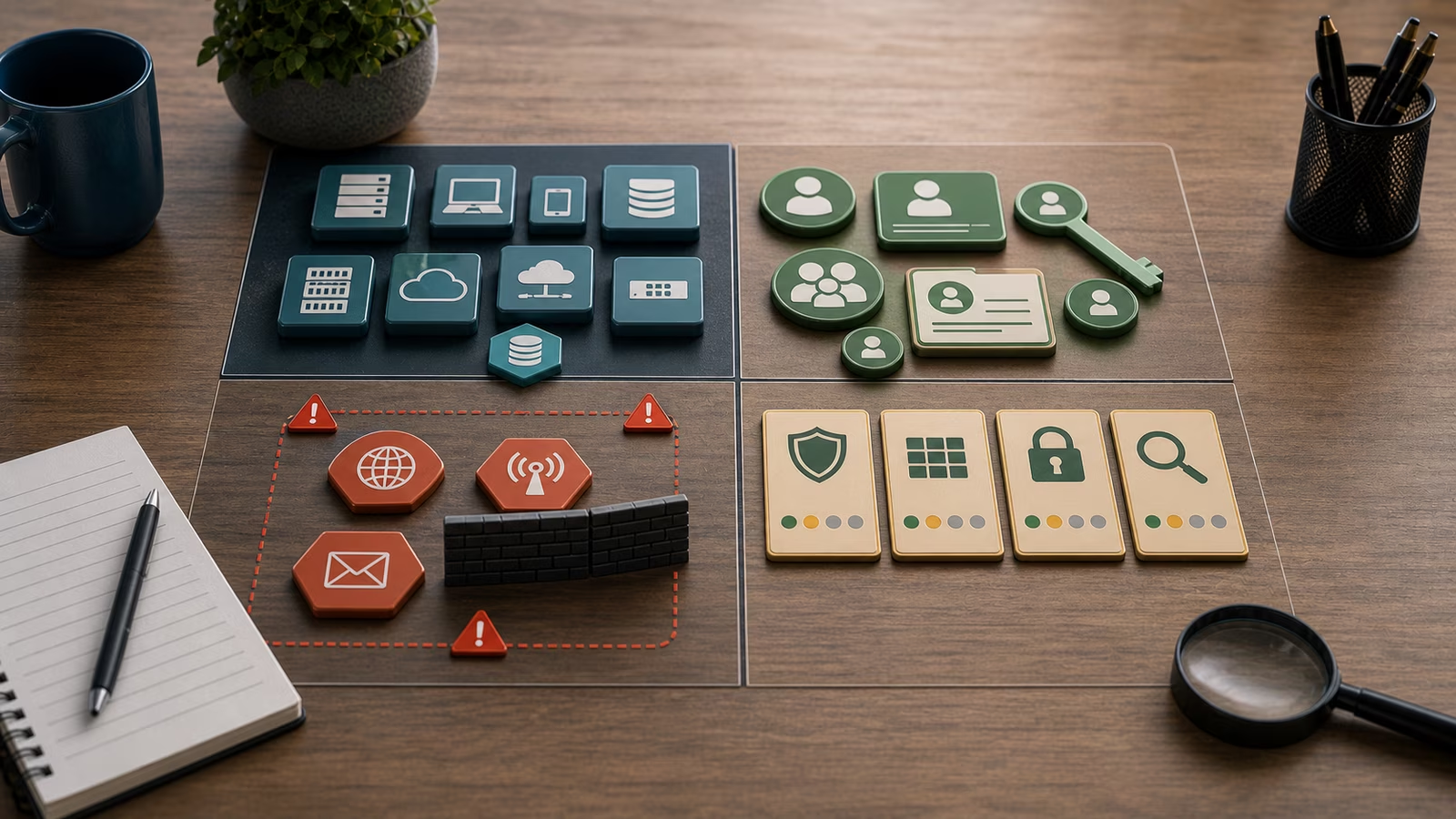
Data classification is the quiet work that lets defenders explain why one alert can wait for owner review while another needs immediate escalation. A file share, database, ticket queue, chat export, or model prompt log is not important only because it exists. It becomes important because of what it contains, who can reach it, how it supports the business, and what harm could follow if it were changed, lost, copied, or exposed. For background, see CIS — Critical Security Controls v8 .
Cybersecurity teams often meet classification late, after a confusing alert has already arrived. Someone asks whether the affected data was sensitive, and the answer comes back as a guess. A better habit is to treat classification as evidence that belongs beside asset inventory, identity permissions, logging, and recovery planning. The label itself is not the whole control. It is a compact signal that should point to an owner, a reason, a retention expectation, and the access boundary that is supposed to protect the data.
This guide is defensive education. It uses toy examples, observable evidence, and safe reasoning. It does not provide exploit instructions, malware code, credential theft steps, evasion playbooks, target scanning procedures, or operational offensive workflows. If you are handling an active incident, preserve evidence, follow your organization's incident-response plan, and involve qualified responders and legal counsel where appropriate.
Why classification belongs in defense
Classification helps a defender translate a technical event into a risk question. A sign-in from an unusual location matters more when the account can export customer records than when it only reads public marketing files. A public link matters more when the folder contains contract drafts than when it contains published images. An unavailable database matters more when it blocks payroll, care delivery, shipping, or another core workflow than when it stores a low-risk test copy.
The useful classification question is not “what fancy label can we apply?” The useful question is “what would change if this data were seen, changed, deleted, or unavailable?” That framing keeps the work practical. It also prevents teams from treating every file as equally sensitive, which is another way of having no useful classification at all. If everything receives the strongest label, defenders lose the ability to focus. If nothing receives a meaningful label, responders must reconstruct impact during the worst possible moment.
Classification also supports calm conversations with non-security teams. A business owner may not care about an abstract alert name, but they can usually explain whether a folder contains customer contact details, internal financial planning, product source material, public documentation, or throwaway test data. That owner knowledge is evidence. It should be captured in a durable place rather than rediscovered through hallway memory.
The smallest useful labels
A classification program can become too elaborate to use. For defensive triage, a small set of clear labels is usually more useful than a ceremonial taxonomy that no one applies consistently. A beginner-friendly scheme distinguishes public material, ordinary internal work, restricted business data, highly sensitive data, and regulated or contractually controlled records. The exact words can vary by organization, but the defensive habit is stable: the label should say something about likely harm and expected control strength.
The label should not stand alone. It needs a data owner, a business purpose, an expected access group, a retention expectation, and a place to find logs or change history. Without those supporting facts, “restricted” can mean almost anything. With them, the label becomes actionable. A responder can ask whether access matched the expected group, whether an export was unusual for the owner, whether logging covered the relevant window, and whether recovery plans include that system.
Good labels also recognize copies. Sensitive data rarely lives in only one place. It may appear in support tickets, analytics exports, spreadsheets, backups, chat attachments, AI tool prompts, development fixtures, or email threads. The classified system of record matters, but the defensive risk often comes from the easier copy that escaped the main control path. That is why Shadow AI Data Leaks and SaaS sharing reviews belong in the same conversation as data classification.
Evidence behind a label
A defender should be able to show where a classification came from. The evidence might be a data catalog entry, a system owner note, a ticket, a retention schedule, a schema review, a sample-free description of data types, or an access policy. Evidence does not need to expose the data itself. In many cases, the safer note says that a dataset contains customer support records, billing metadata, source code, or internal planning material without pasting examples into the incident record.
The strongest classification evidence is current enough to trust and specific enough to change a decision. A two-year-old owner note may still be useful, but it should be treated as lower confidence if the product changed. A folder name may hint at sensitivity, but it is weaker than an owner-confirmed catalog entry. A data-loss prevention alert may identify a pattern, but it still needs context about false positives, business use, and whether the destination was expected.
Evidence quality matters because classification can create both overreaction and underreaction. If a folder is mislabeled as public, responders may miss the impact of exposure. If it is mislabeled as highly sensitive, a routine sharing event may trigger unnecessary escalation. The goal is not perfect certainty. The goal is to record enough confidence that a later reviewer can understand why a decision was reasonable.
How labels change triage
During triage, classification changes the next question. For low-sensitivity material, the main concern may be integrity, availability, or reputational confusion rather than confidentiality. For restricted internal data, the defender may focus on whether access was limited to a known group and whether the event matched a normal workflow. For highly sensitive data, the same signal may require preservation, owner notification, legal review, or leadership awareness before anyone takes a disruptive action.
Classification also changes how defenders estimate Impact and Blast Radius . A single compromised identity can have a small blast radius if it touches only a narrow working set. It can have a large one if it can reach many sensitive repositories, export records, or change retention settings. The difference is not visible from the username alone. It comes from connecting identity permissions to classified data and business function.
In suspected exfiltration, classification helps separate data movement from data harm. A large transfer of public build artifacts is not the same as a small transfer of payroll records. A compressed archive is not automatically sensitive, and a small file is not automatically harmless. Defenders should connect transfer evidence with data owner evidence, access history, destination context, and the classification of the affected content. The Exfiltration Paths guide is easier to use when the data side of the story is already named.
Messy cases
The hardest classification problems are rarely the obvious crown jewels. They are mixed folders, exports, derived data, logs, and collaboration spaces where sensitivity changes over time. A project folder may start with public research and later collect contract drafts. A log stream may look operational until it includes tokens, session identifiers, personal data, or confidential customer names. A development dataset may be described as synthetic but still contain fields copied from production long ago.
These messy cases need humility. A defender can write that classification is unknown, partially confirmed, or dependent on owner review. That is better than inventing certainty. Unknown classification is itself a triage fact because it affects the next step. If the data might be sensitive and the exposure is real, preservation and owner contact may be more appropriate than quick cleanup with no record. If the data is confirmed public and the control gap is still worth fixing, the response can focus on hygiene without overstating incident impact.
Classification also needs maintenance. A label applied once can become stale as workflows, integrations, and copies change. Access reviews, data retention work, SaaS administration, and logging decisions should feed back into the classification record. When a defender discovers that a system contains more sensitive material than expected, the finding should become a control improvement, not just an incident footnote.
Practice safely
A safe practice exercise uses fictional assets and invented data names. Create a pretend company with a public website, a support queue, a billing database, a code repository, a shared drive, and an analytics export. For each item, write a plain-language classification note that names the owner, business purpose, expected access group, logging source, and likely impact if the data were exposed or unavailable. Do not use real customer records, real credentials, or real production screenshots.
Then add a fictional alert. A service account exported a report. A public link appeared on a folder. A laptop synchronized a large archive. A chat integration gained access to files. For each scenario, explain how the classification changes the response. The exercise should produce careful sentences rather than dramatic verdicts. A good note might say that the affected folder is owner-confirmed internal planning data, that access is broader than expected, that logs cover only part of the relevant window, and that owner review is needed before impact can be stated with confidence.
Related guidebooks
Data classification is easiest to understand after Assets, Identities, Exposures, and Controls because classification gives the asset side more meaning. It connects naturally to Logs: What to Keep and Why because sensitive systems need useful records. It also supports Evidence-First Triage by giving responders a careful way to say what is known, what is assumed, and what still needs owner confirmation.