Authentication logs are often the first place a defender looks when an account behaves strangely, but they are easy to overread. A failed sign-in is not automatically an intrusion attempt. A successful sign-in from a new device is not automatically compromise. A clean sign-in record is not proof that the account is safe. The useful question is narrower: what does this record show, what identity or asset does it affect, and what other evidence would make the interpretation stronger?
Cybersecurity Encyclopedia treats authentication evidence as part of the same identity story covered in MFA, Passkeys, and Recovery Paths and Valid Accounts . The point is not to memorize every possible login event. The point is to make a careful distinction between an event, a pattern, and a decision.
This guide is defensive education. It uses toy examples, observable evidence, and safe reasoning. It does not provide exploit instructions, malware code, credential theft steps, evasion playbooks, target scanning procedures, or operational offensive workflows. If you are handling an active incident, preserve evidence, follow your organization's incident-response plan, and involve qualified responders and legal counsel where appropriate.
Why authentication logs need context
Authentication records usually mix human behavior, device behavior, policy behavior, and service behavior. A person may mistype a password several times before remembering that their password manager has an old value. A device may refresh a token while the user is asleep. A federated identity provider may show a geographic surprise because a network provider, VPN, mobile carrier, or proxy location is imprecise. A service account may authenticate on a schedule that looks odd until the owner explains a batch job.
That ambiguity is why defenders should write the observation before writing the conclusion. “Five failed attempts appeared for this account between these timestamps” is an observation. “This account is under attack” is an interpretation. The interpretation may become reasonable after more evidence appears, but it should not be smuggled into the first note.
Authentication logs are also uneven. Some systems record device identifiers, conditional access outcomes, MFA method details, session age, application name, client type, and policy decisions. Other systems record only a username, a source address, a timestamp, and a success or failure flag. Strong triage does not pretend that missing fields exist. It records what the source can actually prove.
Defensive mental model
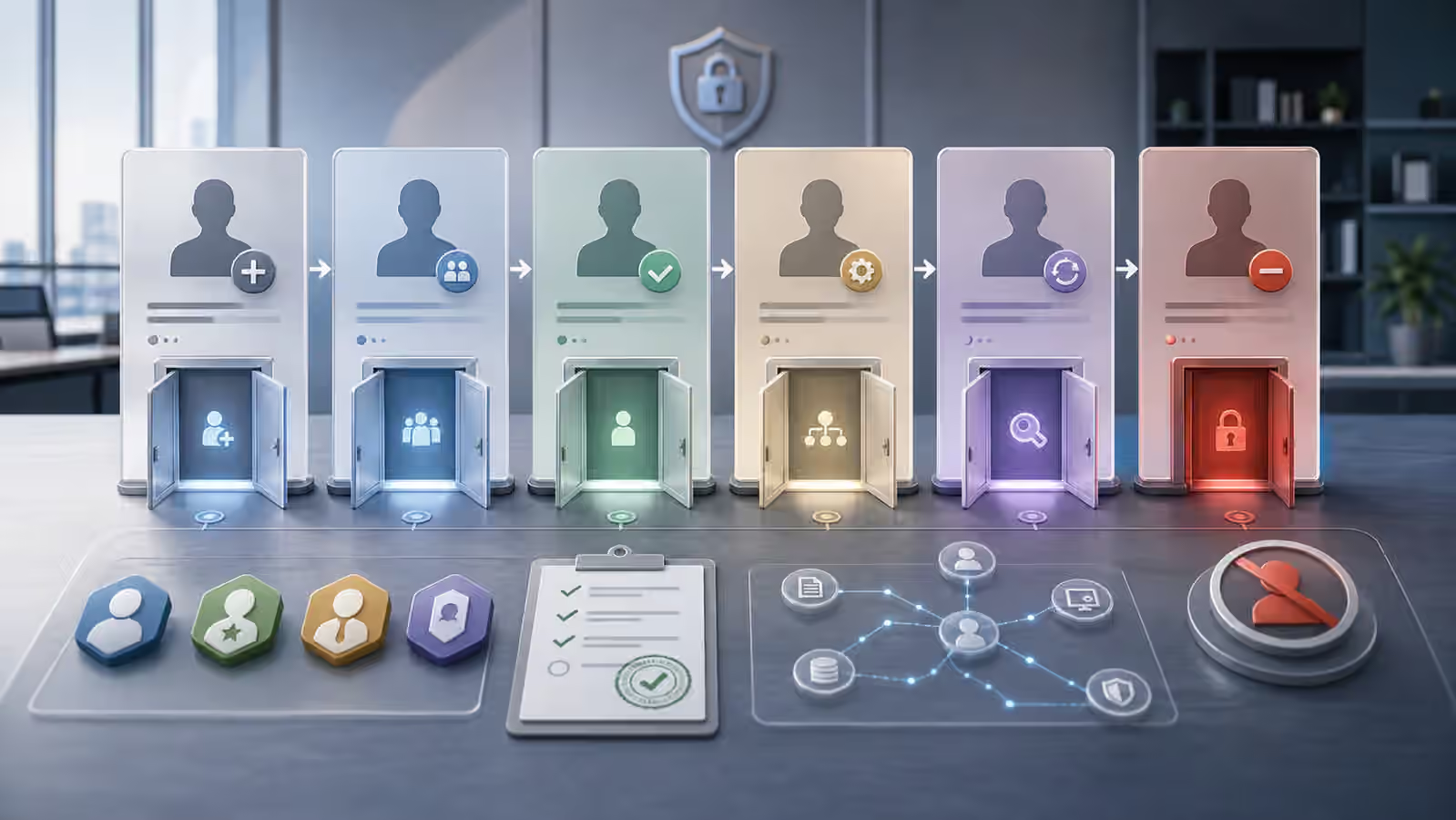
Read an authentication event as a relationship between a subject, a gate, and a result. The subject is the human or non-human identity. The gate is the service, identity provider, remote access portal, SaaS application, or administrative surface. The result is not just success or failure. It can include a denied policy, a satisfied MFA challenge, a token refresh, a password reset, a recovery flow, or a device registration.
The next step is to connect that relationship to normal behavior. Has this user signed in from this device before? Is this application part of their role? Does the account normally operate from multiple locations? Was there an approved travel, migration, support action, or password reset? Does a related SaaS Admin Change Logging record show a role change that explains the access?
The model gets stronger when time is handled carefully. Authentication systems may use different time zones, different clock sources, and different names for the same session. A suspicious sequence can disappear when timestamps are aligned, or it can become more concerning when a new sign-in, device registration, mailbox rule change, and file access line up. The Time Synchronization and Log Correlation guide is useful when the sequence matters more than a single event.
What evidence matters?
Start with the event source. A primary identity provider log is usually more authoritative for login outcomes than a screenshot copied into a chat. A SaaS audit log may be better for application-specific actions after login. Endpoint telemetry may show whether the device was present, healthy, and associated with the same user. Network evidence may explain why a location or address looks unfamiliar.
Then look for policy context. A denied sign-in can be good news if a control worked, but it still may reveal password spraying, stale credentials, or a targeted account. A successful sign-in with MFA may be acceptable when the recovery path is strong and the device is known, but it deserves more attention when the MFA method was newly enrolled, the recovery email changed, or the account has privileged access.
Finally, separate account risk from business impact. A strange sign-in for a low-privilege training account is not the same as a strange sign-in for a finance approver, tenant administrator, production deploy identity, or mailbox with sensitive customer data. The same pattern can deserve different response based on privilege, data access, and recovery impact.
Toy example
Imagine a fictional design studio where an employee account shows three failed sign-ins, one successful sign-in, and then a file-sharing application access. The first note should not say that the account was compromised. It should say that the account had a short burst of failures, then a success, then application access, and that the device and location context are not yet confirmed.
A calm defender asks the owner whether they were signing in, checks whether the device is known, verifies whether MFA was required and satisfied, and reviews whether any sensitive files were accessed. If the owner confirms the activity and the device history is normal, the event may become a baseline note. If the owner denies the activity, the next response belongs in the incident process. The important part is that the note preserved uncertainty until evidence narrowed it.
Common mistakes and false positives
The most common mistake is treating geography as proof. Location data often reflects network routing rather than physical presence. It can still be useful, especially when paired with impossible timing or an unfamiliar device, but it should not stand alone as a verdict.
Another mistake is treating MFA as a magic word. MFA reduces many risks, but weak recovery paths, stale devices, shared accounts, poorly governed push approvals, or newly enrolled methods can still matter. A defender should ask how the authentication was completed and whether that completion fits the user’s normal access pattern.
There is also a temptation to ignore service accounts because no human is complaining. Non-human authentication can be noisy, but it is still identity evidence. The Service Accounts and Secrets guide helps connect those events to ownership, rotation, and blast radius.
What to do next
For a low-confidence event, preserve the record, confirm ownership, and compare the pattern with a baseline. For a medium-confidence event, add surrounding evidence such as device history, MFA details, application access, role changes, and recent recovery activity. For a high-confidence event involving privileged access, sensitive data, active harm, or owner denial, move from informal triage into the approved incident-response process.
The best authentication review leaves behind a reusable note. It names the account, the application, the time window, the policy outcome, the known device or unknown device, the owner response, and the next decision. That note helps the next defender avoid repeating the same uncertainty later.
How this guide was made
This page was written as defensive education for identity evidence review. It avoids credential theft procedures and operational testing steps, and it focuses on observable records, cautious interpretation, and proportionate escalation.
Official references
For orientation, compare this topic with the NIST Digital Identity Guidelines , the CISA Secure Cloud Business Applications project , and the CIS Critical Security Controls v8 . Those references are broader than any single login review, but they reinforce the same themes: strong identity proofing, accountable access, logging, and control evidence.
Related guidebooks
Authentication log review fits naturally beside MFA, Passkeys, and Recovery Paths , Valid Accounts , SaaS Admin Change Logging , and Time Synchronization and Log Correlation .