The invitation came casually. “Come for coffee,” my neighbor Tigist said, leaning over the fence one Saturday morning. “Real coffee. The way we do it at home.”
I said yes because I liked coffee and I liked Tigist. I did not understand that I was agreeing to a three-hour ritual that would fundamentally rearrange how I thought about the beverage I drank every morning.
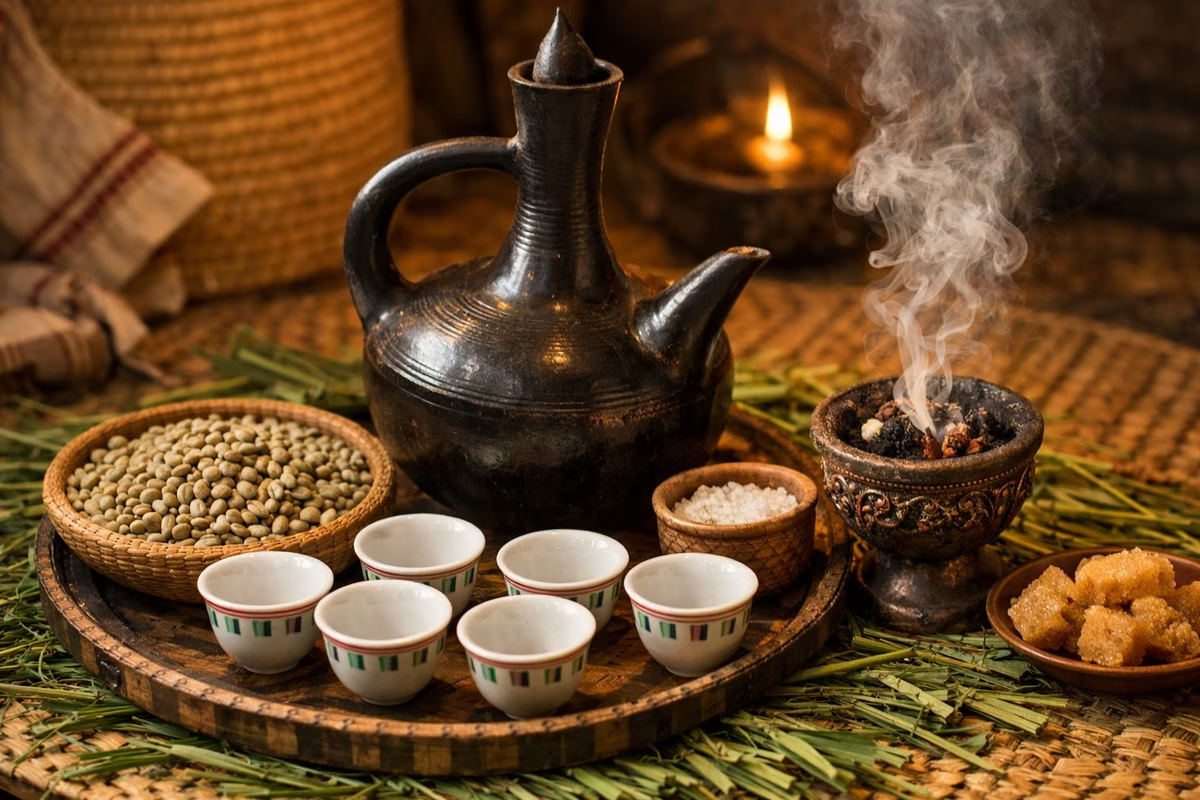
When I arrived, her living room had been transformed. The furniture was pushed back. A low table sat on a bed of fresh grass and scattered flowers—she explained later that the grass represented abundance and the flowers invited good spirits. The air was thick with frankincense smoke from a small clay burner. On the table sat a flat pan, a clay pot with a narrow neck and a round base, a set of small handleless cups, and a bowl of raw, green coffee beans.
Green coffee beans. I had never seen coffee before it was roasted. These looked like pale green pebbles—nothing like the dark, fragrant beans I ground every morning.
“We start from the beginning,” Tigist said. “You can’t understand coffee if you skip the beginning.”
The first step: roasting by hand
Tigist placed the green beans in the flat pan—a traditional menkeshkesh—and held it over a small gas burner. She shook the pan with a steady, circular motion, and for a few minutes, nothing seemed to happen.
Then the color started to shift. Pale green became yellow. Yellow became light brown. The first wisps of smoke appeared, carrying a scent that was grassy and sweet, like toasted grain.
“This is first crack,” Tigist said. The beans began to pop—a sound like distant firecrackers. The color deepened rapidly now: medium brown, dark brown, approaching the color of the beans I bought at the store. The aroma had transformed completely: the grassy sweetness had given way to the deep, complex, unmistakable smell of roasting coffee. But richer than anything I’d smelled from a bag. Raw. Alive. Somehow more itself.
She pulled the pan from the heat—a medium-dark roast, she said, though the exact level depended on preference and the quality of the beans. Then she did something beautiful: she walked the smoking pan through the room, waving it gently so that the roasting aroma reached every person present. Each guest leaned in, breathed deeply, and nodded.
“This is part of the ceremony,” she explained. “The smoke is a blessing. The aroma is shared before the coffee is.”
Ethiopia is where coffee began—not as a crop, but as a wild forest plant. The species Coffea arabica evolved in the highland forests of southwestern Ethiopia, where it still grows wild today.
The legendary origin story involves a goat herder named Kaldi who noticed his goats dancing after eating red berries from a certain tree. He brought the berries to a monastery, where monks brewed a drink that kept them awake for evening prayers. Whether or not Kaldi existed, the basic story is archaeologically supported: humans in the Ethiopian highlands have been consuming coffee in some form for over a thousand years.
Ethiopia remains unique in the coffee world for several reasons:
- It has more genetic diversity in coffee than the rest of the world combined. Wild Ethiopian forests contain thousands of coffee varieties, most of them unnamed and unstudied.
- Ethiopian coffee is categorized by region, not variety: Yirgacheffe, Sidamo, Harrar, Limu, Guji, and Jimma are place names, not cultivar names.
- The coffee ceremony (buna) is the social and spiritual center of Ethiopian hospitality. It’s performed daily in many households and is as fundamental to Ethiopian culture as tea ceremony is to Japanese culture.
The second step: grinding in a mortar
After roasting, Tigist let the beans cool briefly, then transferred them to a wooden mortar—a mukecha—and began grinding with a heavy iron pestle. The rhythm was steady and musical: a deep, resonant thud every second, the pestle rising and falling with practiced ease.
This was not quick. In an age of burr grinders that finish in thirty seconds, hand-grinding coffee in a mortar takes five to ten minutes. But the sound was hypnotic, and the slowness was the point. The ceremony is not a method of making coffee. It is a method of making time.
“In Ethiopia, coffee is not fast,” Tigist said, grinding steadily. “Fast coffee is for airports. This coffee is for people. When we do this ceremony, we are saying: I have time for you. You are worth three cups.”
Three cups. I would learn what that meant soon.
The ground coffee was coarse—much coarser than espresso, closer to the grind you’d use for a French press. The aroma from the mortar was extraordinary: concentrated, almost chocolatey, with a sweetness and depth that machine grinding never seemed to produce. Whether this was chemistry or romanticism, I couldn’t tell. Both, probably.
The third step: brewing in the jebena
The jebena is the defining object of the Ethiopian coffee ceremony. It’s a clay pot—round-bellied, long-necked, with a single spout and a straw lid. Tigist filled it with water, added the ground coffee, and placed it over the burner.
“We don’t filter,” she said. “We don’t press. We let the water and the coffee become one thing. Then we let gravity and patience do the separating.”
The jebena heated slowly. When the coffee began to boil—rising up through the narrow neck—she lifted it from the heat, waited for the surge to subside, and placed it back. She repeated this three times. Each boil extracted more from the grounds. Each rest allowed the sediment to settle.
This is immersion brewing in its oldest form. No paper filter, no metal mesh, no technology more complex than fire and clay. The resulting coffee is thick, rich, and slightly silty—similar to Turkish coffee but with its own distinct character shaped by the clay vessel, the roast level, and the particular beans.
The clay jebena isn’t just a container—it’s a brewing variable. Unglazed clay is porous and absorbs coffee oils over years of use, developing a seasoned interior (like a cast-iron skillet) that adds depth to every subsequent brew. An old, well-used jebena produces notably different coffee than a new one.
The narrow neck serves a functional purpose: it traps the grounds at the bottom when pouring, acting as a natural filter. The round belly provides space for the grounds to settle. The design hasn’t changed in centuries because it doesn’t need to.
If you want to try this at home, jebena pots are available online for $15-$30. Use a coarse grind, a 1:10 coffee-to-water ratio, and bring to a boil three times. Pour slowly from the jebena to avoid disturbing the settled grounds.
The first cup: Abol
Tigist poured the coffee into small cups—si’ni—without handles, each holding about two ounces. She poured from high above the cups, a thin, steady stream that she controlled with remarkable precision. Not a drop spilled. The height of the pour, she explained, helps cool the coffee and aerate it slightly.
She offered sugar—never milk, traditionally—and I took a small spoonful.
The first sip was unlike any coffee I’d ever tasted. It was intense—much stronger than drip coffee, almost espresso-like in concentration—but it was also round. There were no sharp edges, no bitterness, no sourness. The clay brewing had softened everything into a warm, velvety continuum of flavor: dark chocolate, dried fruit, a faint smokiness from the hand-roasting, and underneath it all, a sweetness that wasn’t the sugar. It was the coffee itself.
“This is abol,” Tigist said. “The first cup. The strongest. This is the body.”
I drank it slowly. There was no other option—two ounces of liquid this intense demands attention. Around me, the other guests—Tigist’s sister, a friend from her church, a neighbor I recognized—were drinking in the same measured way. Conversations were quiet. The frankincense smoke curled around us. Time, which had been rushing all week, had stopped.
The second cup: Tona
Tigist added fresh water to the same grounds in the jebena and brewed again. The second extraction was lighter—still rich, but less intense, with different flavors emerging now that the strongest compounds had already been pulled.
“Tona,” she said, pouring the second round. “The second cup. This is the spirit.”
The second cup was, to my surprise, my favorite. The chocolate had softened into caramel. The dried fruit had become more citrus-like. There was a floral quality—almost like jasmine—that hadn’t been present in the first cup. The second extraction had revealed what the first had hidden, the way a second listen to a piece of music reveals melodies you missed the first time.
“In Ethiopia,” Tigist’s sister said, “they say the first cup is for the tongue, the second is for the heart, and the third is for the soul.”
The three rounds of the Ethiopian coffee ceremony have names and meanings:
Abol (first cup): The strongest brew, made from the first extraction of fresh grounds. Represents the physical—the body, the earth, the material world. This is where you taste the coffee’s origin most clearly.
Tona (second cup): Made by re-brewing the same grounds with fresh water. Lighter and more nuanced. Represents the spirit—the emotional and relational dimension. This is traditionally when deeper conversation begins.
Baraka (third cup): The final, lightest extraction. Represents blessing—the spiritual completion of the ceremony. Drinking the third cup is considered a blessing upon the household. It’s impolite to leave before the third cup.
The three-cup structure isn’t just tradition—it’s practical coffee science. Each extraction pulls different compounds: the first gets the heavy, bold flavors; the second gets the lighter, more aromatic notes; the third gets the delicate, sweet residuals. Together, they tell the complete story of the bean.
The third cup: Baraka
The third cup was almost tea-like. Light, sweet, with a ghostly echo of coffee flavor—like the memory of the first cup rather than the cup itself. I would have dismissed it if I’d tasted it in isolation. But after the first and second cups, it felt like a resolution. The final chord of a piece of music. The quiet after the storm.
“Baraka,” Tigist said. “Blessing. Now you have had the complete coffee.”
The ceremony had taken almost two hours. We had roasted, ground, brewed, poured, and shared three rounds of coffee. We had talked about families, about work, about the neighborhood. Tigist’s daughter had fallen asleep on the couch. The frankincense had burned down to ash. The grass on the floor was scattered with fallen flowers.
I thought about my morning routine: eighteen seconds of grinding, four minutes of brewing, a gulp in the car on the way to work. I thought about how I’d optimized coffee into a delivery mechanism for caffeine—fast, efficient, and completely devoid of everything that Tigist’s ceremony contained.
What the ceremony teaches about coffee
The Ethiopian coffee ceremony is not a recipe. It’s a philosophy. And it contains lessons that apply to how we drink coffee in any context:
Lesson 1: Coffee begins before the cup. The roasting and grinding are part of the experience, not obstacles to it. Even if you never hand-roast beans in a pan, the principle holds: pay attention to what happens before brewing. The selection, the grind, the water—these are not chores to rush through.
Lesson 2: Slowness is not inefficiency. The ceremony takes two to three hours because connection takes time. The coffee creates the container for conversation, and conversation requires patience. Even a five-minute pour-over, made with attention, is a different experience than a pod machine on autopilot.
Lesson 3: Three extractions are three experiences. The Ethiopian practice of re-brewing the same grounds reveals something that single-extraction methods hide: coffee is not one flavor. It’s a spectrum, and different brewing intensities reveal different parts of it. Try this at home—brew a pour-over, then re-brew the used grounds with fresh water. The second cup will surprise you.
Lesson 4: Coffee is social. The ceremony exists to bring people together. It’s performed for guests, for neighbors, for family. Coffee in Ethiopia is never solitary—it’s always shared. And the sharing transforms the beverage from a stimulant into a bond.
Tasting Ethiopia in the modern world
Ethiopian coffees are widely available from specialty roasters, and they’re among the most prized origins in the world. Here’s what to look for:
Yirgacheffe: The most famous Ethiopian region. Expect bright, floral, citrusy coffee with jasmine-like aromatics and a clean, tea-like body. Often naturally processed (dried in the fruit), which adds berry sweetness.
Sidamo/Sidama: Rich, complex, with stone fruit (peach, apricot) and chocolate notes. Slightly fuller body than Yirgacheffe. Exceptional balance.
Guji: A sub-region gaining recognition for intensely fruity, wine-like coffees. Berry, tropical fruit, and a sweetness that can be almost candy-like.
Harrar: From eastern Ethiopia, sun-dried and wild. Blueberry is the signature note—sometimes so pronounced it’s startling. Bold, fruity, and unmistakable.
Limu: Balanced and approachable, with mild fruit notes and a smooth, rounded profile. An excellent introduction to Ethiopian coffee.
Next steps
- Read Origins for the complete geography of coffee
- Explore Brewing Methods for finding your ideal technique
- See Coffee Beans for understanding varieties and processing
- Read Coffee and Food Pairing for the complete experience
- Check Coffee History for the global story of coffee