Coffee has been shaping how humans think, talk, work, and revolt for over five hundred years. It fueled the Enlightenment, financed empires, toppled governments, and transformed the rhythm of daily life across every continent.
It also started, according to legend, with a goat.
The goat, the berries, and the beginning (c. 850 CE)
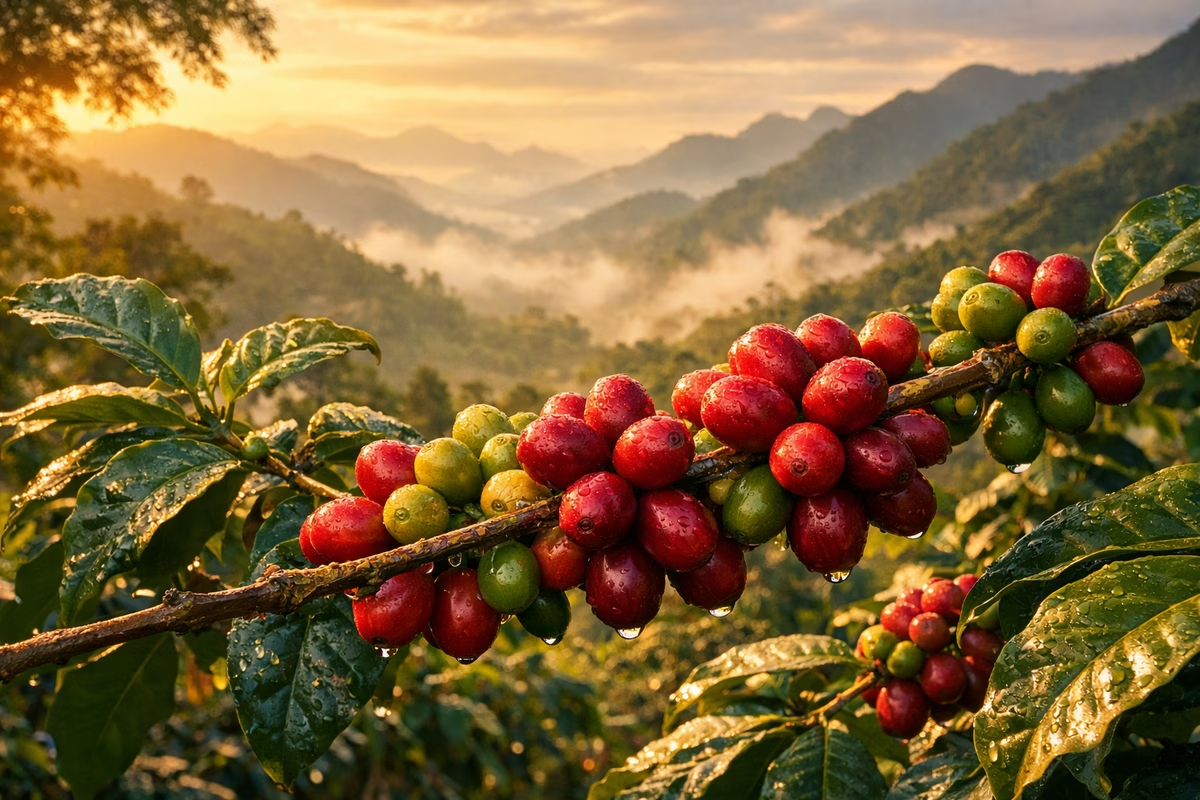
The most famous origin story of coffee belongs to Kaldi, an Ethiopian goatherd who noticed his goats dancing with unusual energy after eating the bright red cherries of a certain shrub. Curious, he tried the fruit himself and felt a similar alertness. He brought the cherries to a local monastery, where monks threw them into a fire—either in suspicion or by accident—and the roasting berries released an aroma so captivating that the monks pulled them from the coals, crushed them, and dissolved the result in hot water.
Whether Kaldi was real or metaphor, the plant was real: Coffea arabica, native to the forests of southwestern Ethiopia, where it still grows wild today. For centuries, Ethiopian communities consumed coffee not as a beverage but as food—ground beans mixed with animal fat into energy-dense balls for long journeys, or the cherry fruit itself brewed into a tea-like drink called qishr.
The transition from food to brewed drink happened gradually, and the precise timeline is lost. What survives is a consistent thread: coffee originated in Ethiopia, and everything that followed—every café, every espresso, every morning ritual—traces back to those highland forests.
Coffee crosses the Red Sea (1400s–1500s)
Coffee’s first great migration was across the Red Sea to Yemen, where Sufi monks adopted the beverage as an aid for nighttime prayer and meditation. They called it qahwa—a word that originally meant “wine” and would eventually become “coffee” through Turkish, Italian, and Dutch.
In Yemen, coffee was cultivated deliberately for the first time. The port city of Mocha (Al-Makha) became the world’s first coffee trading hub. For over a century, Yemen held a near-monopoly on coffee production, and Mocha became synonymous with the drink itself—a name that still appears on café menus today, though now it usually refers to chocolate.
Yemeni coffee culture established patterns that would repeat across the world: communal drinking spaces, intellectual conversation, and periodic attempts by authorities to ban the beverage. Coffee’s stimulating effects made it both beloved and suspicious from the very beginning.
The coffeehouse revolution (1500s–1700s)
Constantinople and the birth of the café
Coffee arrived in the Ottoman Empire in the early 1500s and immediately became central to social life. Istanbul’s first coffeehouses—kahvehane—opened around 1555 and quickly became gathering places for conversation, chess, poetry, and political discussion.
Ottoman coffeehouses were radically egalitarian spaces. Men of different social classes sat together, discussed ideas, and debated politics over small cups of strong, unfiltered coffee. This made authorities nervous. Sultan Murad IV briefly banned coffee and coffeehouses in the 1630s, threatening violators with beatings and, for repeat offenders, drowning.
The ban didn’t last. Coffee was too popular, too profitable, and too deeply woven into daily life to suppress.
Europe’s coffeehouses: the original social networks
Coffee reached Europe through Venetian traders in the early 1600s and spread rapidly. By the mid-1600s, coffeehouses had appeared in London, Paris, Vienna, and Amsterdam.
European coffeehouses served the same social function as their Ottoman predecessors—and drew the same suspicion. King Charles II tried to suppress London’s coffeehouses in 1675, calling them “seminaries of sedition.” The ban lasted eleven days before public outcry forced its repeal.
London’s coffeehouses became known as “penny universities”—for the price of a cup of coffee, anyone could sit, listen, and participate in conversations about science, commerce, literature, and politics. Isaac Newton debated at coffeehouses. The stock exchange grew out of Jonathan’s Coffee-House. Lloyd’s of London began as a coffeehouse where merchants gathered to discuss shipping insurance.
In Paris, coffeehouses became salons for Enlightenment thinkers. Voltaire reportedly drank forty to fifty cups a day (likely exaggerated, but the enthusiasm was real). The Café Procope, opened in 1686, hosted Rousseau, Diderot, and eventually the revolutionaries who would overthrow the monarchy.
Coffee didn’t cause the Enlightenment. But it created the spaces—sober, stimulating, egalitarian—where Enlightenment ideas found their audience.
Colonial coffee: sugar, slavery, and global spread (1600s–1800s)
Breaking the Yemeni monopoly
European colonial powers wanted coffee, and they didn’t want to depend on Yemen. The Dutch were the first to successfully transplant coffee seedlings—stolen from Yemeni stock—to their colonies in Java (present-day Indonesia) in the late 1600s. “Java” became a synonym for coffee, just as “Mocha” had before it.
From Java, the Dutch sent coffee plants to their botanical gardens in Amsterdam. From Amsterdam, a single coffee plant was gifted to King Louis XIV of France. From that single plant, cuttings were carried across the Atlantic to the Caribbean island of Martinique by a naval officer named Gabriel de Clieu—who, according to his own account, shared his drinking water with the plant during a difficult sea voyage.
From Martinique, coffee spread to the rest of the Caribbean, Central America, and South America. Brazil received its first coffee seeds in 1727—according to legend, smuggled out of French Guiana by a Brazilian diplomat who seduced the governor’s wife to obtain them.
Within a century, Brazil would become the world’s largest coffee producer—a position it still holds today.
The human cost
Coffee’s global expansion was inseparable from colonialism and forced labor. Plantations in the Caribbean, Central America, Indonesia, and East Africa relied on enslaved people and, later, exploitative labor systems. The coffee that fueled Enlightenment conversations about liberty was grown by people who had none.
This history is not separate from modern coffee culture. It’s the foundation of it. The regions that grow coffee today—often in the Global South, often in former colonies—still face economic imbalances rooted in these colonial structures. Understanding coffee’s history means understanding this uncomfortable continuity.
The American century (1800s–1960s)
How coffee became the American drink
Tea was the preferred beverage in colonial America until the Boston Tea Party of 1773 made tea-drinking feel unpatriotic. Coffee filled the gap. By the Civil War, coffee was standard military ration; Union soldiers received approximately 36 pounds of coffee per year. Confederate soldiers, cut off from supply lines, made do with substitutes brewed from chicory, acorns, and sweet potatoes—and deeply resented it.
After the war, coffee became America’s default hot beverage. The rise of industrial roasting, vacuum packaging, and national brands—Folgers, Maxwell House, Hills Bros—made coffee cheap, consistent, and universally available by the early 1900s.
The age of convenience
The 20th century prioritized convenience over quality. Instant coffee (invented in 1901, popularized in the 1930s–1950s) offered speed. Automatic drip machines (Mr. Coffee, introduced in 1972) offered ease. The result was a culture where coffee meant “brown caffeinated liquid” rather than a specific flavor experience.
By the 1960s, American coffee consumption was at an all-time high, but coffee quality was at an all-time low. Beans were blended for cost, roasted dark to mask defects, and ground weeks before purchase. Coffee was fuel, not food.
The three waves of modern coffee (1960s–present)
Coffee’s modern evolution is often described in “waves”—three overlapping movements that transformed coffee from commodity to craft.
First wave: coffee for everyone (1960s–1980s)
The first wave made coffee universally accessible. Brands like Folgers and Maxwell House put coffee in every American kitchen. The focus was availability, consistency, and low price. Quality was an afterthought.
Second wave: coffee as experience (1970s–2000s)
The second wave, led by Peet’s Coffee (founded 1966) and Starbucks (founded 1971), introduced Americans to the idea that coffee could be an experience—not just fuel. Espresso drinks, origin labeling (“Colombian,” “Sumatran”), darker roasts, and the café as a social destination all became mainstream.
The second wave’s achievement was cultural: it taught millions of people to care about what was in their cup. Its limitation was that it still treated roasting as the primary variable, often roasting so dark that origin character was obscured.
Third wave: coffee as craft (2000s–present)
The third wave treats coffee the way the wine world treats wine: as an agricultural product shaped by variety, terroir, processing, and craft at every stage from farm to cup.
Third-wave roasters prioritize lighter roasts that preserve origin character. They source directly from farms, paying higher prices for higher quality. They publish the producer’s name, the farm’s elevation, the processing method, and the harvest date. They approach brewing as a precise technical practice—measured doses, controlled water temperature, timed extractions.
The third wave didn’t invent quality coffee. Ethiopian and Yemeni traditions had it from the beginning. What the third wave did was reconnect the consumer with the producer—closing a circle that had been broken by centuries of commodification.
Where coffee is going
The fourth wave—if it exists—is about accessibility without sacrifice. Making specialty-quality coffee available beyond expensive urban cafés. Making direct trade sustainable for producers, not just marketable for roasters. Making the knowledge of brewing methods, origin character, and freshness available to anyone with a kettle and curiosity.
It’s also about confronting coffee’s vulnerability. Climate change is shrinking the land suitable for Arabica cultivation. The crop is genetically narrow, making it susceptible to diseases like coffee leaf rust, which devastated Central American harvests in the 2010s. The future of coffee depends on agricultural research, fair economics for growers, and consumer willingness to pay what quality coffee actually costs to produce.
Every cup you brew carries this history—the Ethiopian discovery, the Yemeni traders, the Enlightenment coffeehouses, the colonial plantations, the instant-coffee decades, and the modern craft revival. It’s a five-hundred-year story, still unfolding, one morning at a time.
Next steps
- Read Coffee Origins Guide for detailed flavor profiles from today’s major growing regions
- See Coffee Roasting Guide for how roast level shapes the flavors history created
- Explore Coffee Processing Methods for the post-harvest decisions that define modern specialty coffee
- Try The Afternoon Everything Slowed Down for a personal coffee discovery narrative