The first time I stood at an Italian espresso bar, I almost sat down.
The bartender looked at me—not unkindly, but with the specific patience reserved for tourists who don’t know the rules—and tilted his head toward the counter. In Italy, espresso is consumed standing. You order, you drink in three sips, you leave. It costs half as much at the bar as it does at a table.
The espresso arrived in a ceramic cup the size of a thimble. I drank it in fifteen seconds. It was hot, dense, bittersweet, and perfect. No milk. No sugar (though sugar is acceptable—many Italians add it). No lingering. Just a concentrated moment of caffeinated clarity, and then back to the day.
That fifteen-second experience in Rome changed how I think about coffee. Not because the espresso was the best I’d ever had—though it was extraordinary—but because the ritual around it was so different from anything I knew. Coffee wasn’t a thing to carry around. It was a thing to pause for.
Over the next two years, I sought out coffee rituals in other countries. Each one taught me something different about what coffee can be.
Italy: Coffee as punctuation
Italian coffee culture isn’t about the coffee. It’s about the bar.
The bar (not “café”—Italians call them bars) is a social institution. You stop in two or three times a day: once in the morning for a cappuccino and cornetto, once after lunch for an espresso, perhaps once in the afternoon for another espresso or a caffè macchiato.
Each visit lasts five minutes. You don’t work in the bar. You don’t settle in with a laptop. You stand at the counter, exchange pleasantries with the barista, drink your coffee, and leave.
What I learned
Espresso is a craft of consistency. Italian baristas aren’t pulling experimental single-origin shots. They’re pulling the same blend, the same way, dozens of times per hour. The goal is consistency—a dependable moment of pleasure, repeated perfectly across days and years.
Milk has a time limit. Italians drink cappuccino only in the morning. Ordering one after noon marks you as a tourist. The reasoning is digestive—heavy milk after a meal is considered disruptive—but the cultural norm runs deeper than biology. It’s a rhythm: milk in the morning, espresso after meals.
The cup matters. Italian espresso is served in pre-heated ceramic cups, which maintains temperature and crema. Paper cups don’t exist at the bar. The tactile experience—hot ceramic against your lips, the weight of the cup, the sound of the saucer—is part of the ritual.
Japan: Coffee as meditation
Tokyo’s coffee scene is the opposite of Italian speed. It’s slow, precise, and intensely focused on the cup itself.
I visited a kissaten—a traditional Japanese coffee house—in a basement in Shibuya. The room was small, dark, wood-paneled, with jazz playing softly. A man behind the counter was making pour-over coffee with movements so deliberate they looked choreographed.
He ground the beans by hand in a ceramic mill. He heated water to a precise temperature (measured with a thermometer). He poured in a thin, circular stream from a swan-neck kettle, pausing between pours to let the grounds bloom and degas.
The entire process took seven minutes for a single cup.
When it arrived—in a white ceramic cup on a white saucer—the coffee was translucent, clean, and tasted like brown sugar, plum, and a whisper of jasmine. It was the clearest, most nuanced cup of coffee I’d ever had.
What I learned
Pour-over is about control. The Japanese pour-over method (perfected by brands like Hario and Kalita) gives the brewer total control over extraction: water temperature, pour rate, bloom time, and grind size are all calibrated to the specific beans. The result is a cup that reveals the bean’s character without any interference.
Single-origin coffee makes sense here. In a kissaten, the beans are the star. There’s no milk, no sugar, no flavoring to hide behind. A Kenyan AA tastes like blackcurrant and citrus. An Ethiopian Yirgacheffe tastes like blueberry and bergamot. The brewing method is designed to highlight these differences, not smooth them over.
Atmosphere shapes the experience. The dim lighting, the jazz, the unhurried pace—all of it frames the cup as an event, not a commodity. You taste differently when you’re sitting still and paying attention than when you’re walking to the subway with a paper cup.
Ethiopia: Coffee as ceremony
Ethiopia is where coffee began. The legend says a goatherd named Kaldi noticed his goats dancing after eating berries from a certain tree. Whether or not that’s true, Ethiopia’s relationship with coffee is older and deeper than any other country’s.
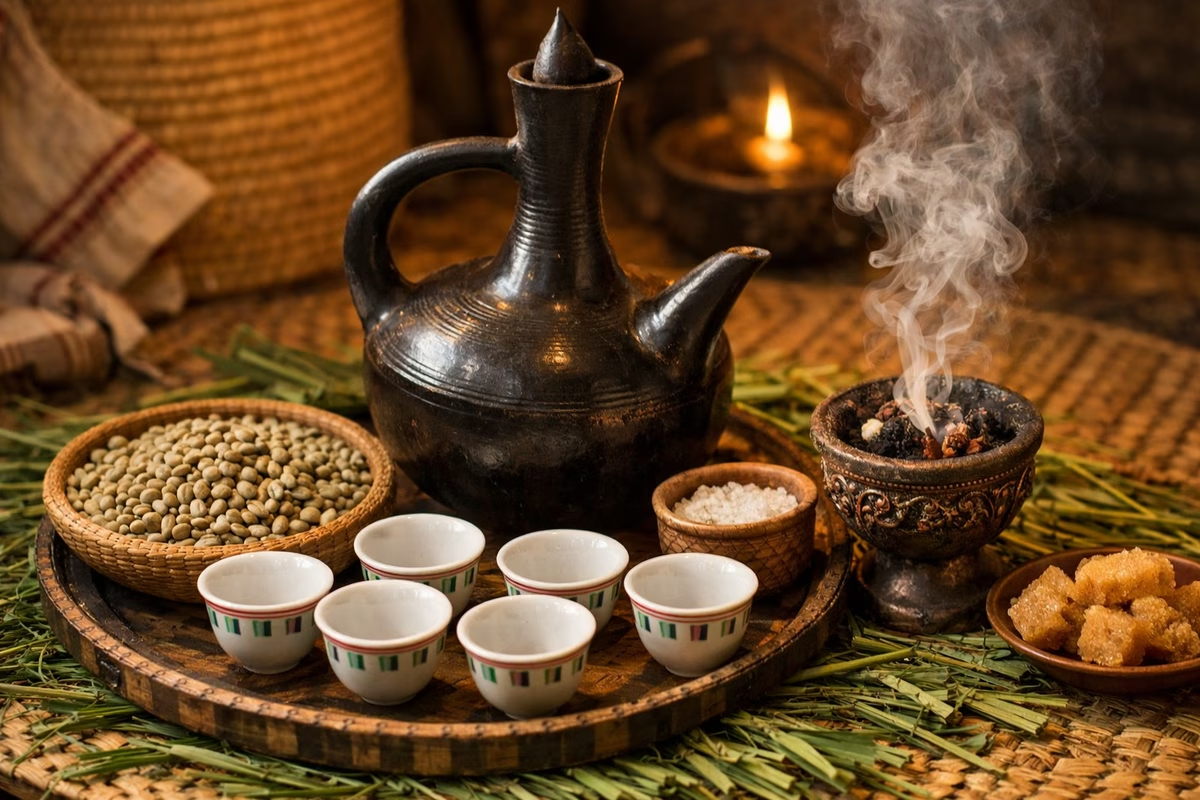
I attended a traditional Ethiopian coffee ceremony in Addis Ababa. The host—a young woman in a white cotton dress—roasted green coffee beans over a charcoal brazier in the living room. The smoke filled the space with a scent that was part coffee, part incense.
She ground the roasted beans by hand with a mortar and pestle, brewed them in a jebena (a traditional clay pot), and poured the coffee in a single stream from about a foot above the cups—small, handleless cups arranged on a tray.
The ceremony took ninety minutes. Three rounds of coffee were served: abol (the strongest), tona (medium), and bereka (the lightest). Each round uses the same grounds, re-brewed with fresh water, so the flavor profile changes from rich and intense to light and floral.
What I learned
Coffee is a social contract. The Ethiopian ceremony isn’t about caffeine. It’s about community. You sit together. You talk. You share three rounds. Leaving after the first round is considered rude—the ceremony is designed to keep people together long enough for real conversation to happen.
Green beans smell nothing like roasted beans. Watching green beans transform in a pan—from pale green to yellow to brown to dark, fragrant, oily—is the most direct way to understand what roasting does. The Maillard reaction and caramelization that happen during roasting create the hundreds of volatile compounds we recognize as “coffee flavor.”
Origin isn’t just about geography—it’s about people. In Ethiopia, coffee is grown by millions of small farmers, many on plots smaller than a hectare. The genetic diversity of Ethiopian coffee is staggering—there are thousands of heirloom varieties, many unnamed, growing wild in highland forests. This diversity is the genetic treasury of the global coffee industry.
Vietnam: Coffee as invention
Vietnamese coffee hit me like a sweet, caffeinated brick.
At a street stall in Hanoi, I ordered cà phê sữa đá—Vietnamese iced coffee. The preparation was unique: a small metal filter (phin) sat on top of a glass. Dark-roasted, coarsely ground coffee was packed into the filter. Hot water was added. And gravity did the rest—coffee dripped slowly through the metal screen into the glass, which already contained a thick layer of sweetened condensed milk.
The whole process took five minutes. When it was done, I stirred the milk into the coffee, added ice, and took my first sip.
It was a revelation of a different kind. Not subtle. Not nuanced. Not delicate. It was bold, sweet, creamy, and intensely caffeinated—a drink designed for the tropical heat, for sitting on a tiny plastic stool on the sidewalk, for watching motorbikes stream past while the ice melts slowly.
Then I tried egg coffee—cà phê trứng—at Giảng Café, the shop that invented it in the 1940s when fresh milk was scarce. An egg yolk is beaten with condensed milk and sugar until it becomes a thick, custard-like foam, then spooned over strong black coffee.
It tasted like coffee-flavored tiramisu in a cup. It was absurd and perfect.
What I learned
Robusta has a place. Vietnamese coffee is predominantly Robusta—a species that the specialty coffee world often dismisses as inferior to Arabica. But Vietnamese Robusta, dark-roasted and brewed through a phin with condensed milk, is exactly what it should be: bold, thick-bodied, high-caffeine, and designed for a specific preparation. Not every coffee needs to taste like a light-roast Ethiopian.
Sweetness is not a sin. The Western specialty coffee movement tends toward unsweetened, black coffee. Vietnamese coffee culture cheerfully rejects this. Condensed milk isn’t a compromise—it’s the point. The interplay between bitter coffee and sweet milk is the flavor the culture designed.
Innovation comes from constraint. Egg coffee was invented because fresh milk was scarce. The phin filter was adopted because it’s cheap, portable, and requires no electricity. Vietnamese coffee culture is brilliant not despite its constraints but because of them.
Turkey: Coffee as fortune
In Istanbul, coffee is served in a cup the size of a shot glass, brewed in a cezve (a small, long-handled pot) with the grounds still in the liquid.
Turkish coffee is the oldest continuously practiced brewing method in the world—over 500 years old. The beans are ground to a powder (finer than espresso), mixed with water and sugar in the cezve, and heated slowly until a foam rises. It’s poured unfiltered into the cup.
You drink the liquid and stop when you hit the sediment at the bottom. Then—if you’re inclined—you flip the cup upside down on the saucer, let the grounds dry, and someone reads your fortune in the patterns.
What I learned
Grind size changes everything. Turkish coffee uses the finest grind possible—almost flour-like. This means full extraction happens quickly, producing an intensely flavored, thick, almost syrupy brew. It demonstrates a principle that applies to all coffee: grind size is the primary variable controlling extraction and body.
Brewing coffee with the grounds in the cup was the original method. Before paper filters, metal screens, or pressure machines, all coffee was brewed this way—grounds mixed with water, the liquid poured off the top. Turkish coffee is living history.
Ritual transcends the drink. The fortune-telling tradition isn’t about believing in prophecy. It’s about creating a moment of connection—a reason to stay at the table after the coffee is finished, to talk, to laugh, to share stories. The best coffee cultures build community around the cup.
Melbourne: Coffee as craft obsession
Melbourne, Australia, has one of the most advanced specialty coffee cultures on Earth. The city has more independent cafés per capita than almost anywhere, and the standard of quality is punishingly high.
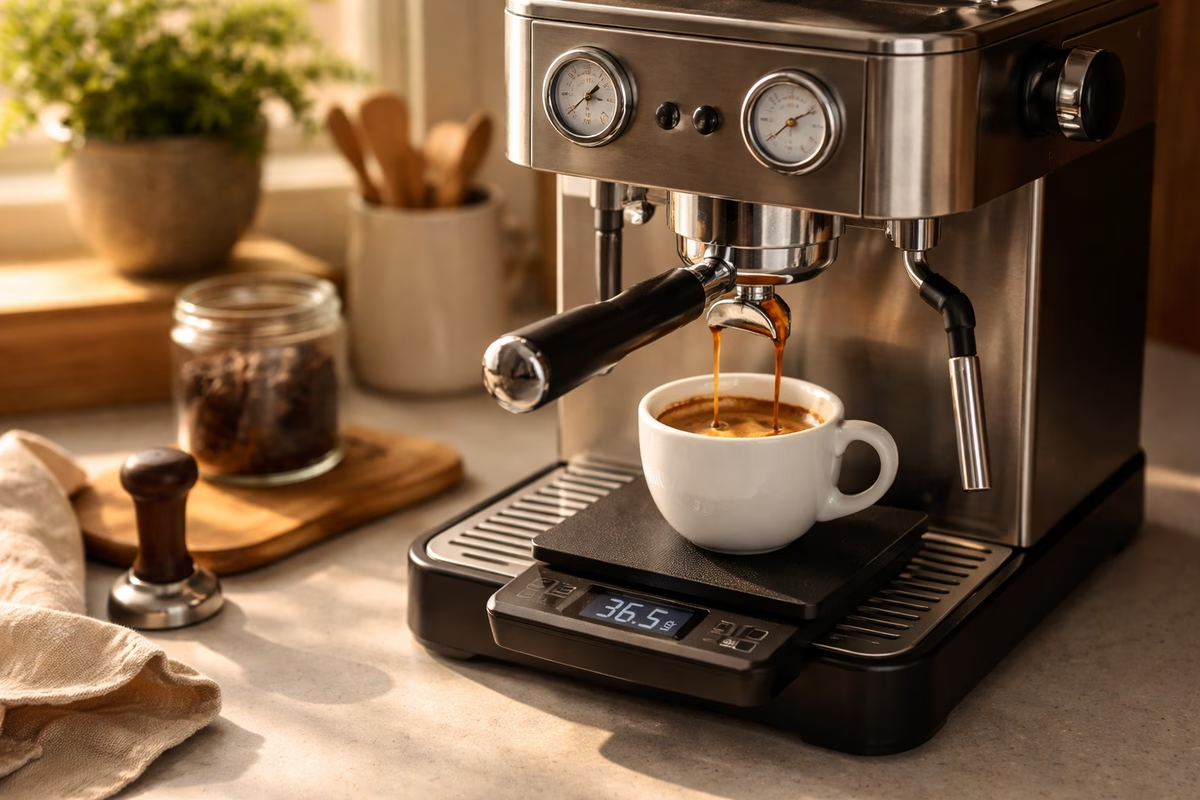
At a café in Fitzroy, I watched a barista dial in a single-origin espresso for forty-five minutes before opening. She pulled shot after shot, adjusting grind size by microns, tasting each one, making notes. The goal: a 36-second extraction that tasted like mandarin and milk chocolate.
When she was satisfied, she served it to me in a ceramic cup. It was—genuinely—one of the finest espressos I’ve ever tasted. Balanced, sweet, fruit-forward, with none of the bitterness I’d been taught to expect from espresso.
What I learned
Specialty coffee is data-driven. Melbourne cafés weigh their doses to 0.1g, time their extractions to the second, and measure water temperature to the degree. The result is repeatable quality—every cup tastes like the previous one, because every variable is controlled.
Flat whites are a revelation. The flat white—microfoamed milk poured over a double espresso—originated in Australia/New Zealand. It’s smaller than a latte, with less milk and more coffee flavor. The microfoam is silky, integrated, and enhances the espresso rather than drowning it.
The barista is an athlete. Great baristas in Melbourne train for years. They compete in national and world championships. They approach coffee with the seriousness and precision of a chef. And they’ve proven that treating coffee as a craft rather than a commodity produces dramatically better results.
What café culture teaches that equipment can’t
After two years of café crawling—from Rome to Tokyo to Addis Ababa to Hanoi to Istanbul to Melbourne—I came home with a realization that no gear review or brewing guide had given me:
There is no correct way to drink coffee. Every culture has its own relationship with coffee, shaped by history, climate, economics, and taste. Italian espresso is correct. Japanese pour-over is correct. Vietnamese phin with condensed milk is correct. Turkish coffee with grounds in the cup is correct.
The specialty coffee movement sometimes forgets this. In the pursuit of optimal extraction and origin transparency, it can become narrow—privileging light roasts, black coffee, and Western brewing methods above all else. But coffee’s beauty is its universality. It’s consumed on every inhabited continent, in thousands of preparations, and each one is a valid expression of the relationship between people and a bean.
The cup is never just a cup. In every culture I visited, coffee was a frame for something else: community, ritual, meditation, invention, fortune, craft. The liquid in the cup mattered—but the moment around the cup mattered more.
Bringing café culture home
You can’t replicate a Roman espresso bar in your kitchen. But you can borrow the principles:
- From Italy: Make coffee a pause, not a background activity. Stand at the counter. Drink it in three sips. Be present.
- From Japan: Slow down. Use a pour-over. Pay attention to the variables. Taste the origin.
- From Ethiopia: Share coffee with others. Make it a communal event, not a solitary habit.
- From Vietnam: Embrace sweetness and invention. Try condensed milk. Try egg coffee. Not everything needs to be austere.
- From Turkey: Let coffee be an excuse to sit with someone. The conversation after the cup is the point.
- From Melbourne: Take the craft seriously. Weigh your doses. Time your shots. Small improvements in technique produce dramatic improvements in the cup.
Next steps
- Read Brewing Methods for the technical guide to pour-over, espresso, and more
- Explore Coffee Origins for how geography shapes flavor
- See First Espresso Story for another narrative about espresso discovery
- Try Equipment Guide for setting up your home café
- Check Coffee and Food Pairing for extending the experience beyond the cup