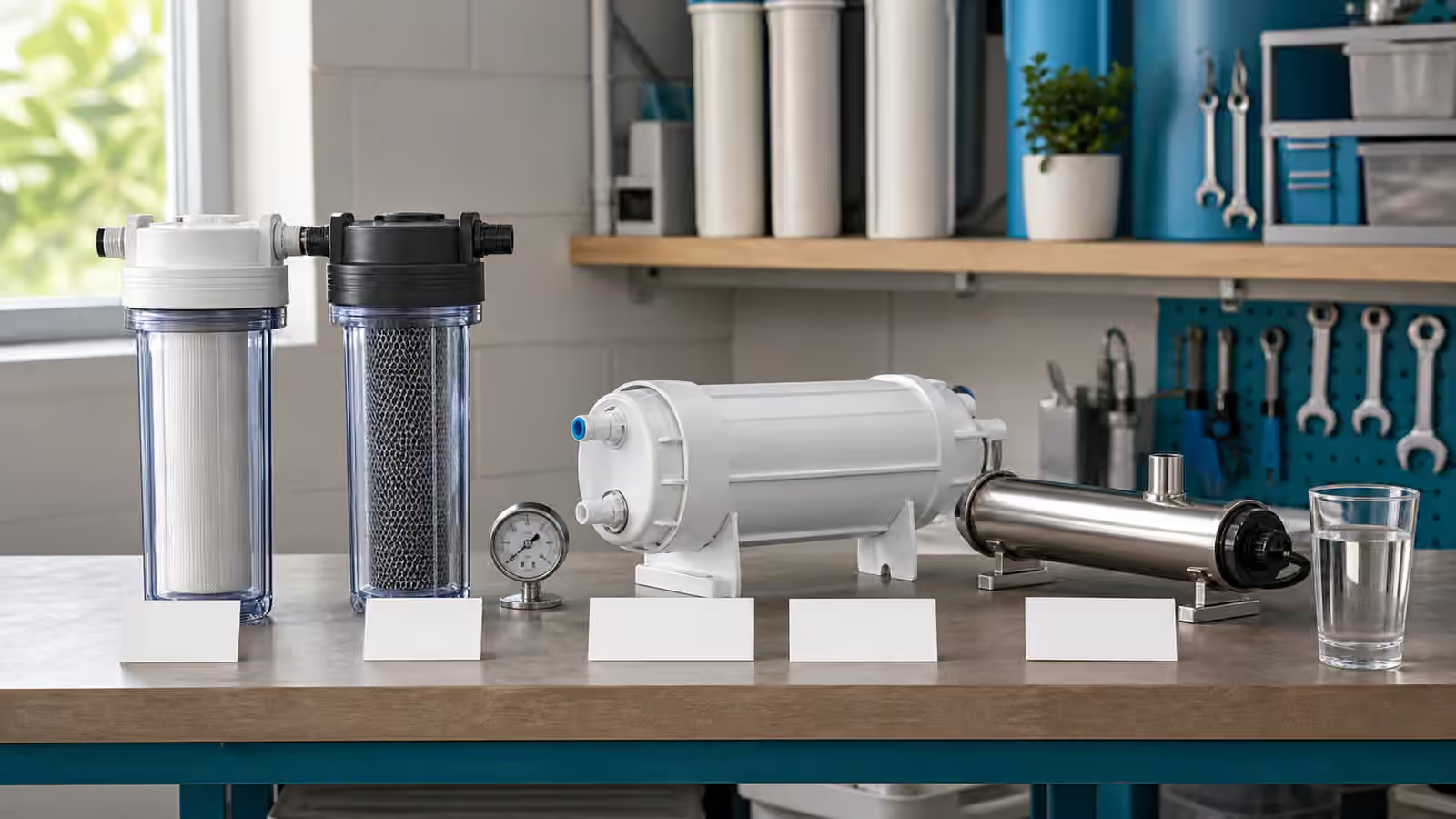
Water treatment is often discussed as a set of separate products, but a real home setup behaves like a sequence. The first device changes what the second device receives. A clogged sediment cartridge can starve a carbon filter. A softener can protect some downstream equipment while changing taste. A carbon stage can protect certain membranes or improve aesthetic quality while doing nothing for a contaminant it was never certified to reduce. UV can help with a specific disinfection role only when the water reaching the lamp is clear enough and the unit is maintained. Order is not decoration. It is part of performance. For background, see NSF — Standards for Water Treatment Systems .
Clear Water Lab helps with everyday water decisions, reports, testing, certification checks, and maintenance. It is not medical advice, legal advice, or a substitute for local boil-water notices, certified lab results, utility instructions, or health department guidance.
Start with the problem, not the sequence
The correct order is not chosen from a universal diagram. It starts with source water, target problem, flow needs, pressure, maintenance access, and where the treated water will be used. City water with chlorine taste at one kitchen tap does not need the same route as a private well with sediment, iron staining, bacteria concerns, and whole-home fixtures to protect. City Water vs Well Water is the upstream guide because treatment order is shaped by responsibility as much as by equipment.
The first discipline is to name the target. Is the goal taste and odor, scale control, lead reduction at one drinking tap, PFAS reduction, sediment protection, private-well disinfection, appliance protection, coffee flavor, or emergency backup? Each target has a different evidence path. Pitcher, Faucet, Countertop, Under-Sink, RO, and Whole-Home Filters compares device locations, but a sequence asks a second question: what must happen before this device can do its job reliably?
Avoid stacking devices because each one sounds useful. More treatment can mean more pressure drop, more maintenance, more bypass temptation, more leaks, and more confusion about which part is responsible for which claim. A compact point-of-use setup with a verified cartridge may be better than a whole-house line of equipment nobody understands. The sequence should be explainable in ordinary language before it is installed.
Sediment often protects the rest
Sediment filtration is usually a protective stage rather than a final answer to every water concern. Grit, rust flakes, sand, and visible particles can clog small passages, scratch valves, reduce flow, and shorten the life of downstream cartridges. That is why a sediment stage often appears early in a whole-home or well-water setup. It removes material that would otherwise make later stages work harder.
The micron rating deserves care. Smaller is not automatically better when the water has a heavy particle load. A very fine cartridge may clog quickly, reduce pressure, and invite bypassing. A staged approach may use a coarser protective filter before a finer one when the source has real sediment. The discussion in Sediment, Rust, and Cloudy Water is useful because it separates visible particles from dissolved contaminants and taste problems.
Sediment filters can also mislead. Clear water after a sediment cartridge does not prove that lead, nitrate, arsenic, PFAS, chlorine, or microbes have been addressed. It means particles within that filter’s practical capture range may have been reduced. The word “filter” is too broad to be trusted by itself. Stage order only helps when each stage has a narrow job.
Carbon, softening, RO, and UV each have boundaries
Activated carbon often sits where taste, odor, chlorine, some VOC claims, or protection of downstream components is relevant. It can be excellent for the right job and inadequate for the wrong one. Carbon may go before certain equipment to reduce chlorine exposure, or it may sit at a drinking tap for taste. The product’s certification, capacity, flow, and maintenance decide the real claim. Activated Carbon Filters is the natural companion because carbon media is not a single promise.
Softening is different. A softener changes hardness behavior by exchanging minerals, usually to reduce scale and protect plumbing or appliances. It is not a universal contaminant filter. In a hard-water home, softening upstream of some devices can help with scaling, but it may also change drinking-water taste or sodium contribution depending on the system and household needs. Water Softeners and Scale Control keeps that distinction clear.
Reverse osmosis is usually a point-of-use or small-system stage for certain dissolved substances when the model has the right claim and maintenance. It has prefilters, membrane behavior, storage, flow, drain water, post-filtration, and taste tradeoffs. The membrane does not float outside the sequence. It depends on the quality and pressure of feed water, and it usually asks for a replacement schedule that differs from the prefilters. Reverse Osmosis for Beginners is where those tradeoffs belong.
UV disinfection is even more sequence-sensitive. Light cannot work well through water that blocks the dose from reaching the target organisms. Sediment, cloudiness, iron, hardness scale, sleeve fouling, flow rate, lamp age, and power all matter. UV may be relevant for a private-well microbiological plan, but it does not remove nitrate, arsenic, PFAS, lead, salt, hardness, or chemical taste. UV Water Disinfection explains why the lamp is one stage, not the whole system.
Maintenance is part of the order
A sequence fails when nobody can maintain it. Each housing needs room to open. Each cartridge needs a date. Each pressure gauge or flow clue needs to be visible. A UV lamp needs lamp-hour attention and sleeve cleaning. A softener needs salt and settings. An RO tank needs access. If the perfect sequence is crammed into a corner where cartridges cannot be changed without spilling water into a cabinet, the design is fragile from the first day.
The order should also preserve troubleshooting. If a pressure drop appears, can you tell which stage is clogging? If taste changes, can you isolate the carbon stage from the softener or refrigerator line? If a lab result changes, can you sample before and after the relevant stage? A treatment system should make evidence easier to gather, not harder. Home Water Testing explains why sample location and method matter; a good sequence gives those locations a physical place.
Treat final water as the result of source, sequence, and upkeep. Do not install from a shopping-cart diagram and then hope the claims add together. Ask what each stage protects, what it reduces, what it does not touch, what it needs upstream, and what maintenance keeps it honest. When every stage has a reason, the order becomes easier to understand and easier to live with.