Nobody invented cheese. Cheese invented itself.
Somewhere around 8000 BCE, in the fertile crescent of the Near East, a traveler poured fresh milk into a pouch made from a young animal’s stomach, the standard container of the era. Hours later, under the Middle Eastern sun, the milk had separated into solid white curds and thin, watery whey.
The stomach lining contained rennet, an enzyme that coagulates milk protein. The traveler didn’t know this. What they knew was: the curds tasted good, they didn’t spoil as fast as milk, and they were light enough to carry.
That accidental discovery, milk plus enzyme plus time, is the foundation of every cheese today. From a fresh ball of mozzarella to a three-year-old Parmigiano-Reggiano, every cheese is a variation on what happened in that animal-skin pouch ten thousand years ago.
The ancient world: cheese as survival (8000 BCE – 500 CE)
Why cheese mattered
Before refrigeration, fresh milk was a problem. It spoiled within hours in warm climates. Animals produced milk seasonally. The calories were precious but the product was fragile.
Cheese solved this. By converting milk into a solid, portable, shelf-stable form, early cheesemakers turned a perishable liquid into food that could last weeks, months, or, in the case of hard aged cheeses, years.
This was not a culinary choice. It was a survival technology. Cheese allowed herding cultures to store the summer’s abundance for the winter’s scarcity. It turned grass (which humans can’t digest) into concentrated nutrition (which humans can), via the intermediary of the milk animal.
The earliest evidence
The oldest direct evidence of cheesemaking comes from pottery shards found in Poland, dating to about 5500 BCE. These shards contain traces of milk fats and show patterns consistent with straining curds from whey, essentially ancient cheesecloth residue.
Earlier evidence is circumstantial but compelling. Sumerian cuneiform tablets from around 3000 BCE describe dairy processing. Egyptian tomb murals from 2000 BCE depict milk being poured into vessels and curds being collected. The Bible mentions cheese multiple times, including David bringing “ten cheeses” to the Israelite army camp.
Greece and Rome
The ancient Greeks considered cheese essential. Homer’s Odyssey describes the Cyclops Polyphemus making cheese in his cave, curdling milk in woven baskets, pressing whey out, and aging the results on racks. This is not mythology. It is a technical description of a process Greek shepherds had been using for centuries.
The Romans industrialized cheese. Roman caseus (the root of the English word “cheese” via Germanic languages, and directly of “casein”) was produced in standardized forms, traded across the empire, and included as part of soldiers’ rations. Roman writers described soft fresh cheeses, smoked cheeses, aged hard cheeses, and cheese seasoned with herbs and spices.
Roman legions carried cheese across Europe. Where they built roads, cheese culture followed.
The monastery tradition (500 – 1500 CE)
Monks as cheesemakers
When the Roman Empire collapsed, the monasteries of medieval Europe became the custodians of cheesemaking knowledge, just as they preserved brewing, winemaking, and literacy.
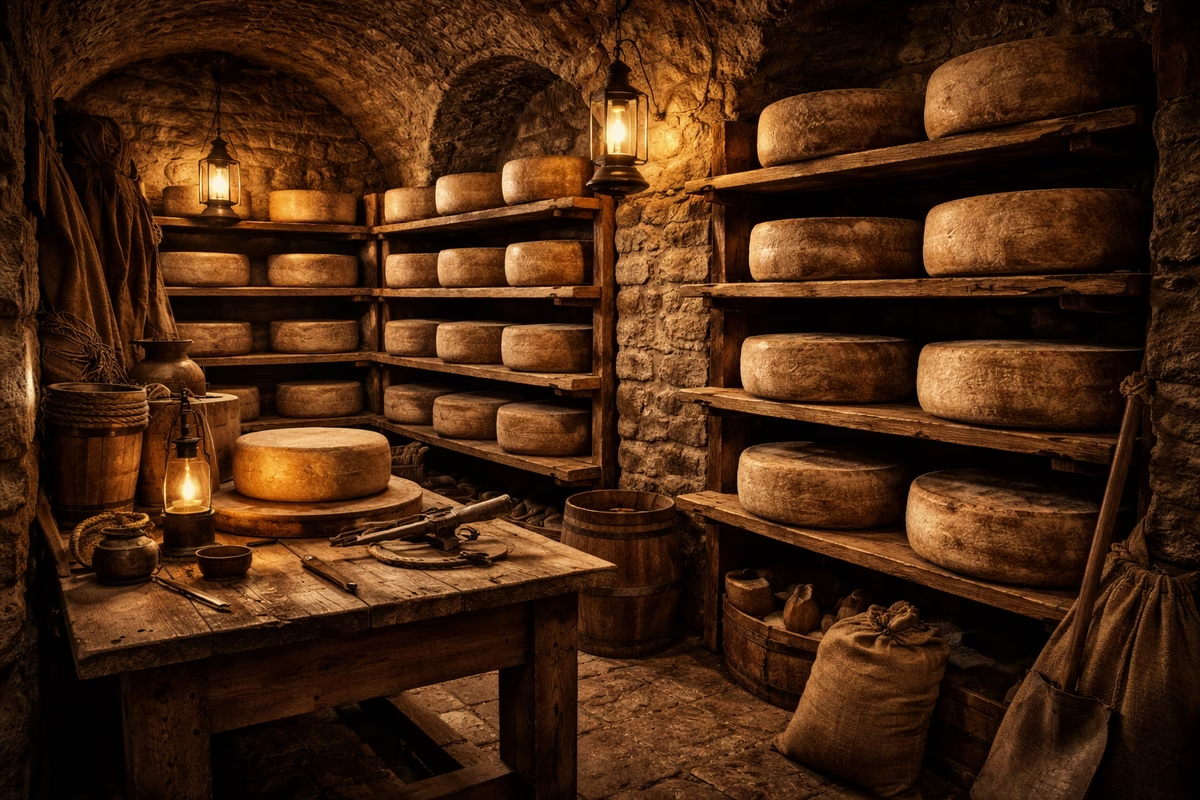
Monastic life was perfectly suited to cheese. Monks had: cows and goats (for milk), time (for aging), discipline (for the precise, patient work of affinage), cellars (for temperature-controlled storage), and the Benedictine rule of self-sufficiency (which required producing food on-site).
Many of Europe’s most famous cheeses trace their origins to specific monasteries:
- Munster (Alsace, France): created by Benedictine monks in the 7th century. Named after monasterium.
- Maroilles (northern France): documented in a monastery since 960 CE.
- Pont-l’Évêque (Normandy): likely developed by Cistercian monks in the 12th century.
- Époisses (Burgundy): attributed to Cistercian monks in the 16th century.
The monastery tradition established the idea that cheese is a place-based craft. The same techniques in different places, with different milk, caves, and microclimates, produce different cheeses. That became the foundation of terroir in cheesemaking.
Fasting and cheese
Cheese also played a theological role. During Lent and other fasting periods, meat was forbidden but dairy products were sometimes permitted (the rules varied by era and region). Cheese became a critical source of protein and fat during weeks of restricted diet. Monasteries developed new cheese styles specifically to meet the nutritional demands of fasting monks.
The age of regional identity (1500 – 1800)
Every valley, a cheese
By the late Middle Ages, Europe had developed an extraordinary range of cheeses, each tied to a specific place, climate, breed of animal, and set of techniques passed down through generations.
The Alps alone produced dozens of distinct styles, from Gruyère in Switzerland to Fontina in Italy’s Aosta Valley, Beaufort in Savoie, and Appenzeller in eastern Switzerland. Mountain cheeses tended to be large, hard, and long-aged, which was practical for communities that needed to store summer milk through alpine winters.
Lowland areas produced softer, smaller cheeses: Brie and Camembert in northern France, Gouda and Edam in the Netherlands, fresh cheeses across the Mediterranean.
This regional diversity was not accidental. It came from constraints like the breed of cow or goat, the elevation, the cave temperature, and the local molds and bacteria in the air. Cheesemakers worked within those limits. The result was that each region’s cheese was genuinely different.
The market emerges
As European trade networks expanded, cheese became a commodity. The Netherlands became the first great cheese-exporting nation; by the 1600s, Dutch Gouda and Edam were shipped across Europe and to colonial outposts worldwide. English Cheddar followed, becoming the dominant cheese of the British Empire.
Cheese markets, many of which still operate today in towns like Alkmaar and Cheddar, were among the earliest standardized trading systems for a perishable agricultural product.
Industrialization: cheese for the masses (1800s – 1950s)
The factory changes everything
In 1851, Jesse Williams opened the first cheese factory in Oneida County, New York. Instead of each farm making cheese from its own milk, Williams collected milk from neighboring farms and produced cheese at scale using standardized methods.
The factory model spread rapidly. By 1900, factory cheese had largely replaced farmstead cheese in the United States and was gaining ground in Europe. The advantages were clear: consistency, efficiency, and lower cost.
The losses were equally clear: diversity, terroir, and the link between a specific animal’s milk and the cheese it became. Factory cheese was good, but it was the same everywhere.
Pasteurization and the safety debate
Louis Pasteur’s discovery of pasteurization in the 1860s changed dairy. Heating milk to kill harmful bacteria made dairy products safer, which was a real public health gain.
But pasteurization also killed the beneficial bacteria and enzymes that give raw-milk cheeses their complexity. A debate began that continues today: raw milk vs. pasteurized milk in cheesemaking.
In the United States, the FDA requires cheese made from raw milk to be aged for at least 60 days before sale. That allows some traditional cheeses while lowering risk. In Europe, raw-milk cheese is common and handled through different rules.
Processed cheese
In 1911, Swiss inventor Walter Gerber created processed cheese by melting natural cheese with sodium citrate to produce a smooth, shelf-stable product. James L. Kraft patented a similar process in the United States in 1916 and built a business empire on it.
Processed cheese solved a real problem. Natural cheese is perishable, inconsistent, and does not melt uniformly. Processed cheese is stable, predictable, and melts well. It became the cheese of the American century, from Kraft Singles to Velveeta to canned cheese.
It also widened the gap between cheese as a food product and cheese as craft. The artisan movement later tried to bridge that gap.
The artisan revival (1970s – present)
Back to the farm
Starting in the 1970s in Europe and the 1980s in the United States, a new generation of cheesemakers began reviving traditional, small-scale cheesemaking.
In France, the AOC system, established in 1925 for wine and later extended to cheese, protected traditional cheeses from industrial imitation. Roquefort, Comté, Camembert de Normandie, and dozens of others got legal definitions for milk source, production methods, and aging conditions.
In the United States, pioneers like Mary Keehn (Humboldt Fog), the Jasper Hill Farm team (Harbison, Bayley Hazen Blue), and Cowgirl Creamery (Mt Tam, Red Hawk) proved that American farmstead cheese could compete with European traditions in quality and originality.
The modern cheese world
Today’s cheese landscape is the most diverse in history. Supermarkets carry industrial cheddar and artisan cave-aged Gruyère in the same aisle. Farmstead cheesemakers in Vermont and Wisconsin produce world-class blue cheeses. Japanese cheesemakers adapt European techniques to local milk. Australian artisans create original styles that reflect their own terroir.
The thread connecting a goatherd’s accidental discovery ten thousand years ago to a perfectly aged wedge of Comté in a cheese shop today is remarkably direct: milk, enzyme, salt, time, and the human intuition to guide the process.
Every cheese on the shelf is controlled spoilage. And controlled spoilage, it turns out, is one of the most creative things humans have ever done with food.
Next steps
- Read Cheese Types: A Comprehensive Guide for understanding the modern cheese landscape
- See The Art of Cheese Aging for how time transforms fresh curd into complex cheese
- Explore The Afternoon We Made Mozzarella for a hands-on connection to the cheesemaking tradition
- Try Your First Cheese Board for a practical way to taste across styles and histories
- Check Affinage at Home for aging cheese yourself