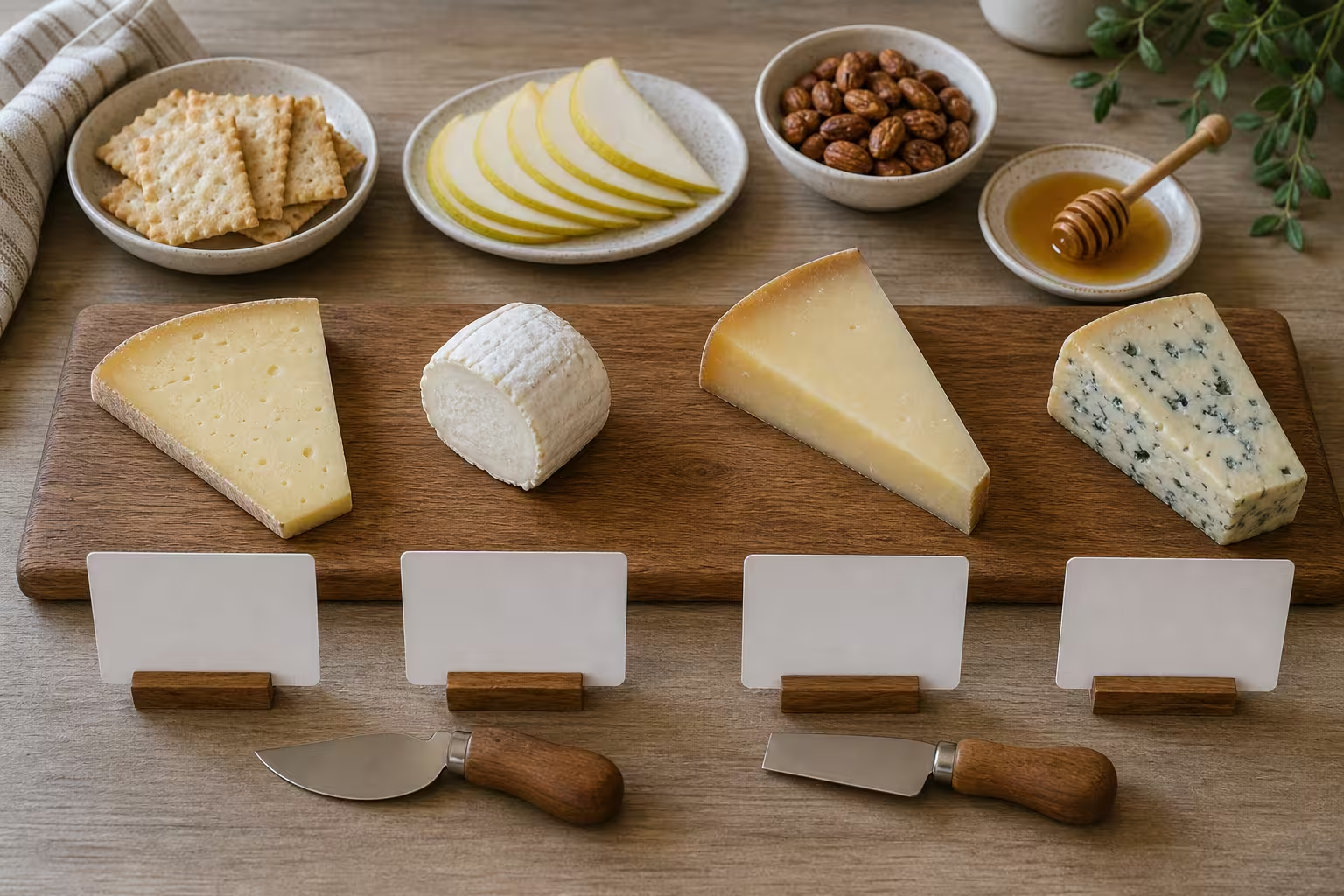
I organized the blind tasting because we kept arguing about cheese.
At dinner, someone would put an expensive Comté next to a cheap cheddar and call the Comté better in every way. Someone else would quietly prefer the cheddar and not say so.
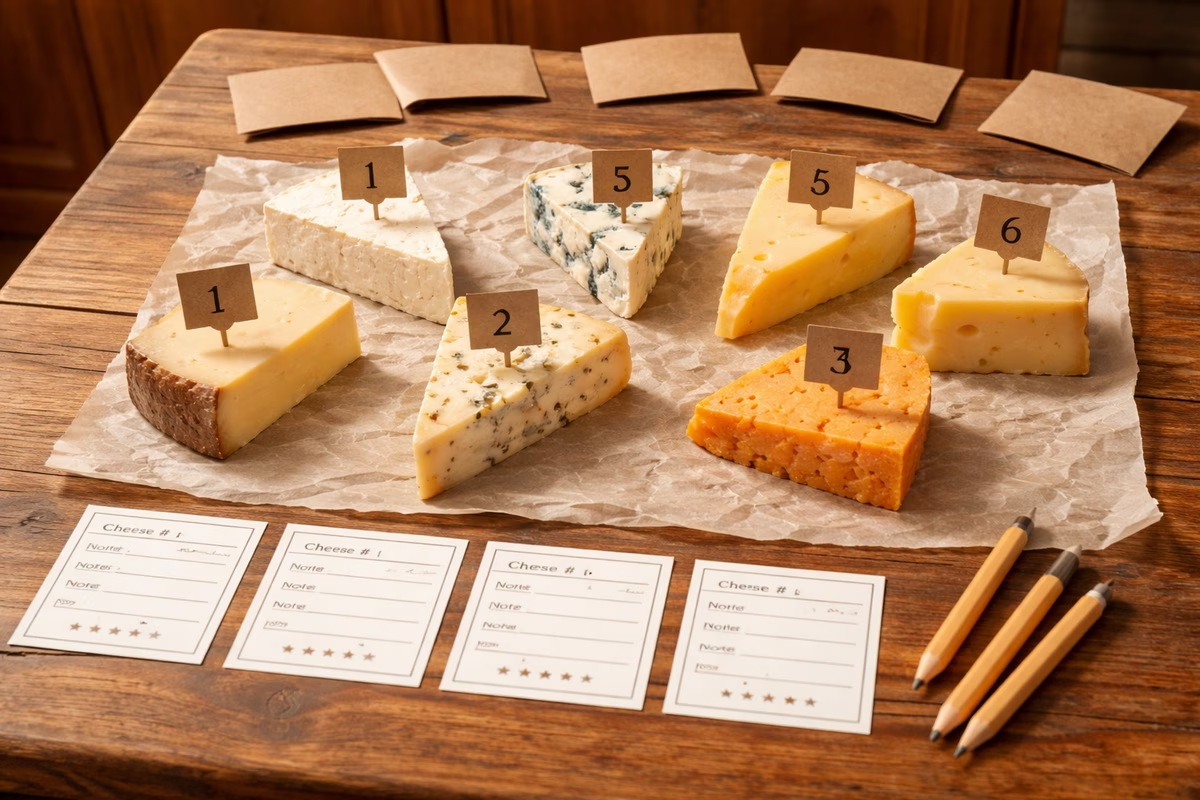
So I set up a test. Eight cheeses. No labels. No prices. Just numbered wedges, pencils, and score cards. I wanted to know if people could still tell which cheese cost more.
The answer was less clear than anyone expected.
Setting up the blind tasting
A good blind tasting does not need much, but it does need a few rules.
The cheese selection
I chose eight cheeses across a range of prices, styles, and origins. I mixed in both prestige cheeses and everyday ones so the tasting would show whether price matched preference.
The lineup (which nobody knew until the reveal):
- A $26/lb 24-month aged Comté from a Paris-trained cheesemonger
- A $4/lb store-brand mild cheddar
- A $18/lb Vermont artisan cheddar aged 18 months
- A $8/lb Trader Joe’s unexpected cheddar
- A $32/lb raw-milk Gruyère from a Swiss alpine dairy
- A $6/lb pre-sliced deli Swiss cheese
- A $22/lb artisan triple-cream Brie from a small French producer
- A $7/lb supermarket Brie
I cut each cheese into small wedges, removed any obvious clues, and arranged them on parchment paper labeled 1-8.
The scoring system
Each person scored every cheese on three dimensions:
- Flavor (1-10): How complex, interesting, and enjoyable is the taste?
- Texture (1-10): How appealing is the mouthfeel?
- Overall (1-10): Would you buy this cheese?
I also asked one bonus question for each cheese: “How much do you think this costs per pound?”
The rules
- No talking about the cheeses until everyone had finished scoring all eight
- Taste in order (1-8) with plain crackers and water between samples
- Write first impressions-don’t overthink
For 6-8 people, buy:
- 6-8 cheeses, about 2-3 oz per person per cheese
- Plain water crackers (nothing flavored)
- Room-temperature water
- Printed scoring sheets (flavor, texture, overall, estimated price)
- Pencils
- Numbered parchment paper or plates
Budget: $60-$100 total for a memorable evening.
Temperature: Remove all cheeses from the fridge 60-90 minutes before tasting. Cold cheese = muted flavor. Room temperature = full expression.
What happened
We had eight tasters. Here are the results that surprised everyone:
Surprise #1: The cheap cheddar scored higher than expected
Cheese #2-the $4/lb store-brand mild cheddar-did not win anything. But it didn’t finish last either. It placed fifth overall out of eight, ahead of the $6/lb Swiss and one of the Bries. Several tasters described it as “clean,” “simple,” and “pleasant.” One person scored it a 7 for overall enjoyment.
The $4 cheddar isn’t good cheese in the artisanal sense. It’s mild, one-dimensional, and engineered for inoffensiveness. But inoffensive is not the same as bad, and in a blind setting without the negative association of its price point, people evaluated it on its own terms and found it… fine. Unremarkable but not unpleasant.
Surprise #2: The Trader Joe’s cheddar rivaled the artisan cheddar
This was the evening’s biggest upset. Cheese #4-the $8/lb Trader Joe’s unexpected cheddar-and Cheese #3-the $18/lb Vermont artisan cheddar-were statistically tied in overall scores. The Trader Joe’s scored slightly higher on flavor with three tasters and slightly lower with two others. The average scores were within 0.4 points.
When I revealed the prices, the room went quiet. The $8 cheese had held its own against a cheese that cost more than twice as much.
The lesson is simple. Some mid-price cheeses are a good deal. The gap between good and great is often smaller than the price suggests.
Surprise #3: The expensive Gruyère won-but not unanimously
Cheese #5-the $32/lb raw-milk Swiss Gruyère-did win the highest average score. Its flavor complexity was genuinely in a different category: notes of brown butter, toasted nuts, caramelized onion, and a long, evolving finish that kept revealing new flavors. Six of eight tasters ranked it first or second overall.
But two tasters ranked it fourth. Their comments: “Too strong,” “A bit overwhelming,” “I’d enjoy this in small amounts but wouldn’t eat a big piece.”
This showed something important. The best cheese is the cheese you enjoy. Some people prefer milder, simpler flavors. Complexity and enjoyment are not the same thing.
Surprise #4: The Brie divide
Cheese #7 (artisan triple-cream, $22/lb) and Cheese #8 (supermarket Brie, $7/lb) were the most polarizing pair. The artisan Brie was richer, funkier, and had a more developed bloomy rind. The supermarket Brie was milder, creamier in a simpler way, and had a thinner rind.
Five tasters preferred the artisan Brie. Three preferred the supermarket Brie. The three who preferred the supermarket version all said something similar: “I like Brie to taste like butter, not like a barn.”
The artisan Brie was more complex. But some people read that complexity as earthiness, ammonia, or mushroom funk. The supermarket Brie was milder and easier to like.
Surprise #5: The price guesses were wildly wrong
The bonus question-“How much do you think this costs?"-produced the evening’s best entertainment. On average:
- The $4 cheddar was guessed at $9/lb
- The $8 Trader Joe’s cheddar was guessed at $16/lb
- The $32 Gruyère was guessed at $20/lb
- The $7 supermarket Brie was guessed at $14/lb
Nobody correctly identified the cheapest cheese. The most expensive cheese was also undervalued.
Price in cheese comes from things you cannot taste directly:
- Production scale (artisan vs. factory)
- Aging time (which requires climate-controlled storage space)
- Milk source (pastured, organic, raw milk costs more)
- Import costs (European cheeses include shipping, tariffs, and distributor margins)
- Labor (handmade cheeses require more human touch)
None of those factors are obvious in a blind tasting. A cheese can be expensive because it is rare. A cheese can be affordable because it is made at scale.
What the tasting taught us
Lesson 1: Price doesn’t predict preference (but quality does predict complexity)
More expensive cheeses are usually more complex. They have more layers of flavor, longer finishes, and more texture. But complexity is not the same as enjoyment.
The link between price and quality is real, but it is not linear. The jump from $4/lb to $10/lb is easy to notice. The jump from $15/lb to $30/lb is smaller.
Lesson 2: Context shapes perception enormously
When you know a cheese costs $32/lb, you taste it differently. You look for complexity and give it more credit. When you do not know the price, you just taste it.
Blind tasting strips away the context. What is left is you and the cheese.
Lesson 3: The best cheese for you might not be the “best” cheese
After the tasting, I asked which cheese people would buy for everyday use. The most common answer was the $8 Trader Joe’s cheddar. It was not the best cheese on the board, but it was good, flexible, and easy to buy.
For a cheese board, most people still wanted the Gruyère or the artisan Brie. For a Tuesday sandwich, they wanted something simpler.
That is the main point. You do not need the best cheese all the time. You need the right cheese for the job.
Lesson 4: Everyone’s palate is valid
The most important thing the tasting showed is that taste is personal. There is no single best cheese.
The friend who preferred the supermarket Brie was not wrong. The friend who loved the Gruyère was not more sophisticated. They just like different things.
How to run your own version
A blind cheese tasting teaches you a lot, and it costs about $80 and an evening.
Quick setup
- Buy 6-8 cheeses across a range of prices and styles
- Include at least two “comparison pairs” (expensive vs. affordable in the same category)
- Remove all packaging, cut into uniform pieces, number them
- Print simple scoring sheets (flavor, texture, overall, price guess)
- Provide plain crackers and water
- Enforce no-talking until everyone has scored everything
- Reveal the identities and prices at the end
- Discuss what surprised you
The golden rule
No judgment. The point is not to prove who has the best palate. It is to find out what you actually like when the labels are gone.
Next steps
- Read Cheese Types for the full taxonomy of cheese families
- Explore How to Buy Cheese to navigate cheese counters and shops
- See Art of the Cheese Plate for building a board after you know your preferences
- Try Wine and Cheese Pairing for matching wines to your favorite cheeses
- Check Cheese Storage to keep your tasting cheeses at their best
Let the cheese tell the story
Cheese rewards slow looking. For Blind Cheese Tasting, the useful practice is to notice milk, rind, texture, age, aroma, temperature, and pairing before reaching for a rule. A wedge is a small record of animals, microbes, salt, moisture, time, and care.
Start at serving temperature and texture. Cold cheese can hide aroma and firmness can change as it warms. Notice whether the paste is dense, elastic, crumbly, fudgy, runny, crystalline, or chalky. Those clues often explain flavor before a label does.
Then taste with contrast. Bread, fruit, nuts, honey, pickles, wine, beer, tea, or nothing at all can reveal different parts of the cheese. Pairing is not about showing off. It is about finding balance.
Storage and handling matter too. Wrap, humidity, air, time, and rind condition can decide whether a good cheese opens beautifully or fades in the refrigerator.
Blind Cheese Tasting should make the counter feel less intimidating and more generous: observe, taste, ask good questions, and buy only what you can enjoy while it is at its best.
What to notice after you use this guide
After reading Blind Cheese Tasting, choose one next action that can be observed. A guide becomes more valuable when it changes a real choice, not only when it adds more facts.
Name the context. Where are you, what are you trying to improve, and what would count as a good result? The answer keeps the advice grounded in daily life.
Change one variable first. A small controlled change teaches more than a dramatic reset because you can tell what mattered.
Keep one note. Write the date, the choice, the outcome, and the thing you would repeat. The note can be plain and still useful.
Look for tradeoffs. Better cheese decisions often involve cost, time, maintenance, comfort, fit, risk, or skill. Seeing the tradeoff makes the decision calmer.
If the result is unclear, wait before adding another fix. Some lessons need a second use, a different day, or a quieter comparison.
If the stakes are high, use qualified sources and professional guidance where appropriate. A guide can organize the question, but it should not pretend to replace expertise.
The goal is practical confidence. Blind Cheese Tasting should make the next step easier to choose and easier to repeat.