The cowbells woke me up.
I was in a mountain hut above Gruyères, Switzerland—not the touristy town in the valley but the real Alps above it, where the pastures tilt at angles that would alarm a civil engineer and the cows seem unfazed by inclines that had me using my hands. The bells were tuned to different pitches, so a herd moving across a hillside sounded less like livestock and more like a slow, dissonant symphony being carried on the wind.
I had come for the cheese. Specifically, I had come to understand why a wheel of Gruyère made from milk collected at 1,500 meters tastes different from one made in the valley below—and why that difference matters enough for Swiss law to regulate it.
What I discovered, over five days of hiking and eating, is that alpine cheese isn’t just cheese from the mountains. It’s cheese of the mountains—a product so shaped by altitude, pasture, season, and tradition that it can’t be separated from its landscape. Take the same recipe to a factory in the lowlands and you’ll make cheese. But you won’t make this.
What makes alpine cheese different
Every cheese begins with milk. And milk from alpine pastures is fundamentally different from milk produced in lowland dairies.
The pasture effect: Alpine meadows sit between 1,000 and 2,500 meters. At these altitudes, the growing season is short and intense—wildflowers, grasses, and herbs crowd together in meadows that can contain 50 to 100 different plant species per square meter. Cows grazing these pastures produce milk with a higher concentration of beta-carotene, terpenes, and fat-soluble compounds than cows eating monoculture grass or silage in the valley.
These compounds directly affect flavor. Beta-carotene gives alpine cheeses their characteristic golden-to-deep-yellow color (lowland cheeses tend to be paler). Terpenes from wildflowers contribute floral, herbal, and fruity notes that are literally impossible to replicate without the plants.
The seasonal rhythm: In the traditional transhumance system still practiced across the Alps, cattle move uphill in spring (the alpaufzug) and downhill in autumn (the alpabzug). Cheese made from summer alpine milk is considered the finest—it captures the peak diversity of the high pastures. Some producers date their wheels by the month of production, and cheese from July or August commands a premium.
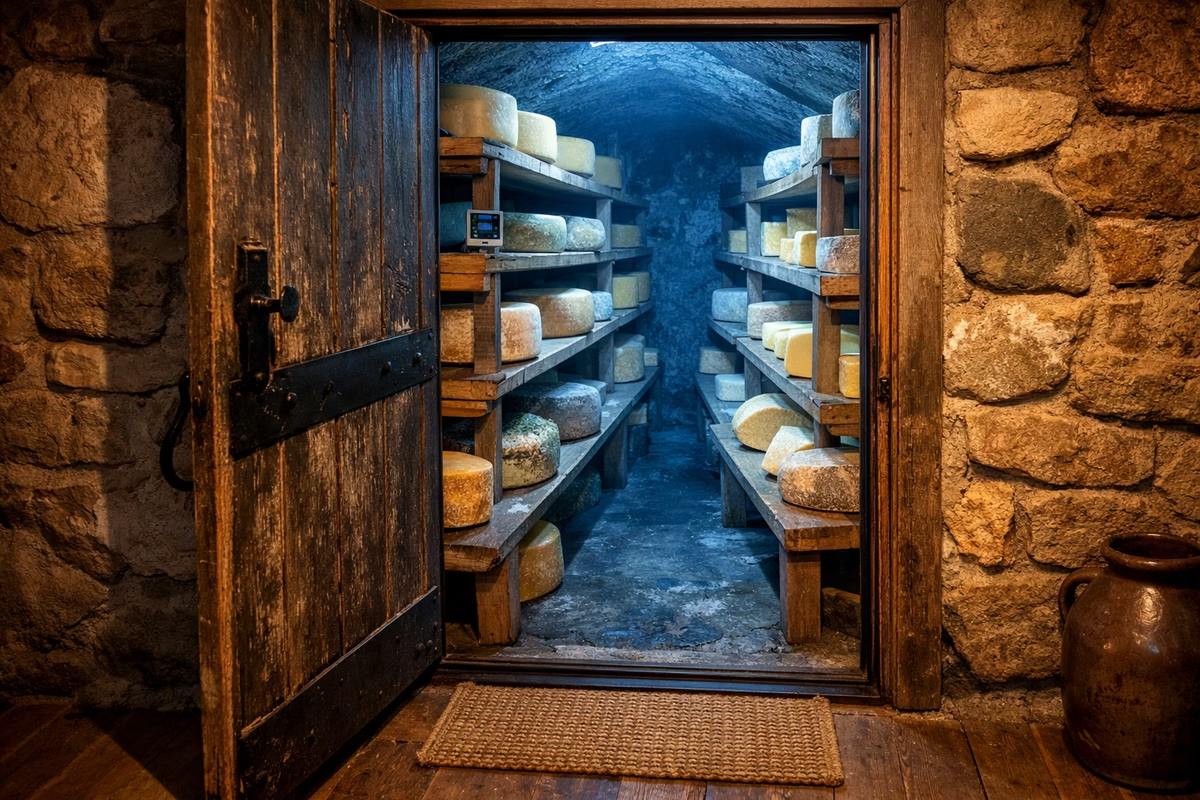
The making tradition: Alpine cheeses are almost exclusively cooked and pressed hard cheeses. This isn’t arbitrary—it’s survival. At altitude, cheesemakers historically had to produce wheels that would last through winter without refrigeration. Cooking the curd (heating it to 50-55°C) and pressing it into dense wheels creates a cheese with low moisture and high fat concentration that can age for months or years without spoiling. The same environmental pressure that shaped the pastures shaped the cheese.
Many alpine cheeses have protected designations of origin (PDO/AOP) that legally define where and how they can be made:
- Gruyère AOP: Must be made in the cantons of Fribourg, Vaud, Neuchâtel, Jura, or Bern, from raw cow’s milk, using natural rennet and no additives.
- Comté AOP: Must be made in the Jura Massif region of France, from raw milk of Montbéliarde or Simmental cows, in wheels of at least 40kg.
- Beaufort AOP: Must be made in Savoie, France, from Tarine or Abondance cows. Summer Beaufort (Beaufort d’été) specifically requires alpine pasture milk.
- Appenzeller: Made in the Appenzell region of northeast Switzerland, rubbed with a proprietary herbal brine whose recipe is a closely guarded secret.
These designations aren’t bureaucratic formalities. They’re quality guarantees that link each cheese to its specific geography, cattle breed, and technique.
Gruyère: the keystone cheese
My trail started in Gruyères (the town), where the Maison du Gruyère sits across from the medieval castle and you can watch wheels being made through glass windows.
Gruyère is arguably the most important alpine cheese—not because it’s the “best” (that argument could last lifetimes and several bottles of wine), but because it demonstrates the altitude principle most clearly. Gruyère ranges from 5 months to 18+ months of aging, and each stage reveals something different:
5-6 months (Le Gruyère mild): Supple, slightly elastic, with notes of fresh cream, butter, and a faint nuttiness. The texture is smooth and approachable. This is the Gruyère most people know from fondue.
9-12 months (Le Gruyère reserve): Firmer, drier, with crystalline crunch developing as the protein matrix breaks down. The flavors deepen: caramelized onion, toasted hazelnuts, a sweet-savory balance that’s nearly addictive.
14-18+ months (Le Gruyère d’alpage): Dense, granular, complex. The alpine pasture flavors are at their most concentrated—dried flowers, honey, brown butter, a mineral backbone that lingers for minutes. This is the cheese that justifies the hike.
The tasting at the Maison du Gruyère arranged all three side by side, and the transformation was obvious. The same recipe, the same cows (more or less), the same cellar—but time and altitude had created three entirely different experiences.
Comté: Gruyère’s French cousin
Two days later, I crossed the border into the French Jura Massif, where Comté is king.
Comté looks like Gruyère’s sibling—a large, concave-sided wheel with a brown rind—but the flavor profile diverges in interesting ways. Where Gruyère tends toward nutty sweetness, Comté leans into a broader aromatic spectrum that the French categorize into six “flavor families”:
- Lactic (fresh milk, butter, yogurt)
- Fruity (citrus, dried apricot, pineapple)
- Roasted (toast, coffee, caramel, chocolate)
- Vegetal (fresh-cut grass, hay, mushroom)
- Animal (leather, broth, stable)
- Spicy (pepper, nutmeg, smoke)
A single wheel of well-aged Comté might express notes from three or four of these families, and different wheels from different fruitières (the cooperative dairies where Comté is made) will emphasize different ones depending on the specific pastures, the season, and the cellar conditions.
The idea that a single cheese can taste like caramel and apricot and leather and fresh grass simultaneously seemed impossible until I tasted a 24-month Comté in a cave-aged cellar outside Poligny. It was all of those things. Not sequentially—simultaneously.
- Temperature matters. Take the cheese out of the fridge 30-60 minutes before tasting. Cold mutes flavor. Alpine cheeses open up dramatically at room temperature.
- Cut a wedge from rind to center. The flavor varies from the rind edge (more complex, more aged) to the center (creamier, milder). A proper wedge captures the full gradient.
- Start with the youngest. In a tasting flight, go from mild to aged. Your palate can handle increasing intensity but not the reverse.
- Chew slowly. The crystalline crunch in aged alpine cheese releases concentrated amino acids (the same umami compounds found in Parmesan). These need time on your tongue.
- Pair with the landscape. Crusty bread, cornichons, cured meats, and a glass of white wine from the same region. The terroir of the cheese and the wine often harmonize because they share the same geography.
Beaufort: the prince of the Alps
Further south, in Savoie, I found Beaufort.
If Gruyère is the keystone and Comté is the philosopher, Beaufort is the aristocrat. It’s made in smaller quantities, from specific breeds (Tarine and Abondance only), and the summer alpine version—Beaufort d’été or Beaufort d’alpage—is considered one of the finest mountain cheeses in the world.
Beaufort is immediately recognizable by its concave sides (the result of the specific beechwood mold used during pressing) and its smooth, golden paste. The texture is uniquely supple for an alpine cheese—less crystalline than aged Gruyère, more like a firm, yielding butter.
The flavor is where Beaufort distinguishes itself: a pronounced sweetness (honey, cooked cream, butterscotch) balanced by a mineral depth that speaks directly of the mountains. Summer Beaufort adds floral and herbal notes—gentian, wild thyme, alpine sorrel—that are traceable to the specific pastures where the cows grazed.
I ate Beaufort on a stone wall overlooking the Tarentaise valley, sliced thick with a pocket knife, alongside a chunk of bread and an apple. Below me, the valley dropped away into a haze of green pastures and distant glaciers. The cheese tasted like the view—layered, expansive, impossible to fully comprehend in a single sitting.
Appenzeller: the secret recipe
Back in Switzerland, in the rolling eastern hills of Appenzell, I discovered the most mysterious of the alpine cheeses.
Appenzeller’s secret is its brine. Every wheel is hand-rubbed with a mixture of herbs, spices, wine, and other ingredients whose exact composition has been kept secret for over 700 years. The producers claim that only two living people know the full recipe.
Whether this is marketing or genuine is debatable. What’s not debatable is the result: Appenzeller has a flavor that’s unlike any other alpine cheese. It’s spicy, tangy, and complex, with notes of fermenting fruit, black pepper, and a warm herbal quality that sits somewhere between medicinal and magical.
The cheese comes in three grades: Classic (3-4 months, mild), Surchoix (4-6 months, fuller), and Extra (6+ months, intense). I tried all three at a farmhouse tasting, and the Extra was the most memorable—almost aggressive in its flavor, with a persistent tingle on the tongue that reminded me more of a good cocktail than a cheese.
What the trail taught me
Five days of hiking and eating taught me that alpine cheese is the purest expression of terroir in the cheese world. More than wine, more than olive oil, more than coffee—because the connection between landscape and flavor is so direct and so visible. The cows eat the meadow. The meadow is the mountain. The mountain is the cheese.
This isn’t mysticism. It’s biology and chemistry with a beautiful outcome. The 80 plant species in an alpine meadow produce 80 different aromatic compounds in the milk, which undergo hundreds of chemical reactions during aging, which produce a flavor complexity that no factory, no matter how advanced, can replicate. The mountain is not optional. It’s the primary ingredient.
I came down from the Alps with a backpack full of cheese (vacuum-sealed, carefully wrapped) and a conviction that the next time someone puts a slice of Gruyère on a cracker, they should know—even briefly—about the meadow it came from, the altitude that shaped it, and the cowbells that mark its origin in the thin, clear air above the treeline.
Next steps
- Read Cheese Types for the broader landscape of cheese styles
- Explore Cheese Aging for how time transforms cheese
- See Wine Pairing for matching alpine cheese with wine
- Read How to Buy Cheese for finding quality alpine cheeses at home
- Check Art of the Cheese Plate for building a mountain cheese board