My friend’s basement stairs were steep and uneven, the kind that make you grip the railing with conviction. At the bottom, behind the water heater and a shelf of old paint cans, he’d built a small wooden rack against the coolest wall. On it sat about thirty bottles—dark glass, some with wax-sealed caps, a few with dust on the shoulders and dates written in Sharpie on the labels.
“The beer cellar,” he said, with the pride of someone who knows exactly how ridiculous and exactly how wonderful this is.
He pulled out a bottle of Thomas Hardy’s Ale—an English barleywine that had been sitting on that rack for six years. The label was faded. The wax seal cracked when he peeled it. He poured carefully into two snifters, leaving a thin sediment at the bottom of the bottle.
The beer was not what I expected. I’d had barleywines before—big, boozy, malty, often harshly alcoholic when young. This was transformed. The alcohol had softened into warmth rather than heat. The malt had developed into dark toffee, sherry, dried fruit, and something leathery and old that I could only describe as “library.” The carbonation was gentle. The finish went on for a full minute.
“Six years ago,” he said, “this tasted like a beautiful mess. Now it tastes like it was always supposed to be this.”
That was the evening I started my own cellar.
Why some beer ages (and most doesn’t)
Let’s get this out of the way first: most beer should be drunk fresh. IPAs, pale ales, lagers, wheat beers, session beers—anything where hops, freshness, or delicate aromatics are the point—these decline from the moment they’re packaged. An IPA that’s six months old isn’t aged. It’s stale.
But certain beers are built to evolve. They have characteristics that improve—or at least change in interesting ways—over months and years:
High alcohol (8%+ ABV): Alcohol acts as a preservative and contributes to long-term stability. It also mellows over time, evolving from hot and boozy to warm and integrated.
Residual sugars and malt complexity: Rich, malty beers have compounds that undergo slow chemical changes in the bottle—Maillard reactions continue, sugars oxidize into sherry-like and toffee notes, and flavors that were once separate begin to merge into something unified.
Active yeast in the bottle: Bottle-conditioned beers (carbonated by live yeast in the bottle, not force-carbonated) have living organisms that continue to metabolize over time, producing subtle flavor changes and maintaining carbonation.
Robust bitterness or acidity: Very bitter or very sour beers have structural elements that provide a backbone for aging. Hop bitterness fades, but the structural support remains, allowing other flavors to emerge.
Excellent for aging (1-10+ years):
- Barleywine (English and American)
- Imperial stout and Russian imperial stout
- Belgian strong dark ale (Quadrupel)
- Old ale
- Lambic and gueuze (wild/sour ales)
- Barrel-aged stouts and barleywines
- Doppelbock
Can age interestingly (1-3 years):
- Belgian dubbel and tripel
- Scotch ale / Wee Heavy
- Baltic porter
- Strong bitter
- Flanders red/brown ale
Do NOT age (drink fresh):
- IPA (any variety)
- Pale ale
- Pilsner / lager
- Wheat beer / hefeweizen
- Session beers (under 5% ABV)
- Any hop-forward beer
What happens inside the bottle
Beer aging isn’t just waiting. It’s chemistry in slow motion.
Oxidation (controlled)
In small amounts, oxidation creates desirable flavors: sherry, toffee, dark fruit, leather, port wine. In large amounts, it creates wet cardboard. The difference is controlled—dark, still, cool storage minimizes aggressive oxidation while allowing gentle, positive changes.
Ester evolution
The fruity esters produced by yeast during fermentation continue to evolve in the bottle. Banana esters may shift toward dried fruit. Cherry esters may deepen into plum or raisin. These changes are slow and subtle but unmistakable in a vertical tasting (the same beer, different vintages, side by side).
Tannin polymerization
Like red wine, beers with significant tannins (from roasted malt or wood aging) undergo polymerization—tannin molecules link together into larger chains that feel softer on the palate. A young imperial stout with aggressive roast bitterness becomes a mature imperial stout with smooth, rounded chocolate and coffee.
Hop degradation
Hop aromatics and bitterness fade over time. For hop-forward beers, this is a loss. For malt-forward beers, this is a benefit—the fading hops reveal underlying malt complexity that was previously masked.
Yeast autolysis
In bottle-conditioned beers, yeast cells eventually die and break down (autolyze), releasing compounds that can add savory, bread-like depth—similar to what happens in champagne aged on its lees. In moderation, this adds complexity. If it goes too far, it can produce off-flavors.
How to store beer for aging
You don’t need a wine cellar. You need a cool, dark, still place with reasonably consistent temperature.
Temperature
Ideal: 50-55°F (10-13°C). This is the same range recommended for wine. A basement, closet against an exterior wall, or a dedicated beverage fridge set to its warmest works well.
Acceptable: 55-65°F (13-18°C). Warmer storage accelerates aging. A beer stored at 65°F for one year may evolve as much as a beer stored at 55°F for two years. This isn’t necessarily bad—just faster—but temperatures above 70°F risk off-flavors.
Avoid: Temperatures above 75°F, temperature swings (the garage that’s 40°F in winter and 90°F in summer), and proximity to heat sources (furnace, water heater, south-facing window).
Light
None. UV light causes skunking—a photochemical reaction with hop compounds that produces the infamous “skunky” off-flavor. Brown bottles protect against most UV, but complete darkness is best. A closet, a box, or a rack in an unlit basement corner all work.
Position
Upright. Unlike wine, beer should be stored upright. This minimizes the surface area in contact with air (reducing oxidation) and keeps the yeast sediment settled at the bottom for cleaner pouring later.
Still
Don’t move the bottles more than necessary. Movement disturbs sediment and can accelerate unwanted chemical changes. Find a spot, put the bottles down, and leave them alone.
You don’t need thirty bottles to start. Here’s a practical beginner approach:
- Buy two bottles of three age-worthy beers (6 bottles total). Good candidates: Sierra Nevada Bigfoot (barleywine), North Coast Old Rasputin (imperial stout), Chimay Blue (Belgian strong dark).
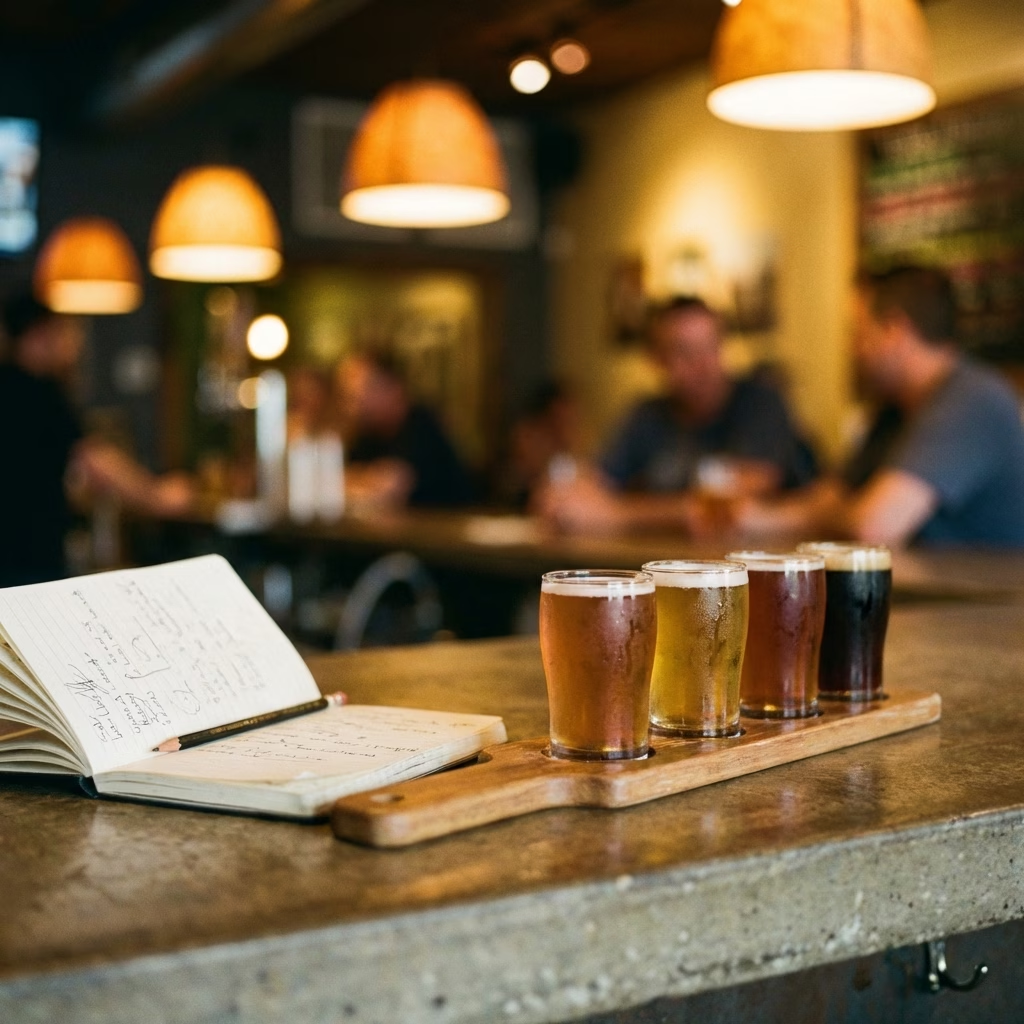
- Drink one of each now. Take notes. What does it taste like fresh?
- Store one of each for 1-2 years. Somewhere cool, dark, and stable.
- Open the aged bottles and compare your notes. The difference will be your education.
Total cost: $30-$50 for a revelation in what beer can become.
The vertical tasting: beer’s time machine
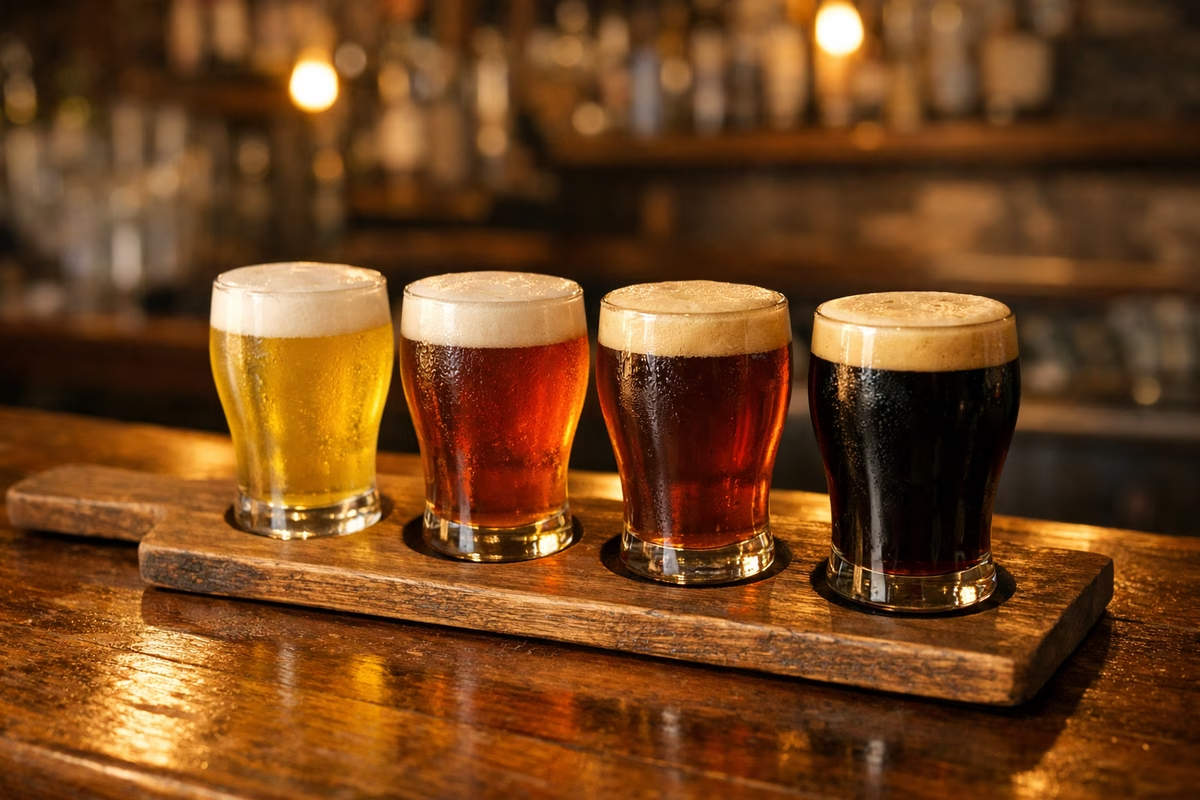
The most educational and enjoyable thing you can do with aged beer is a vertical tasting—the same beer from different years, tasted side by side.
Some breweries release the same beer annually (Sierra Nevada Bigfoot, Anchor Christmas Ale, many Belgian abbey ales), making verticals easy to assemble. Buy a few bottles each year, store them, and when you have 3-5 vintages, open them all on the same evening.
What you discover is that the same recipe—identical ingredients, identical process—produces dramatically different flavors depending on age:
Year 1 (fresh): Hop-forward (if any hops present), bright, aggressive, individual flavors stand apart. Often “hot” from alcohol.
Year 2-3: Hops fade, malt moves forward, alcohol integrates, flavors start merging. The beer gets rounder.
Year 4-6: Oxidative character emerges—sherry, toffee, dried fruit. Carbonation may soften. The beer becomes contemplative rather than assertive.
Year 7+: At its peak (for appropriate styles), the beer achieves a unity that young beer cannot—a seamless integration where individual flavors are subsumed into a single, complex, evolving taste. Or, past its prime, it begins to thin out and show excessive oxidation.
Every beer has a window. The art is finding it.
The cellar that grew
My cellar started with six bottles on a shelf in the basement closet. That was three years ago.
It now holds about fifty bottles. Not because I’m a collector, but because every few months I find something age-worthy and buy an extra bottle (or three) to set aside. A few Russian imperial stouts from the October release. A couple of Belgian quads picked up in December. A barleywine or two from the January seasonal.
The best evening I’ve had with beer in my adult life was opening a three-year vertical of Founders KBS (Kentucky Breakfast Stout)—2022, 2023, and 2024—with two friends. We tasted them blind, tried to guess the year, and discussed what we noticed changing. The 2024 was bold and roasty. The 2023 was smoother, the coffee notes richer. The 2022 was silk—chocolate mousse with bourbon warmth and a finish that kept evolving in the glass for minutes.
We argued about which year was best. We didn’t agree. That was the point.
Aging beer is not about finding the objectively “best” version of a beer. It’s about understanding that beer is alive—it changes, it evolves, it peaks and fades—and that paying attention to those changes is one of the most rewarding things a beer drinker can do. It costs nothing but patience and a shelf in a cool, dark place.
And patience, it turns out, is its own kind of ingredient.
Next steps
- Read Serving & Storage Guide for proper temperature and handling
- Explore Beer Styles Guide to identify age-worthy styles
- See Beer Tasting 101 for systematic tasting technique
- Read Beer History for the tradition of aged and cellared beers
- Check Homebrewing Basics to brew your own age-worthy beers