Choosing CO2 and tuning CO2 are different decisions. The basic choice is covered in CO2 Versus Low-Tech Planted Tanks , where the question is whether injected carbon belongs in the tank at all. Once the equipment is installed, the better question becomes narrower and more practical: can the tank receive a steady, useful amount of CO2 without stressing livestock or turning the whole system into a fragile machine?
CO2 rewards patience because the visible response is delayed. A bubble rate changes immediately, but plants respond over days and weeks. Livestock respond more quickly when the level is too high, which is why animal behavior must be watched as carefully as plant growth. A stable CO2 tank is not defined by a fashionable number. It is defined by repeatable timing, good distribution, healthy plants, normal livestock behavior, and maintenance habits that catch equipment drift before it becomes a crisis.
Start With Light, Not Bubbles
CO2 demand rises with light. A dim tank with slow plants may not use much additional carbon, while a bright tank packed with fast stems can become unstable if carbon is inconsistent. The mistake is to tune CO2 in isolation, as if the regulator alone controls plant health. It does not. Light, nutrients, plant mass, flow, and livestock waste all shape what the tank can use.
Before increasing CO2, make sure the photoperiod is deliberate and not excessive. Light Balance for Aquatic Plants is the companion decision. If light is too strong for the plant mass and maintenance rhythm, raising CO2 may reduce one limitation while exposing another. The tank may grow faster, but algae can still appear if nutrients, trimming, and water changes do not keep up.
A useful first target is consistency. The lights turn on at the same time. CO2 begins early enough that plants have access when photosynthesis starts. CO2 ends before lights out so gas exchange can recover overnight. The exact schedule depends on the tank and equipment, but random manual switching usually makes tuning harder than it needs to be.
Distribution Matters As Much As Dose
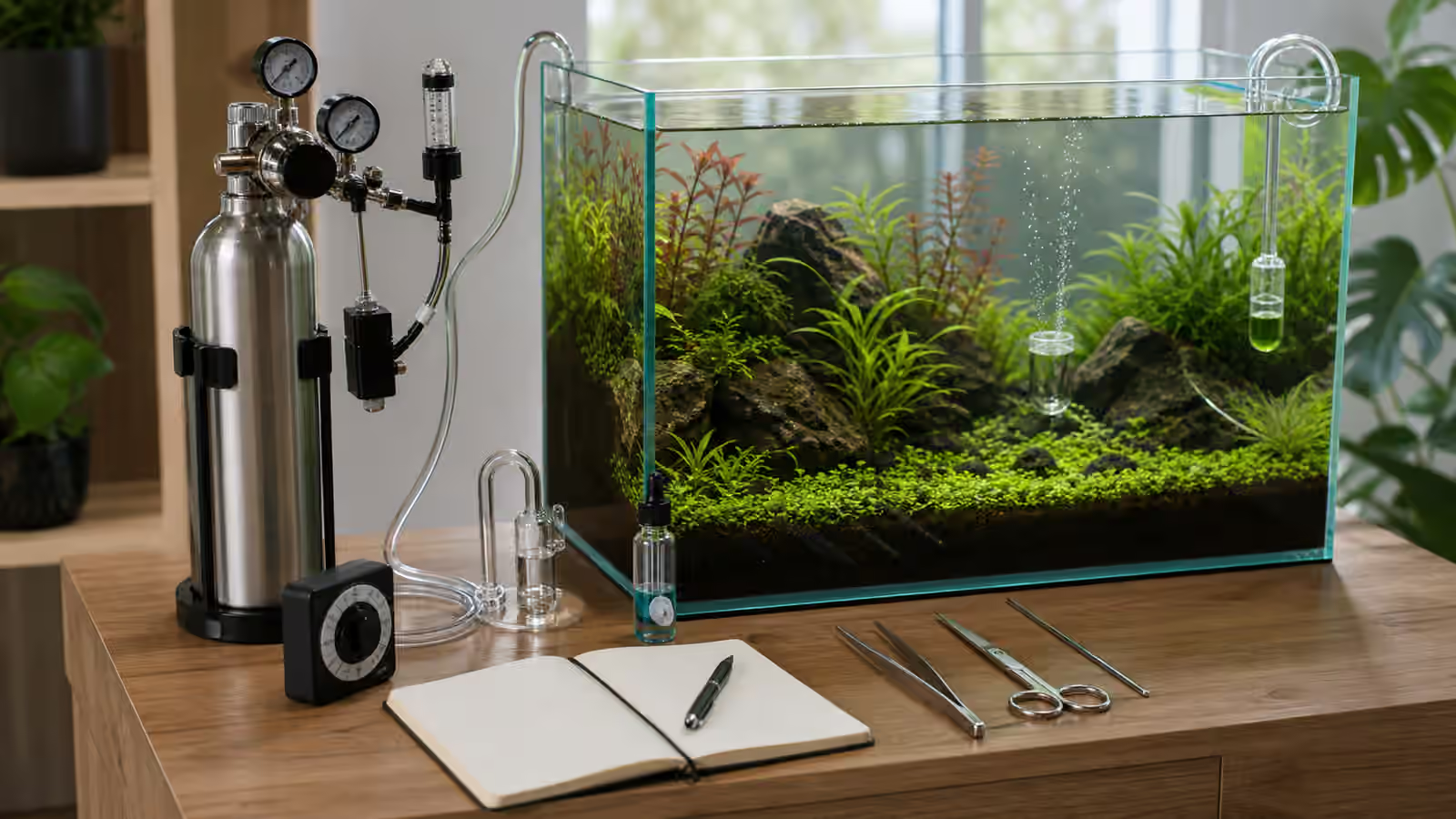
A bubble counter shows gas entering the system. It does not prove that dissolved CO2 reaches every plant. Diffuser placement, outlet direction, surface agitation, plant density, and hardscape all affect distribution. If one corner grows well while another struggles, the issue may be circulation rather than total dose.
Watch fine bubbles or water movement after the diffuser starts. They should move through the planted areas rather than collecting behind one rock, rising immediately to the surface, or drifting only along the front glass. A filter outlet can help carry CO2-rich water across the tank, but it should not blast fish or uproot plants. The flow principles in Filter Flow and Surface Agitation still apply.
Surface agitation requires nuance. A completely stagnant surface can limit gas exchange and collect film. A violently churning surface can waste CO2 and create an unstable daily swing. Many planted tanks do well with a steady ripple that keeps oxygen exchange healthy while allowing the injected gas to remain useful during the light period.
Watch Livestock Before Trusting Color
Drop checkers and pH changes can be helpful tools, but they are not permission to ignore animals. Fish lingering at the surface, rapid breathing, unusual hiding, loss of balance, or shrimp rushing and climbing can all signal distress. Those observations matter immediately. Equipment readings are context, not a shield.
Tune slowly, especially in stocked tanks. Make one small adjustment, then observe through the full light period and the following day. Avoid changing CO2, light intensity, fertilizer, and flow all at once. If livestock react badly, reduce CO2, improve gas exchange, and stabilize the system before trying again. A planted aquarium is not a laboratory sample that can be sacrificed for growth data.
The most responsible CO2 tanks also have a plan for failure. A solenoid can stick. A needle valve can drift. Tubing can pop loose. A cylinder can empty and then be refilled with different pressure behavior. A diffuser can clog. The aquarist who checks equipment casually but regularly is less likely to discover a problem through stressed animals.
Plant Signals Need Context
Healthy CO2 often shows up as steadier new growth, denser stems, stronger carpeting plants, and better recovery after trimming. It may also reveal that nutrients were too low for the higher growth rate. Pale new leaves, pinholes, weak tips, or stalled growth can point toward nutrition, but plant signals are rarely a single-cause puzzle. Fertilizing Aquatic Plants Without Overdoing It helps keep those decisions measured.
Do not chase pearling as the only sign of success. Oxygen bubbles on leaves can be satisfying, but they are influenced by water changes, light, plant health, and saturation. A tank can be healthy without constant pearling, and a tank can pearl while still being hard on livestock if CO2 is pushed recklessly.
Trim response is one of the more useful observations. Fast stems in a stable CO2 tank should recover predictably after cutting and replanting. If each trim leads to algae, melting, or wild parameter swings, the tank may be running too close to the edge. Stability is better than maximum speed.
Timing Makes The Daily Curve
CO2 is usually most useful when available before lights reach full output. If gas starts only after the lights have been on for a while, plants spend the early part of the photoperiod carbon-limited. If gas runs too late, livestock may face elevated CO2 into the night when plants are no longer photosynthesizing and oxygen demand continues.
A timer and solenoid make the daily curve repeatable, but they do not remove the need to observe. Room temperature, filter cleaning, plant growth, and surface agitation can change how the tank behaves. A diffuser that was clear last month may clog enough to alter output. A dense plant mass can change circulation. The same settings are not always the same tank.
Keep a short record when tuning. Note light schedule, approximate bubble rate, diffuser cleaning, water test trends, livestock behavior, and visible plant response. The record does not need to be elaborate. It needs to prevent the common loop of adjusting by memory, forgetting the last change, and then blaming the tank for being inconsistent.
Keep The System Humane
Injected CO2 can make aquascaping more flexible, but it also raises the standard for attention. The aquarist becomes responsible for compressed gas, check valves, timers, seals, and animal behavior. That responsibility is manageable when the setup is simple to inspect and the routine is realistic.
Good CO2 tuning feels almost boring after the initial learning period. The cylinder is secure. The regulator behaves. The diffuser is clean. Plants grow at a pace the aquarist can trim. Livestock act normally during the whole photoperiod. Algae clues are addressed with measured changes rather than panic. The tank is more energetic than a low-tech setup, but it is not treated as an excuse to abandon restraint.