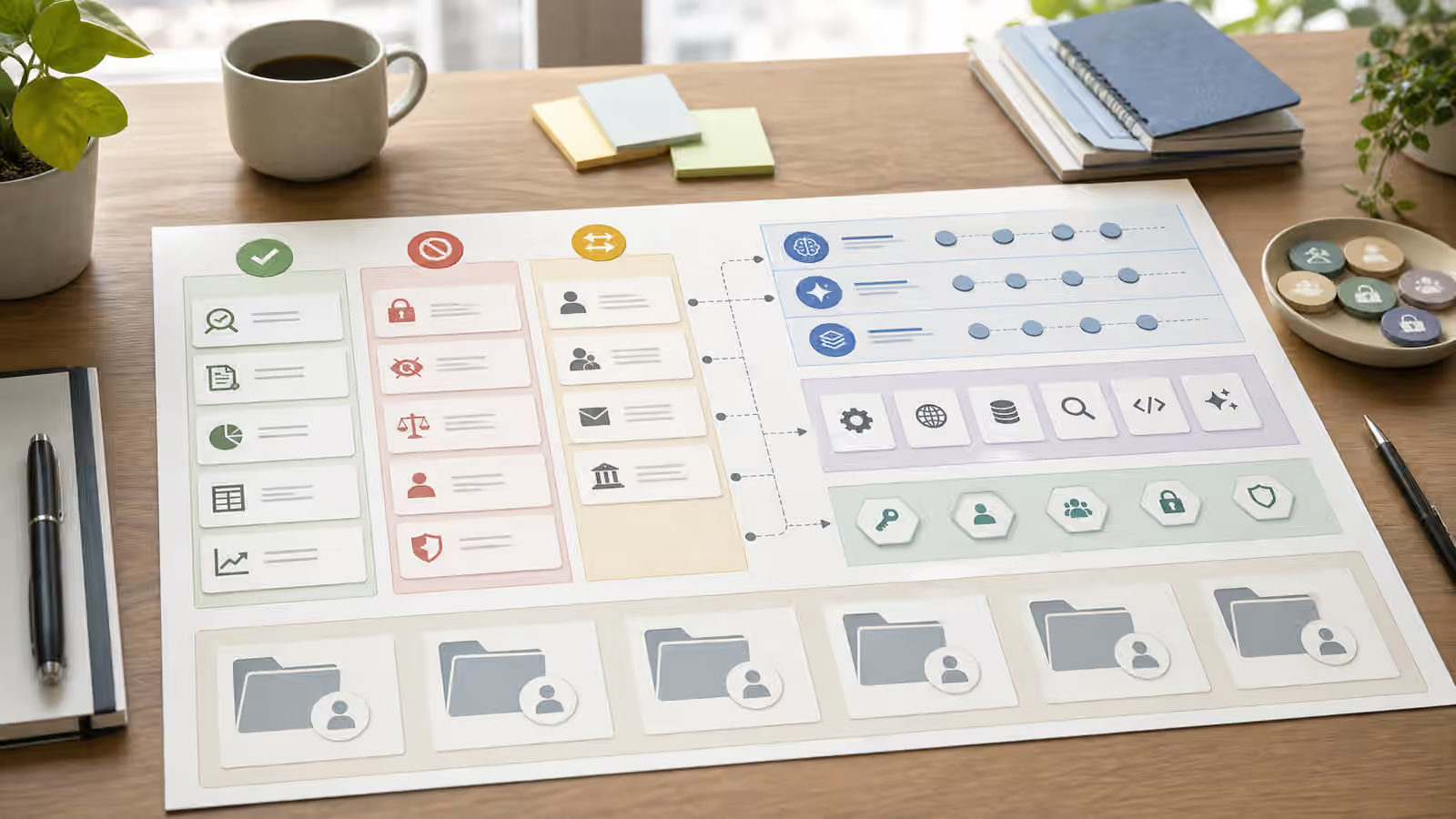
The future of AI agents will not arrive as one dramatic morning when software wakes up and goes to work.
It will arrive as permissions.
At first, the agent may read. Then it may draft. Then it may file. Then it may schedule. Then it may purchase within a limit. Then it may negotiate within a policy. Then it may coordinate with other agents. Every step will ask the same quiet question: what are we willing to let this system do without stopping to ask a person?
That is the real frontier.
Agents will get identities
Enterprises cannot manage thousands or millions of agents as anonymous scripts. They need to know which agent exists, who created it, what it can access, what it did, and when it should be retired.
Microsoft’s 2026 Agent 365 announcement pointed directly at this problem, describing agent registries, governance, and visibility across enterprise workflows. This is likely to become normal. Agents will have identities, permissions, owners, logs, and lifecycle rules.
That may sound administrative, but it is the difference between useful scale and agent sprawl. A company that cannot answer “which agents can touch payroll data?” is not ready for broad autonomy.
The web will become more agent-readable
Today’s web is built mostly for human eyes. Agents can use it, but often awkwardly. They scrape pages, click buttons, parse layouts, and work around interfaces that were never designed for them.
The next web will have more machine-readable doors.
Microsoft’s 2025 Build announcements framed this as the open agentic web, including support for Model Context Protocol and NLWeb. The direction is clear: sites, apps, and services will expose structured ways for agents to discover capabilities, request access, and take action.
This does not mean every website becomes an agent playground. It means the web may gain a layer where agents can interact with services more safely and explicitly than pretending to be a hurried person with a mouse.
Personal agents will become brokers
A strong personal agent will not simply answer questions. It will represent your preferences across services.
It may know how you like to travel, which subscriptions you use, which meetings are worth moving, which documents matter, and which purchases require a second look. It may negotiate with company agents: ask for a refund, reschedule an appointment, compare plans, or gather quotes.
This future depends on trust. A personal agent touches intimate context. It needs strong privacy, local controls, clear memory, easy deletion, and explicit authority boundaries. If people feel watched by their own assistant, they will withhold the context that makes it useful.
Enterprise agents will become fleets
One agent can help a person. A fleet can change a process.
Imagine a product launch. One agent gathers customer feedback. Another monitors support tickets. Another drafts release notes. Another checks policy language. Another watches analytics. Another opens engineering follow-ups. The value is not each agent alone. It is the coordination.
This future needs orchestration. It also needs restraint. Multi-agent systems can multiply confusion if roles overlap or if agents pass weak information to one another. The winning pattern will be smaller agents with clear jobs, shared state, and strong review points.
Robotics will make agents physical
Most AI agents today live in software. Robots bring the same idea into the physical world: perceive, plan, act, observe, and adapt.
McKinsey’s 2025 work on people, agents, and robots treated these as linked parts of the future labor system. That connection matters. A warehouse robot, a lab robot, a home robot, and a software agent may eventually share planning systems, memories, policies, and supervision tools.
Physical action raises the stakes. A software agent can send a bad email. A robot can break an object or injure someone. The more agents move into the world, the more safety engineering must look like aviation, medicine, and industrial control, not only app design.
The hard problems will be social
The next technical improvements are easy to list: better reasoning, longer context, cheaper inference, stronger tool use, better memory, better multimodal perception, more reliable computer use, stronger evaluation, and better sandboxes.
The harder problems are social:
- Who is accountable when an agent acts?
- Who owns the data it used?
- How does a person appeal an agent’s decision?
- How do workers know whether they are being evaluated by an agent?
- How do agents handle laws that differ by country or state?
- How do we stop prompt injection, impersonation, and credential abuse?
- How do we prevent agent markets from becoming spam markets?
The future will not be decided only by model benchmarks. It will be decided by governance, incentives, liability, product design, labor choices, and whether users can understand what happened.
What to expect next
Over the next few years, expect these shifts:
- More agents inside everyday work tools.
- More sandboxed coding, data, and document agents.
- More agent identity and governance products.
- More open protocols for connecting agents to tools.
- More human approval gates for sensitive actions.
- More lawsuits, policy fights, and audit requirements.
- More personal agents that start as researchers and become delegates.
The promise is not that agents remove work. The promise is that they can take on the brittle middle of work: the searching, stitching, drafting, checking, and retrying that sits between intention and outcome.
The risk is that we grant authority faster than we build trust.
The best future is neither full autonomy nor permanent babysitting. It is earned delegation. Agents do more as they prove themselves in clear lanes, under clear rules, with records people can inspect.
Put the guide into a real workflow
AI agent work becomes useful when the task, evidence, permissions, and review loop are all visible. For The Future of AI Agents: Permission, Memory, and the Open Agentic Web, the important question is not whether an agent sounds capable. It is whether the surrounding workflow can tell good progress from confident drift.
Start with a concrete job. Name the input, the desired output, the tools allowed, the files or systems in scope, and the point where a human should review. The clearer the boundary, the easier it is to give the agent autonomy without losing control of the result.
Then decide what evidence counts. A passing test, a reproduced bug, a saved artifact, a source citation, a diff, or a deployment log can all be evidence. A fluent status update is not enough by itself. The workflow should make verification natural.
Good agent practice also includes stopping rules. If credentials are missing, instructions conflict, tests cannot run, or the task touches sensitive data, the agent needs a path to pause and ask. Escalation is not failure. It is part of keeping the system trustworthy.
The Future of AI Agents: Permission, Memory, and the Open Agentic Web should be read as an operating habit, not a slogan. The goal is a workbench where humans stay in charge of intent and standards while agents handle bounded execution with a clear audit trail.