The first office computers did not replace the office. They changed what counted as office work.
Spreadsheets changed finance. Email changed coordination. Search changed memory. Cloud software changed where records lived. AI agents may do something similar to the small decisions and handoffs that fill the day.
The office is full of half-tasks. A meeting creates notes that need actions. A customer call creates a follow-up. A bug report creates a reproduction step. A sales conversation creates CRM updates. A policy change creates dozens of edits across documents and help pages. People spend a stunning amount of time not doing the expert part of their job, but moving context from one system to another.
Agents are aimed at that middle layer.
The first wave: assistant plus action
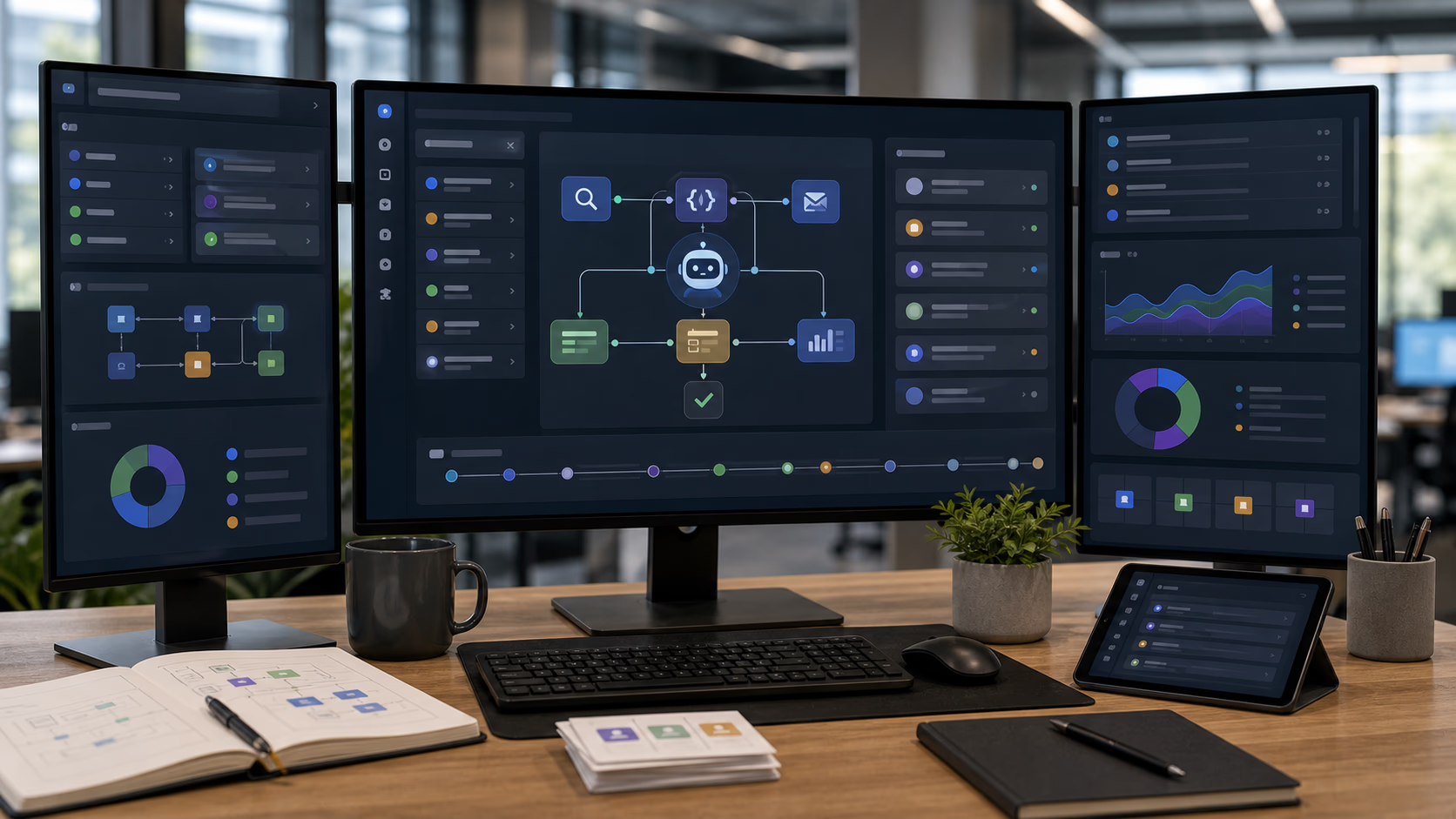
The familiar assistant answers questions and drafts text. The workplace agent goes further. It can look up the customer, read the ticket, check the contract, draft the response, update the record, and ask a person to approve the final send.
This is why companies talk about agents as a digital workforce. The phrase can sound inflated, but the underlying idea is concrete: a business can create software workers for repeated workflows where the tasks are known, the data is available, and the permission model is clear.
Salesforce built Agentforce around customer service, sales, commerce, and marketing tasks. Microsoft has pushed agents through Copilot Studio, Azure AI Foundry, GitHub, and Microsoft 365. Google Agentspace focused on enterprise knowledge and agent adoption across silos. The common target is the same: make organizational information actionable.
The adoption gap
The technology is moving faster than operating habits.
McKinsey’s 2025 State of AI survey reported broad experimentation with AI agents, but also found that many organizations had not scaled AI across the enterprise. That matches what adoption feels like on the ground. Teams can make impressive prototypes. Scaling them requires data access, permission design, evaluation, change management, cost control, and leaders who can decide which workflows matter.
Agents do not fix messy operations by magic. They expose the mess.
If policies conflict, the agent will stumble. If the knowledge base is stale, the agent will repeat bad information. If nobody owns the process, the agent will automate confusion. If every useful action requires a credential nobody wants to grant, the agent will be trapped as a summarizer.
Where agents fit best
The best early workplace agents have several traits:
- The task happens often.
- Success is easy to inspect.
- The data is available.
- The cost of a mistake is limited.
- The agent can draft before it acts.
- A person can approve high-impact steps.
- The workflow has a clear owner.
Customer support triage fits. Internal IT help fits. Sales research fits. Code maintenance fits. Document comparison fits. Compliance evidence gathering can fit if the sources are controlled and the review process is strict.
The weak cases are vague executive wishes. “Make us agentic” is not a workflow.
New jobs around agents
Agents will create work as well as absorb it.
Someone must define the workflow. Someone must decide tool permissions. Someone must write instructions that match policy. Someone must evaluate outputs. Someone must monitor costs. Someone must handle failures. Someone must improve the knowledge base that the agent depends on.
The job titles may vary: agent product manager, AI operations lead, workflow architect, evaluation engineer, automation owner, knowledge steward. The work will be real because agents need care. A neglected agent is not like a neglected spreadsheet. It can keep acting.
Human skill does not disappear
McKinsey’s 2025 report on people, agents, and robots argued that future work will become a partnership between humans, agents, and robots, with many human skills enduring but being applied differently. That is a useful frame.
People will still need judgment, taste, accountability, negotiation, empathy, domain knowledge, and the ability to notice when the system is solving the wrong problem. Agents may take over more collection, comparison, formatting, first drafting, routing, and retrying. The human job shifts toward intent, review, exception handling, and relationship.
This will not happen evenly. Some roles will change quickly. Some will barely change. Some organizations will use agents to remove drudgery. Others will use them to create surveillance and pressure. The technology does not guarantee the labor model.
The leadership test
A serious agent program should be able to answer these questions:
- Which workflows are we changing first?
- Who owns each agent?
- What data may it access?
- What actions may it take alone?
- What actions require approval?
- How do we evaluate quality and safety?
- How do workers challenge or correct the agent?
- What happens to the time the agent saves?
The last question is the most human one. If saved time becomes only more volume, people will notice. If saved time becomes better service, deeper work, faster learning, or fewer late nights, they will notice that too.
Put the guide into a real workflow
AI agent work becomes useful when the task, evidence, permissions, and review loop are all visible. For AI Agents at Work: The New Shape of the Office, the important question is not whether an agent sounds capable. It is whether the surrounding workflow can tell good progress from confident drift.
Start with a concrete job. Name the input, the desired output, the tools allowed, the files or systems in scope, and the point where a human should review. The clearer the boundary, the easier it is to give the agent autonomy without losing control of the result.
Then decide what evidence counts. A passing test, a reproduced bug, a saved artifact, a source citation, a diff, or a deployment log can all be evidence. A fluent status update is not enough by itself. The workflow should make verification natural.
Good agent practice also includes stopping rules. If credentials are missing, instructions conflict, tests cannot run, or the task touches sensitive data, the agent needs a path to pause and ask. Escalation is not failure. It is part of keeping the system trustworthy.
Read this guide as an operating habit, not a slogan. The goal is a workbench where humans stay in charge of intent and standards while agents handle bounded execution with a clear audit trail.
What to notice after you use this guide
Once you have finished this guide, choose one next action that can be observed. A guide becomes more valuable when it changes a real choice, not only when it adds more facts.
Name the context. Where are you, what are you trying to improve, and what would count as a good result? The answer keeps the advice grounded in daily life.
Change one variable first. A small controlled change teaches more than a dramatic reset because you can tell what mattered.
Keep one note. Write the date, the choice, the outcome, and the thing you would repeat. The note can be plain and still useful.
Look for tradeoffs. Better AI agent decisions often involve cost, time, maintenance, comfort, fit, risk, or skill. Seeing the tradeoff makes the decision calmer.
If the result is unclear, wait before adding another fix. Some lessons need a second use, a different day, or a quieter comparison.
If the stakes are high, use qualified sources and professional guidance where appropriate. A guide can organize the question, but it should not pretend to replace expertise.
The goal is practical confidence. AI Agents at Work: The New Shape of the Office should make the next step easier to choose and easier to repeat.