
An AI agent becomes more useful when it can act. It can read files, call tools, update drafts, run tests, browse sources, compare records, prepare pull requests, or move a workflow forward while a person does something else. The same ability that makes it useful also changes the risk. A bad answer is one kind of problem. A bad action in the wrong environment is another.
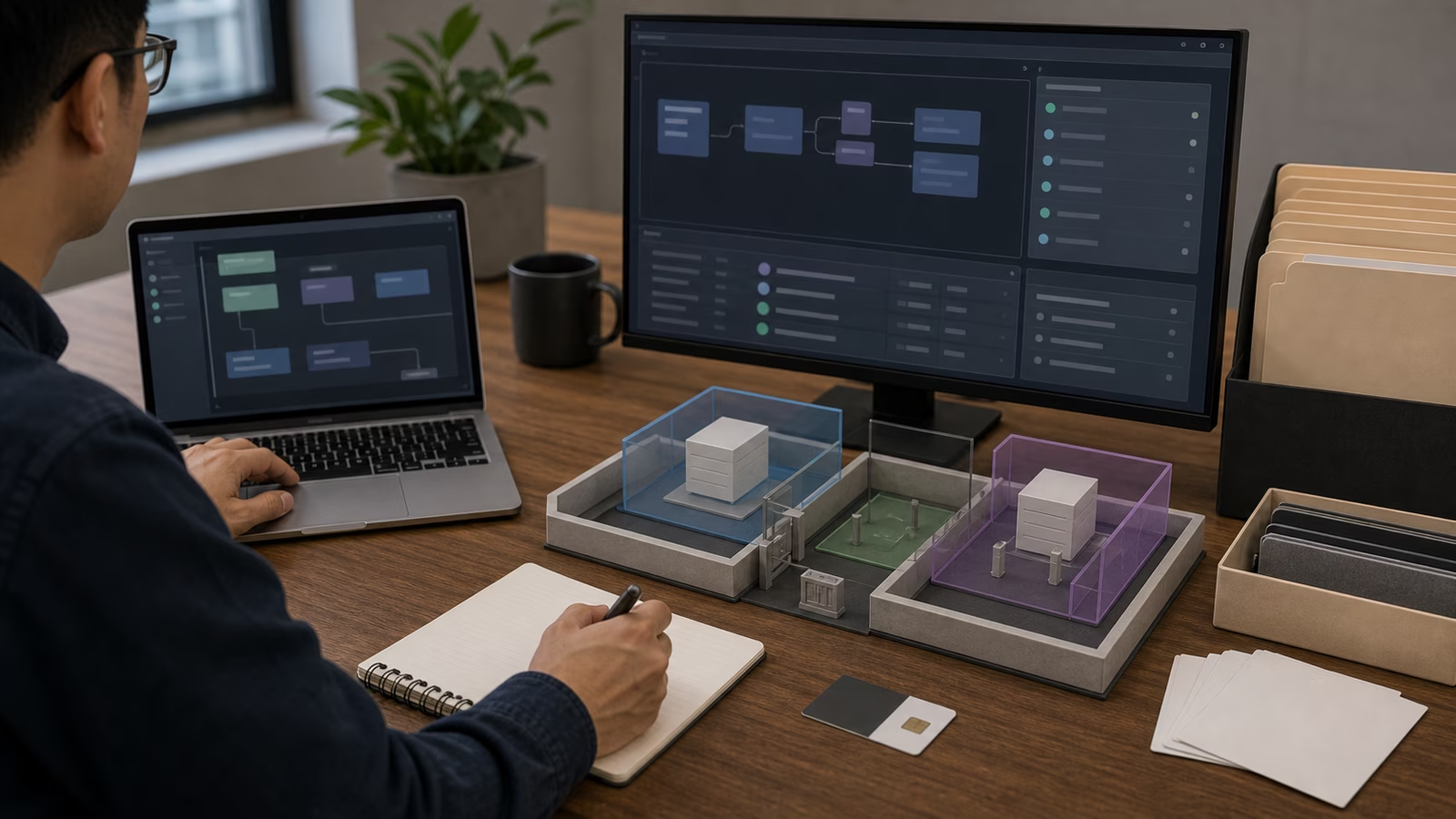
That is why sandboxes matter. A sandbox is a place where an agent can work with limits. It may look like a test database, a temporary branch, a mock customer account, a read-only copy of files, a local development environment, or a simulated tool surface. The point is not to make the agent powerless. The point is to give it a room where mistakes are observable, reversible, and contained.
The sandbox answers a practical question
The practical question is simple: where should the agent do the work before anyone trusts the result?
If the task is writing a first draft, the sandbox may be a document that is clearly not published. If the task is code, the sandbox may be a branch, test suite, and local environment. If the task is customer operations, the sandbox may be a mock record or read-only audit view. If the task is finance, billing, permissions, or deletion, the sandbox may be the only place the agent is allowed to rehearse, while final action stays human-owned.
This does not remove the need for judgment. It gives judgment a safer surface. A human reviewer can inspect what the agent produced, compare evidence, run tests, and decide whether anything should cross into the real system.
AI Agent Permissions explains the ladder from read to act. A sandbox sits between those rungs. It lets an agent practice action without granting full consequence.
Read-only is often the first sandbox
The simplest sandbox is read-only access. The agent can inspect, summarize, classify, and propose. It cannot mutate the source of truth. This is not glamorous, but it is often the correct first step for a new workflow.
Read-only work reveals whether the agent understands the domain. Does it look in the right places? Does it cite the right records? Does it notice missing context? Does it escalate ambiguity instead of inventing certainty? If the agent cannot do the read-only version well, giving it write access will not make it wiser. It will only make the failure more expensive.
Read-only work also teaches what the next sandbox should contain. Perhaps the agent needs a test branch, a staging account, a mock API, or synthetic examples. Perhaps it needs narrower context. Perhaps it needs a better runbook. The first sandbox is diagnostic.
Mock tools prevent real accidents
A mock tool behaves like a real tool without touching the real system. It might accept the same shape of request, return realistic responses, and record what the agent attempted. For agent workflows, mock tools are valuable because they reveal intent. You can see whether the agent would have sent the email, closed the ticket, changed the setting, or deleted the file before it is allowed to do so.
This is especially useful for high-consequence workflows. A customer support agent can draft and classify in a mock queue. A sales operations agent can propose CRM changes in a staging system. A code agent can run migrations against a disposable database. The agent gets to perform the workflow, but the organization gets evidence before consequences.
AI Agent Tool Contracts is the companion guide here. A tool contract defines the handle. A sandbox defines where that handle points during learning, testing, and review.
Production should feel like a border
Many mistakes happen because the border between test and production is vague. A person says “just try it,” the agent has a tool, and nobody has clearly said whether the target is real. That ambiguity is dangerous even when everyone has good intentions.
Production should feel like a border. Crossing it should require explicit permission, evidence, and a reason. The agent should know when it is working in a scratch space, when it is preparing a proposed change, when it is touching a staging system, and when it must stop for human approval.
The border should also be visible to the reviewer. If an agent says it updated something, the handoff should make clear whether it updated a draft, test account, local file, branch, staging record, or real customer-facing state. Without that clarity, review becomes a guessing game.
AI Agent Runbooks helps turn that border into an operating rhythm. Intake, execution, checkpoint, and handoff should all name the environment where the work happened.
Sandboxes need realistic friction
A toy sandbox can produce false confidence. If the test data is too clean, the tool responses too easy, or the workflow too short, the agent may look competent until it meets real disorder. Real work has missing fields, stale records, contradictory instructions, rate limits, ambiguous names, partial failures, and people who changed their minds.
A good sandbox includes some of that friction. It does not need to be chaotic, but it should represent the real workflow enough to expose bad assumptions. If customer names are similar in production, the sandbox should include similar names. If source documents disagree, the sandbox should test disagreement. If tool calls fail sometimes, the sandbox should let failures happen.
The goal is not to trap the agent. The goal is to learn whether the workflow is ready.
Logs turn sandbox runs into evidence
A sandbox run should leave evidence. What did the agent read? Which tool calls did it attempt? What did it change in the sandbox? What did it refuse to do? Where did it ask for approval? What uncertainty remains?
The log does not need to be a full transcript. It needs to be useful for trust. A reviewer should be able to see whether the agent followed the runbook, stayed inside permissions, used the right context, and produced a result that can be promoted or rejected.
AI Agent Observability explains why traces and logs matter. Sandboxes make those traces safer. They let teams study agent behavior without waiting for a real incident to teach the lesson.
Promotion is a separate decision
One of the most important sandbox habits is separating doing from promoting. The agent may draft a change, update a branch, prepare a staged record, or produce a mock action. A person or controlled process then decides whether that result moves into production.
This separation protects both sides. The agent can work more freely inside the bounded space. The human does not have to monitor every small step in fear that the next action is irreversible. Review becomes a decision point instead of constant interruption.
As confidence grows, some workflows may allow more autonomy. But that should be earned by repeated evidence, not granted because the agent sounded confident once.
An AI agent sandbox is not a sign that agents cannot be trusted at all. It is the way trust is built. People test new software before deploying it. They rehearse operational procedures. They use staging environments, feature flags, backups, and approvals. Agents belong in that same engineering culture.
The mature question is not “Can the agent act?” It is “Where can the agent act first, what evidence will it leave, and what has to happen before the action becomes real?”


