
An AI agent becomes more useful the second time it does the same kind of work. The first run is discovery. You learn where the instructions were vague, which tool call needed permission, what evidence was missing, and where the agent was tempted to wander. The second run should not start from scratch. It should inherit what the first run taught.
That inheritance is the job of a runbook.
A runbook is not a prompt template with nicer formatting. It is the operating memory of a repeated workflow. It explains what the agent is supposed to accomplish, where it may look, which tools it may use, when it must stop, what kind of proof it should leave behind, and how a person can tell whether the work is ready to trust. In ordinary software operations, runbooks help people handle incidents and routine tasks without improvising every step. For AI agents, the same idea matters because improvisation is both the power and the risk.
The best agent runbooks are modest. They do not pretend the agent has judgment it does not have. They do not bury the task in a wall of policy language. They give the agent a lane, give the human reviewer a way to inspect the work, and make the next run less mysterious than the last.
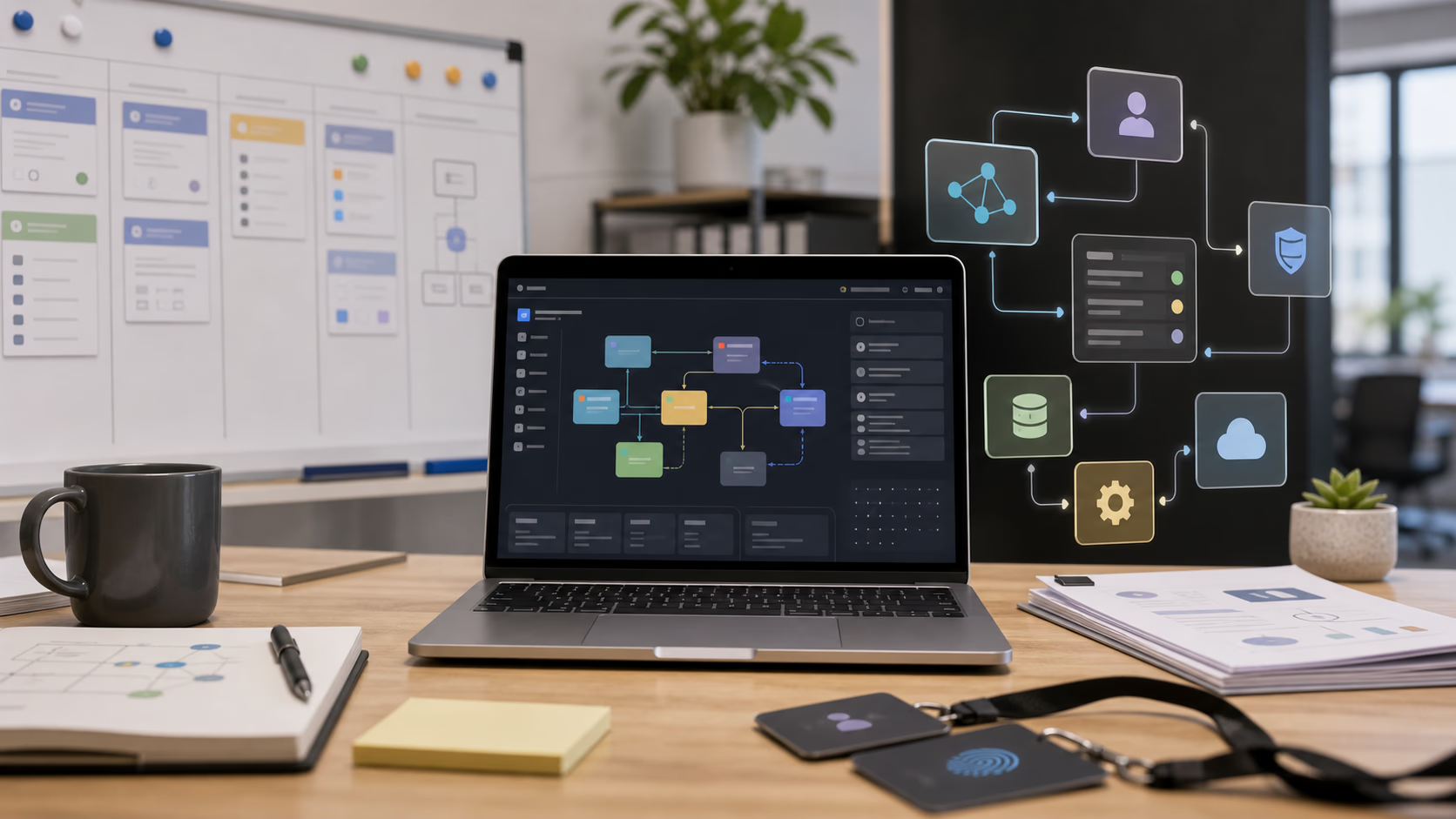
A runbook turns a wish into an operation
Many agent failures begin as soft wishes. “Research our competitors.” “Clean up these tickets.” “Prepare the launch plan.” “Review the docs.” A person can often infer what those requests mean because they share office history, politics, deadlines, and consequences. An agent sees a broad field and starts walking.
A runbook narrows the field. It says what counts as the work, what does not count as the work, and what shape the finished result should take. A competitor research runbook might define the allowed sources, the comparison categories, the time window, and the evidence standard. A ticket cleanup runbook might define which labels can be changed, which comments require human review, and how to summarize ambiguous cases. A docs review runbook might say that the agent may propose edits but may not publish them.
This sounds bureaucratic until you watch the alternative. Without a runbook, every run becomes a negotiation between a broad instruction and a model’s guess about usefulness. The agent may do extra work that looks impressive but does not matter. It may skip boring checks that mattered most. It may produce a polished summary with no way to audit how it got there.
Runbooks make boring checks visible. That is their value.
The operating rhythm matters as much as the instructions
An agent workflow does not only need a task. It needs a rhythm. When does it run? What triggers it? How long should it work before reporting back? What should happen if a tool fails? When does a human review the intermediate state instead of only the final answer?
A useful rhythm often has three moments. The first is intake, when the agent receives the task, checks the available context, and restates the plan in a way a person can correct. The second is execution, when it gathers information, edits files, compares options, or performs whatever bounded work the runbook allows. The third is handoff, when it explains what changed, what evidence supports the result, what remains uncertain, and where a human decision is still needed.
That rhythm prevents a common agent problem: silent confidence. A silent agent can spend a long time going in the wrong direction. A chatty agent can interrupt too often to be useful. A runbook can define the middle ground. It can tell the agent when to proceed, when to checkpoint, and when to stop.
Good operating rhythm also protects the human. If every agent task requires constant supervision, the agent has not reduced workload. It has created a new kind of monitoring job. The point is not to watch every keystroke. The point is to choose the few moments where human judgment changes the outcome.
Permissions should be written where the work happens
Permission rules are easier to respect when they are attached to the runbook, not floating in a separate philosophy document. An agent that researches public sources needs different permissions from an agent that edits customer records or opens pull requests. The runbook should make that difference plain.
The permissions should describe practical boundaries. The agent may read these folders. It may create a draft. It may update a local file. It may not send email. It may not delete records. It may not spend money. It must ask before using private customer data. It must stop if it encounters credentials. These boundaries are not there because the agent is bad. They are there because the cost of a mistake depends on the surface it can touch.
This is where AI Agent Permissions and AI Agent Tool Contracts meet. A tool contract describes the handle. The runbook describes when that handle belongs in the workflow. A filesystem update tool may be safe in one runbook and dangerous in another. A browser tool may be harmless for public research and risky for logged-in account work. Context decides.
The cleanest runbooks use escalation as a normal step, not an error. Asking for approval is not failure. It is part of the workflow. If the agent reaches a decision with consequences outside its lane, it should hand the decision back with enough context that a person can answer quickly.
Logs are not decoration
Agent logs are often treated as technical exhaust: useful only when something breaks. For repeated work, logs are part of the product. They show what the agent saw, what it changed, what it could not verify, and where it made judgment calls.
A good runbook tells the agent what evidence to leave. For research, that may mean links, dates, and source notes. For code, it may mean files changed, tests run, and known gaps. For operations, it may mean records inspected, records skipped, and reasons for escalation. The important detail is not volume. A huge transcript can be harder to review than no transcript. The useful log is shaped for the human who has to trust the result.
Logs also help improve the runbook. If the same uncertainty appears in every run, the runbook is missing guidance. If the agent keeps touching a file it should ignore, the boundary is weak. If reviewers keep asking the same question, the handoff format is wrong. The log turns annoyance into a revision path.
This is the quiet work that makes agents better in practice. Not a grand model upgrade, but a clearer instruction, a better checkpoint, a sharper evidence requirement, and a removed ambiguity.
A runbook should expect exceptions
A fragile runbook assumes the normal path. A useful runbook explains what to do when the normal path breaks. Sources are missing. A tool returns an error. Two documents disagree. A test fails for a reason outside the agent’s change. A customer record looks sensitive. The task appears larger than the time budget. A requested action conflicts with policy. These are not rare edge cases. They are the texture of real work.
The runbook does not need to solve every exception. It needs to teach the agent how to pause honestly. A good exception handoff says what happened, what was tried, why the agent stopped, and what decision is needed next. That is better than an agent forcing a partial answer into the shape of completion.
This is also where humans need discipline. If a person punishes every escalation, the agent will be tuned toward guessing. If a person rewards clean stopping points, the workflow becomes safer and faster. The culture around the runbook matters as much as the words inside it.
The runbook is never finished
The first version of a runbook should be short enough to use. After a few runs, it should become specific enough to trust. That means revising it when reality teaches you something. Add the missing source. Remove the confusing instruction. Clarify the permission. Tighten the handoff. Change the checkpoint timing. Archive the runbook if the workflow no longer matters.
This is why agent operations should feel more like maintaining a kitchen than writing a constitution. The goal is a working station where tools are where people expect them, labels mean something, and cleanup happens before the next shift begins. A messy runbook library becomes its own hazard. Agents will follow stale instructions with the same confidence they follow good ones.
The mature team does not ask, “Do we have agents?” It asks, “Which agent workflows are repeatable, inspectable, and worth running again?” Runbooks answer that question in a practical way. They turn one-off delegation into an operating system for work.
The result is not glamorous. It is better than glamorous. It is repeatable.