
An AI agent’s final answer is never the whole story. It may be polished, confident, and useful, but it is still only the surface. The important question is what happened underneath. Which sources did the agent read? Which tools did it use? What did it change? Where did it hesitate? Which assumptions did it make? What evidence did it ignore because it did not fit the path it had already started down?
Observability is the practice of making that hidden work inspectable. In ordinary software systems, observability helps engineers understand what a service did after a request entered the system. Logs, metrics, and traces make failures less mysterious. AI agents need a similar discipline, but the object being observed is not only a server. It is a sequence of reasoning, tool use, context selection, judgment calls, and handoffs.
That makes agent observability less tidy than application monitoring. A web service may return a slow response because a database query took too long. An agent may return a weak result because it searched the wrong source, summarized too early, misunderstood a file, skipped a permission boundary, or converted uncertainty into prose. If you cannot see the path, you can only judge the ending. That is not enough for serious work.
The trace is the workbench
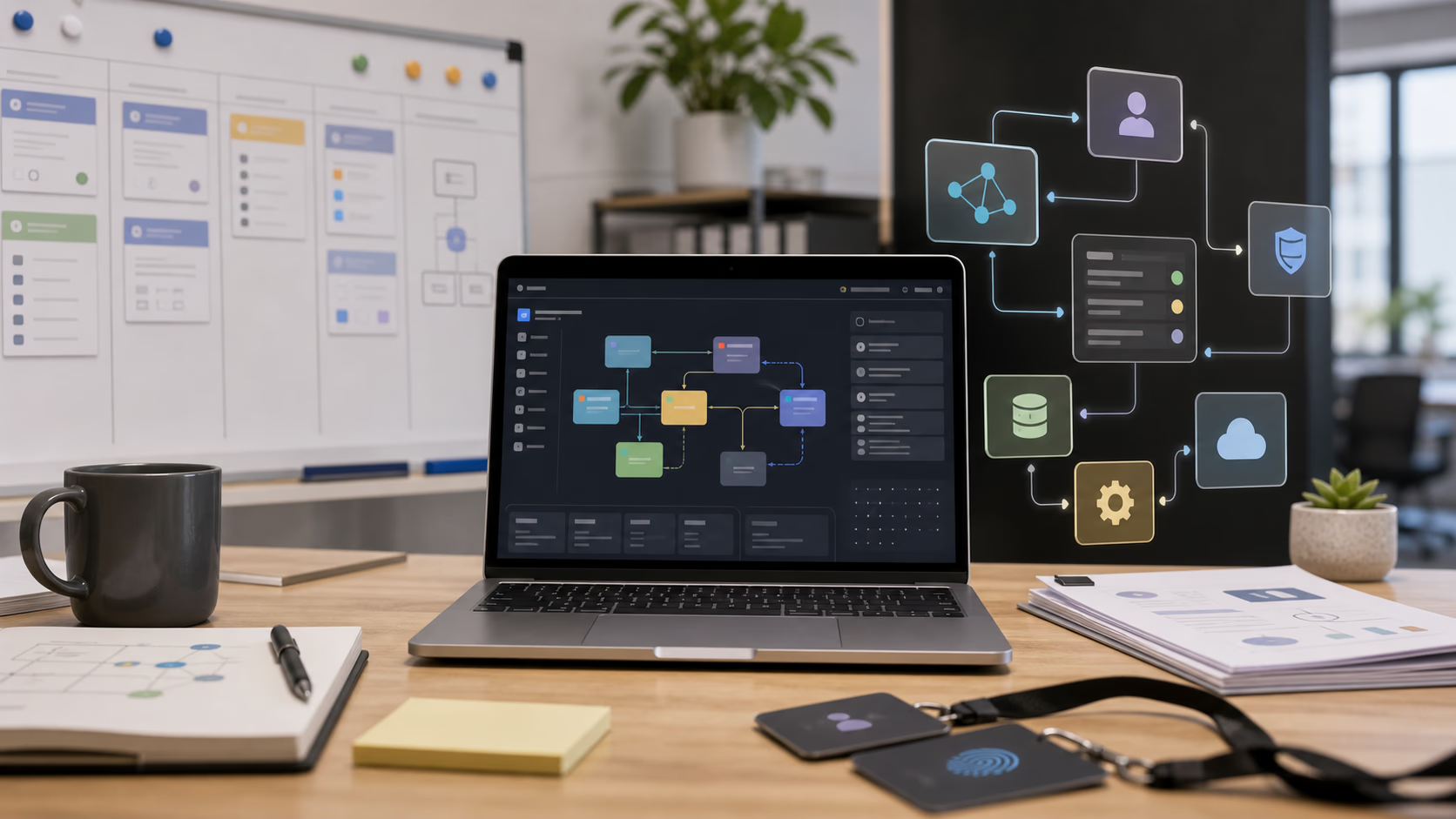
A trace is the record of the agent’s run. It can show the task it received, the steps it took, the tools it called, the files it opened, the sources it used, the errors it hit, the approvals it requested, and the output it produced. A good trace feels like looking over the workbench after someone has finished a job. You can see the tools, the scraps, the measurements, and the places where the work changed direction.
The trace does not have to expose every private token of internal model activity to be useful. In many settings, it should not. What matters is that the operational path is visible enough for a reviewer to reconstruct the work. If the agent says it compared three vendors, the trace should show where those vendors came from. If it edited code, the trace should show which files it touched and which tests it ran. If it refused to proceed without approval, the trace should show why.
This is different from asking the agent to explain itself after the fact. A post-hoc explanation can be tidy and wrong. A trace preserves the event. The agent may still summarize the trace for a human, but the summary should point back to evidence instead of replacing it.
Logs should be written for review, not decoration
Some agent systems produce huge logs that nobody reads. That is not observability. That is storage. A useful log is shaped around the questions a reviewer will ask. Did the agent stay inside its lane? Did it use the right sources? Did any tool fail? Did it alter anything irreversible? Did it leave uncertainty where uncertainty belonged?
Good logs are neither theatrical nor silent. They do not narrate every obvious step as if the agent deserves applause for opening a file. They also do not hide the moments that matter. A permission denial matters. A source conflict matters. A failed test matters. A decision to skip a risky action matters. A handoff to a human matters.
The best logs make review faster. They let a person move from “I hope this is fine” to “I can see why this is probably fine, and I know what still needs checking.” That is the difference between trust as a feeling and trust as a workflow.
Evidence trails prevent beautiful guessing
Agents are good at producing fluent work. Fluency is useful, but it can become a disguise. A report with confident structure may be built on weak evidence. A code change may look reasonable while missing the failing edge case. A research summary may sound balanced while relying on stale sources. Observability gives the reviewer a way to separate polish from proof.
An evidence trail should connect claims to materials. For research, that may mean sources, dates, and short notes about what each source actually supports. For code, it may mean changed files, test output, and the reason each change was made. For business operations, it may mean records inspected, records skipped, and the rule used to classify them.
Evidence trails also help agents improve. If a reviewer rejects a result, the trace shows whether the problem was poor instruction, bad search, weak tool design, missing context, or a model mistake. Without that evidence, every failure collapses into “the agent got it wrong.” That may be true, but it is too vague to fix.
Observability supports permission design
An agent with broad permissions and poor observability is hard to trust. An agent with narrow permissions and good observability is easier to use because mistakes are bounded and visible. The two ideas support each other.
If a runbook says the agent may read files but not write them, the trace should make that visible. If the agent may draft an email but not send it, the log should show the draft stopped at review. If the agent may open a pull request, the trace should show the commit, tests, and changed files. If the agent asks for an approval, the reason should be preserved alongside the decision.
This is where observability connects to AI Agent Permissions and AI Agent Runbooks . Permissions define what can happen. Runbooks define when it should happen. Observability shows what actually happened. Missing any one of the three makes the system weaker.
Debugging agents needs a timeline
When an agent fails, people often jump to the final mistake. The answer was wrong. The edit broke a page. The summary missed the key point. But the final mistake may have begun much earlier. The agent may have misunderstood the task, searched too narrowly, trusted the wrong source, missed a warning, or kept going after a tool returned partial data.
A timeline helps. It lets you see the first bad turn, not only the crash at the end. Maybe the agent’s plan was wrong from the beginning. Maybe the plan was fine but the tool contract was ambiguous. Maybe the agent asked for approval and the human gave a rushed answer. Maybe the context window filled with irrelevant material and the important file disappeared from attention.
This kind of debugging is less satisfying than blaming the model, but it is more useful. It turns failure into engineering work. You can improve the prompt, the runbook, the tool, the permission boundary, the checkpoint, or the review process. You can also decide that the task is not a good agent task yet.
Privacy limits still matter
Observability can become surveillance if designed carelessly. A system that logs every private document, customer record, personal message, or sensitive prompt may create a new risk while trying to reduce another. Agent traces should be useful, but they should also respect data boundaries.
That means deciding what to log, what to redact, how long to keep traces, who can view them, and how to handle sensitive tool outputs. A financial agent, healthcare agent, legal agent, or HR agent needs a different observability posture from a public web research agent. The more sensitive the work, the more deliberate the logging design must be.
The goal is not maximum recording. The goal is accountable recording. A reviewer should be able to understand the work without turning the trace archive into a liability.
Trust is earned at the process level
People often ask whether they can trust AI agents. The better question is which agent, doing which task, with which tools, under which runbook, leaving which evidence, reviewed by whom. Trust is not a property sprinkled over a model. It is built from the surrounding process.
Observability is one of the places where that process becomes real. It gives the agent a visible path, the human a review surface, and the team a way to learn from both success and failure. It also changes the emotional texture of agent work. Instead of hoping the answer is good, you can inspect the work that produced it.
That inspection does not make agents perfect. It makes them workable. And for most real organizations, workable is the threshold that matters.