
AI agent incidents do not always look like disasters. Sometimes they look like a support draft sent to the wrong customer segment, a file edited more broadly than intended, a workflow stuck in a retry loop, a tool call made with stale context, a database update that should have waited for review, or a series of small mistakes that nobody notices until the queue is messy. Delegation went wrong, but not in a cinematic way.
That quietness is exactly why incident response matters. If agents are allowed to read, write, call tools, move work through queues, interact with customers, change files, open tickets, or trigger other systems, then organizations need a way to stop, understand, repair, and learn when the delegate behaves badly. Trusting agents does not mean assuming they never fail. It means preparing for failure with enough discipline that the failure stays bounded.
The first mistake is treating every agent problem as a model problem. Models matter, but incidents often involve the surrounding system: vague instructions, weak permissions, missing review gates, stale data, bad tool contracts, hidden retries, poor observability, or an escalation path nobody practiced. The agent is part of an operating environment. Incident response has to cover the whole environment.
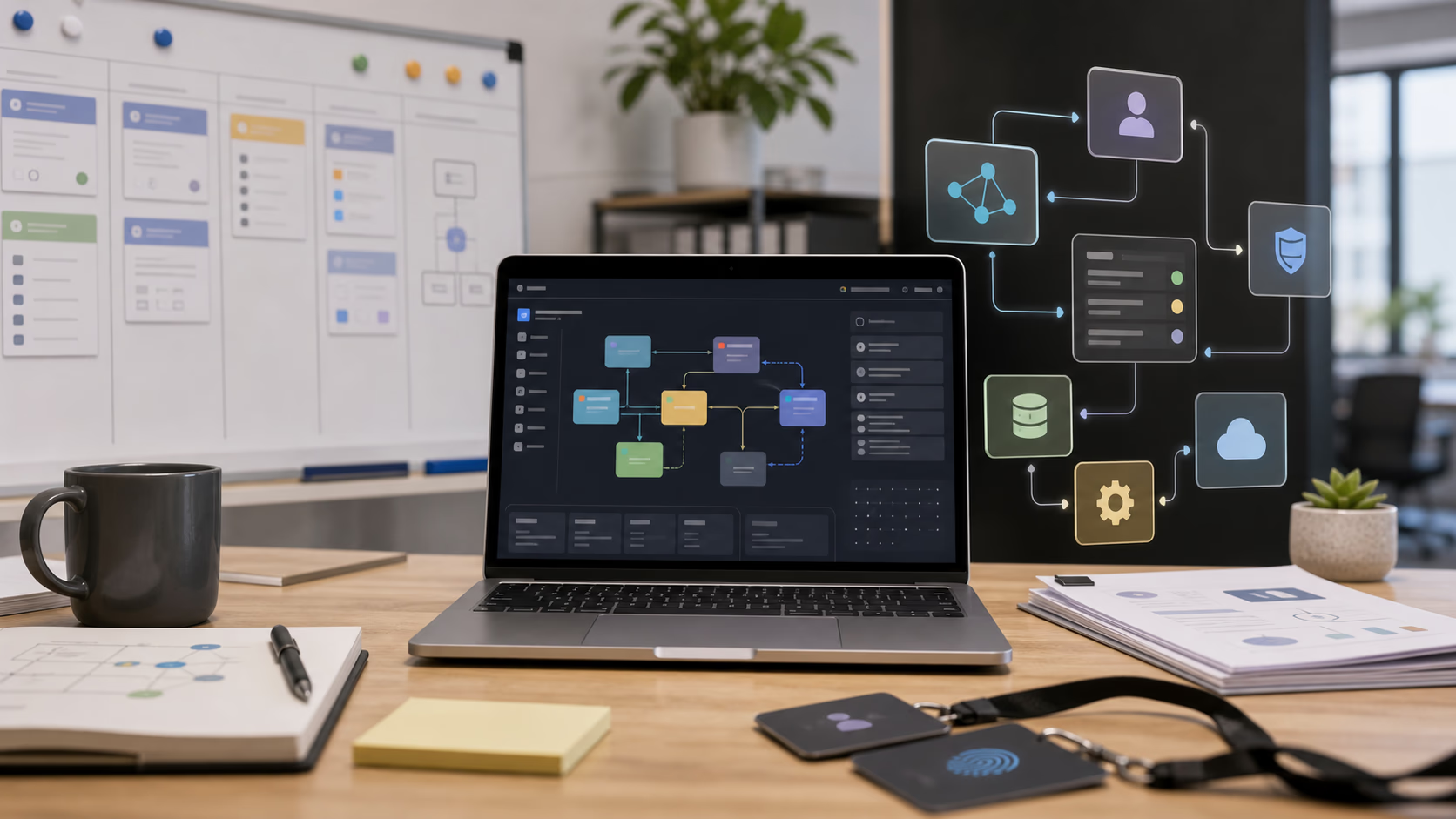
The Stop Control Must Be Real
Every serious agent system needs a way to stop work. Not a decorative pause button hidden in an admin page, but a real operational control that can halt runs, revoke permissions, block risky tools, stop outbound actions, and prevent queued work from continuing blindly. The exact design depends on the system, but the principle is simple. When something is going wrong, people should not have to race the automation.
Stopping should also be scoped. Sometimes the right move is to stop one run. Sometimes it is to pause a workflow. Sometimes it is to revoke a tool across an agent class. Sometimes it is to block all external actions while allowing read-only analysis to continue. A crude all-or-nothing switch may be better than nothing, but mature operations need more nuance.
The stop control should be known before the incident. People should know who can use it, what it affects, how to confirm it worked, and how to restart safely. An emergency process that exists only in a document nobody has opened is not yet a process.
Evidence Comes Before Storytelling
When an incident starts, people naturally want an explanation. The agent ignored the instruction. The tool failed. The user gave a bad prompt. The model hallucinated. The reviewer missed it. These explanations may be partly true, but early certainty is dangerous. Incident response should begin by preserving evidence.
Useful evidence includes the original assignment, system instructions, tool calls, permissions, retrieved context, memory used, files read, files changed, messages sent, external actions taken, timestamps, model outputs, review decisions, retries, errors, and any human interventions. Without that timeline, the team may argue from impressions. With it, they can reconstruct what happened.
This is why observability is a safety feature. If an agent’s work cannot be replayed, inspected, or summarized accurately, incidents become harder to contain. A black-box delegate may feel convenient when work goes well, but it becomes expensive when trust breaks.
Evidence also protects the agent from unfair blame. Sometimes the system did exactly what it was allowed to do under unclear rules. Sometimes the user gave contradictory instructions. Sometimes a tool returned bad data. The point of incident response is not to find a villain. It is to make the next failure less likely and less damaging.
Triage Should Separate Harm From Mess
Not every agent mistake has the same severity. A typo in a draft, a failed research run, and an unauthorized customer-facing action do not deserve the same response. Triage separates inconvenience, quality issue, operational delay, privacy risk, financial risk, security issue, compliance concern, and user harm.
This distinction matters because overreacting to every issue can make agents unusable, while underreacting to serious issues can make them dangerous. A team needs language for severity before emotions take over. What systems were touched? Did data leave a boundary? Did money move? Were users affected? Can the change be reversed? Is the agent still running? Are similar runs queued? Was this one mistake or a pattern?
The triage phase should also identify containment. Stop the run. Pause similar tasks. Revoke a permission. Disable a tool. Notify the reviewer queue. Snapshot affected records. Block outbound sends. The first goal is to prevent the incident from growing while the team learns what happened.
Rollback Is Easier When It Was Designed Earlier
Rollback is not something to invent after damage occurs. If agents can make changes, the system should know how those changes can be undone or compensated. File edits may be reverted through version control. Database changes may need transaction logs, soft deletes, restoration procedures, or compensating updates. Customer messages cannot be unsent, but follow-up communication can be prepared. Workflow state may need to be moved back carefully.
This is one reason high-risk actions should be separated from low-risk ones. A read-only research agent has a different incident profile from an agent that updates billing records. A drafting agent has a different profile from an agent that sends messages automatically. The more irreversible the action, the stronger the approval and rollback design should be.
Rollback should also be tested. A backup nobody has restored is a hope, not a recovery plan. A version history nobody can navigate under pressure is only partially useful. The agent system should make changes in ways humans can understand and reverse when needed.
Users Deserve Clear Communication
If users, customers, employees, or partners are affected, incident response must include communication. Silence may protect the team from discomfort for a few hours, but it can damage trust. The right message depends on severity, but the basics are consistent: what happened, who was affected, what has been done, what remains uncertain, what users should do if anything, and when an update will come.
The communication should not hide behind the word “AI” as if that explains everything. People do not need a theatrical apology about emerging technology. They need plain accountability. An automated workflow took an incorrect action. A review gate failed. A tool permission was too broad. A message was sent before approval. Say what is known without inventing certainty.
Good communication also avoids overpromising. “This can never happen again” is rarely credible. “We paused the workflow, reviewed the affected records, tightened the permission boundary, and will publish the remaining findings by Friday” is more useful.
The Postmortem Should Improve the System
After containment and repair, the team needs a postmortem. The goal is not blame. The goal is to identify the conditions that allowed the incident and the changes that will reduce future risk. Those changes may involve prompts, tools, permissions, evaluations, runbooks, review thresholds, monitoring, user interface, documentation, training, or organizational ownership.
A useful postmortem asks why the task was delegated in that form, why the agent had the permissions it had, why the output was or was not reviewed, why observability was sufficient or insufficient, why the stop control worked or failed, and why similar incidents might still happen. It should produce concrete changes, but not an endless list that nobody owns.
The best postmortems make future delegation clearer. They narrow tools, improve task templates, add tests, change defaults, create better warnings, or make risky actions require explicit approval. They do not simply add a paragraph telling people to be more careful.
AI agents will fail because all operational systems fail. The question is whether the failure is bounded, visible, reversible, and educational. A team that can stop an agent, preserve evidence, triage risk, repair harm, communicate honestly, and redeploy carefully is building real trust. Not blind trust in the model, but earned trust in the system around it.
That is the practical standard. Agents can be useful without being fragile, but only if the humans who deploy them prepare for the day the delegate needs to be stopped.