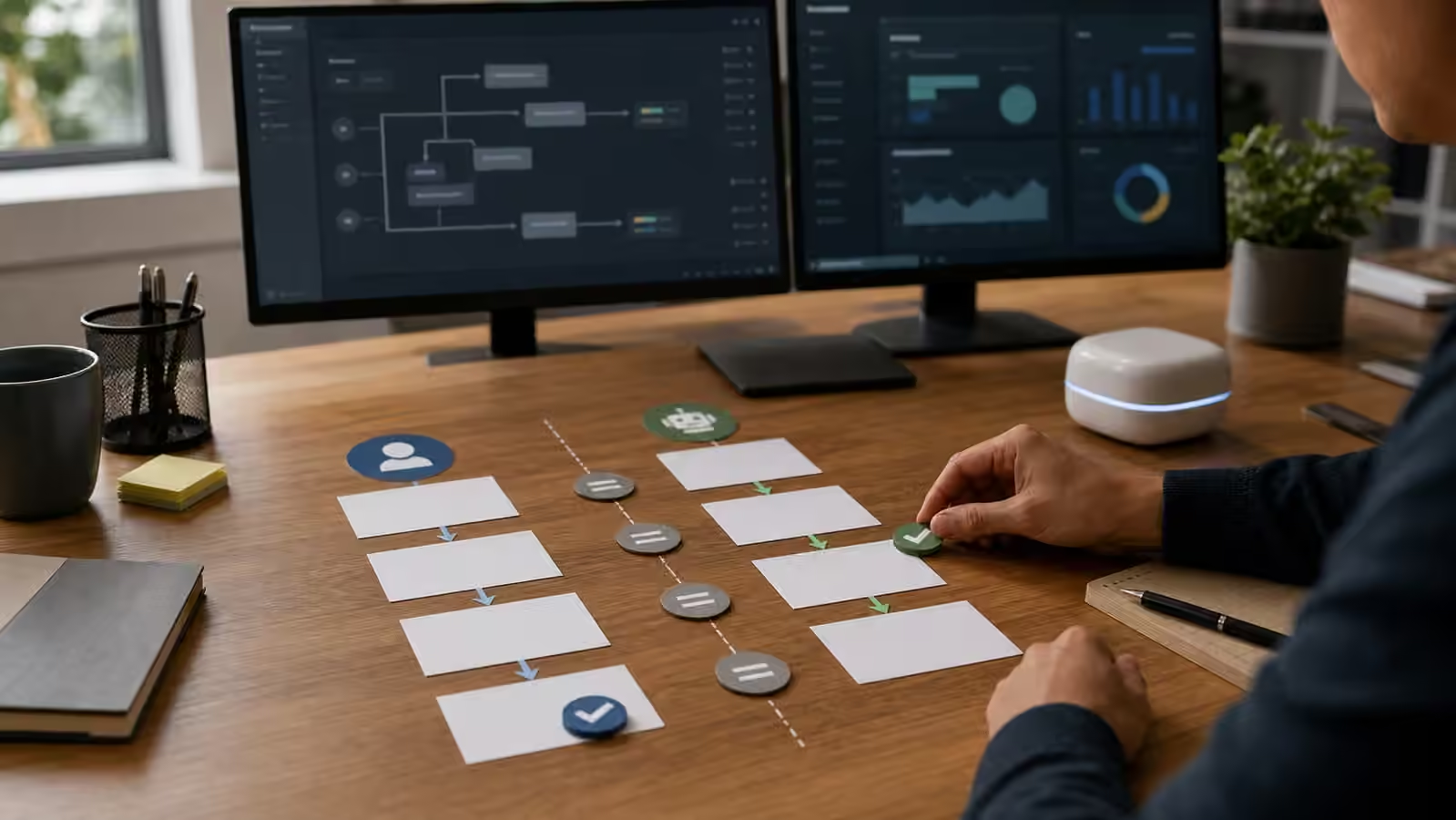
An AI agent that can act should also be able to rehearse. The rehearsal is where the system learns the shape of the work without yet spending the authority that makes the work consequential. It lets the agent discover missing context, wrong assumptions, brittle tool calls, confusing approvals, and bad stop conditions while the cost of being wrong is still low.
Dry runs matter because delegated work often hides risk inside ordinary steps. A customer reply can look harmless until it selects the wrong account. A code change can look small until it touches a shared migration. A research summary can look polished until it relies on a stale source. A record update can look routine until the agent applies it to every duplicate match. The dry run gives the workflow a chance to show its path before that path becomes real.
This guide sits between AI Agent Sandboxes and AI Agent Evaluations . A sandbox gives the agent a safer place to work. Evaluations test behavior across a suite of cases. A dry run is the live task’s rehearsal. It asks the agent to walk the actual job, with the actual constraints, and return a preview that a person or system can inspect before the final action is allowed.
A dry run is not a weaker run
The most common mistake is treating a dry run as a polite summary. The agent says what it plans to do, the person nods, and the real action proceeds almost unchanged. That is useful only when the task is simple enough that the plan itself reveals the risk. Serious dry runs should exercise the same path the agent would use later, except at the boundary where state would change.
If the agent would search a knowledge base, the dry run should search it. If it would match a customer record, the dry run should perform the match and explain the confidence. If it would update files, it should prepare the diff. If it would send a message, it should compose the exact message, recipient, identity, and attachments. If it would run a tool that changes state, the dry run should call a preview version of that tool or produce the same structured payload the real tool would receive.
That distinction keeps rehearsal honest. A vague plan can hide problems behind intention. A dry run with tool-shaped outputs exposes them. The reviewer can see that the account match was weak, the file diff reached outside the assigned path, the source was older than the policy, or the agent is about to use a permission it was not meant to use. The dry run is not less rigorous than execution. It is execution with the final consequence held back.
Preview the consequence, not only the content
Many agent workflows preview the visible artifact but not the action around it. A draft email is shown, but the recipient is hidden. A code patch is shown, but the commands that will run after commit are not. A database update is summarized, but the affected record set is not. That leaves the reviewer judging prose while the risk lives in scope.
A useful dry run names the consequence. It should say what would be created, edited, sent, deleted, published, charged, archived, retried, or escalated. It should also name what would remain untouched. A preview that says “three records would be updated” is weaker than one that shows the three records, the fields, the before state, the proposed after state, and the reason each record is in scope.
This connects directly to AI Agent Permissions . Permission ladders are easier to trust when the rung change is visible. The dry run is a natural place to ask whether the agent is still reading, preparing, requesting approval, or acting. If the agent is only approved to draft, the rehearsal should stop before sending. If it is approved to prepare a refund, the rehearsal should stop before issuing it. The dry run turns authority into something concrete enough to inspect.
Simulation should preserve friction
A dry run can become misleading when the simulated world is too clean. If the test records are perfectly named, the tools always respond, the sources never conflict, and approvals are obvious, the agent learns to succeed in a polished miniature rather than in the operating environment. Rehearsal should preserve the friction the real task is likely to contain.
That does not mean every dry run needs chaos. It means the preview should keep the parts that matter. Duplicate records should remain duplicate. Missing fields should remain missing. Tool latency should be represented enough that the workflow does not assume instant response. Conflicting sources should be visible rather than resolved by convenience. If the agent will encounter stale knowledge, partial access, dirty worktrees, or ambiguous customer language, the dry run should not quietly remove those conditions.
AI Agent Knowledge Bases makes this especially important. A grounded answer depends on source selection. A rehearsal that uses a friendly sample document may prove little about how the agent will behave when the real knowledge base contains overlapping policies and older drafts. A better dry run asks the agent to show which source it would use, which sources it considered, and why the chosen source governs the task.
Design tools with preview modes
Dry runs are much easier when tools are built for them. A tool that can only act or fail forces the agent to simulate in prose. A tool that supports preview, validation, and commit lets the workflow separate judgment from consequence. The preview call can return the matched records, the proposed changes, warnings, required approvals, estimated cost, and a stable token that the commit call later uses.
That pattern is a close cousin of AI Agent Tool Contracts . A good contract does not simply expose power. It exposes the shape of the action before the action occurs. The preview should be boring, structured, and inspectable. It should avoid clever natural-language summaries when a table-shaped or diff-shaped result would be safer. It should make the agent’s next step obvious enough that a reviewer does not need to guess.
Preview modes also reduce accidental drift between rehearsal and execution. If the dry run generates one payload and the live action recomputes everything from scratch, the agent may pass the preview and then act on changed inputs. For consequential work, the live step should either reuse the reviewed payload or clearly mark what changed since review. A dry run that cannot be tied to the eventual action is closer to advice than control.
Decide what blocks promotion
Not every dry run should be allowed to proceed. The workflow needs block conditions that are known before the agent starts. A missing source, a low-confidence record match, a new permission request, an unusually large change set, an unresolved tool warning, or a validation failure should stop the run until a person or a stronger policy resolves it.
The important part is that block conditions should not be invented after the reviewer feels uneasy. They should be part of the task contract. AI Agent Acceptance Criteria explains this at the level of done. Dry runs use the same habit earlier. They define what must be true before a preview can become action.
This is also where AI Agent Output Verification becomes more useful. Verification after action can catch errors, but some errors are cheaper to catch before action. A dry run can verify that the draft cites the governing source, the diff stays inside the assigned files, the message uses the right identity, and the record update affects the expected scope. The agent should not earn promotion merely by sounding confident. It should earn promotion by showing the evidence the workflow asked for.
Rehearsal is part of the user experience
Dry runs are not only backend controls. The person supervising the agent experiences them through the control surface. If the preview is noisy, vague, or hard to compare with the final action, it will be skipped under pressure. If it is concise and concrete, it becomes a natural part of delegation.
The preview should show the original assignment, the proposed action, the evidence used, the validations performed, the warnings raised, and the exact approval being requested. It should separate what the agent knows from what it inferred. It should make remaining uncertainty visible without turning every ordinary caveat into an alarm. AI Agent Control Surfaces covers that interface layer, but dry runs give the surface one of its most useful moments: the pause before consequence.
A well-designed rehearsal also teaches the human where trust is deserved. The reviewer sees how the agent behaves when asked to prove its work. Over time, repeated low-risk dry runs can justify narrower approvals or lighter review. Repeated warnings can reveal that a task is not ready for automation. The dry run becomes evidence about the workflow, not only a preview of a single action.
The rehearsal should leave a trace
Dry runs are most valuable when they become part of the run history. If the live action later fails, the team should be able to compare the rehearsal with what actually happened. Did the reviewed payload change? Did a tool return a different result? Did a human approve a warning without understanding it? Did the agent ignore a block condition? Those questions are answerable only if the preview was preserved.
AI Agent Observability gives that history a place to live. The dry run should be recorded as a meaningful event, not as a loose chat message. It should include the preview inputs, outputs, warnings, approvals, and promotion decision. If the agent later acts, the trace should link the action back to the dry run that authorized it.
This is the quiet discipline behind reliable agents. The system does not ask people to trust a future action because the agent sounds capable. It asks the agent to rehearse, expose consequence, preserve evidence, and earn the next step. For low-risk work, that rehearsal may be small. For high-risk work, it may be the difference between useful delegation and an expensive surprise.
Dry runs do not make agents harmless. They make risk visible at the moment when visibility still matters. That is enough to change the operating rhythm. Instead of discovering the agent’s judgment after the action, the team can inspect it before the boundary is crossed.